Numerology Calculator: A Practical Guide to Reading Your Four Core Numbers
A client once handed me her numerology calculator results from three different websites and asked which one was right. One said she was a Life Path 4. Another said 22/4. The third just said 11. All three had crunched the same birth date. The difference wasn't magic — it was math. Two of those calculators had bugs, and one of the bugs was hiding a master number that genuinely described her life. That's the thing nobody warns you about with numerology: the calculation is deterministic, but the method matters, and sloppy reductions throw away the most interesting information.
This guide walks you through the calculation the way I teach it to clients who want to do it by hand, then shows you how to read your four core numbers as a single portrait instead of four unrelated digits. If you're coming from an angel number practice, you'll recognize the reduction logic. Numerology just applies it to your whole identity instead of a single number you keep seeing on receipts.
Step 1: Prepare Your Name and Birth Date the Right Way
Pull out your original birth certificate. Not your passport, not your driver's license, not the name you go by at work. The numerological blueprint locks in with the full name recorded at birth, and most people get this wrong on the first try because they drop their middle name or use a married name.
Write the full name in all caps on paper. Letters only — no apostrophes, hyphens, or accents. "O'Brien" becomes OBRIEN. "José" becomes JOSE. Yes, the accent matters in linguistics; in Pythagorean numerology, the base letter is what carries the number. Then jot your birth date below it in MM/DD/YYYY format.
If you were adopted and know both the birth name and the adoptive name, calculate both and note the difference. The original carries the vibration present at birth; the adoptive name often describes the life you actually ended up living. The gap between them is a real piece of information — not an error.
Step 2: Calculate Your Life Path by Hand
Here's where most free numerology calculators go sideways. The correct method reduces the month, day, and year separately, preserving master numbers at each step, then adds the three reduced values. The wrong method flattens the entire date into a single string and reduces from there — which almost always destroys master numbers.
Worked example — birth date November 29, 1988:
- Month: 11 — that's already a master number. Leave it at 11.
- Day: 29 → 2 + 9 = 11 — master number again. Leave it at 11.
- Year: 1988 → 1 + 9 + 8 + 8 = 26 → 2 + 6 = 8.
- Sum: 11 + 11 + 8 = 30 → 3 + 0 = 3.
Final Life Path: 3. But notice what just happened — this person has a 3 as their final result, shaped by two 11s behind it. A calculator that flattens 11/29/1988 to 1+1+2+9+1+9+8+8 = 39 → 3 + 9 = 12 → 1 + 2 = 3 gives the same final digit but erases the two master numbers completely. The 3 alone reads as a creative expresser. The 3 with two hidden 11s reads as a creative expresser with intense intuition and nervous-system sensitivity that showed up in childhood. Those are different people in a reading.
Rule to remember: reduce each component separately, and stop the reduction any time you hit 11, 22, or 33. The only exception is the very last sum — if that total is itself a master number, you also leave it alone.
Step 3: Pull Your Destiny, Soul Urge, and Personality Numbers
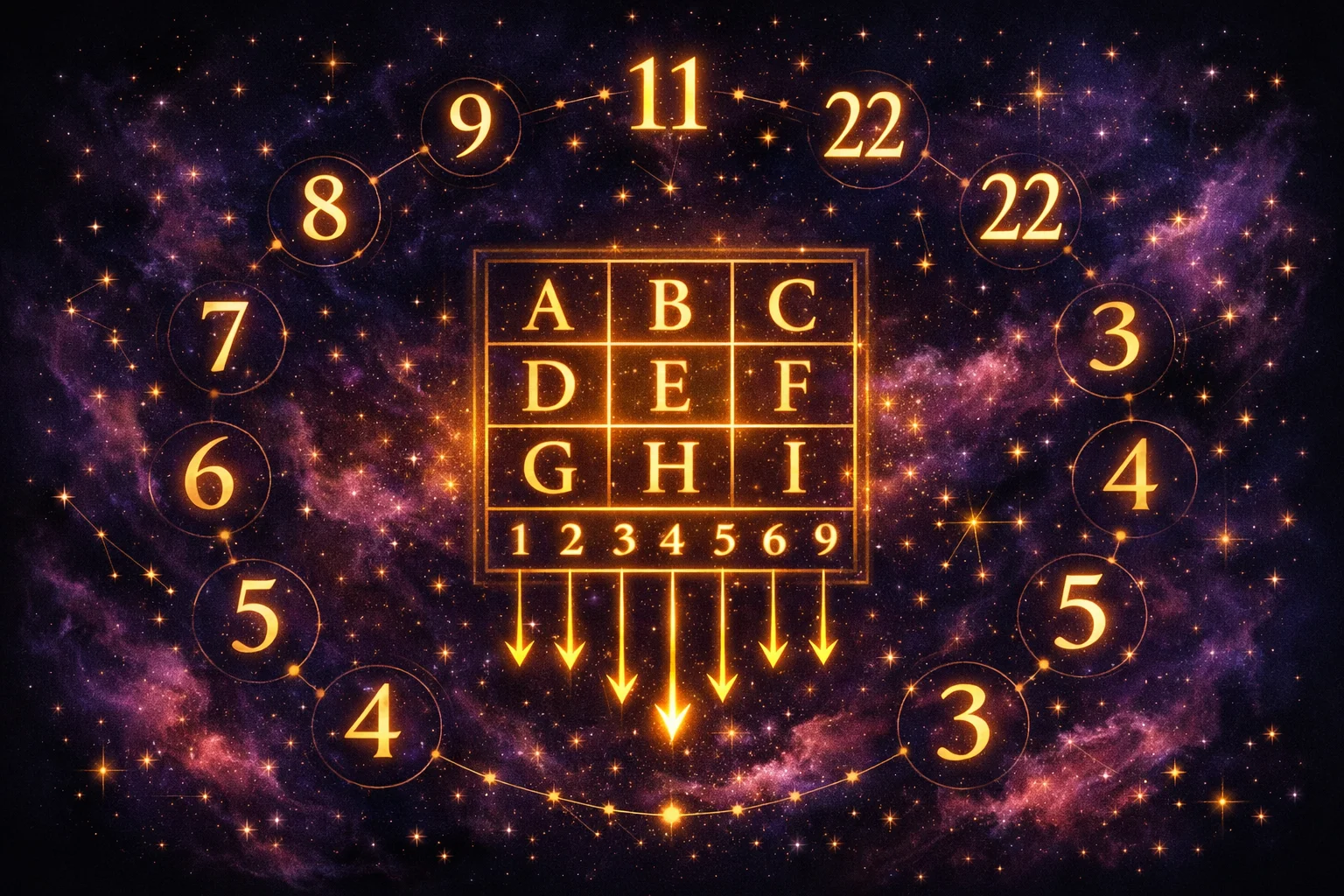
These three all come from your name using the Pythagorean letter chart — named for the school of thought that treated number as the underlying structure of reality, though the letter-to-digit grid itself is a much later invention than the Pythagoreans who lend it their name. Each letter maps to a digit 1–9 based on its position in the alphabet:
| Number | Letters |
|---|---|
| 1 | A · J · S |
| 2 | B · K · T |
| 3 | C · L · U |
| 4 | D · M · V |
| 5 | E · N · W |
| 6 | F · O · X |
| 7 | G · P · Y |
| 8 | H · Q · Z |
| 9 | I · R |
For Destiny (sometimes called Expression), add up every letter in the full name and reduce. For Soul Urge, add only the vowels (A, E, I, O, U — and Y if it functions as a vowel in that word, though many numerologists simply exclude Y to keep the reading consistent). For Personality, add the consonants only.
Take ADA KING LOVELACE as a worked example. Destiny adds every letter: A(1)+D(4)+A(1) + K(2)+I(9)+N(5)+G(7) + L(3)+O(6)+V(4)+E(5)+L(3)+A(1)+C(3)+E(5) = 59 → 5 + 9 = 14 → 1 + 4 = 5. That 14 in the middle is a karmic debt flag that stays in the chart even after reducing to 5. Soul Urge uses only the vowels: A+A+I+O+E+A+E = 1+1+9+6+5+1+5 = 28 → 2 + 8 = 10 → 1. Personality uses only the consonants: D+K+N+G+L+V+L+C = 4+2+5+7+3+4+3+3 = 31 → 3 + 1 = 4.
Quick Reference: What Each Number Means
| Number | Archetype | Core Theme |
|---|---|---|
| 1 | Pioneer | Independence and starting things |
| 2 | Diplomat | Partnership and sensitivity |
| 3 | Communicator | Creative self-expression |
| 4 | Builder | Structure and discipline |
| 5 | Seeker | Freedom and change |
| 6 | Nurturer | Care and responsibility |
| 7 | Truth-Seeker | Analysis and inner life |
| 8 | Executive | Power and manifestation |
| 9 | Humanitarian | Completion and compassion |
| 11 | Illuminator | Intuition, inspiration, sensitivity |
| 22 | Master Builder | Building things that outlast you |
| 33 | Master Teacher | Selfless service and unconditional care |
Reading All Four Numbers as One Picture
Single-number readings are where most free numerology reports stop, and it's also where they become useless. The four core numbers are meant to be read in relation to each other. Think of them as four layers of the same person:
- Life Path is the road you're walking — the curriculum of this lifetime.
- Destiny is what you're here to express in the world — your output.
- Soul Urge is what you secretly want, independent of what looks good on paper.
- Personality is the first impression — what strangers read off you before you speak.
When the Life Path and Soul Urge agree, life feels relatively coherent — you want what your path asks of you. When they disagree, you get the classic "I have the career I worked for and I'm still miserable" situation. A Life Path 8 with a Soul Urge 7, for example, describes someone whose path pulls them toward executive power while their inner motivation wants solitude and research. Not wrong, just tension-filled. That tension is information.
The Personality number often mismatches the Soul Urge on purpose. A Soul Urge 4 with Personality 3 comes across as playful and expressive (consonants producing 3) while secretly craving structure and routine (vowels producing 4). The interesting readings happen at the seams between the numbers, not inside any single one. Compare this layering to how astrology uses Sun, Moon, and Rising sign — the three-layer model maps almost directly onto Destiny (external), Soul Urge (internal), and Personality (social mask).
Master Numbers, Karmic Debt, and Why They Change Everything
Master numbers — 11, 22, and 33 — are not "better" than single digits. They're more demanding. An 11 comes with 2's sensitivity cranked to a pitch that gives many elevens chronic anxiety until they learn to manage their nervous system. A 22 carries the builder's 4 energy at a scale that can exhaust the person carrying it. A 33 asks for unconditional service, which only becomes sustainable after personal boundaries are solid — otherwise it collapses into burnout.
Karmic debt numbers — 13, 14, 16, and 19 — appear mid-calculation when a sum lands on one of those values before reducing. A Life Path 4 that comes from 13 describes someone with a pattern of avoiding hard work (the inverse of the 4's builder energy). A Life Path 7 from 16 describes a tendency toward ego collapse and sudden identity shakeups. A Life Path 1 from 19 describes a stubborn self-reliance that blocks receiving help. The final digit is the same; the route there isn't.
Check your calculator's intermediate sums. If you see 13, 14, 16, or 19 anywhere along the reduction path, note it. A good report should flag this. Most free tools silently discard it. It's also the one part of a reading that changes depending on which reduction method you use — the final digit is method-proof, the route to it isn't, and the three published methods disagree about karmic debt for 30% of birth dates. The karmic debt number calculator runs all three at once and prints every pre-reduction total, which is the only way to see where a 13 or a 16 is hiding — or to confirm that nothing is.
Those intermediate sums matter in tarot too. Because digit sums preserve a number's value modulo 9, your fully reduced Life Path number is always identical to your tarot birth card soul number — a Life Path 8 always carries Strength as its soul card. The difference is where each tradition stops: numerology freezes at master numbers 11 and 22, while the tarot system keeps reading them as Justice and The Fool in their own right.
Three Mistakes That Break a Numerology Reading
First mistake: using the wrong name. The name on your credit card, passport, or Instagram handle is not the numerological you. People change names for plenty of reasons — marriage, transition, anglicization, preference — and each of those names creates its own sub-vibration, but the core four numbers come from the birth certificate. Full stop. When someone asks me why their Destiny feels completely off, "wrong name" is the answer 80% of the time.
Second mistake: reducing master numbers too early. If your calculator silently flattens 11 to 2, 22 to 4, and 33 to 6 at every step, it will give you an accurate final digit and a wildly inaccurate reading. Always verify that at least one calculator you're using preserves master numbers during reduction. The calculator on this page does.
Third mistake: treating the Life Path as a fixed personality. Your Life Path describes the lesson, not the limitation. A Life Path 6 isn't doomed to be a people-pleaser. It's a curriculum that keeps presenting the "caretaking vs. self-neglect" lesson until the person learns it. The highest expression of each number requires effort. The low expression is what happens when the number goes unconscious.
When Numerology Gives You the Wrong Answer
One structural limit worth naming before the honesty moment: every number on this page is a sum. Life Path adds your date, Destiny adds your name, and both reduce the total to one digit. That means a number appearing three times in your birth date and a number appearing once contribute identically, and the digits missing from your date contribute nothing at all. If you want the other half of that picture, the angel number calculator counts digits instead of adding them, which returns a repeating sequence rather than a single figure and reports the digits your date never carries. And if you want a birth-date system that never touches arithmetic on the digits at all, a Human Design chart reads planetary longitudes instead of sums, so your birth time does most of the work — the type it returns changes across the day for 38% of dates.
Honesty moment: numerology is not a predictive tool. It doesn't tell you when you'll meet your partner, when to switch jobs, or whether next year will be good for buying a house. If someone sells you a numerology reading with those claims, they're making it up. The system describes pattern, tendency, and theme. The one number in numerology that genuinely moves is the yearly cycle: a personal year number calculator swaps your birth year for the current one, so it climbs by one every January and resets every ninth year while everything on this page stays fixed for life. Be aware it is far less private than it looks — the formula drops your birth year entirely, so roughly one person in nine shares your number. For timing questions beyond that, use birth chart transits or a tarot spread designed for timing.
Numerology also flattens cultural specificity. Pythagorean numerology was built on the Latin alphabet and carries assumptions about how letters map to sound and meaning. If your birth name is originally in a non-Latin script (Cyrillic, Arabic, Chinese characters, Devanagari), the standard calculation uses the romanized spelling, which is a simplification. Some practitioners use Chaldean numerology instead, which has a different letter-to-number mapping and tends to handle non-English names more gracefully. That difference is bigger than it sounds: only ten letters carry the same value in both systems, and the two land on the same reduced number just 11.55% of the time against a chance rate of 11.11%. The lucky number calculator scores your name in both systems side by side and prints a letter-by-letter ledger of exactly where they split. If you want a date-based system that sidesteps names entirely, the Chinese zodiac animal and element are read purely from your birth year and the lunar calendar, and a birthstone calculator by month and zodiac sign needs nothing but the day itself.
Finally: numerology tells you about you, not about other people. Don't calculate a partner's numbers to "figure them out" — use it on yourself, and let the other person do the same if they want to. Numbers used as a surveillance tool create the same problems as armchair diagnosis of anyone else's mental health. Helpful for self-knowledge. Weird when applied to people who didn't ask.