Your Birth Chart Isn’t a Horoscope — It’s a Full Portrait
Birth chart astrology confuses more people than it should, and that's mostly the internet's fault. You search “what's my birth chart,” get back a circular diagram crammed with glyphs, and immediately feel like you need a PhD in ancient Greek. You don't. A natal chart is a map. Like any map, you just need to know what the symbols mean \u2014 and once you do, it reads like a story. Your story.
What Most People Get Wrong About Birth Charts
Here's the biggest misconception: people think their birth chart is their Sun sign with extra decorations. It isn't. Your Sun sign is one placement out of more than 30 that matter. Saying “I'm a Leo” is like describing a painting by naming one color. Accurate? Sure. Complete? Not remotely.
The second biggest misconception is that a birth chart predicts your future. It doesn't. It describes tendencies, patterns, and internal tensions. Think of it less like a fortune and more like a personality scan taken from the sky. The planets at your birth moment didn't cause your traits \u2014 they mapped them. That distinction matters, because it means your chart shows potential, not fate.
The Planets Are the Cast, Not the Whole Movie
Ten celestial bodies. Ten dimensions of your personality. The Sun is your ego and sense of purpose. The Moon is how you feel when no one else is around. Mercury governs how you think and argue. Venus controls what you find attractive and how you show love. Mars determines your drive, your anger, and your energy in bed. Those five inner planets shape the parts of you that feel most personal.
Then come the outer planets. Jupiter expands whatever it touches \u2014 it's where luck and excess live. Saturn restricts and disciplines \u2014 it shows where you'll face your hardest lessons. Uranus brings sudden change and rebellion. Neptune dissolves boundaries between reality and imagination. Pluto transforms at a level so deep you often don't notice it happening until it's done.
But here's what most guides skip: the planet alone tells you nothing useful. Mars where? Mars how? You need the sign (how Mars expresses itself) and the house (where in your life it acts). Mars in Aries in the 10th house is an aggressively ambitious career climber. Mars in Pisces in the 12th house fights invisible battles in dreams and spiritual practice. Same planet. Completely different person. If you want to see exactly where your planets fall, our free birth chart calculator will plot them for you in seconds.
But What About the Houses?
The 12 houses are why your birth time matters so much. They carve the sky into 12 slices, each governing a specific life domain. The 1st house is your identity and body. The 4th house is your home and family roots. The 7th house is your committed partnerships. The 10th house is your career and public reputation.
A planet in a house activates that domain. Venus in the 5th house? Romance and creative expression come easily. Saturn in the 7th house? Relationships feel heavy and demand maturity before they work. The sign on each house cusp adds another layer \u2014 it sets the tone for how that life area operates even without any planets inside it.
Here's a quick reference for all 12:
| House | Life Domain | Keywords |
|---|---|---|
| 1st | Self & Identity | Appearance, first impressions, body |
| 2nd | Money & Values | Income, possessions, self-worth |
| 3rd | Communication | Siblings, learning, daily conversations |
| 4th | Home & Roots | Family, childhood, emotional foundation |
| 5th | Creativity & Romance | Fun, children, self-expression |
| 6th | Health & Routine | Work habits, wellness, daily service |
| 7th | Partnerships | Marriage, business partners, open rivals |
| 8th | Transformation | Shared money, intimacy, death/rebirth |
| 9th | Philosophy & Travel | Higher education, worldview, law |
| 10th | Career & Legacy | Reputation, ambition, public image |
| 11th | Community | Friends, groups, long-term goals |
| 12th | Subconscious | Hidden patterns, spirituality, isolation |
Reading Aspects Without Losing Your Mind
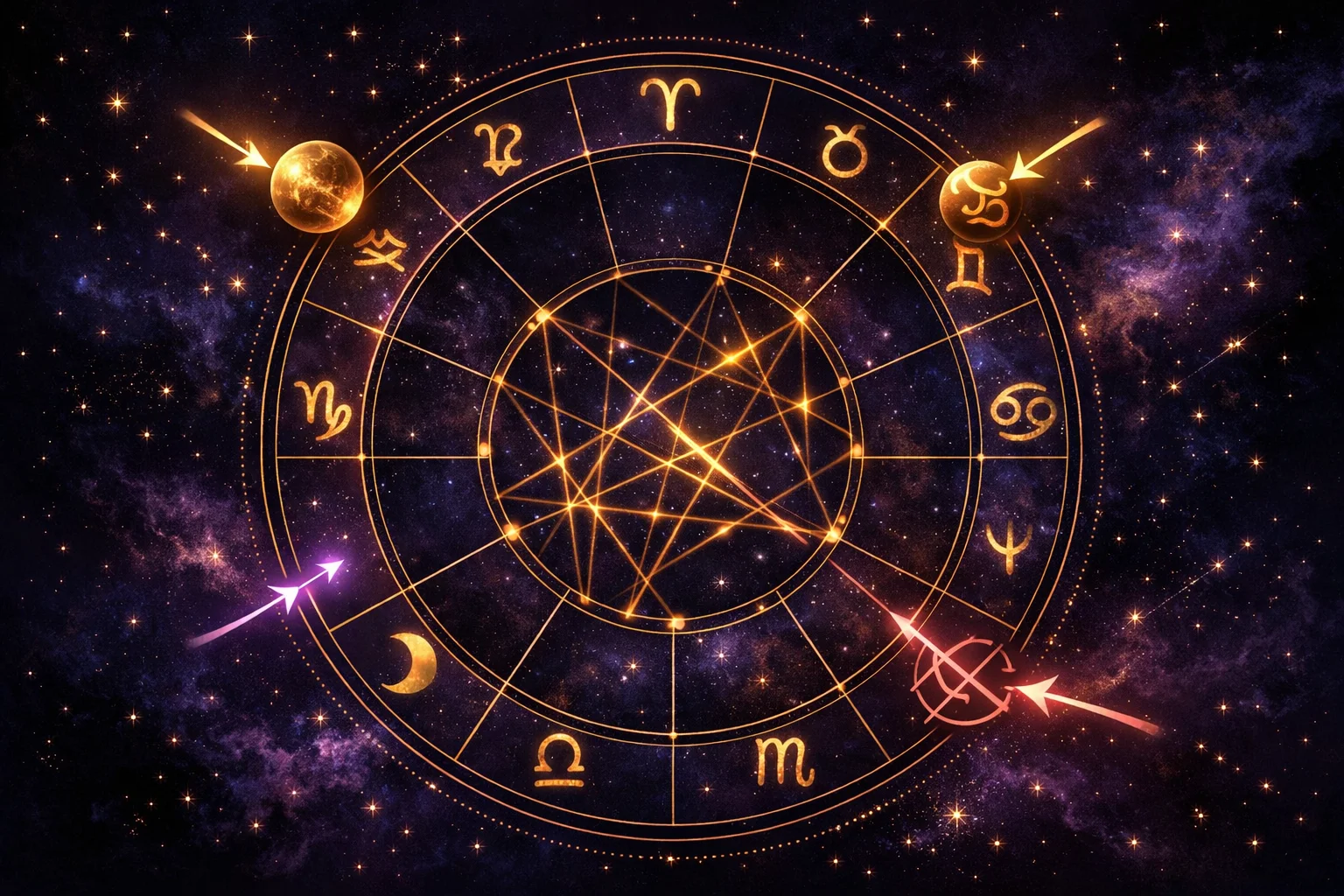
Aspects are where beginners usually quit. The lines criss-crossing the center of the chart look like a toddler attacked it with a crayon. But the concept is simple: aspects measure the angle between two planets, and that angle determines whether they cooperate or clash.
Five aspects do 90% of the work. A conjunction (0\u00B0) merges two planets into a single fused energy. A sextile (60\u00B0) creates gentle opportunity. A square (90\u00B0) produces friction \u2014 uncomfortable, but it's where your growth lives. A trine (120\u00B0) flows effortlessly, sometimes too effortlessly (talent without challenge breeds complacency). An opposition (180\u00B0) pulls you in two directions until you learn to balance both.
Don't try to memorize every aspect in your chart at once. Start with aspects to your Sun and Moon. Those two bodies are the loudest voices in your chart, and their aspects shape how your core identity and emotional nature interact with everything else. A Moon square Saturn, for example, often shows up as a person who learned early that expressing emotion gets punished. That single aspect can explain decades of relationship patterns.
The Empty House Myth That Won't Die
“My 7th house is empty \u2014 does that mean I'll never have a relationship?” No. Absolutely not. This is the single most common panic I see from people reading their chart for the first time, and it's based on a misunderstanding.
An empty house just means no planet happened to be in that section of the sky when you were born. Most people have 5 to 7 empty houses. That's normal. The sign on the cusp of the empty house still shapes that life area, and the ruling planet of that sign influences it from wherever it sits in your chart. An empty 7th house with Libra on the cusp and Venus in the 5th? Your partnerships are colored by romance, beauty, and creative chemistry. Nothing missing there.
Elements and Modalities \u2014 Your Chart's Hidden Pattern
Count up how many planets sit in Fire signs versus Water, Earth, and Air. Then count how many are Cardinal versus Fixed versus Mutable. The distribution tells you something that individual placements can't: the background hum of your personality.
Someone with five planets in Water signs will process the world emotionally no matter what their Sun sign says. An Aries Sun with a Pisces Moon, Cancer Rising, and Venus in Scorpio doesn't act like the stereotypical fiery ram \u2014 they're deeply feeling, protective, and emotionally absorbent. The element balance explains why.
Modalities work the same way. Heavy Cardinal energy means you start things constantly but struggle to finish. Heavy Fixed energy means nothing moves you once you've decided. Heavy Mutable energy means you adapt brilliantly but commit reluctantly. Knowing your dominant element and modality gives you a shortcut to understanding your chart before you analyze a single planet.
For a different angle on how systems map personality, try our Mayan astrology sign calculator \u2014 it uses a 260-day cycle instead of planetary positions, and the contrast is genuinely interesting.
Birth Chart vs. Sun Sign \u2014 Why It's Not Even Close
| Feature | Sun Sign Only | Full Birth Chart |
|---|---|---|
| Data points | 1 (Sun position) | 30+ (10 planets \u00D7 signs, houses, aspects) |
| Birth time needed | No | Yes, for Rising sign and houses |
| Personality detail | Core ego and identity | Emotions, communication, love style, career drive, fears, growth areas |
| Accuracy | Shared with ~8% of the population | Effectively unique to you |
| Best for | Quick daily horoscopes | Deep self-understanding and relationship insight |
Reading your Sun sign is fine for entertainment. But if you've ever thought “that doesn't sound like me at all,” it's because the other 29 placements in your chart might be pulling you in a completely different direction. A Capricorn Sun with a Sagittarius Moon and Gemini Rising is going to feel restless, chatty, and adventure-seeking \u2014 nothing like the stereotypical disciplined goat.
What to Actually Do with Your Birth Chart
Start with the Big Three: Sun, Moon, Rising. Read those three descriptions together and see if the combination clicks more than your Sun sign alone. It almost always does.
Next, look at where your planets cluster. If you have four planets in the 10th house, career and public reputation dominate your chart. If most of your planets sit below the horizon (houses 1 through 6), your life energy is more internal and private than public.
Then check your Saturn. Seriously. Saturn is the least glamorous planet but often the most useful for personal growth. Its sign and house show exactly where you'll be tested hardest \u2014 and where you'll build the most lasting strength if you put in the work.
Finally, don't treat your chart as a fixed sentence. It's a map of potential. A square between your Sun and Pluto doesn't mean you're destined for power struggles. It means power dynamics are a theme you'll work through across your life \u2014 and how you navigate that theme is entirely up to you. Explore your zodiac sign profile to see how your Sun sign energy plays out in daily life alongside everything else your chart reveals.