
Stop Guessing Which Layout to Use — Here's the Honest Answer
Tarot spreads are the difference between reading cards and reading a situation. A single card tells you an energy. A well-chosen spread tells you how that energy connects to your past, your blind spots, and the decision sitting in front of you. But here's what most tarot guides won't say upfront: the wrong spread for your question produces a worse reading than pulling no cards at all.
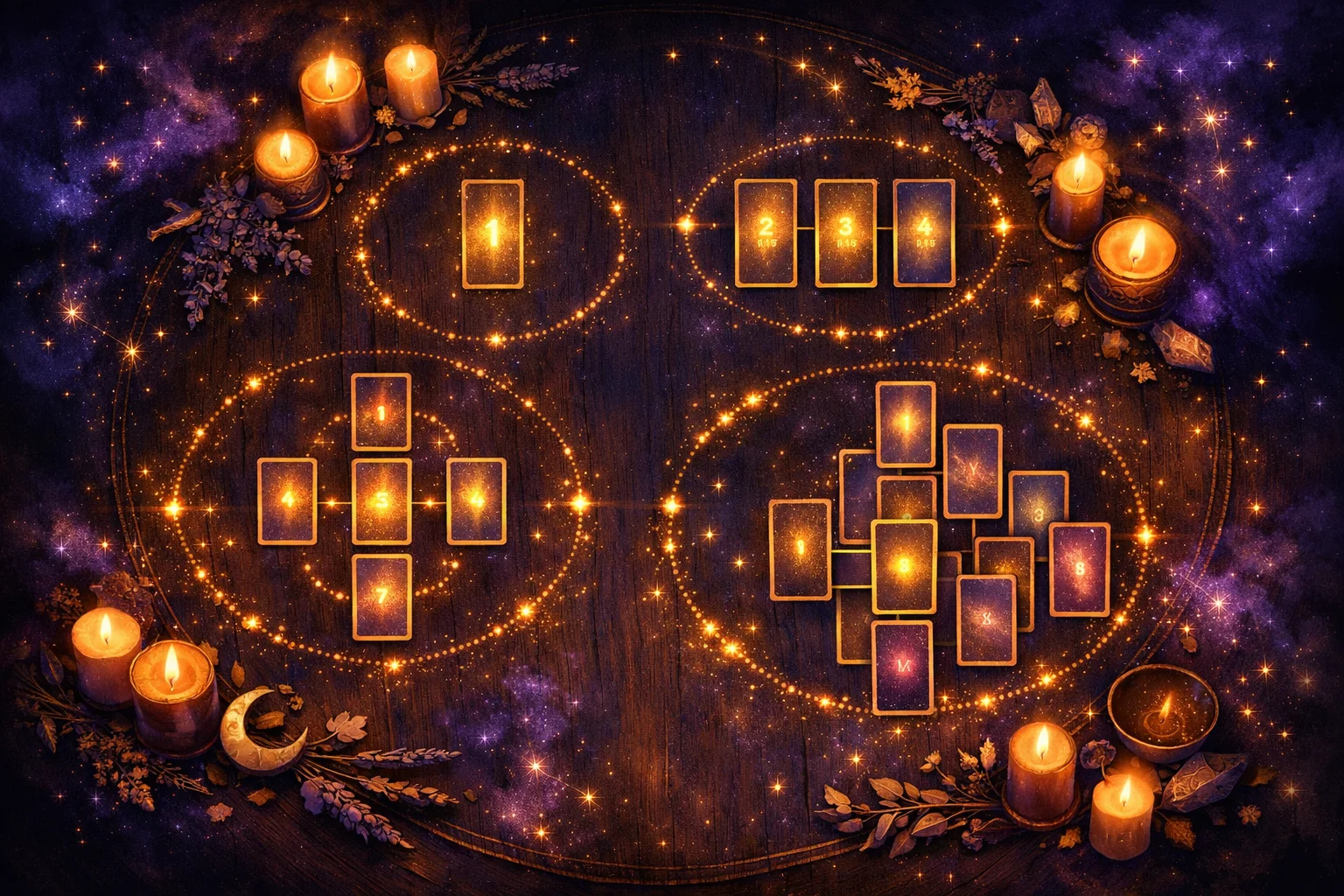
I've watched it happen hundreds of times. Someone with a straightforward yes/no question lays out a full Celtic Cross and drowns in contradictions. Someone processing a major breakup pulls a single card and gets frustrated that it doesn't address the fifteen things they're actually feeling. The spread is the container for your reading. Pick the wrong container and even accurate cards produce confusion.
The 30-Second Rule for Picking the Right Spread
Before you shuffle, ask yourself one question: how many moving parts does my situation have?That's it. The answer determines your spread.
One moving part (“Should I take this job?”) → one card. Two or three (“Why did this relationship end and what should I do now?”) → three cards. Five or more (“My career, relationship, finances, and family are all shifting at once”) → Celtic Cross. Match the spread to the complexity of the question, not to how serious you feel the question is. A life-changing decision with a clear binary (“Do I move to Berlin?”) needs one card, not ten.
This rule eliminates the most common tarot spread mistake: treating larger spreads as “more powerful” or “more accurate.” They aren't. They're more detailed. Detail helps complex situations and hurts simple ones.
Five Spreads Compared: Cards, Difficulty, and Best Use
This table is worth bookmarking. When you're about to start a reading and aren't sure which layout to use, scan the “Best For” column and pick the first match.
| Spread | Cards | Level | Best For | Avoid When |
|---|---|---|---|---|
| Single Card | 1 | Beginner | Yes/no, daily guidance, quick gut-checks | Your question has multiple layers needing separate answers |
| Three-Card | 3 | Beginner | Timeline view, decisions, relationship snapshots | You need to see subconscious or external influences |
| Five-Card Cross | 5 | Intermediate | Internal vs. external tension, weighing two paths | Your question is about another person's perspective |
| Relationship | 7 | Intermediate | Romantic dynamics, friendship tension, business partnerships | The question is about you alone — no second person involved |
| Celtic Cross | 10 | Advanced | Major turning points, deep self-analysis, layered situations | You want a simple answer — 10 cards will contradict each other |
Notice the “Avoid When” column. Most tarot spread guides only tell you when to use a layout. Knowing when not to use one is just as important. A Relationship Spread for a question about your solo career path will produce meaningless noise in the “their energy” positions. A Celtic Cross for “Should I get a cat?” will generate ten cards of interpretive gymnastics about a decision that needs one clear pull.
Why the Single Card Pull Isn't a Shortcut
New readers often treat the single card as training wheels — something to use until you're “ready” for bigger spreads. That's backwards. The single card pull is a complete reading method that professional readers use daily, including readers with decades of experience. Rachel Pollack, one of the most respected tarot authors of the 20th century, consistently advocated for single-card work as a standalone practice.
The reason is simple: one card demands that you go deep instead of wide. When you pull The Tower as a single card, you can't hide behind surrounding cards that soften its message. You sit with the full weight of that card and work out what it means for your specific question. That's a harder interpretive skill than reading three comfortable cards that tell a neat story.
For daily practice, pull one card each morning and journal a two-sentence interpretation before looking up any reference meaning. Over time, this builds what experienced readers call “card voice” — an intuitive feel for what each card means toyou, not just what the book says.
The Three-Card Spread Can Ask Any Question
The power of the three-card spread is that the position meanings are yours to assign. Past/Present/Future is the most popular configuration, but it's far from the only one. Here are assignments I've used in practice that produce sharper readings than the default timeline:
- Situation / Obstacle / Advice— when you know the problem but not the solution
- Mind / Body / Spirit— for wellness questions or general energy check-ins
- What I See / What I Don't See / What I Need to Accept— brutally honest, best for situations where you suspect you're in denial
- Option A / Option B / What I'm Not Considering— for binary decisions where you're stuck between two choices
- You / Them / The Relationship— a compact version of the full Relationship Spread for quick check-ins
The position meanings must be decided before you shuffle. Assigning meanings after seeing the cards is just confirmation bias with extra steps.
The Celtic Cross: Overrated or Underused?
Both, depending on who's reading it. The Celtic Cross is the most taught, most illustrated, and most attempted tarot spread in the Western tradition. It's also the spread that produces the most confused readers, because 10 interconnected positions create a web of relationships that beginners aren't equipped to parse.
But when a skilled reader uses the Celtic Cross for the right question, nothing else comes close. The crossing card (Position 2, laid sideways over Position 1) is one of the most powerful constructs in any spread — it physically blocksthe present situation card, showing you the specific friction point you're wrestling with. When The Hanged Man appears in Position 2, the obstacle isn't anything external. It's your own refusal to let go. That positional specificity is something a single-card pull can never replicate.
My honest advice: don't attempt the Celtic Cross until you've done at least 50 three-card readings. Not because of gatekeeping — because the interpretive muscles you build with three cards are exactly the muscles the Celtic Cross demands, just at triple intensity. Jumping straight to ten cards is like entering a marathon because you jogged last Tuesday.
The Skill Nobody Teaches: Reading Position, Not Just Cards
Here's the secret that separates average tarot readers from excellent ones: the same card means different things in different positions. Every beginner knows The Tower means upheaval. But The High Priestess in the “Foundation” position of a Celtic Cross (Position 3) means something completely different from The High Priestess in the “External Influences” position (Position 8).
In Position 3 (Foundation), The High Priestess says: the root of your current situation is something you've been intuitively aware of for a long time but haven't acknowledged. The hidden knowing isn't new. It's been there from the beginning.
In Position 8 (External Influences), the same card says: someone around you is withholding information, or the external environment is not what it appears to be. The hidden knowing isn't yours — it's theirs.
Same card. Opposite readings. The position did that. Most tarot resources teach you 78 card meanings and call it done. But competent spread reading requires you to filter every card meaning through its positional context. A “positive” card in the “Fear” position means you're afraid of something good happening. A “negative” card in the “Advice” position means the hard thing is exactly what you should do.
Design Your Own Spread (It's Easier Than You Think)
Every spread that exists was invented by someone. The Celtic Cross wasn't handed down on a stone tablet — it evolved through decades of readers adapting and sharing layouts. You can do the same thing.
To design a custom spread, start with the question and work backward. Write down exactly what you need to know about the situation. Each “need to know” becomes a card position. Then arrange the positions in a shape that reflects the relationship between them — linear for timelines, circular for cycles, branching for decisions.
A concrete example: a client came to me processing a career transition. The standard three-card timeline didn't fit because she wasn't deciding between two options — she was trying to understand why she kept sabotaging her own progress. I designed a five-card spread on the spot:
- What you tell people you want
- What you actually want
- The gap between those two
- What created the gap
- The first real step to close it
That layout produced the clearest reading of her week-long search for answers. Position 3 pulled the Ten of Swords — the gap between her stated ambition and real desire was already killing her. No standard spread would have surfaced that specific insight because no standard spread asks that specific question.
Three rules for custom spreads: keep it under eight positions (complexity has diminishing returns), make every position mean something genuinely different from the others (don't create redundant positions), and write the position meanings down before touching the deck.
Four Mistakes That Ruin Multi-Card Readings
Mistake 1: Reading cards in isolation.A five-card spread is not five separate one-card readings. The cards talk to each other. If Position 2 (Challenge) and Position 5 (Subconscious) share the same suit, the challenge is coming from inside. If they're opposing elements — fire vs. water, earth vs. air — the tension is between two genuinely different forces. Read across positions, not just down each card.
Mistake 2: Reshuffling because you don't like the result.The first pull is the reading. Full stop. If you reshuffle because The Tower showed up in the outcome position, you're not doing tarot — you're doing a slot machine. The uncomfortable reading is almost always the one you needed most.
Mistake 3: Overloading position meanings. “This position represents your past, your childhood, your karma, and the energy of your ancestral line.” That's four positions crammed into one. When a position tries to mean everything, the card that fills it means nothing specific. One position, one question.
Mistake 4: Ignoring the visual pattern.Before interpreting individual cards, step back and look at the spread as a whole. Are most cards Major Arcana? The situation involves forces bigger than your daily choices. Are most cards reversed? There's significant blocked energy. Is one suit dominating? That element is running the show. The spread-level pattern often tells you more than any single card.