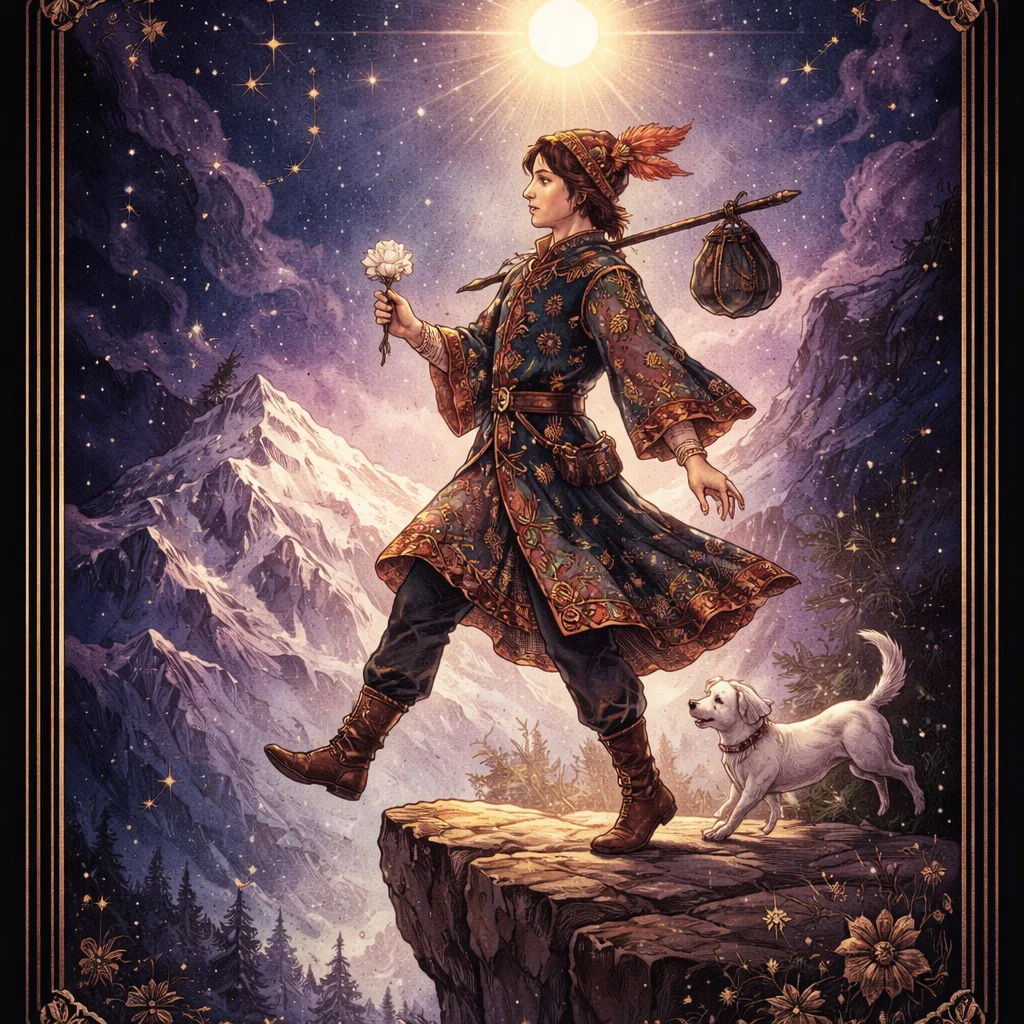
The Fool Tarot Card: Why Card Zero Is the Bravest Card in the Deck
The Fool tarot card meaning has almost nothing to do with being foolish — and that single misread trips up more beginners than any other card in the deck. Card 0 shows a traveler mid-stride at the edge of a cliff, face turned to the sky, a small white dog at their heels. Everyone sees the cliff and thinks: careless, about to fall. But look at the figure's face. There's no panic there. The Fool isn't about to stumble off a ledge by accident. The Fool is choosing to step into the unknown, on purpose, with a smile. That's not stupidity. That's courage most of us spend our whole lives wishing we had.

After years of pulling this card for people, here's the pattern I see: The Fool shows up when someone is standing at the start of something and pretending they're not. The new job they haven't applied for. The relationship they keep talking themselves out of. The move, the project, the leap they describe to me in detail and then explain all the reasons it's not the right time. The Fool is the card that calls that bluff.
The Fool Isn't Foolish — Start Here
The medieval fool, the court jester, was the one person allowed to tell the king the truth. He played dumb so he could be honest. That's the energy here. The Fool's “innocence” is really a kind of freedom — freedom from the cynicism, baggage, and over-planning that keep the rest of us frozen. When you approach something with beginner's mind, you see options the experts have ruled out. You ask the obvious question nobody else dared. You start the thing everyone agreed was impractical.
So when this card lands in your reading, resist the urge to hear “you're being naive.” Nine times out of ten it's saying the opposite: you've been overthinking, and it's time to trust the leap.
Why The Fool Wears the Number Zero
Every other Major Arcana card has a normal number — The Magician is I, The High Priestess is II, all the way to The World at XXI. The Fool alone gets zero. That's not an accident or a leftover. Zero is the number of pure potential: nothing has happened yet, which means everything still can. The Fool hasn't made any of the choices the other cards represent. It hasn't learned discipline, faced loss, or earned wisdom. It's the blank first page.
That zero also does something clever with the deck's structure. Because The Fool sits outside the 1–21 sequence, it can move freely through all of them. Many readers place The Fool at both the beginning and the end of the Major Arcana — the journey finishes at The World, and then a new Fool steps off a new cliff, and it starts again. You're never just at the end of a chapter. You're always at the start of the next one. As the historical record of the card shows, this “unnumbered” quality goes all the way back to the earliest Italian tarot decks, where the Fool stood apart from the rest of the trumps.
The Fool's double life as both 0 and 22 has one concrete consequence worth knowing. In the tarot birth card system, birth dates reduce to a number no higher than 22 — and only a handful of totals land on 22 exactly. That makes The Fool the rarest birth card of all 22 Majors, and the only one you reach by hitting the ceiling rather than falling short of it.
The Fool's Journey: A Map of the Whole Major Arcana
The single most useful thing to understand about this card is the concept of The Fool's Journey. The idea is that the 21 numbered Major Arcana cards aren't a random gallery — they're the story of The Fool growing up. Card 0 is the protagonist; every other card is a person they meet or a lesson they survive. When The Fool appears in your spread, you're being told: you're at the start of one of these arcs. Here's the shape of the road ahead — and if you want to walk it station by station, the interactive Major Arcana journey map lays out all 22 cards as three lines of seven with the lesson at each stop.
| Stage | Cards | What The Fool Learns |
|---|---|---|
| The first steps | I–V | Willpower (Magician), intuition (High Priestess), and the rules of the world from mother, father, and teacher figures. |
| The trials | VI–XI | Love and choice, drive, courage, solitude, fate, and justice — the messy middle where the Fool actually grows up. |
| The reckoning | XII–XVI | Surrender, endings, balance, temptation, and sudden collapse — the dark night that strips away illusions. |
| The return | XVII–XXI | Hope, mystery, joy, rebirth, and finally The World — wholeness, completion, and the start of a brand-new Fool cycle. |
This is why pulling The Fool feels both thrilling and a little daunting. It's not just “something new is coming.” It's “you're about to walk the whole road again, and you don't get to skip the hard parts.” The road ends at The World, the card of completion and wholeness — which then loops straight back to The Fool and a brand-new journey. If you want to see exactly where The Fool lands in a layout, the tarot spreads guide breaks down how position changes a card's message.
The Cliff, the White Rose, and the Dog Most Readers Get Wrong
The Rider-Waite-Smith Fool is packed with detail, but four symbols carry the real meaning — and one of them is almost always misread.
The cliff is the obvious one: the edge of the known, the threshold of the leap. Notice The Fool isn't looking down at it. The gaze is up and out, toward the sun. The message: keep your eyes on where you're going, not on the drop.
The white rose in The Fool's hand stands for purity of intention. This is a clean beginning, untainted by ulterior motive. Unlike the red roses of passion elsewhere in the deck, the white rose says the Fool wants this for its own sake, not to prove anything to anyone.
The little white dog is the one people get wrong. Most guides call it loyalty or protection, full stop. But look at what it's doing — it's leaping up at the Fool's leg. It's your instinct, and instinct does two jobs: it cheers you on toward a good leap, and it tries to pull you back from a bad one. The dog isn't just a companion. It's the gut feeling you have to learn to read. Is it celebrating, or is it warning? Same animal, two completely different messages.
The bindle — the small bag on a stick over the shoulder — holds everything the Fool owns. It looks like nothing, but it's actually every tool and talent the Fool will need, packed and ready, just not yet unpacked. You already carry what this journey requires. You just haven't opened the bag.

The Fool Upright: Permission to Begin Before You're Ready
Upright, The Fool is a green light. New beginnings, spontaneity, a free spirit refusing to be boxed in. In a reading it's the universe handing you permission to start the thing you've been circling — without the full plan, the perfect timing, or the guarantee it works out. That last part is the whole point. The Fool never promises the leap succeeds. It promises that not leaping is the bigger regret.
What makes the upright Fool genuinely useful rather than just inspirational is its honesty about the trade-off. This card's gift is fearless momentum; its blind spot is the boring stuff — logistics, fine print, follow-through. So the practical reading is almost always “yes, begin, and do the one grown-up task you keep skipping.” Sign up for the class, but also block the time on your calendar. Send the message, but also be ready for the reply. The Fool gets you off the cliff; The Magician, the very next card, is the one who teaches you to actually fly.
Reversed — When the Leap Is Really Avoidance in Disguise
Here's where The Fool gets interesting, because reversed it points to two opposite problems and you have to read the rest of the spread to know which. The first is recklessness: leaping with no parachute, betting the savings on a hunch, ignoring every red flag because the rush feels good. This is the Fool's shadow — spontaneity curdled into self-sabotage.
The second is the one nobody expects: refusing to jump at all. Reversed, The Fool can mean you're standing at the edge, you know you want to leap, and you've frozen. You dress it up as being responsible — “I'm just waiting for the right time, more experience, better conditions” — but underneath, it's fear of the unknown wearing a sensible coat. The cruel irony is that the planning becomes the hiding place. You can research a leap forever as a way of never taking it.
The fix depends entirely on which version you're facing. If you're leaping blind, the reversed Fool says slow down and look before you step. If you're frozen, it says the safety you're clinging to is an illusion — the ground under “staying put” is crumbling too, just more slowly. This is where The Fool and The Tower's forced upheaval rhyme: one is the leap you choose, the other is the leap life chooses for you when you wait too long.
Is The Fool a Yes or a No?
The Fool is a yes. In yes-or-no readings, it's one of the clearest green lights in the deck — go, begin, take the chance. But it's a specific flavor of yes: it says yes to starting, not yes to a guaranteed outcome. If you ask “should I take this leap?” The Fool says absolutely. If you ask “will it definitely work out?” The Fool just shrugs and smiles, because that part hasn't been written yet — and honestly, no single card can answer it.
For a question about a brand-new venture, relationship, or risk, treat The Fool as encouragement to move. For a question about whether to continue something already in motion, it's gentler — more “approach this with fresh eyes” than a hard yes. Need a decisive answer on one specific question? A focused yes-or-no tarot pull pairs well with The Fool's leap energy when you want clarity on a single fork in the road.
When The Fool Says Don't Jump
A good reading is honest about a card's limits, so let's be clear about when The Fool's green light turns yellow. The Fool is a beginning card, not a wisdom card. There are leaps it should not be cheering on, and a real reader names them.
Don't take the leap when the “new beginning” is really an escape hatch — quitting impulsively to avoid a hard conversation, jumping into a rebound to outrun grief, blowing up a stable life because boredom feels like a sign. That's reversed Fool energy, and it leaves real wreckage. Don't leap when other people are pushing you off the ledge; The Fool jumps because it wants to, never because someone set a deadline. And don't leap on money you can't afford to lose just because the upside sounds exciting — the Fool's naivety with finances is its single most expensive trait, and con artists love an optimist.
The honest summary: The Fool is brilliant for the leaps your fear has been blocking, and dangerous for the leaps your impulse is rushing. Knowing the difference is the whole skill. If the leap survives a night's sleep and a sober look at the downside, The Fool is right — go. If it only feels right in the heat of the moment, that's the white dog barking, not cheering.
The Fool Beside The Magician, Death, and The World
A single card sets the theme; the card next to it tells you what kind of beginning you're actually looking at. These are the pairings that shift The Fool's meaning the most.
| Paired With | Combined Meaning |
|---|---|
| The Magician (I) | The dream gets a builder. The Fool supplies the raw idea and the nerve; The Magician supplies the skill to make it real. Together they're the most action-ready pairing in the deck — start now, you already have what you need. |
| The High Priestess (II) | Leap, but listen first. The Fool wants to move; The High Priestess says the answer is already inside you if you go quiet long enough to hear it. This pairing favors an intuitive jump over an impulsive one. |
| Death (XIII) | An ending makes room for the beginning. Something has to be released before the new chapter can start — this is the “you can't start over while clutching the old thing” combination. Often a genuinely fresh life phase. |
| The Tower (XVI) | The chosen leap meets the forced one. You either jump now on your own terms, or circumstances knock the structure down and you fall anyway. A nudge to move before life moves you. |
| The Lovers (VI) | A leap of the heart. A new relationship or a relationship decision made with The Fool's open, baggage-free energy — thrilling, sincere, and worth protecting from the urge to overthink it. |
| The World (XXI) | The full circle. The Fool's journey ends and immediately begins again — you've completed something major and you're already standing at the edge of the next cliff. Endings and beginnings in the same breath. |
One pairing worth a special mention: The Hierophant next to The Fool is a genuine standoff. The Hierophant is tradition, convention, the established rule book; The Fool is the Uranian rebel who breaks it. When they appear together, the reading is asking whether this is the moment to color inside the lines or step outside them. Nine times out of ten, if The Fool drew your eye first, you already know the answer.