The Hermit Tarot Card: What the Lantern Bearer Illuminates on Your Inner Path
The Hermit tarot card meaning gets mistaken for loneliness more than any other card in the deck. A client once turned it over in a spread about her marriage, saw the old man alone on his frozen mountain, and immediately asked me if it meant she'd end up by herself. It's the question I hear most about card IX, and the answer surprises almost everyone: the Hermit isn't about being left alone. It's about choosing to be. That one distinction — solitude versus loneliness — unlocks everything else this card has to say.
Solitude Isn't Loneliness — and That's the Whole Card
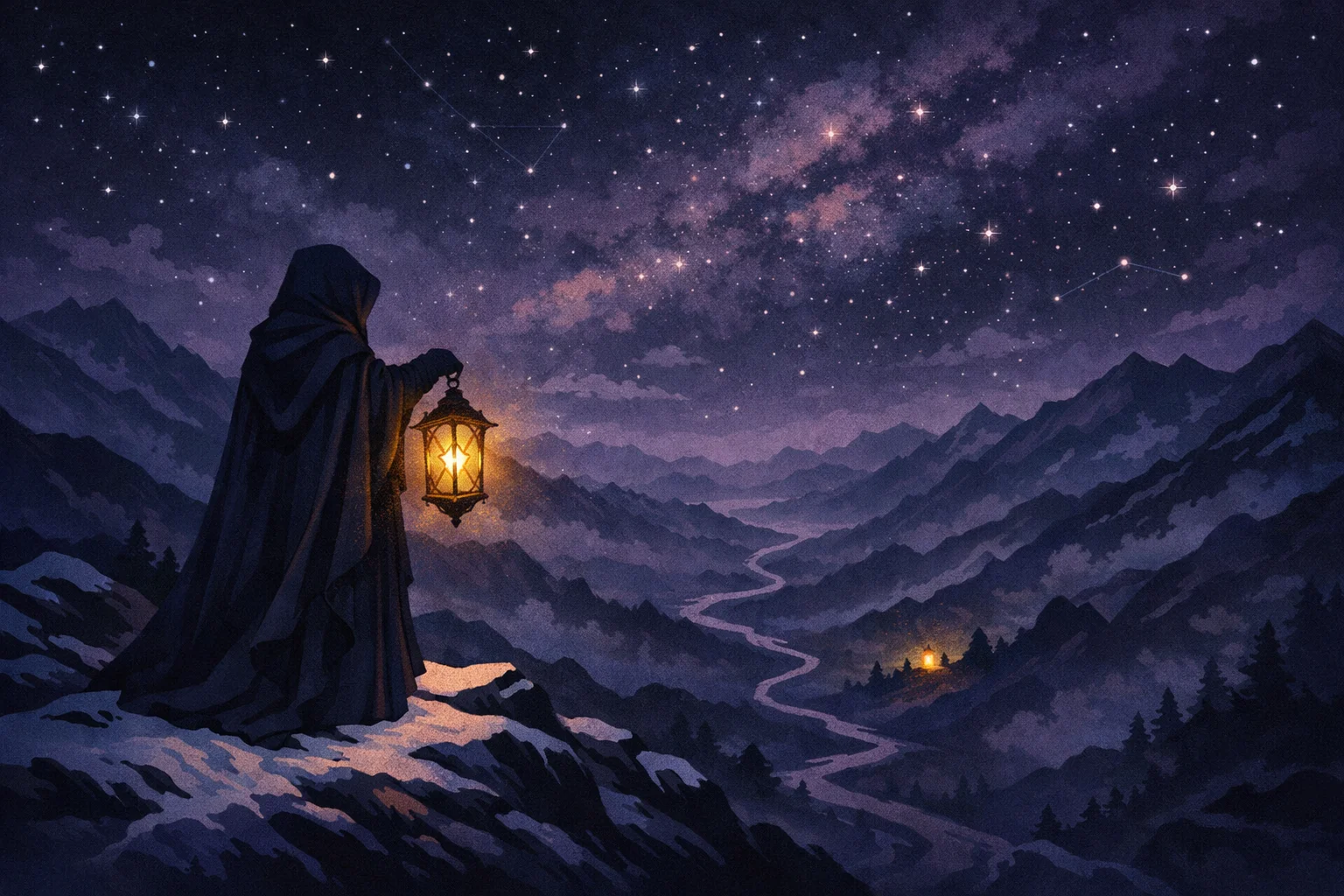
Here's the line that changes how you read the Hermit forever: solitude is a room you walk into on purpose, and loneliness is a door that got stuck behind you. The Hermit is always the first one. He didn't get stranded on that peak — he climbed it. The withdrawal is deliberate, temporary, and productive. He's up there to think, to strip away the noise, to hear the thing he couldn't hear down in the crowded valley.
That's why the card lands so differently depending on which version of alone you're living. When the Hermit shows up in a reading, the real question it's asking is: are you retreating, or are you hiding? Retreat has a purpose and a return trip. Hiding just accumulates. The upright card is the good kind of alone — the quiet you seek out to get clear. The reversed card, as we'll see, is what happens when that quiet stops being a choice and becomes a cage. Same mountain, opposite meaning.
What the Lantern Actually Does
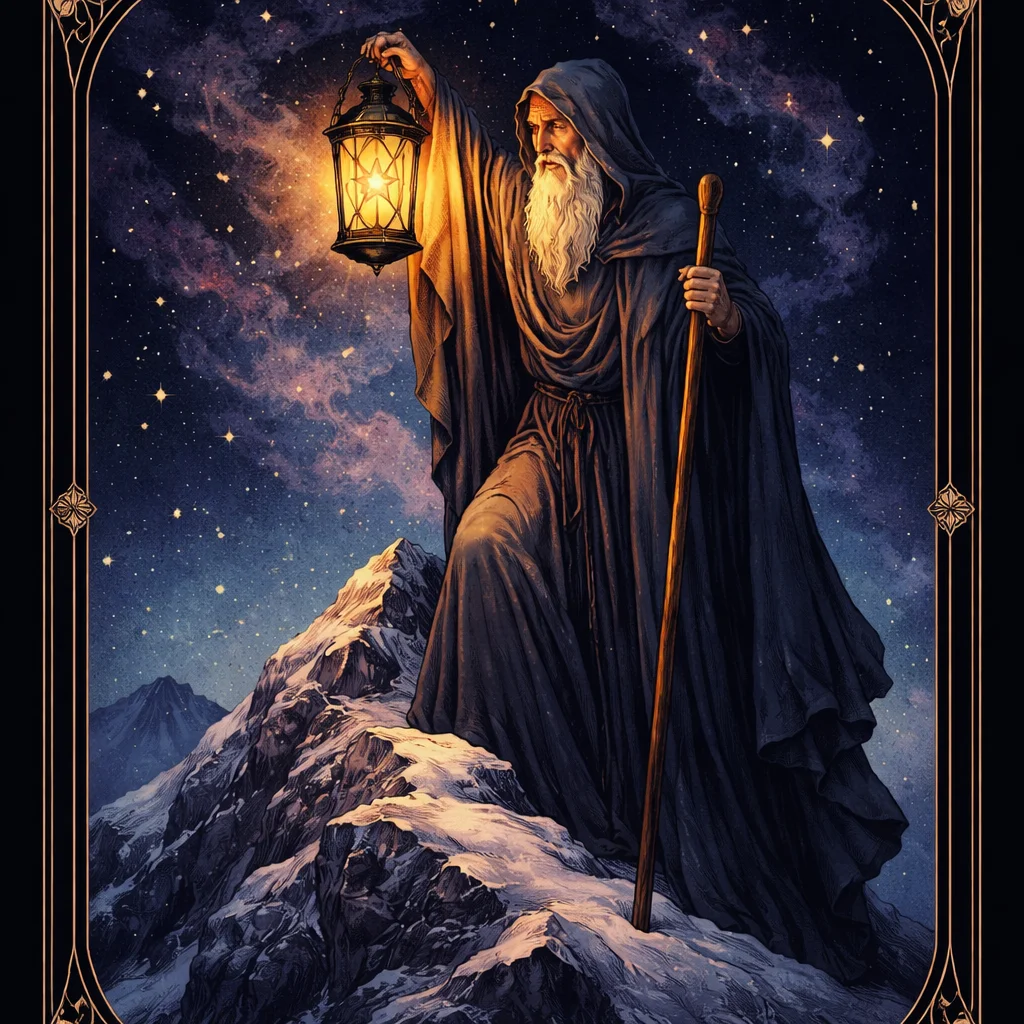
Look closely at what the Hermit is holding, because the whole card is encoded in it. In his raised right hand is a lantern, and inside the lantern is a glowing six-pointed star — the Seal of Solomon, an old symbol of wisdom and the union of opposites. That detail matters: the light isn't reflected sunlight or borrowed moonlight. It's generated inside the lantern. The Hermit's guidance comes from within him, not from any authority outside. When this card appears, it's telling you the answer you need is already in your possession — you just have to get quiet enough to see it glow.
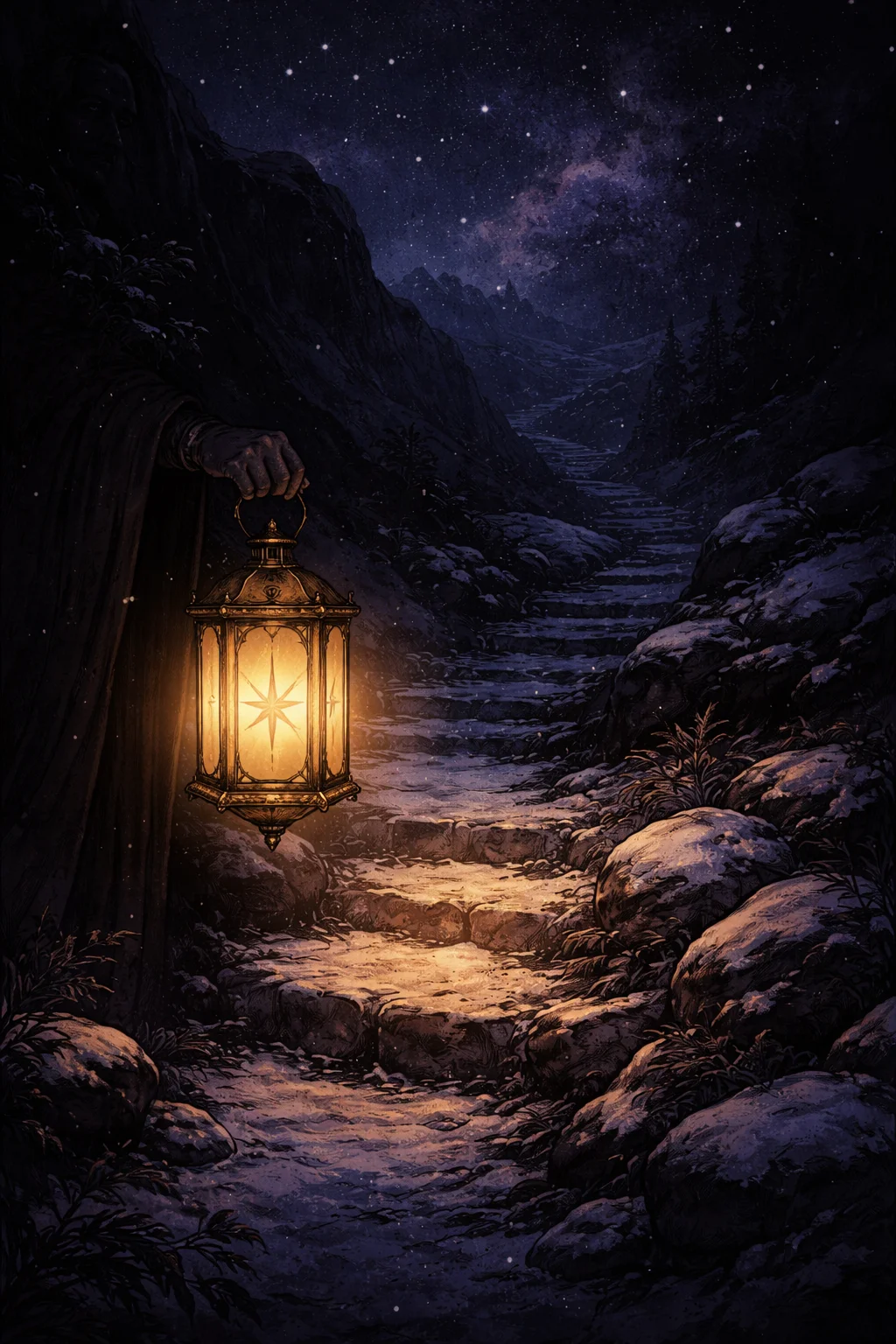
Now the detail almost every guide skips: the lantern is small, and it only lights the next step. It doesn't flood the whole mountain. The Hermit can't see the full path down from where he stands, and neither can you. That's not a flaw in the card — it's the instruction. You're not meant to map the entire journey from the summit tonight. You're meant to take the one step the light reveals, and trust that the next one will show itself once you move. People pull the Hermit hoping for a floodlight and forget they were handed a lantern on purpose.
The rest of the imagery reinforces the theme. The tall staff in his left hand is the same wand of will and experience he carried as a younger man — wisdom earned, not gifted. His grey cloak is anonymity, a deliberate stepping-back from status and identity. And the snowy peak beneath his feet is attainment: he's not lost on the mountain, he's standing at the top of it, having already made the climb. If you want the historical thread, the Rider-Waite-Smith Hermit drew on the older figure of Father Time and the classical ideal of the wise elder when Pamela Colman Smith illustrated it in 1909.
The Hermit Is Both the Seeker and the Guide
Most people read the Hermit as only half of what he is. Yes, he's the seeker — the one who withdraws to search for truth. But look again at that raised lantern. He's not just using it to find his own footing; he's holding it up, high enough to light the way for anyone climbing behind him. The Hermit is a seeker who has become a guide. That's the arc of the card: you go inward to find the light, and then you carry it back down to share.
This is why the Hermit so often shows up representing a mentor, teacher, counselor, or wise older figure in someone's life — or the querent stepping into that role for someone else. The retreat is never the endpoint. A hermit who climbs the mountain and never comes down isn't enlightened; he's just gone. The card's promise is the round trip: solitude that produces something worth bringing home. If your reading has the Hermit, ask not only “what am I searching for?” but “who's waiting for me to come back with it?”
Virgo, the Number 9, and the Card Before Fate Turns
The Hermit's astrology and numbering aren't trivia — they sharpen how you read it. The card corresponds to Virgo, the mutable earth sign ruled by Mercury, which is why the Hermit seeks by analyzing and refining rather than by asking a crowd. Virgo's discernment, its quiet perfectionism about understanding things properly, is the exact energy of a figure who climbs a mountain alone just to think clearly.
| Correspondence | The Hermit (IX) |
|---|---|
| Zodiac sign | Virgo · mutable earth |
| Ruling planet | Mercury — mind, analysis, discernment |
| Number | 9 — completion of a cycle of seeking |
| Element | Earth — grounded, patient, practical wisdom |
| Key symbol | Lantern with the six-pointed Seal of Solomon |
The number 9 is just as telling. Nine is the last single digit — the end of a cycle, the culmination of everything learned before it. In the Major Arcana that puts the Hermit at a very specific spot in the story. He comes right after Strength (VIII) and its lesson of inner mastery, and right before the Wheel of Fortune (X) and its great turn of fate. Read as a sequence, it's a small, complete teaching: first you tame your own nature, then you withdraw to make sense of what you've learned, and only then is fate ready to spin the wheel. The Hermit is the pause of reflection that has to happen before the next chapter can begin. When it shows up, it's often a sign that a big change is coming — but you're being told to prepare for it in stillness first.
Upright or Reversed: Retreat, or Just Hiding?
Upright, the Hermit is chosen solitude working exactly as intended: soul-searching, honest introspection, the willingness to sit with a question until it yields. You're seeking guidance in the one place it's actually reliable — inside — and it's paying off. This is a reassuring card upright, even though it looks somber. It says the answers are coming, just quietly, and on their own schedule.
Reversed, the same mountain becomes a hiding place. Now the solitude has tipped into isolation: withdrawing so far that loneliness sets in, using “I need space” as a permanent wall, or refusing help you genuinely need out of stubbornness or pride. There's a second flavor too — overthinking a decision entirely alone until you're paralyzed, when a single outside perspective would have freed you. And occasionally the reversal flips the other way: you're being forced back into noise and crowds when what you desperately need is quiet. The honest test is the one the upright card sets up. If your alone time has a purpose and a return trip, it's the Hermit upright. If it's just accumulating with no door out, it's reversed — and the fix is to open that door before the habit closes it for good.
The Hermit in Love, Work, and the Quiet Places
The Hermit is the card people dread pulling in a love reading, and they almost always misread it. It very rarely means “you'll be alone forever.” Far more often it's asking for space — a genuine need for one or both partners to step back and understand what they actually want before the relationship can move honestly. For couples, that's usually a reflective season, not a breakup. For singles, it's frequently a deliberate pause from dating to do the inner work first, which is exactly the kind of self-knowledge the intuitive, inward-facing High Priestess also points to. The two cards are cousins: the Priestess receives inner knowing passively, while the Hermit goes out and actively searches for it, lantern in hand.
At work, the Hermit favors depth over noise — the researcher, the specialist, the person who steps back to think before the rest of the room reacts. It can mean a sabbatical, mentoring, or a role that suits a quieter temperament, and it's a strong sign that the clarity you'll gain from stepping back is worth more than another frantic month of doing. In money matters it counsels the same: review before you act, audit what you have, and don't chase the get-rich-quick temptation. And in health, it's permission to rest — one of the deck's clearest cards for withdrawal, sleep, therapy, and the slow, unglamorous work of recovery. Across every area the Hermit's advice rhymes: the answer is quieter than the noise you're used to. Turn the volume down and it gets loud.
Card Combinations That Tell You What You're Searching For
The Hermit is always seeking something, and the cards around it name it. These are the pairings that come up most often at the table:
| Paired Card | Combined Meaning |
|---|---|
| The High Priestess (II) | Inner knowing doubled. A deeply intuitive, introspective reading — trust the quiet voice you've been talking yourself out of. The answer is already in you. |
| Wheel of Fortune (X) | The reflection was preparation. A turn of fate is arriving, and the solitude you just went through is exactly what readied you to meet it well. |
| Three of Swords | The solitude is grief. You're withdrawing to heal a heartbreak — and for now, that retreat is healthy. Let yourself process before you rejoin the noise. |
| The Sun (XIX) | Coming out of the cave. The introspection ends and you rejoin the world lit up with what you learned — one of the deck's most hopeful transitions. |
| The Moon (XVIII) | Two inner journeys, one warning. The Hermit's steady self-made light against the Moon's shifting reflected glow — trust your own lantern, not the illusions in the dark. |
The pairing I flag most is the Hermit beside the Wheel of Fortune. On their own, the Hermit looks static and the Wheel looks chaotic. Together they tell a single story: the quiet you're in right now isn't a dead end, it's a staging ground. The reflection is doing its work precisely so that when the wheel turns — and it always turns — you meet the change with a lantern in your hand instead of being caught in the dark. That's the Hermit's real gift. Not escape from the world, but the light you bring back to it.