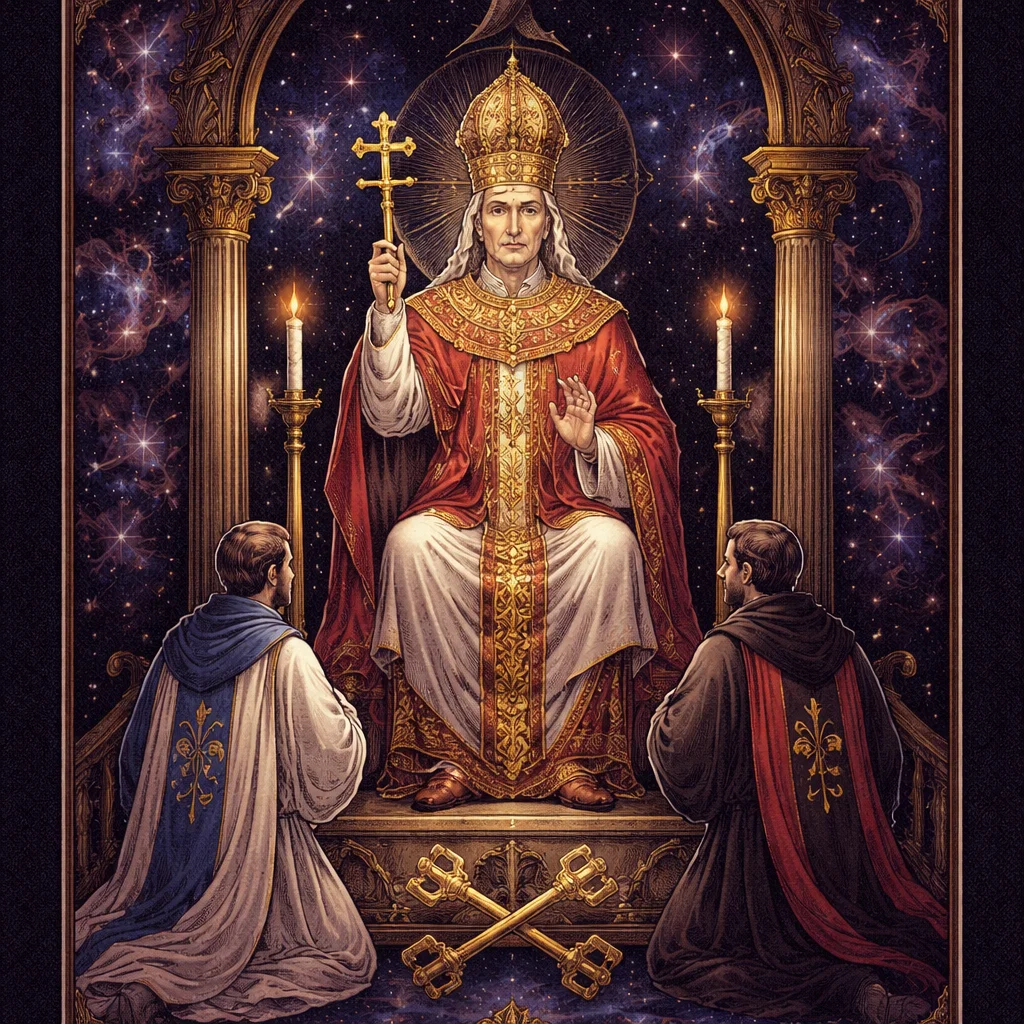
The Hierophant Tarot Card: What the Keeper of Sacred Tradition Teaches You
The Hierophant tarot card meaningis the one that makes people groan. They wanted The Lovers or The Star, and instead they got the guy in the robe telling them to follow the rules. But here's what most readers miss about card V: The Hierophant isn't demanding obedience. He's offering a shortcut. Every tradition he guards is a lesson someone else already paid for in mistakes, failures, and hard-won understanding. The real question isn't whether you like authority — it's whether you're willing to learn from people who walked this path before you did.
That reframe changes everything about how this card reads. The Hierophant in a spread isn't the universe telling you to sit down and shut up. It's saying: the knowledge you need already exists. Someone codified it, tested it, refined it across generations. You don't have to build from scratch. You just have to find the right teacher — or the right tradition — and commit.
The Earth-Sign Teacher Nobody Expected
The Hierophant is ruled by Taurus. Not Sagittarius, the sign everyone associates with higher learning. Not Pisces, the spiritual mystic. Taurus — the bull, the earth sign, the one people think is all about food and comfort and nice sheets.
But Taurus is the sign of preservation. It holds onto what matters. It builds things that last. A Taurus doesn't start five spiritual practices — it finds one and commits for decades. That's exactly what The Hierophant teaches: depth over breadth, consistency over novelty, mastery through repetition. Venus, Taurus's ruling planet, adds something else. Venus doesn't just govern romance — she governs values. What you love enough to preserve. What you find beautiful enough to pass down. The Hierophant guards tradition not out of stubbornness but out of love for the sacred things that would be lost if nobody bothered to maintain them.
Check your Taurus horoscope to see how this earth-sign energy is active in your life right now.
The Triple Cross, the Raised Hand, and the Two Acolytes
The Rider-Waite-Smith Hierophant is one of the most symbol-dense cards in the deck, and most guides just list the symbols without ranking them. Here are the three details that actually change readings:
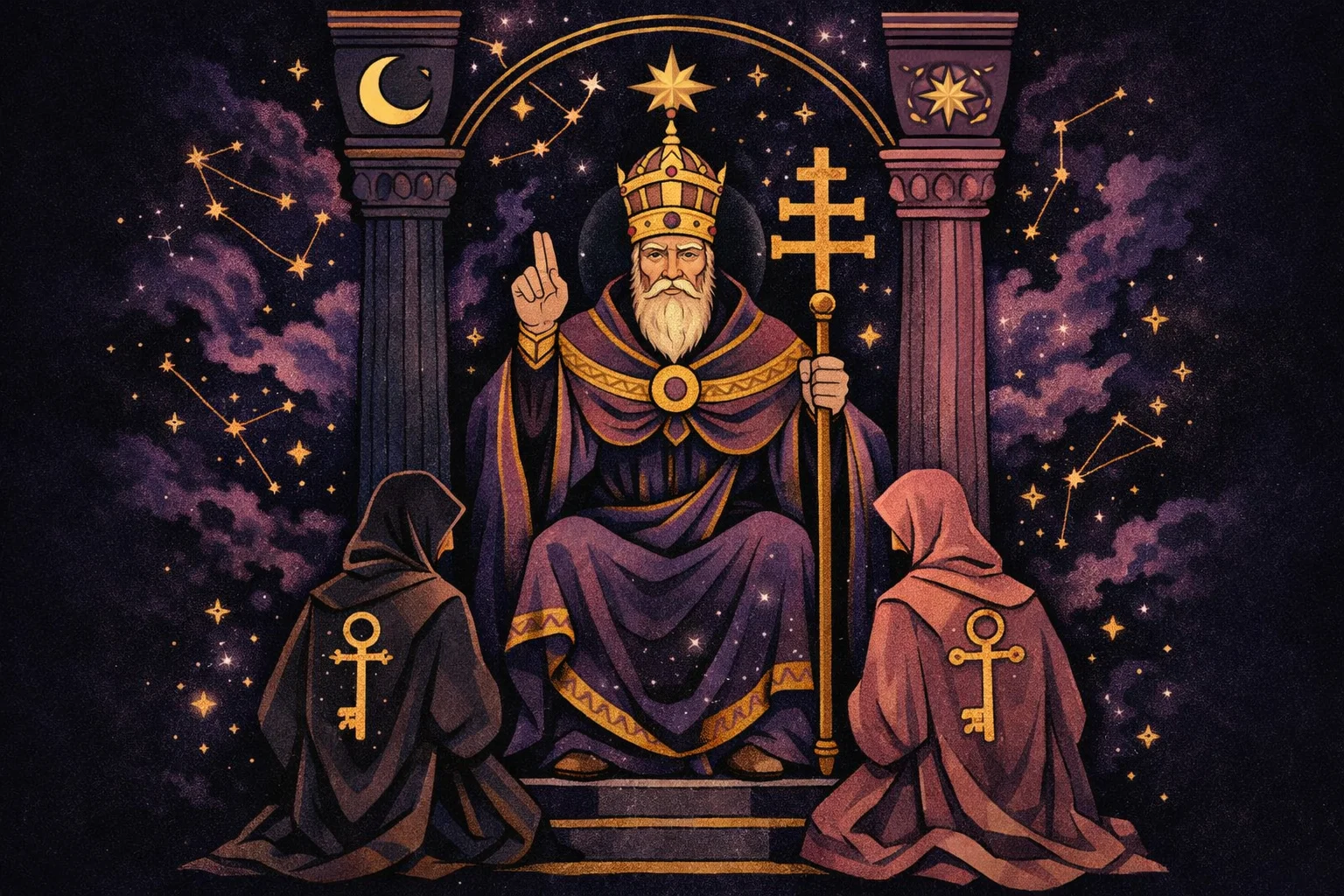
The triple crossin his left hand represents mastery across three realms: the conscious mind, the subconscious mind, and the super-conscious (or divine). This isn't ordinary knowledge. The Hierophant doesn't teach you how to do your taxes. He teaches you how the visible and invisible worlds connect — and how to navigate between them. If you've ever met a teacher who made you see the world differently, not just learn new facts, that was Hierophant energy.
The raised right handshows two fingers pointing up and two pointing down. This is the benediction gesture — “as above, so below” made physical. The Hierophant doesn't separate spiritual wisdom from everyday life. His entire teaching is that they're the same thing. How you wash dishes, how you speak to your partner, how you handle money — that is your spiritual practice.
The two kneeling acolytesare the detail most people misread. They're not worshipping The Hierophant. They're being initiated. There's a difference between kneeling to submit and kneeling to receive. These figures chose to be here. They sought out the teaching. When The Hierophant appears in your reading, it's asking: are you willing to be the student? Not forever. But long enough to actually learn something.
The Hierophant vs. The High Priestess: Two Keepers, Different Keys
This is the most important comparison in the Major Arcana for understanding how wisdom works in tarot. People confuse these two constantly, and the confusion matters because the advice they give is opposite.
| Quality | The Hierophant (V) | The High Priestess (II) |
|---|---|---|
| Knowledge type | Codified, institutional, shared | Intuitive, personal, hidden |
| How you access it | Study, mentorship, practice | Meditation, dreams, gut feeling |
| Teaching method | Speaks openly, lectures | Stays silent, waits for you to know |
| Ruling energy | Venus / Taurus (earth) | Moon (water) |
| When it appears | “Seek a teacher” | “Trust yourself” |
| Shadow side | Rigidity, dogma, blind conformity | Withdrawal, secrets, avoidance |
Here's the practical version: if The High Priestess appears, the answer is already inside you — stop asking everyone else and listen to your own knowing. If The Hierophant appears, the answer is outside you — find someone who has it and humbly ask them to teach you. Getting this backwards is how people waste years trying to intuit knowledge they could have learned in a weekend workshop, or studying frameworks when what they actually need is to sit still and trust their gut.
Upright: When the Teacher Arrives
An upright Hierophant in a reading almost always points to one of these specific situations — not vague “spiritual wisdom” generalities:
You need a mentor, not more solo research.The internet has convinced everyone they can self-teach anything. And for many skills, that's true. But some knowledge only transfers person-to-person. A meditation technique that looks simple on paper but requires someone to correct your posture in real time. A professional skill where the unwritten rules matter more than the official ones. The Hierophant says: find the person, not the YouTube video.
An institution will help you right now. Not every institution is corrupt or outdated. The Hierophant sometimes literally means: go to therapy. Join the church. Enroll in the program. Get the certification. Accept that the structure exists to serve a purpose, and that purpose includes you.
Shared values matter more than shared interests. This applies to relationships, business partnerships, and friendships. The Hierophant cares less about whether you enjoy the same restaurants and more about whether you agree on what matters: honesty, family, faith, money, how to treat people. Surface compatibility fades. Value alignment compounds.
Reversed — The Student Who Outgrew the Classroom
The Hierophant reversed gets misread as “reject all authority” so often that the misreading has become its own problem. What this reversal actually signals is more nuanced: you've reached a point where following the established path is no longer serving your growth. The tradition hasn't failed — you've graduated from it.
But graduation requires having actually attended the class. The reversed Hierophant respects the person who studied the doctrine, practiced the discipline, understood why the rules exist — and then consciously chose to walk a different path. It does notrespect the person who never engaged with the tradition and calls their avoidance “being spiritual but not religious.” Those are two very different people, and the card knows the difference.
In readings, reversed Hierophant often appears during these moments: leaving a religion you were raised in. Firing a therapist who's stopped challenging you. Quitting a job where the corporate culture conflicts with your values. Ending a relationship that looked perfect on paper but felt spiritually empty. The thread connecting all of these is outgrowing a container that used to fit — which is painful even when it's right.
Love Under The Hierophant: Rings, Rituals, and Real Talk
The Hierophant is one of the strongest marriage and commitment cards in the deck — stronger, honestly, than The Emperor, who rules through authority but doesn't necessarily commit emotionally. The Hierophant commits through shared belief systems. The couples who thrive under Hierophant energy aren't necessarily the most passionate — they're the ones who agree on what's sacred.
For singles, The Hierophant rarely predicts the kind of love-at-first-sight story that the Cups suit specializes in. Instead, it points to connections that form through shared structures: a meditation retreat, a book club, a professional conference, a church group, a mutual friend who says “you two would get along.” The attraction builds slowly. It doesn't feel electric at first — it feels reliable. And then one day you realize reliable is exactly what you needed.
Reversed in love, watch for two patterns. First: someone using tradition as a weapon (“this is how relationships are supposed to work”) to shut down legitimate needs. Second: someone avoiding commitment by disguising it as “independence.” The reversed Hierophant in love asks you to examine whether your resistance to conventional relationship structures comes from genuine self-knowledge or from fear of being known.
Career and Money: The Institutional Path
Professionally, The Hierophant is the card of credential-holders, institutional knowledge, and playing the long game within established systems. It doesn't favor the startup founder burning venture capital — it favors the person who got the MBA, built relationships within the company, understood the unwritten promotion criteria, and positioned themselves accordingly.
That doesn't mean The Hierophant is anti-entrepreneurship. It means the successful entrepreneurs under this card's energy are the ones who learned the industry rules before breaking them. The restaurateur who worked in other people's kitchens for a decade. The consultant who spent years inside the machine before hanging their own shingle. Mastery, then innovation. The Hierophant is offended by the idea that you can skip the mastery part.
Financially, this card is conservative in the best sense. It trusts time-tested strategies: diversified portfolios, emergency funds, living below your means, compound interest. If you've been ignoring financial advice from a professional because you think you know better, The Hierophant's message is blunt: you probably don't. The financial advisor exists for the same reason the teacher does — they've seen patterns you haven't seen yet.
Pairings That Rewrite The Hierophant's Lesson
The Hierophant shifts meaning dramatically depending on the cards beside it. Here are the combinations that show up most often and what they actually signal:
| Paired Card | Combined Meaning |
|---|---|
| The Lovers (VI) | A marriage or commitment ceremony is approaching. Also: choosing between following tradition and following your heart — the two cards sit right next to each other in the Major Arcana because this choice is universal. |
| The Tower (XVI) | A belief system is about to collapse. An institution you trusted reveals its cracks. Painful but necessary — the old structure has to fall before a new one can be built. |
| The Devil (XV) | Dogma becoming toxic. Someone using spiritual authority for control rather than liberation. A warning about cults, manipulative mentors, or religious guilt weaponized against you. |
| Three of Pentacles | Apprenticeship energy at its strongest. You're in the right program, under the right mentor, building the right skills. Trust the process and do the work. |
| The Star (XVII) | Spiritual renewal through returning to a tradition you'd abandoned. The practice that once felt stale now feels alive again — because you've changed, not because it has. |
| Eight of Swords | Feeling trapped by religious or institutional expectations. The structures meant to support you are now caging you. Time to examine which rules are protecting you and which ones are just habit. |
The most telling Hierophant combination is with The Hermit. When these two appear together, you're being asked to decide: is this a season for learning from others (Hierophant), or for withdrawing to discover your own truth (Hermit)? The answer changes depending on where you are in your journey — but whichever card falls in the “future” position tells you which mode you're moving toward.