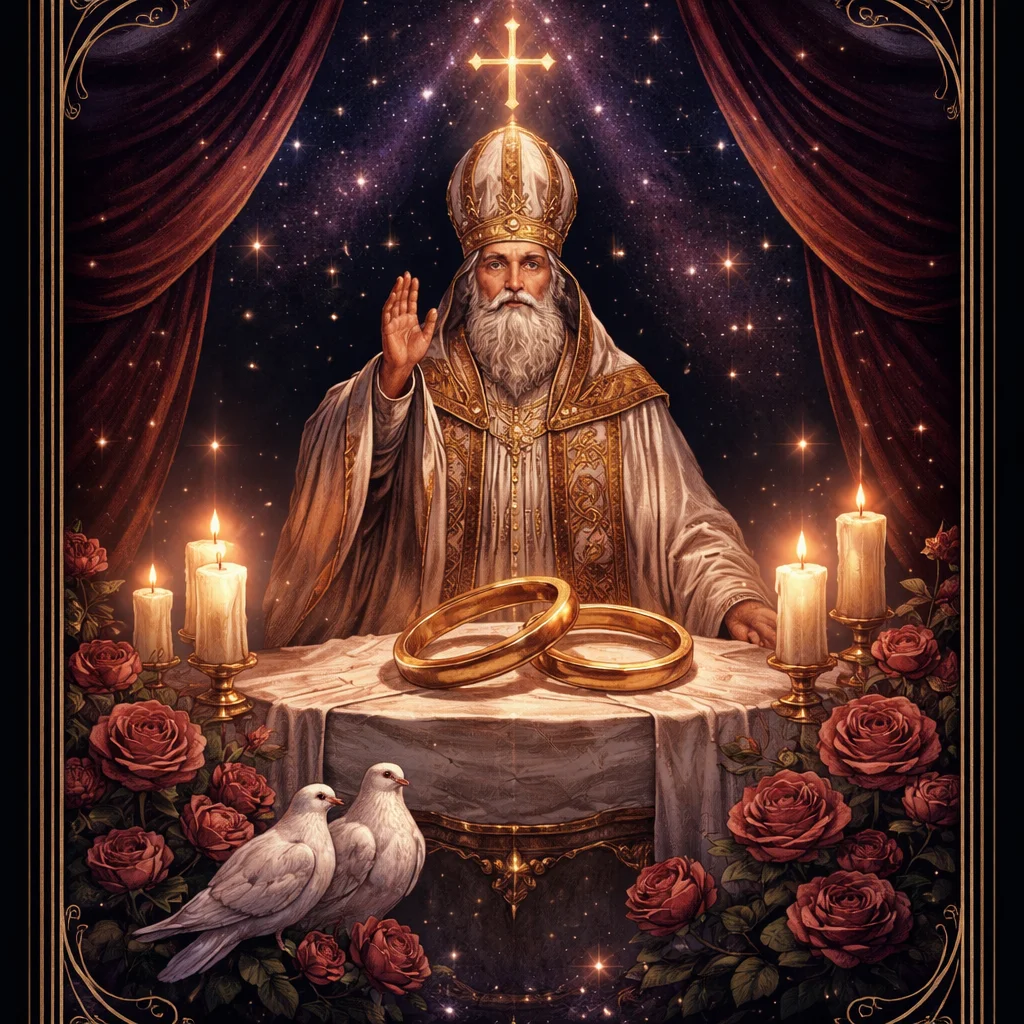
The Hierophant in Love: The Tarot Card Most Linked to Marriage and Commitment
The Hierophant love meaning tends to arrive at the exact moment someone asks the biggest question there is: “are we going to get married?” A client once turned over Card V after three years of dating a partner who wouldn't define anything. She groaned — she wanted the fireworks of The Lovers, and instead got the man in the robe. But the Hierophant was the better news. Where The Lovers asks “is there a spark?” the Hierophant answers a harder question: “is this built to last?” In a love reading, this is the card of vows, ceremonies, shared values, and the kind of commitment that comes with a name.
That reframe is everything. When people call the Hierophant “boring” in love, they're really saying it isn't dramatic. Correct — it isn't. It doesn't promise the electric, swept-off-your-feet story. It promises something rarer and more durable: two people who agree on what matters and are willing to make it official. Below, I'll walk through what the card means upright and reversed, what it signals as someone's feelings, how to tell it apart from The Lovers, and when it's quietly warning you instead of blessing you.
Why the Hierophant Is the Tarot Marriage Card
Out of all 78 cards, the Hierophant is the one traditional readers reach for when a spread is pointing at marriage. There's a reason that goes deeper than “he looks like a priest.” The Hierophant — card V of the Rider-Waite-Smith Major Arcana — governs institutions and rites of passage, the formal ceremonies a community recognizes. A wedding is precisely that: a private bond made public and official. When this card lands in a love position, it's pointing at the moment love stops being a feeling between two people and becomes a commitment witnessed by everyone else.
The astrology backs it up. The Hierophant is ruled by Taurus, and Taurus's planet is Venus — the planet of love and values. But Taurus-Venus isn't the flirtatious side of Venus you see in The Empress. It's the loyal, build-it-to-last side. Taurus doesn't fall in love with five people a year. It finds one and stays for decades. That's the flavor of love the Hierophant blesses: steady, committed, values-first, and in it for the long haul. If Taurus energy runs in your chart, your Taurus love traits read almost like a mirror of this card.
Here's the practical takeaway most guides skip: the Hierophant rarely appears at the start of a great love story. It shows up at the threshold — the engagement, the moving-in, the moment a relationship crosses from casual to formal. If you pull it, ask which threshold is standing in front of you right now.
Upright in Love: Commitment You Can Build a Life On
Upright, the Hierophant in a love reading is about as strong a commitment omen as the deck offers. It points to relationships with structure: defined roles, shared traditions, meeting the families, agreeing on the big stuff before the big day. For couples, it often marks the transition into a formal next step — engagement, marriage, buying a home, or blending two lives into one household.
What makes the upright Hierophant different from every other “good” love card is what it's built on. The Cups cards run on emotion. The Lovers runs on chemistry and choice. The Hierophant runs on agreement — specifically, agreement about the unglamorous essentials: money, honesty, faith, how you handle conflict, how you treat each other's people. Couples who share those hold together long after the honeymoon chemistry cools. That's the durability this card is pointing at.
For singles, the upright Hierophant makes a very specific prediction, and it's not romantic in the movie sense. You're most likely to meet a serious partner through an established structure — a class, a congregation, a professional network, a volunteer group, or a trusted introduction from someone who knows you both. The attraction builds slowly and feels less like lightning and more like recognition. If dating apps have left you drained, the card's advice is blunt: go where people gather around a shared purpose, not a shared swipe.
Reversed in Love: When Tradition Turns Into a Cage
The Hierophant reversed in love splits into two very different stories, and reading which one you're in is the whole skill. The first is liberating: your relationship simply doesn't fit the traditional mold, and it shouldn't be forced to. Different backgrounds, different faiths, a non-conventional structure, a timeline that ignores what your relatives expect. Reversed, the Hierophant says stop apologizing for a bond that works just because it doesn't match the template. Not every real love looks like the one in the wedding brochure.
The second story is the warning. Reversed, this card also describes a relationship going through the motions of tradition with none of the meaning left — a couple performing a marriage neither of them is actually present for. And it flags the person who weaponizes “I'm just not the commitment type” the moment things get serious, using unconventionality as a shield against vulnerability. Questioning tradition thoughtfully is maturity. Dodging commitment and calling it a personality is not. The reversed Hierophant knows the difference, and part of an honest reading is admitting which one applies to you.
The Hierophant as Feelings: What They Actually Feel for You
“What does the Hierophant mean as feelings?” is one of the most-searched tarot questions, so let's answer it plainly. As someone's feelings for you, the Hierophant means they see you as long-term — not a passing interest, not a fling, but a person they could genuinely build a future with. Their feelings are steady, serious, and a little traditional. They're thinking about meeting your family, doing things properly, and where this could lead if it keeps going.
The catch: this isn't obsessive, can't-eat-can't-sleep infatuation. If you were hoping the card would reveal that someone is consumed with passion for you, the Hierophant is the calmer answer. It's the feeling of “I want to do this right” rather than “I can't stop thinking about you.” For a lot of people, that steadiness is exactly what they've been missing. Reversed as feelings, it flips: they may feel pressured, uncertain about commitment, or torn between what they actually want and what they think they're “supposed” to want.
Hierophant vs. Lovers: Which Card Means What in Love
These two Major Arcana cards sit side by side (V and VI) and get mixed up constantly in love readings — which is a problem, because their advice is nearly opposite. Here's how to tell them apart at a glance:
| In a love reading | The Hierophant (V) | The Lovers (VI) |
|---|---|---|
| Core energy | Commitment & vows | Chemistry & choice |
| Built on | Shared values | Attraction & alignment |
| The question it answers | “Will this last?” | “Is there a spark?” |
| Marriage odds | Strong — the marriage card | Possible, but about the decision |
| Pace | Slow, deliberate | Immediate, magnetic |
| Shadow side | Duty without feeling | Indecision, temptation |
The cleanest way to remember it: The Lovers is the falling-in-love card, the Hierophant is the getting-married card. When both appear in one spread, you're looking at a relationship with genuine spark and a real shot at permanence — the combination most people are actually hoping for when they sit down for a reading.
The Emperor adds another distinction: shared values still need everyday arrangements. Two people can agree on commitment while disagreeing about who makes decisions or carries the workload. The Emperor in love pairing explorer lets you compare these cards in pattern and advice positions to separate the promise from the practical responsibility.
Does It Actually Predict a Wedding? Reading the Timing
Yes and no — and the difference lives in the surrounding cards. Tarot doesn't hand you a wedding date, but the Hierophant is the single strongest signal in the deck that a relationship is moving toward formal commitment. To read the timing rather than just the possibility, look at what sits beside it. Here's the quick decision framework I use at the table:
If the Hierophant lands with cards of completion or celebration — the Ten of Cups, the Four of Wands, the World — a real ceremony or public commitment is likely in the near term. These are the “it's happening” combinations.
If it lands with slow, building cards — the Two of Cups, the Page of Pentacles, the Knight of Pentacles — the commitment is real but still forming. Think “engaged, not married yet.” The foundation is being laid; the ceremony is further out.
If it lands reversed or beside cards of doubt — the Seven of Swords, the Moon, the Five of Cups — slow down. The pressure toward marriage may be coming from outside the relationship (family, timeline, expectation) rather than from genuine readiness. That's the moment to ask whether you're marrying the person or the idea. For a fast gut-check on a single yes/no love question, a yes or no tarot pull can cut through the noise before you commit to a bigger spread.
Pairings That Rewrite a Hierophant Love Reading
The Hierophant changes its love message depending on the company it keeps. These are the combinations that come up most in relationship readings and what they actually signal:
| Paired card | What it means for love |
|---|---|
| The Lovers | Spark plus permanence. A committed relationship that still has real chemistry — or a marriage proposal born from a genuine choice, not obligation. |
| Four of Wands | The clearest wedding-bells combination in the deck. Engagement, a ceremony, or a milestone celebration is on the horizon. |
| Ten of Cups | Marriage and family in the fullest sense — a values-based union that grows into a shared home and lasting emotional security. |
| The Tower | A commitment or engagement built on the wrong foundation may crack. Better to face the shaky agreement now than after the vows. |
| The Devil | Staying together out of duty, guilt, or fear of judgment rather than love. A warning about commitment as a trap, not a choice. |
| Eight of Swords | Feeling trapped by what a relationship is “supposed” to look like. The expectations meant to support the union are now caging it. |
When a Hierophant Love Reading Is Really a Warning
For all its wedding-bells reputation, the Hierophant isn't always handing you a blessing — sometimes it's holding up a mirror. The most useful thing an honest reader can tell you is when to be careful with this card, so here's the “when not to trust it” side.
Be cautious when the Hierophant's pull toward commitment is coming from everyone except the two people in the relationship. Family pressure, a religious timeline, the fear of being the last single friend, the sunk-cost feeling of “we've already put in this many years” — these can all masquerade as the card's green light. The Hierophant blesses commitment rooted in shared values. It does not bless commitment rooted in obligation. If you strip away every outside expectation and the desire to stay is still there, that's the real signal. If it isn't, the card reversed is quietly telling you to leave with integrity rather than honor an empty vow.
The same caution applies to reconciliations. Upright, the Hierophant can support getting back together — but only as a formal do-over with new agreements and honest conversation about what broke. Sliding back to an ex because the history is familiar and the unknown is scary is exactly the pattern the reversed card warns against. Shared history feels like a foundation, but it isn't one; shared values are. If you want a structured way to weigh a specific pairing, our guide to The Emperor in a relationship makes a useful contrast — authority-based commitment versus the Hierophant's belief-based commitment. Whichever card you're reading, the question underneath the Hierophant is always the same: are you committing to a person, or to an idea of how love is supposed to look? Answer that honestly and it becomes one of the most useful cards you can pull.