Celtic Cross Tarot: How to Read All 10 Positions Like an Experienced Reader
The Celtic Cross tarot spread is the reading everyone recognizes and almost nobody reads well. You've seen it in films, on book covers, in the back of a candlelit shop — ten cards arranged in a cross with a staff running up the side. It looks authoritative. It looks ancient. And the moment most people lay it out, they freeze, because ten cards interacting at once is genuinely a lot to hold in your head. The good news: the spread has a logic, and once you understand what each of the ten positions is actually asking, the cards start talking to each other instead of shouting over one another. The ten-position version nearly everyone uses today was codified by Arthur Edward Waite, co-creator of the Rider-Waite-Smith deck, in his 1910 guide to the tarot.
Where the Ten Cards Actually Go
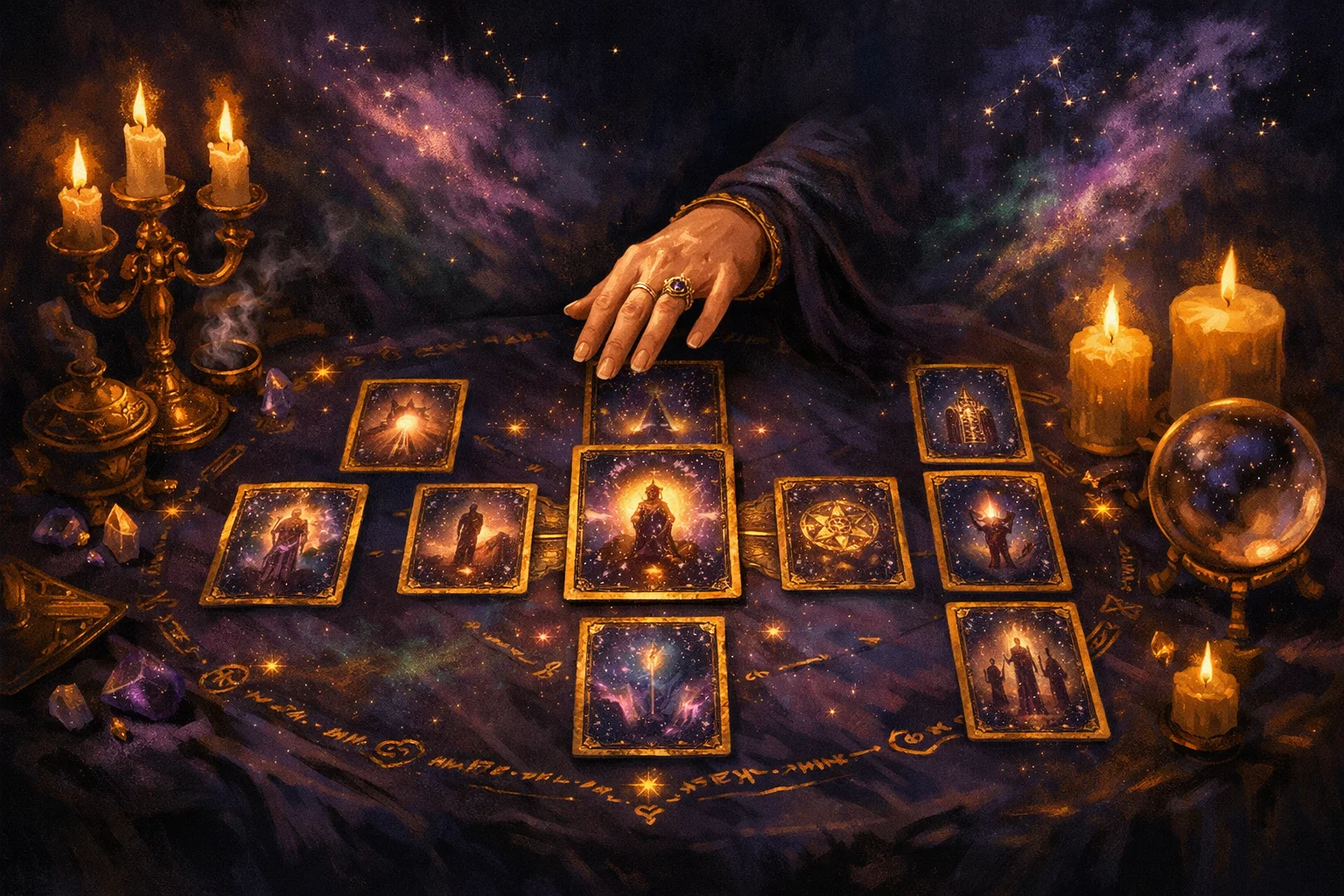
The layout splits into two halves: a central cross of six cards and a vertical staff of four. The cross describes the situation itself — its present, its obstacle, its roots, and its immediate trajectory. The staff zooms out to the bigger context — you, the people around you, your inner world, and the final outcome. Here's the full map, in the order you lay and read them:
| # | Position | What it answers |
|---|---|---|
| 1 | The Heart of the Matter | What's truly at the center right now |
| 2 | The Challenge (crossing) | The obstacle cutting across it |
| 3 | The Foundation | The subconscious root it grew from |
| 4 | The Recent Past | What's fading behind you |
| 5 | The Crown | Your goal or best possible outcome |
| 6 | The Near Future | What's arriving in weeks, not years |
| 7 | Your Approach | The attitude and role you're bringing |
| 8 | External Influences | The people and pressures around you |
| 9 | Hopes and Fears | What you want and dread, often at once |
| 10 | The Outcome | Where this path leads if nothing shifts |
Notice that positions 5 and 10 are easy to confuse. The crown is your conscious aim; the outcome is the actual forecast. When they disagree, that gap is the most useful information in the whole spread. If you want a slower on-ramp before committing to all ten cards, a single-card tarot pull gives you the headline first, and the full tarot spreads guide compares the Celtic Cross to lighter layouts.
Read the Cross Before You Read the Staff
New readers tend to read card 1, then card 2, then card 3, narrating down the line like a grocery list. Don't. Read the six cards of the cross as a single picture first. Position 1 and its crossing card (2) are the situation and its obstacle — read them as a pair, always. Then 3 and 4 give you where it came from, and 5 and 6 show where it's pointed. Six cards, one snapshot.
Only then move to the staff. The staff is the commentary track: how you're handling it (7), what the world around you is doing (8), what's churning inside you (9), and where it all lands (10). Reading the cross as context first means the outcome card has somewhere to land. In isolation, the Ten of Swords in position 10 reads like doom. But following a foundation of the Eight of Cups and a near future of the Six of Swords, that same card reads like the clean ending of something you were already walking away from. Context changes everything.
The Crossing Card Is Where Beginners Slip
Position 2 is the single most misread card in the spread. It's laid sideways across position 1 for a reason: it represents what's crossing you — the challenge, the friction, the thing in the way. Here's the trap that catches almost every beginner: this is the one position where a beautiful, upright, traditionally lucky card can be a problem.
Pull the Wheel of Fortune as your crossing card and it doesn't mean "good luck saves you." It often means your situation is at the mercy of timing and forces outside your control, and that lack of control is itself the challenge. The Ten of Cups crossing you can mean a fantasy of perfect happiness is exactly what's stopping you from accepting the real, imperfect relationship in front of you. Always ask of position 2: how could this energy be the thing standing in my way? That single question separates a flat reading from a sharp one.
A Sample Celtic Cross, Read Position by Position
Theory only goes so far, so here's a worked example. Say the question is "Why do I keep stalling on leaving my job?" and the cards land like this:
1. Heart — Eight of Pentacles. You're heads-down, grinding at the craft. The center of the matter is that work itself has become your identity. 2. Challenge — Four of Pentacles. Crossing it: a white-knuckle grip on security. The obstacle isn't the job, it's the fear of releasing a steady paycheck. 3. Foundation — Six of Cups. The root is nostalgic loyalty; somewhere back there, this job felt like home. 4. Recent Past — Five of Wands. Lately it's been friction and petty conflict, and that energy is finally fading.
5. Crown — Three of Wands. Your conscious goal is expansion, watching your ships come in somewhere new. 6. Near Future — Eight of Wands. Things are about to move fast once you decide. 7. Approach — The Hanged Man. You're in suspended animation, waiting for a perfect sign that isn't coming. 8. External — Ten of Pentacles. Family and financial expectations quietly pull you toward "stay safe." 9. Hopes and Fears — The Tower. You both crave and dread a sudden break. 10. Outcome — The World. If the trajectory holds, completion and a genuine new chapter.
Read as a whole, the story writes itself: the goal (Three of Wands) and the outcome (The World) agree, which is rare and reassuring. The only thing freezing you is your own approach — The Hanged Man waiting for permission — reinforced by family pressure (Ten of Pentacles) and a grip on security (Four of Pentacles). The advice isn't "quit tomorrow." It's "stop waiting for the sign; you already are the sign." That's a reading no single card could give you.
Five Mistakes That Wreck a Celtic Cross
- Reading the cards in a straight line. The positions aren't a list, they're a structure. Cards 1 and 2 are a pair; 5 and 10 are a comparison; 7 is the lever you control. Read the relationships, not just the sequence.
- Treating the outcome as fixed. Position 10 is a forecast based on today's trajectory, not a sentence handed down by fate. Change position 7 — your approach — and the outcome genuinely shifts. Tarot illuminates the path; it doesn't lock the door.
- Ignoring the crossing card's double edge. A "good" card in position 2 is still your obstacle. Skip that nuance and you miss the entire point of the cross.
- Asking a yes-or-no question. Ten cards answering "should I text him back" produces noise. The Celtic Cross needs a situation with moving parts. Save the binary questions for a simpler pull.
- Re-shuffling because you didn't like the outcome. The fastest way to make a spread meaningless is to keep redrawing until you get the answer you wanted. If the cards stung, that sting is the reading. Sit with it before you touch the deck again.
When to Skip the Celtic Cross Entirely
For all its reputation, the Celtic Cross is the wrong tool more often than people admit. Honestly, it's overrated for beginners — a simple three-card tarot spread teaches you more about reading flow, because you can actually hold three cards in relationship at once. The Celtic Cross earns its keep on one specific kind of question: a tangled situation with many factors you genuinely can't see clearly, like a career crossroads or a relationship that's hard to name.
There's a sharper way to decide than difficulty, though, and it's sitting in the layout. This spread has a card laid sideways across another one — it is built to show a situation being opposed. A 7 card tarot reading has no crossing card anywhere; it's an arc that runs one way, from origin to outcome. So if you can name the thing standing in your way, deal ten. If the situation is a slow drift with no obvious opponent in it, seven reads it better — and there's a second reason to prefer the smaller spread that nobody mentions: pattern signals get commoner the more cards you deal. Three or more Major Arcana turns up in about 58% of ten-card spreads and only 31% of seven-card ones, so "this is bigger than me" means considerably less here than readers assume.
For a quick daily check-in, pull one card. For a clear binary decision, a yes or no tarot reading maps each card to a direct answer and spares you the over-analysis. Timing matters too — many readers won't lay a major spread when they're emotionally reactive, because anger or desperation distorts interpretation. If you want to work with the natural rhythm of things, check the current moon phase; new moons favor spreads about beginnings, full moons about culmination and release. The Celtic Cross rewards patience. Bring it the questions that actually deserve all ten cards.