1133 Angel Number: The Sequence That Skips Its Own Middle, Twice
The 1133 angel number meaning starts with something you can check on your own fingers: count the digits as stairs. One, one — then three, three. The staircase skips a step. In numerology, 2 sits between initiative and expression, and it governs everything unglamorous about the climb — the second try, the second draft, the other person, the patient stretch where nothing happens. 1133 leaps over it twice in the space of four digits. Most sites will tell you this number means “positive growth and master teacher energy,” and that isn't wrong, exactly. It's what you get when you read the digits and ignore their order. Read the order, and the sequence turns into a sharper question: you've had the idea, and you're already talking about it — so what got skipped in between?
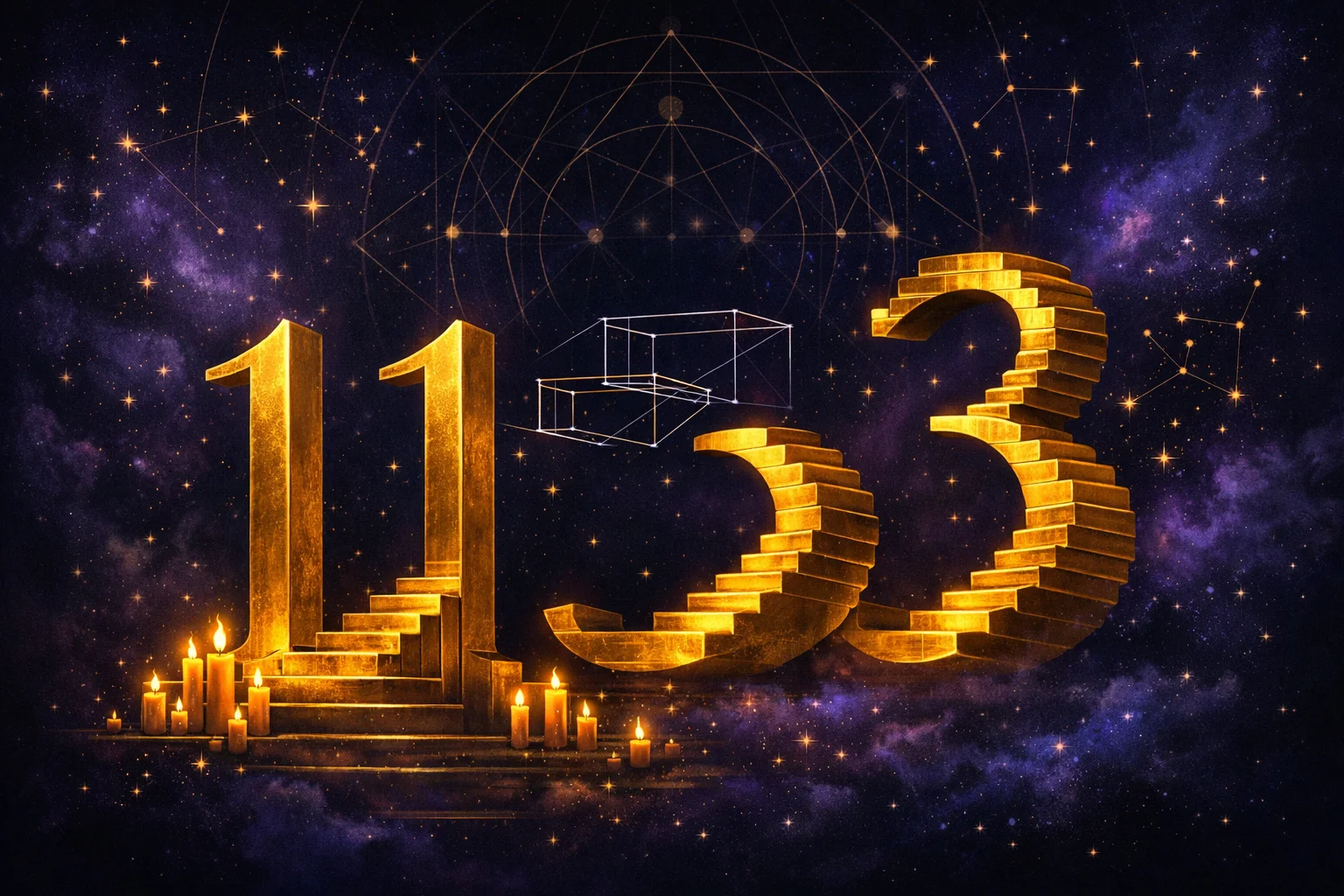
Count the Stairs: One, One, Three, Three
The single digits in numerology run in a fixed order, and the first three form a natural sequence: 1 is the impulse (the idea, the decision, the self starting something), 2 is the middle (partnership, patience, the second attempt), and 3 is the voice (expression, announcement, being seen). A person moves through them in that order whether they mean to or not — you decide, you build quietly, then you speak. 1133 writes the first and third and omits the second. Then it does it again. Doubling, in this tradition, is emphasis: two 1s insist on the vision, two 3s insist on the telling. Which means the omission is doubled too. The number isn't whispering that a step got missed — it's repeating it.
That's the reading the tool above runs. The digit 2 isn't one thing; in practice it fails in four distinct ways, and knowing whichone you skipped changes what you should do next. But before that, it's worth seeing that 1133 makes the same skip a second time, at a completely different zoom level.
The Same Gap at Two Scales
Zoom out from single digits to master numbers — the doubled figures 11, 22 and 33 that numerology refuses to reduce — and read 1133 as two pairs. The face of the number shows 11, the visionary, and 33, the teacher. The one it doesn't show is 22, the builder. The first and third master, with the second missing: exactly the shape the digits made, one level up.
| Master | Register | How it's reached | In 1133? |
|---|---|---|---|
| 11 | The visionary — insight, the charged idea | The base pair | Present, leading |
| 22 | The builder — structure made real | 2 × 11 (11 doubled) | Absent |
| 33 | The teacher — practiced wisdom, transmitted | 3 × 11 — not a doubling of anything | Present, closing |
There's a detail in that middle column worth slowing down for. 22 is 11 doubled, and 44 is 22 doubled — the builder masters sit on a doubling chain. 33 doesn't. It's 3 × 11, the only master you can't reach by doubling a smaller one. The teacher master isn't scaled-up vision; it's vision multiplied by expression, which is a different operation entirely. That's a tidy arithmetic echo of something teachers already know: you don't get to 33 by having a bigger idea. You get there by having built something worth transmitting — and the building is the 22 this number conspicuously leaves out. Its sibling sequence works the other side of the same street: 1144 stacks the visionary on the builder's double and is a number about accumulation. 1133 stacks the visionary on the teacher and asks where the builder went.
What Did You Skip? Four Flavors of Two
“You skipped the 2” is only useful if you can say which 2. In readings, the missing middle shows up in four recognizable flavors, and they need different repairs:
- The Second Rep— repetition. The first session of anything runs on novelty. The second one, done bored, because it's Tuesday, is where a practice begins. If the thing you announced has no recurring slot in your week, this is the missing flavor.
- The Second Draft— revision. Version one of anything is a statement; version two is work. If nothing has ever been rewritten, rebuilt or cut, the project is still living in the announcement register.
- The Second Voice— witness. The 2 is, literally, the other person. If people have heard the announcement but nobody sees the unfinished middle — and nobody would notice for a week if you quietly stopped — the loop runs on your own enthusiasm, which is a 1 wearing a 2's clothes.
- The Second Season— patience. Everything survives its first season, while it's new. The 2 that matters is the stretch where nothing visible happens and nobody claps, and you continue anyway.
The tool asks for two concrete markers per flavor — things that are checkably true, not felt — and names the emptiest one. Feelings score nothing here on purpose. A vision can feel built; a calendar either has the slot or it doesn't.
Every Doubled Pair Hides an 11
Here's a claim you'll find on half the pages written about this number: 1133 “secretly carries the vibration of 11” because it divides evenly by it. True — and it proves nothing. Any four-digit number of the form aabb is divisible by 11, always — it's a two-line case of the standard divisibility rule for 11, because aabb = 1100a + 11b = 11 × (100a + b). 1122 does it. 2233 does it. 1144 does it (11 × 104). The divisibility is a property of the doubled-pair shape, not of this number, so citing it as evidence about 1133 is like being impressed that a square has four corners.
What actually distinguishes 1133 is which multiples of 11 sit on its face: the 1st and the 3rd master, with the 2nd skipped — the argument this whole page is built on. And for what it's worth, the division has one genuinely charming result: 1133 = 11 × 103, and 103 is prime. Strip the visionary out of this number and what remains refuses to factor any further.
The Arithmetic Lands on 8, the Results Digit
Add the digits and you get 1 + 1 + 3 + 3 = 8, in a single step, no intermediate stops. In numerology 8 is the results register — harvest, consequence, the ledger being balanced. So the sequence about vision and voice doesn't root in either of them. It roots in outcome. That's the quiet warning folded inside a “growth number”: growth gets audited. Whatever you announce under the doubled 3s eventually gets weighed under the 8, and the weighing doesn't care how good the announcement sounded. Curiously, 2222 arrives at the same root of 8 from the exact opposite direction — four patient 2s, the very digit 1133 skips twice. Two roads into the results register: one paved entirely with the middle, one missing it.
Why 11:33 Has No Name in Clock Lore
The commonest place people meet this sequence is a phone screen at 11:33 — and here 1133 does something quietly unusual. The time-based reading system has three named classes, and 11:33 fails the entry test for every one of them. A mirror hour needs the minutes to equal the hour (11:11). A reversed hour needs the minutes to reverse it (13:31). A triple hour needs three of the four digits to match (13:33). 11:33 is two pairs — no mirror, no reversal, no triple. Unlike half the mirror hours, it even survives a 12-hour display, showing up twice a day on an American phone. The one repeating-digit time that clock lore never got around to naming is the one this page is about.
I read that as a small freedom. A 1133 sighting at 11:33 isn't about the clock at all — there's no hour-based tradition to defer to, so the number's own structure carries the whole message. If you want the taxonomy itself — which times are mirrors, which are triples, and the guardian-angel roster behind them — the mirror hour calculator tests all 1,440 minutes of the day against every rule.
Reading Your Result — When Nothing Was Skipped
A worked example. Say you've announced a workshop — talk level “announced” — while the one-sentence version of what it teaches keeps changing. You tick two middle markers: it has a weekly slot, and it once survived a dead month. Rep counts 1, season counts 1, draft and voice count 0. The tool names the Second Draft as your skipped step, notes honestly that the Second Voice is tied right behind it, and hands you the project repair: cut or rewrite one piece you've already shown people, before the next announcement. That's a smaller instruction than “embrace growth,” and that's the point.
Two results deliberately refuse the premise. If you haven't told anyone and the middle is near-empty, nothing has been skipped — you're standing on the first 1, and the sequence reads as a preview of the ladder, not a critique of your climbing. And if all four flavors have coverage, the ladder holds: you've built more than you've said, and 1133 becomes the rarest thing an angel number can be — a green light with no homework attached. Honest tools need honest exits, and a diagnostic that finds a deficiency in everyone is a horoscope with a checklist stapled to it.
Two boundaries on all of this. A single sighting means nothing; sequences earn attention by repeating across contexts — a clock, a receipt, an invoice number — not by appearing once while you happened to be anxious. And this page reads what 1133 means, not whether it's yours: if you want to know which sequence your own birth date actually points to, that's a different question, answered by digit frequency rather than symbolism, and it belongs to the calculator linked below.