
The Angel Number Your Birth Date Carries (And Why Most Calculators Get It Wrong)
An angel number calculator should be able to answer one blunt question: which sequence is mine? The answer is the digit your birth date repeats more often than a birth date normally would — and for the date 17 March 1994, that is 9, not the 7 you would get by adding the digits together. Counting and adding are different operations, they disagree most of the time, and almost every tool online quietly does the second while promising the first.
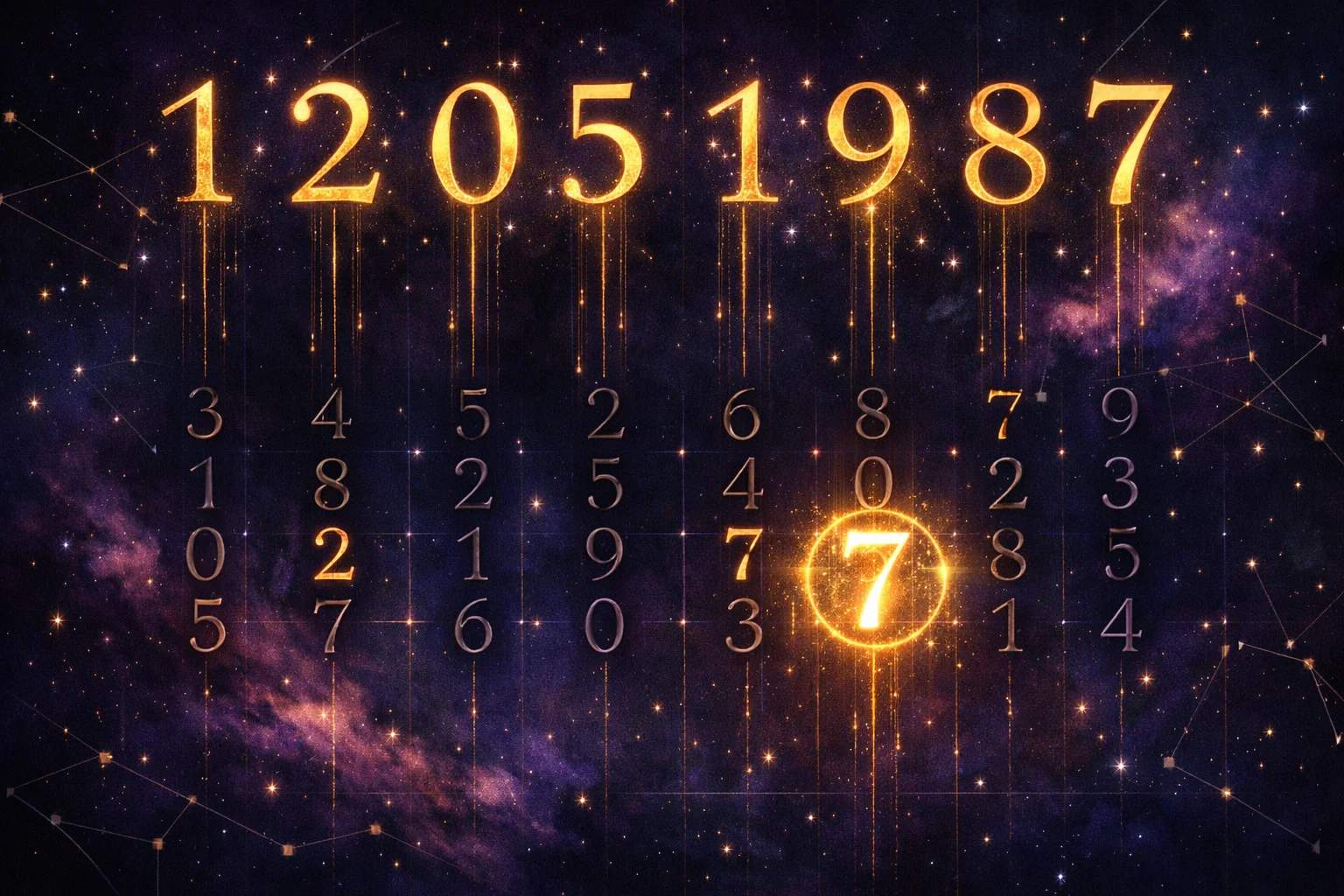
What follows is the reasoning behind the calculator above, including the arithmetic problem that makes most versions of this tool useless, and the part of your result almost nobody reports: the digits your birth date does not contain at all.
So What Is My Angel Number?
It is the digit your birth date over-carries. Take 17 March 1994. Written out as an eight-digit string it reads 19940317, which contains two 9s, two 1s, one each of 3, 4, 7 and 0, and no 2, 5, 6 or 8. Two 9s against an average of 1.08 is a surplus of 0.92. Two 1s against an average of 1.77 is a surplus of only 0.23. So the 9 wins and the sequence is 999, even though both digits appear the same number of times.
That comparison — against an average rather than against the other digits — is the whole method. It is also why this page can tell two people born in the same year apart, which a straight digit count cannot reliably do.
Four in Five People Get the Same Two Answers
Here is the problem nobody building these tools seems to check. Birth dates are not random digit strings. Every year in living memory begins with 19 or 20, which means the digits 1, 9, 0 and 2 are structurally guaranteed a head start that 4, 6, 7 and 8 never get. Run the numbers across all 36,525 real dates between 1930 and 2029 and the gap is not subtle.
| Digit | Appearances per birth date | Raw-count method | Corrected method |
|---|---|---|---|
| 1 | 1.77 | 36.5% | 16.4% |
| 0 | 1.72 | 45.0% | 14.2% |
| 2 | 1.09 | 8.8% | 15.1% |
| 9 | 1.08 | 4.7% | 15.4% |
| 3 | 0.43 | 1.0% | 5.3% |
| 4 | 0.38 | 0.8% | 9.2% |
| 8 | 0.38 | 0.8% | 4.4% |
Read the third column again. A calculator that simply picks your most frequent digit hands 81.5% of everyone either 000 or 111, and tells fewer than one person in a hundred that their number is 444 or 888. It also produces a tie on 42% of dates, which those tools resolve silently and arbitrarily. Correcting for the baseline drops ties below 4% and spreads the ten results across a 4.4% to 16.4% band. Still uneven — but the unevenness now reflects the calendar rather than a bug.
Counting Beats Adding When the Answer Is a Sequence
There is a second, quieter problem with the usual approach, and it is a content problem rather than a maths one. Digit-sum reduction produces a number between 1 and 9, or occasionally 11, 22 or 33. That is a Life Path number — a real and useful thing, calculated the same way for the last century, and already available a click away. Relabelling it as an angel number does not make it one. The one genuinely different question you can ask of a digit sum is which total it passed through on the way down, and that is what a karmic debt number calculator for 13, 14, 16 and 19 reads — the route rather than the destination, which is also why it is the only numerology result that changes when you change the reduction method. There is one other honest use for the same sum: swap the birth year for the current one and it becomes a personal year number — the only figure in numerology that expires, climbing by one each January and resetting to 1 every ninth year. That is a cycle position rather than a sign you were shown, which is why it lives on its own page and not on this one.
Angel numbers are repeating sequences. That is the entire folk tradition: 111 on a receipt, 444 on a clock, 1212 on a phone screen. So the output of an angel number calculator ought to be a sequence, and the input that produces it ought to be something sequence-shaped. Frequency is sequence-shaped. A sum is not. Counting how many times a digit repeats inside your date is, structurally, the same gesture as noticing a digit repeat on a number plate — which is a defensible reason to build the tool this way, and the reason it returns 999 rather than 9.
There is one place that logic stops working, and it is a clock. A time is not a free sequence: minutes cap at 59 and hours at 23, so 999 is impossible as a time and always will be. Clock sightings run on a separate rule set with its own classes and its own angel attributions, which the mirror hour calculator handles for any time of day. If your sequence only ever turns up on a screen showing the time, that is the tool for it — not this one.
Worth being straight about the epistemics here: this is a constructed correspondence, not doctrine. Nobody in the Pythagorean tradition that gave us these letter values was counting digit frequencies in Gregorian dates. What the method has going for it is that it is transparent, reproducible, and testable against your own birth date in about fifteen seconds — three things the average angel number tool cannot claim. The broader history of assigning meaning to numbers is well covered in Britannica's entry on number symbolism, which is a useful corrective to anyone selling certainty.
But What About the Number I Keep Seeing?
That one is still yours. It just answers a different question, and the two are not in competition. The sequence following you around this month is situational — it arrives, it means something about now, and it fades when the situation resolves. If that is what brought you here, the angel number meanings lookup is the tool you actually want, because it takes the number as the input.
The birth sequence is the other axis: fixed, unchanging, and descriptive of what you natively run on rather than what is being said to you. Think of it as the receiver rather than the message.
The genuinely interesting case is when the two collide. If your birth date carries 4 and you keep seeing 444, you are being told something you already know how to do, which usually reads as reassurance. If your date has no 4 in it anywhere and 444 starts turning up, that is the more disruptive version — a request to build something you have no native equipment for. Same number, opposite weight, and no lookup table can tell you which you are in without knowing your date.
Your Missing Numbers Do More Work Than Your Present Ones
Eight digits cannot hold ten values. That is not a limitation of the method, it is arithmetic: every person alive is missing at least two of the ten digits, and most are missing four or five. Here is the actual spread.
- Two missing — 1% of dates. Requires eight distinct digits, so no repeats at all.
- Three missing — 10.9%.
- Four or five missing — 68.5% combined. The ordinary case.
- Six or more missing — 19.6%, and it takes a date like 20000801 to get there.
Classical numerology already has a name for this gap when it appears in a name chart: the karmic lesson, meaning a quality you were not issued and therefore have to construct deliberately. Applied to a birth date it explains something the meaning pages cannot, which is why the same sequence lands so differently on different people. A person whose date is stuffed with 6s experiences 666 as background noise. A person with no 6 anywhere experiences it as an instruction.
If you want one practical thing from this page, take that. Look at your missing digits, not your winning one. The winning digit describes what you already do without being asked. The missing ones are where the work is.
Check How Rare Your Sequence Actually Is
The calculator reports a rarity figure with every result, and it is a real percentage rather than a flourish — the exact share of the 36,525 dates in the window that return that sequence. 111 is the most common at 16.4%. 888 is the rarest at 4.4%, because the digit 8 has almost nowhere to enter from: the last two positions of your year, an August birth, or the 8th, 18th or 28th of a month. That is it.
This matters more than it looks. A tool that tells everyone their number is special is not telling anyone anything, and the rarity figure is the honesty check on the rest of the result. If you land on 111 alongside one in six of the population, that is worth knowing before you read too much into it. If you land on 888, the scarcity is genuine and it is structural.
One more figure worth having: roughly 14% of birth dates literally contain a known angel sequence when written out in one of the three common orderings. Somebody born on 11 November 1993 carries 1111 in plain sight. Somebody born on 1 October 1991 carries 911 in the middle of theirs, and would probably never have looked. The calculator checks all three orderings and reports a clean miss as a clean miss, because the alternative is inventing a hit, and 86% of the time there isn't one.
Where This Method Stops Being Useful
Three situations where I would put this tool down and use something else.
When you want a message rather than a description. The birth sequence does not update, so it has nothing to say about your week. Sighting-based angel numbers and a single-card tarot pull are both better suited to a live question, because both are designed to change their answer.
When your date sits at an extreme. A date like 20000801 has five 0s and a surplus so large that the result is arithmetically correct and interpretively thin — you are being told about the shape of the year 2000 as much as about yourself. Dates around the turn of a century and dates in the first nine days of a month both skew this way. Read the name sequence alongside it if you fall into that group.
When you are looking for prediction. Nothing here forecasts events. The census describes a disposition, in the same register as a personality framework, and the honest ceiling on that is self-recognition rather than foresight. If a number shows up in your reading and you feel nothing, the correct response is to ignore it. That instruction is not a disclaimer — it is how the whole practice is supposed to work.