Birth Chart Calculator: How to Read the Blueprint of Your Life Written in the Stars
A birth chart calculatortranslates the exact positions of the Sun, Moon, and planets at the moment you were born into a circular map that astrologers call a natal chart. That map is divided into 12 zodiac signs and 12 houses, and it reveals far more about your personality, relationships, and life path than your Sun sign alone ever could. Below, you'll learn what every section of your chart means, how the math works behind the scenes, and how to start reading your own results right now.
What Is a Birth Chart?
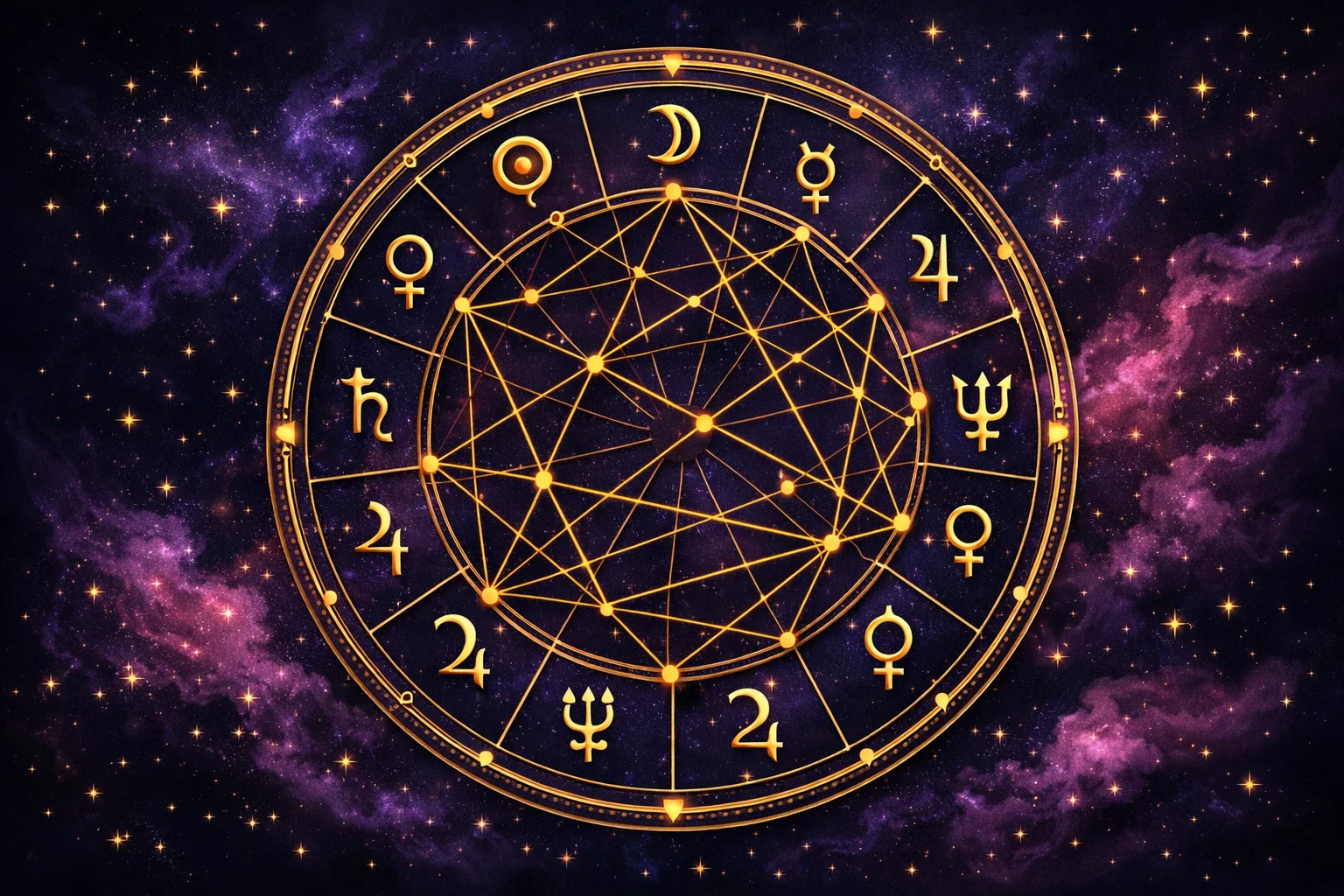
A birth chart — also called a natal chart or astrology chart — is a 360-degree snapshot of the sky viewed from your birth location at the exact moment you took your first breath. Imagine standing where you were born and looking up: the planets, Sun, and Moon each sit in a specific zodiac sign and occupy a particular slice of the sky called a house.
Western astrology uses the tropical zodiac, which anchors the start of Aries to the March equinox rather than to the physical constellations. The chart is then divided into 12 equal or unequal houses (depending on the house system) that begin at the eastern horizon — your Ascendant — and rotate counter-clockwise. Every chart is unique because the fast-moving Moon changes signs roughly every 2.5 days and the Ascendant shifts about 1 degree every 4 minutes.
How a Natal Chart Is Calculated
Behind every free birth chartgenerator is a sequence of astronomical calculations. First, the calculator converts your birth date and time into a Julian Day Number — a continuous count of days used by astronomers since 4713 BCE. Next, it computes each planet's ecliptic longitude at that Julian Day using orbital elements: mean anomaly, equation of center, and corrections for orbital eccentricity.
Your geographic coordinates then determine the Local Sidereal Time (LST), which is the right ascension on the meridian at your location. LST feeds into the Ascendant formula, which uses your latitude and the obliquity of the ecliptic (about 23.44°) to find the degree of the zodiac rising on the eastern horizon. The Midheaven (MC) is calculated similarly using LST and the ecliptic obliquity, marking the highest point of the ecliptic in your chart — the 10th house cusp associated with career and public image.
The Big Three: Sun, Moon & Rising
If you only remember three placements from your entire natal chart, make them the Big Three. Your Sun sign describes your core identity — the conscious self you grow into over a lifetime. Your Moon sign governs your emotional inner world, instinctive reactions, and what you need to feel safe. Your Rising sign (Ascendant) is the zodiac sign that was climbing over the eastern horizon at birth, and it colors your physical appearance, personal style, and the first impression you make on others.
Most horoscope columns only reference your Sun sign, which is why they feel vague to so many people. Once you add the Moon and Rising signs, your astrological profile becomes roughly 3 times more specific. Try our Sun Moon Rising Calculator if you only need these three placements quickly.
What Each Planet Means in Your Chart
Beyond the Big Three, your natal chart includes 7 more celestial bodies, each governing a different dimension of your life. Here's a quick reference:
| Planet | Governs | Orbit |
|---|---|---|
| ☉ Sun | Core identity, ego, vitality | 1 year |
| ☽ Moon | Emotions, instincts, habits | 27.3 days |
| ☿ Mercury | Communication, thinking, learning | 88 days |
| ♀ Venus | Love, beauty, values, money | 225 days |
| ♂ Mars | Drive, ambition, anger, sex | 687 days |
| ♃ Jupiter | Growth, luck, wisdom, travel | 11.9 years |
| ♄ Saturn | Discipline, limits, karma, time | 29.5 years |
| ♅ Uranus | Innovation, rebellion, sudden change | 84 years |
| ♆ Neptune | Intuition, dreams, illusion | 165 years |
| ⯓ Pluto | Transformation, power, rebirth | 248 years |
The inner planets (Sun through Mars) change signs frequently and shape day-to-day personality. The outer planets (Jupiter through Pluto) move slowly and define generational themes — everyone born in the same 1-3 year window shares the same Jupiter sign, for example. The sign a planet occupies tells you how that energy expresses, while the house tells you where in your life it shows up most.
The 12 Houses Explained
Houses are the 12 sections of your chart that map to specific life domains. The 1st house begins at the Ascendant (eastern horizon) and the houses proceed counter-clockwise. While the signs describe personality traits and energy styles, the houses answer the question “in which area of life?”
The angular houses (1st, 4th, 7th, 10th) carry the most weight — planets here dominate your chart. The succedent houses (2nd, 5th, 8th, 11th) relate to resources and stability. The cadent houses (3rd, 6th, 9th, 12th) are about learning, adapting, and serving. If your chart has multiple planets clustered in one house, that life area receives amplified focus and complexity.

Elements and Modalities
Each zodiac sign belongs to one of four elements and one of three modalities. Your chart's element balance reveals your temperament: heavy Fire placements produce passionate, action-oriented people; Earth dominance signals practical, grounded types; Air emphasis creates communicative, intellectual personalities; Water dominance fosters emotionally deep, intuitive individuals.
Modalities describe your approach to change. Cardinal signs (Aries, Cancer, Libra, Capricorn) are initiators who start things. Fixed signs (Taurus, Leo, Scorpio, Aquarius) are stabilizers who sustain effort. Mutable signs (Gemini, Virgo, Sagittarius, Pisces) are adapters who thrive in flux. A balanced chart has a mix; a heavy imbalance in one modality shapes your core operating style.
How to Read Your Birth Chart Step by Step
Reading a natal chart can feel overwhelming with 10 planets, 12 signs, and 12 houses all interacting. Here is a practical 5-step approach:
- Start with the Big Three. Note your Sun sign (identity), Moon sign (emotions), and Rising sign (outward persona). These three placements define roughly 60% of your astrological profile.
- Check your chart ruler. The planet that rules your Rising sign is your chart ruler — its sign and house placement carries extra weight. For example, if you have a Scorpio Rising, Pluto is your chart ruler.
- Look for stelliums. Three or more planets in a single sign or house create a stellium — a concentrated area of focus that dominates your life themes.
- Read Mercury, Venus, and Mars. Mercury shows how you think and communicate, Venus reveals your love language and aesthetic taste, and Mars drives your ambition and conflict style.
- Review the outer planets. Jupiter and Saturn show where you find growth and face challenges. Uranus, Neptune, and Pluto describe generational and transformative themes.
Curious about how the Moon shapes your emotional landscape? Dive deeper with the Moon Sign Calculator for a focused breakdown of your lunar placement.
Common Birth Chart Misconceptions
Myth: Your birth chart predicts your future. A natal chart describes tendencies, strengths, and challenges — not fixed events. Think of it as a weather forecast for your personality, not a script you must follow.
Myth: Only your Sun sign matters. Sun sign horoscopes became popular in the 1930s as a newspaper shortcut. A full natal chart uses 10+ placements and is dramatically more accurate than any single sign.
Myth: Astrology and astronomy are the same thing. Astronomy is a natural science studying celestial objects. Astrology is an interpretive system that finds meaning in planetary positions. Both use the same math, but the conclusions differ.
Myth: You need a professional to read your chart. While professional astrologers offer nuanced synthesis, anyone can learn to read the basics. Start with your Big Three and add one planet at a time.
Birth Chart vs. Daily Horoscope
Your birth chart is a fixed map — it never changes after your moment of birth. A daily horoscope, by contrast, compares the current planetary positions (called transits) against a generic Sun sign template. When Jupiter transits your natal Venus, for example, you might experience a burst of luck in love or finances. But a generic horoscope can only hint at this, because it doesn't know where Venus sits in your unique chart.
That's why two people with the same Sun sign can have radically different weeks — their Moon, Rising, and house placements redirect the same planetary transit into entirely different life areas. Once you know your full birth chart, you can look up specific transits for each of your placements, which is far more useful than a one-size-fits-all column.
When to Use a Birth Chart Calculator
A natal chart calculator is most useful at these specific moments:
- Starting your astrology journey — generate your chart to learn your Big Three and discover which elements dominate your personality.
- Before a major life decision — review your 10th house (career), 7th house (partnerships), or 4th house (home) to understand your natal tendencies in that area.
- When exploring compatibility — compare your chart with a partner's to see where your planets align or clash. Explore our Zodiac Compatibility section for sign-pairing guides.
- During Saturn Return (ages 27-30) — Saturn returns to its natal position roughly every 29.5 years, triggering a major life restructuring. Knowing Saturn's sign and house in your chart helps you understand the lesson.