
Three Lists Claim to Know Your Birthstone. One Was Written by a Jewelers' Trade Group in 1912.
A birthstone calculator has an easy job in April and a genuinely hard one in October. April is diamond on every list ever published. October is opal on the traditional list, tourmaline on the modern one, and — if you were born after the 23rd, when the sun crosses into Scorpio — aquamarine on the astrological list that predates both. Same person, same birthday, three defensible answers. That isn't a flaw in the lists. It's what happens when three traditions written centuries apart, for completely unrelated reasons, all end up labelled "birthstones" in the same display case.
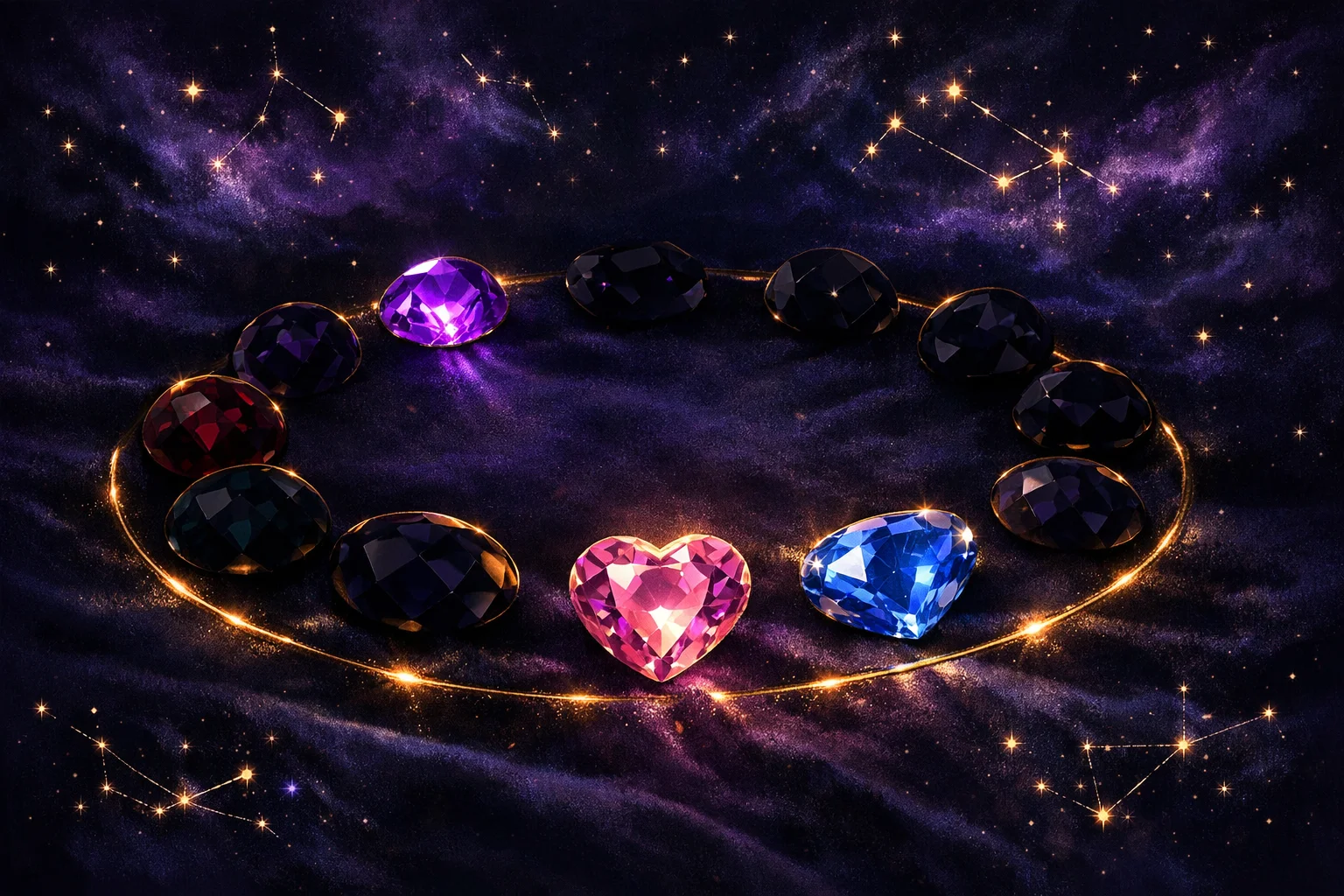
Most tools online pick one list, hide the other two, and hand you a single stone. The calculator above does the opposite: it shows all three, tells you where they diverge, and — because this part actually matters when you spend money — tells you which of your three can survive being worn on a hand.
Three Lists, One Birthday, Half a Year of Disagreement
Line the modern and traditional month lists up next to each other and the result is oddly clean: they agree for exactly six months and part ways for the other six. January, February, April, May, July and September have not moved in centuries. Everything else has.
Of those six changes, only two are true substitutions — a stone removed and a different one put in its place. March lost bloodstone and gained aquamarine. August lost sardonyx and gained peridot. The remaining four months kept their original stone and simply collected company: alexandrite joined June, tourmaline joined October, citrine joined November, and December picked up zircon and later tanzanite while quietly dropping lapis lazuli.
| Month | Modern (1912+) | Traditional | Status |
|---|---|---|---|
| January | Garnet | Garnet | Unchanged |
| February | Amethyst | Amethyst | Unchanged |
| March | Aquamarine + Bloodstone | Bloodstone | Substituted |
| April | Diamond | Diamond | Unchanged |
| May | Emerald | Emerald | Unchanged |
| June | Pearl + Moonstone, Alexandrite | Pearl + Moonstone | Expanded |
| July | Ruby | Ruby | Unchanged |
| August | Peridot + Spinel, Sardonyx | Sardonyx | Substituted |
| September | Sapphire | Sapphire | Unchanged |
| October | Opal + Tourmaline | Opal | Expanded |
| November | Topaz + Citrine | Topaz | Expanded |
| December | Turquoise + Zircon, Tanzanite | Turquoise + Lapis Lazuli | Expanded |
Now add the third list — the zodiac stones — and the picture gets sharper still. Run all three across the whole calendar and there are only three windows in the year where every tradition names the same stone: January 20 to 31 (garnet), February 19 to the end of the month (amethyst), and December 1 to 21 (turquoise). Everyone else gets a split decision. And August is the only complete month in which all three lists disagree on every single day of it — peridot by the modern list, sardonyx by the traditional one, and onyx or carnelian depending on whether you land in Leo or Virgo.
How a Jewelers' Convention Rewrote March and August
The modern list has a date and an author. In 1912 the National Association of Jewelers, meeting in Kansas City, adopted a standard set of month stones for the American trade. That's the entire pedigree. It wasn't handed down, uncovered in a temple, or derived from anything astronomical — it was a trade body agreeing on what its members would stock and market.
Knowing that explains the two substitutions perfectly. Bloodstone and sardonyx are both opaque chalcedonies. You cannot facet them, they don't sparkle under a shop light, and by 1912 the American jewelry counter was built entirely around faceted transparent stones. Aquamarine, meanwhile, was arriving from Brazil in large clean crystals and cut beautifully; peridot was transparent, cheap and already in supply. Two opaque stones out, two faceted stones in. The commercial logic is visible from a mile off.
The list has been edited three times since, and each edit tells the same story. The Jewelry Industry Council added alexandrite, citrine, tourmaline and zircon in 1952 — mostly cheaper or more durable alternatives for months whose original stone was awkward to sell. The American Gem Trade Association added tanzanite in 2002, thirty-five years after the stone was found in Tanzania and at exactly the moment the industry needed a marketing story for it. In 2016 the AGTA and Jewelers of America added spinel to August. You can read the whole chain of amendments on the documented history of the birthstone lists, and once you have, the word "traditional" on a modern jewelry tag looks a little different.
None of this makes the modern list illegitimate. It's the list your jeweler stocks, the one your grandmother's ring was probably chosen from, and a hundred and fourteen years of continuous use is its own kind of tradition. It just isn't ancient, and anyone telling you your April diamond descends from antiquity is selling something.
Your Zodiac Stone Is Not Your Month Stone Renamed
Here's the thing that trips almost everyone up. Put the zodiac list beside the month list and the first three signs of the calendar year line up exactly one slot back: Aquarius takes garnet, which is January's stone; Pisces takes amethyst, February's; Aries takes bloodstone, March's traditional stone. Three for three. It looks like the zodiac list is simply the month list shifted to account for signs starting around the 20th.
Then it collapses completely. Taurus gets sapphire — September's stone. Gemini gets agate, which appears on no month list at all. Cancer gets emerald, which belongs to May. Leo gets onyx, Virgo carnelian, Libra peridot, Capricorn ruby. From April onward there is no pattern whatsoever.
That opening coincidence isn't random, though. Both traditions descend in part from the same twelve stones — the breastplate stones of Exodus, which the first-century historian Josephus explicitly tied to the twelve signs of the zodiac. A later medieval reading re-tied the same twelve stones to the twelve months instead. Same source material, two different orderings, and only the head of the sequence survived both journeys intact. If your birthday falls in the last ten days of a month, the practical consequence is that your two stones will almost always differ, and you should check the exact zodiac sign dates for your birth year before you assume which sign the sun was actually in.
| Sign | Dates | Zodiac Stone | Why That Stone |
|---|---|---|---|
| ♈ Aries | Mar 21 – Apr 19 | Bloodstone | Mars rules Aries, and the red iron flecks tied the stone to Mars in Roman gem lore. |
| ♉ Taurus | Apr 20 – May 20 | Sapphire | A fixed earth sign got the most durable blue the ancient world could cut — permanence over sparkle. |
| ♊ Gemini | May 21 – Jun 20 | Agate | Banded, two-toned, visibly two things at once. The choice for the twins is almost literal. |
| ♋ Cancer | Jun 21 – Jul 22 | Emerald | Green for growth and the tended home — the Moon's sign takes the garden stone. |
| ♌ Leo | Jul 23 – Aug 22 | Onyx | The only black stone on the list, given to the only sign ruled by the sun. Contrast rather than echo. |
| ♍ Virgo | Aug 23 – Sep 22 | Carnelian | Mercury's sign takes the chalcedony that Roman scribes cut into signet seals, because hot wax will not stick to it. |
| ♎ Libra | Sep 23 – Oct 22 | Peridot | The one stone on the list that sits exactly between warm and cool — a yellow-green balanced on the line. |
| ♏ Scorpio | Oct 23 – Nov 21 | Aquamarine | A beryl tied to deep water. Scorpio is a water sign, however little the scorpion imagery suggests it. |
| ♐ Sagittarius | Nov 22 – Dec 21 | Turquoise | The traveller's amulet in Persia, Egypt and the American Southwest alike — handed to the sign of the journey. |
| ♑ Capricorn | Dec 22 – Jan 19 | Ruby | Saturn's sign takes the hardest red there is. Endurance, not brilliance, is the point. |
| ♒ Aquarius | Jan 20 – Feb 18 | Garnet | The stone ancient travellers carried as a lamp in the dark, given to the sign that looks furthest ahead. |
| ♓ Pisces | Feb 19 – Mar 20 | Amethyst | Clarity against intoxication — the boundary between vision and delusion is the classic Pisces problem. |
So Which One Is Actually Yours?
All of them, and the older practice makes that explicit. Before the single-stone convention took hold, the documented custom in Poland and parts of Germany was to own the full set of twelve and wear whichever stone ruled the current month — not the month you were born in. The one-stone-for-life idea is a retail simplification, roughly as old as printed catalogues.
If you do want to pick one, here's a framework that beats guessing. Choose the modern stone when you're buying from a jeweler and want easy availability, repairs and matching pieces later. Choose the traditional stone when you want the older lineage or when you simply prefer the look — bloodstone and sardonyx are far more interesting objects than their replacements, even if they don't sparkle. Choose the zodiac stone when the astrology is the point, when your birthday sits near a sign change and the sign feels more true to you than the calendar month, or when the month stone happens to be one you can't stand.
One more filter that matters more than any of the above: buy the stone you can actually wear. If your month stone is opal or pearl and you want a ring you never take off, the tradition will survive you choosing something else. That's not heresy — the modern list was itself created by swapping stones for practical reasons, and 1952 added tourmaline to October for exactly this problem.
Check the Mohs Number Before You Check the Price
There's one number nobody looks at when buying a birthstone and it predicts more about your experience than the price tag does. The Mohs scale of mineral hardness rates scratch resistance from 1 to 10, and the number that matters is 7 — because ordinary airborne dust contains quartz, and quartz is hardness 7. Anything softer than that is being very slowly sandblasted every day you wear it. That's why a five-year-old opal ring looks tired and a five-year-old sapphire ring looks new.
| Stone | Mohs | Ring you wear daily? |
|---|---|---|
| Diamond | 10 | Daily-wear safe |
| Ruby | 9 | Daily-wear safe |
| Sapphire | 9 | Daily-wear safe |
| Alexandrite | 8.5 | Daily-wear safe |
| Spinel | 8 | Daily-wear safe |
| Topaz | 8 | Wear with care |
| Aquamarine | 7.5 – 8 | Daily-wear safe |
| Emerald | 7.5 – 8 | Not for daily rings |
| Tourmaline | 7 – 7.5 | Daily-wear safe |
| Amethyst | 7 | Daily-wear safe |
| Citrine | 7 | Daily-wear safe |
| Garnet | 6.5 – 7.5 | Daily-wear safe |
| Peridot | 6.5 – 7 | Wear with care |
| Zircon | 6 – 7.5 | Wear with care |
| Moonstone | 6 – 6.5 | Wear with care |
| Tanzanite | 6 – 7 | Not for daily rings |
| Opal | 5.5 – 6.5 | Not for daily rings |
| Turquoise | 5 – 6 | Not for daily rings |
| Pearl | 2.5 – 4.5 | Not for daily rings |
Notice the two stones in that table that sit high on hardness and still fail the everyday test. Topaz is an 8 — harder than aquamarine — and it has perfect basal cleavage, meaning a knock in one particular direction splits it along a flat plane like a deck of cards. Emerald is 7.5 to 8 and is nonetheless the most-repaired colored stone on any bench, because the fractures that give it its jardin also give it a fault line. Hardness resists scratching. Toughness resists breaking. They are different properties and the industry uses both words carefully, even though shop copy tends to blur them.
Four Ways People Buy the Wrong Stone
These come up constantly, and each one costs real money.
Buying "alexandrite" for under fifty dollars a carat. Natural color-change chrysoberyl is among the most expensive gems on earth — fine material outprices diamond per carat. Practically every affordable June piece described as alexandrite is either lab-grown chrysoberyl or, far more often, synthetic color-change sapphire that shifts grey-blue to purple rather than green to red. Lab-grown is a perfectly honest product; the problem is that it's frequently not disclosed.
Assuming November topaz means blue topaz. November's stone is golden imperial topaz. The blue topaz filling most November displays is colorless material that's been irradiated and heated — a stable, legitimate treatment, but a different stone from the one the list intends, and worth a fraction as much.
Putting a pearl or an opal in an engagement ring. Pearl is Mohs 2.5 to 4.5 and made of layered nacre that wears through rather than scratching; opal holds up to a fifth of its weight in water and can craze from a temperature change alone. Both are beautiful and both are wrong for a ring worn through washing up, gym sessions and car doors. June and October both have durable alternates precisely because the trade kept having this conversation.
Cleaning the wrong stone in an ultrasonic. Emerald is oiled, and ultrasonic cleaning strips the oil and makes every fracture leap into view. Tanzanite cracks from thermal shock. Turquoise and lapis are porous and drink the solution. If you own one of those four, the correct cleaning method is a soft cloth and lukewarm soapy water, and nothing else. If date-based systems interest you beyond gemstones, the same birth date also produces your numerology Life Path number, and the Chinese zodiac calculator runs into a boundary problem of its own — the animal year starts at the Lunar New Year, not January 1, which catches out anyone born in the first six weeks of the year.