Vedic Birth Chart: How Jyotish Astrology Differs from Western and Why It Matters
Run your birth details through a Vedic birth chart calculator and there's roughly a four-in-five chance your Sun lands one sign earlier than the one you've read horoscopes for your whole life. That's not an error. It's the single most important thing to understand about Jyotish — the astrology of India — before you look at your Kundali: it measures the sky against the fixed stars, not against the seasons. Everything else that makes a Vedic chart different flows from that one choice.
Two Zodiacs, One Sky: Why Your Signs Move
Western astrology uses the tropical zodiac, which pins 0° Aries to the March equinox. Jyotish uses the sidereal zodiac, which pins the signs to the actual constellations. Around 2,000 years ago the two systems agreed. But Earth's axis wobbles like a slowing top — a cycle called axial precession that takes about 25,800 years — so the equinox point has slowly slid backward through the constellations. The accumulated gap is called the ayanamsa, and by the Lahiri standard (the one adopted by the Indian government in 1955, and the one this free Kundali calculator uses) it now sits at just over 24 degrees.
Subtract 24 degrees from every planet in a Western chart and you have, in essence, a Vedic one. That subtraction is a rigid rotation, which is why it leaves every aspect in your chart exactly where it was and still moves about a third of your whole-sign house placements — the sidereal birth chart calculator measures that on your own data and puts the tropical, sidereal and real-constellation positions side by side. But the conversion is only the doorway. Once inside, the toolkit changes almost completely:
| Western (Tropical) | Vedic (Jyotish) | |
|---|---|---|
| Zodiac anchor | March equinox (seasons) | Fixed stars (constellations) |
| Sign you lead with | Sun sign | Moon sign (Rashi) |
| Bodies used | 10, including Uranus–Pluto | 9 grahas, including Rahu & Ketu |
| House system | Placidus, Koch, and others | Whole-sign (one sign = one house) |
| Timing method | Transits & progressions | Dashas (planetary periods) |
| Chart shape | Circular wheel | Square diamond (North/South Indian) |
Will My Sun Sign Change in a Vedic Chart?
Probably. With the ayanamsa at 24 of a sign's 30 degrees, only people born in roughly the last six days of a tropical sign keep it in the sidereal system — about 20% of birthdays. Take someone born on August 10. In a Western chart they're a mid-Leo. In a Vedic chart the Sun sits around 24° Karka (Cancer), because sidereal Leo doesn't begin until about August 17. Same sky, same person, different ruler for the chart.
Here's the part most articles get wrong: this doesn't mean one system is broken. The tropical zodiac tracks the Sun's relationship to Earth's seasons; the sidereal zodiac tracks its position against the stellar backdrop. They're answering different questions with the same astronomy. If you want to see your placements the Western way for a side-by-side comparison, generate your tropical birth chart and note which planets sit in the first 24 degrees of their sign — those are the ones that shift.
The Moon Runs the Show in Jyotish
Ask someone raised with Vedic astrology “what's your sign?” and they'll give you their Rashi — the sidereal sign the Moon occupied at birth — not their Sun sign. The reasoning is practical: the Moon governs the mind (manas) in Jyotish, it changes signs every 2.25 days so it's far more individual than the month-long Sun sign, and it anchors the timing system that makes Vedic astrology predictive. Daily Vedic horoscopes, muhurta (electional timing), and marriage matching all run on the Moon. If you've never pinned down your lunar placement, our moon sign calculator digs into what the Moon means emotionally; the Kundali above tells you where it sits sidereally.
Beneath the 12 signs, Jyotish divides the zodiac into 27 nakshatras — lunar mansions of 13°20′ each, every one split into four padas of 3°20′. Two people can share a Moon in Vrishabha (Taurus) yet have different nakshatras: one in Krittika, ruled by the Sun, the other in Rohini, ruled by the Moon — and traditionally they'd receive different name syllables at birth, different compatibility matches, and different dasha sequences. The nakshatra is where Vedic astrology gets its resolution; the sign is just the neighborhood.
If that one placement is what you came for, the dedicated nakshatra and pada calculator goes deeper on it than this chart can — deity, shakti, gana, yoni, nadi, your traditional name syllable, and the exact clock times the Moon entered and left your birth star. Both pages use the same Lahiri ayanamsa, so the two will always agree. And if you have two birth records rather than one, the 36-guna Kundali matching calculator runs the full Ashtakoota score plus the Mangal Dosha check off the same engine.

Reading the Diamond: North Indian Chart Basics
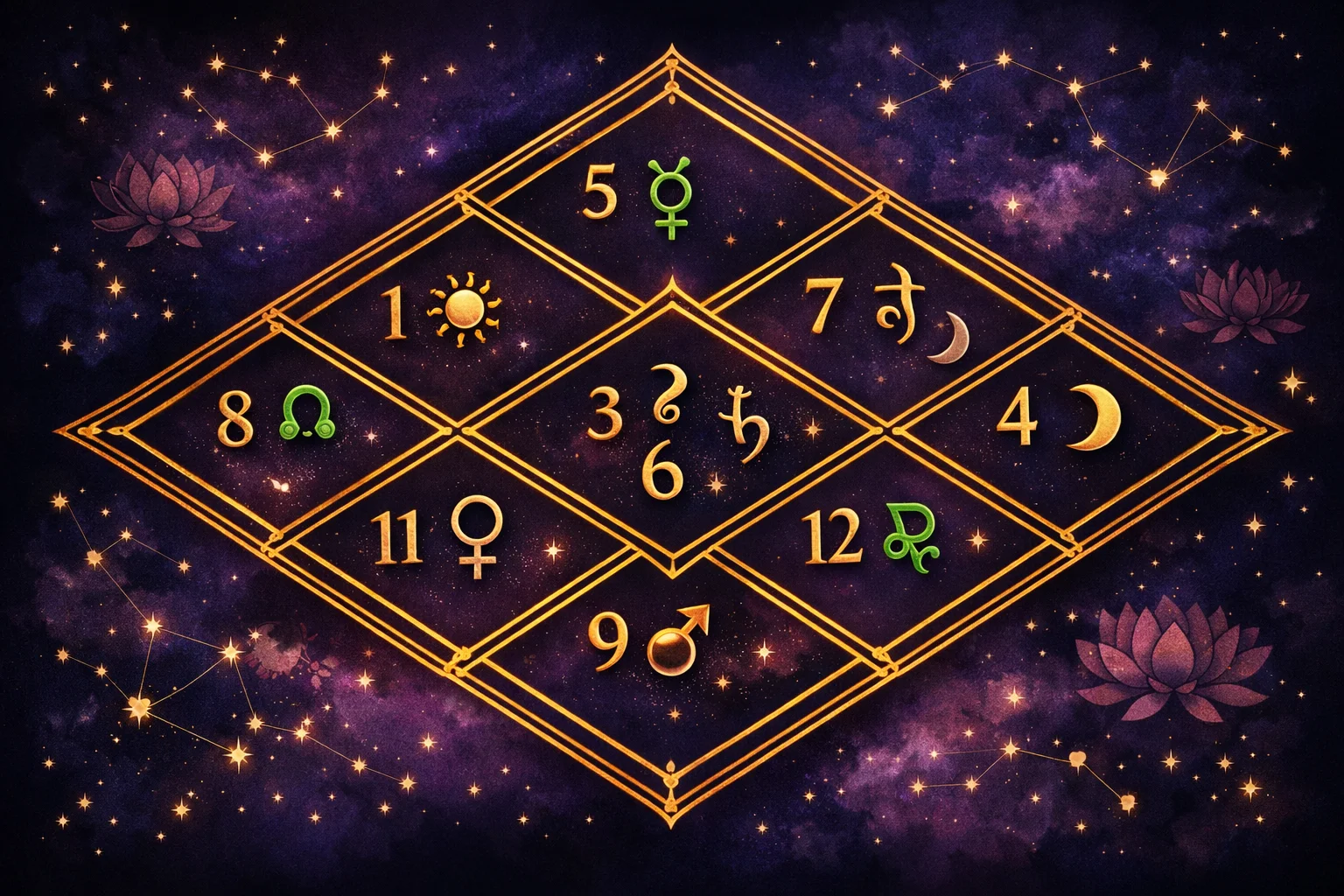
A Kundali doesn't look like the circular wheel Western readers know. In the North Indian style, the chart is a square cut into 12 cells, and the houses stay fixed: the top-center diamond is always the 1st house, holding your Lagna (ascendant). What rotates are the signs — the small number in each cell tells you which Rashi occupies that house, counted 1 through 12 from Mesha (Aries). In the South Indian style it's the reverse: signs stay fixed and the Lagna is marked with a diagonal line. Neither is more correct; it's regional convention, like writing direction.
Houses themselves work differently too. Jyotish uses whole-sign houses: whatever sign holds your Lagna becomes the entire 1st house, the next sign the entire 2nd, and so on. No unequal house cusps, no planets straddling boundaries. If your Lagna is 2° Simha or 28° Simha, all of Simha is still your 1st house. The life topics each house governs largely overlap with the Western meanings — our guide to the 12 astrology houses maps them one by one — though Jyotish adds its own emphases, like the 5th house covering past-life credit (purva punya) alongside creativity.
Vimshottari Dasha: Astrology With a Clock
The feature Western astrology simply has no equivalent for is the dasha system — a fixed 120-year schedule of planetary periods that structures your whole life. In Vimshottari, the most widely used scheme, each of the nine grahas rules a period of set length:
| Mahadasha lord | Length |
|---|---|
| Ketu | 7 years |
| Venus (Shukra) | 20 years |
| Sun (Surya) | 6 years |
| Moon (Chandra) | 10 years |
| Mars (Mangala) | 7 years |
| Rahu | 18 years |
| Jupiter (Guru) | 16 years |
| Saturn (Shani) | 19 years |
| Mercury (Budha) | 17 years |
Where the sequence starts is personal: it begins with the planet ruling your Moon's nakshatra, and the first period is shortened by how far the Moon had already traveled through it. A worked example: say your Moon sits at 20°00′ Vrishabha. That's Rohini nakshatra, which spans 10°00′ to 23°20′ and is ruled by the Moon. You're three-quarters of the way through, so you begin life with only 2.5 years left of the 10-year Moon mahadasha — then Mars for 7 years, Rahu for 18, and so on. Each mahadasha is subdivided into antardashas (sub-periods) that Jyotishis use to time events down to months. It's a bold claim — that a schedule fixed at birth describes when your career, marriage, or losses arrive — and it's precisely this predictive ambition that separates Jyotish from the more psychological style of modern Western practice.
Rahu and Ketu: The Shadow Planets
Open the Grahas tab above and you'll find two names with no physical body: Rahu and Ketu, the north and south lunar nodes — the points where the Moon's tilted orbit crosses the Sun's path. They're where eclipses happen, which is why the old myth casts them as a severed demon who swallows the Sun and Moon. Jyotish treats them as full grahas, and gives them serious weight: Rahu rules an 18-year dasha, longer than the Sun and Moon combined.
In interpretation they form an axis, always exactly 180° apart. Rahu marks where your hunger concentrates in this life — the house it occupies tends to describe an area of obsessive ambition, foreign influence, or unconventional gains. Ketu marks the opposite: what you detach from, or arrive already knowing. Western charts include the same points (usually as the “North Node” and “South Node”), but as karmic footnotes rather than planets with their own periods and dignities. In a Kundali, a badly placed Rahu can dominate the whole reading. Note that this calculator uses the mean node, the traditional Jyotish choice — the “true node” some Western sites display can differ by as much as 1.88 degrees, which is enough to change the sign on roughly one birth date in thirty-two. If that discrepancy is what brought you here, the North Node calculator computes both conventions side by side and dates every nodal return, reading the same two points the Western way.
When a Vedic Chart Isn't the Right Tool
Honestly, a Kundali isn't the answer to every astrological question. If what you want is psychological insight — why you love the way you do, how you argue, what your inner weather looks like — modern Western astrology's aspect-based reading is built for exactly that, and your tropical chart with its rising sign and outer planets will serve you better. Jyotish is at its strongest on questions of timing, life events, and compatibility, where dashas and nakshatras do work no Western technique replicates.
Two more honest caveats. First, don't mix systems mid-reading: taking your sidereal placements and interpreting them with tropical sign descriptions is the most common beginner mistake, and it produces nonsense — the sign meanings were calibrated within each system. If the underlying logic still feels shaky, work through our Vedic astrology guide for beginners first — it covers the nine grahas, all 27 nakshatras, and how a Jyotishi actually reasons, before you try to read your own Kundali. Second, if your birth time is a guess, treat the Lagna, houses, and dasha dates as provisional. The Rashi and most graha positions survive a fuzzy birth time; the ascendant doesn't. And if you were drawn here by curiosity about non-Western systems generally, the year-based Chinese zodiac makes an interesting third lens — it needs no birth time at all, which is exactly why it can't do what a Kundali does.