The 12 Astrological Houses: What Each One Rules and Why It Matters in Your Chart
The 12 houses in astrology matter more than your zodiac signs — and almost every beginner has that backwards. People obsess over whether they're a Leo or a Scorpio while ignoring the part of the chart that actually tells you where that energy lands in real life. A planet's sign is its costume. Its house is the room it walks into. Get the houses right and a vague horoscope turns into a specific, useful map of your life. If the chart's moving parts are still new to you, start with what astrology actually is and how its pieces fit together, then keep our astrology symbols guide handy for decoding the glyphs in each house.
Houses Are Where, Signs Are How
Start with the cleanest way to keep the chart's three layers straight. The planet is what — the raw drive, like Mars for aggression or Venus for love. The sign is how — the style that energy takes, like Mars in cautious Capricorn versus Mars in reckless Aries. The house is where — the department of your life it shows up in. Forget any one of those three and the reading collapses into a fortune-cookie.
Here's why that's not academic. Two people can both have Venus in Gemini, the same flirtatious, word-loving love style. But if one has it in the 5th house and the other in the 10th, their lives look nothing alike. The 5th-house version chases playful romances and creative flings. The 10th-house version marries strategically, charms the boardroom, and builds a reputation on charisma. Same planet, same sign — the house split them in two.
Why the Wheel Starts at the Ascendant
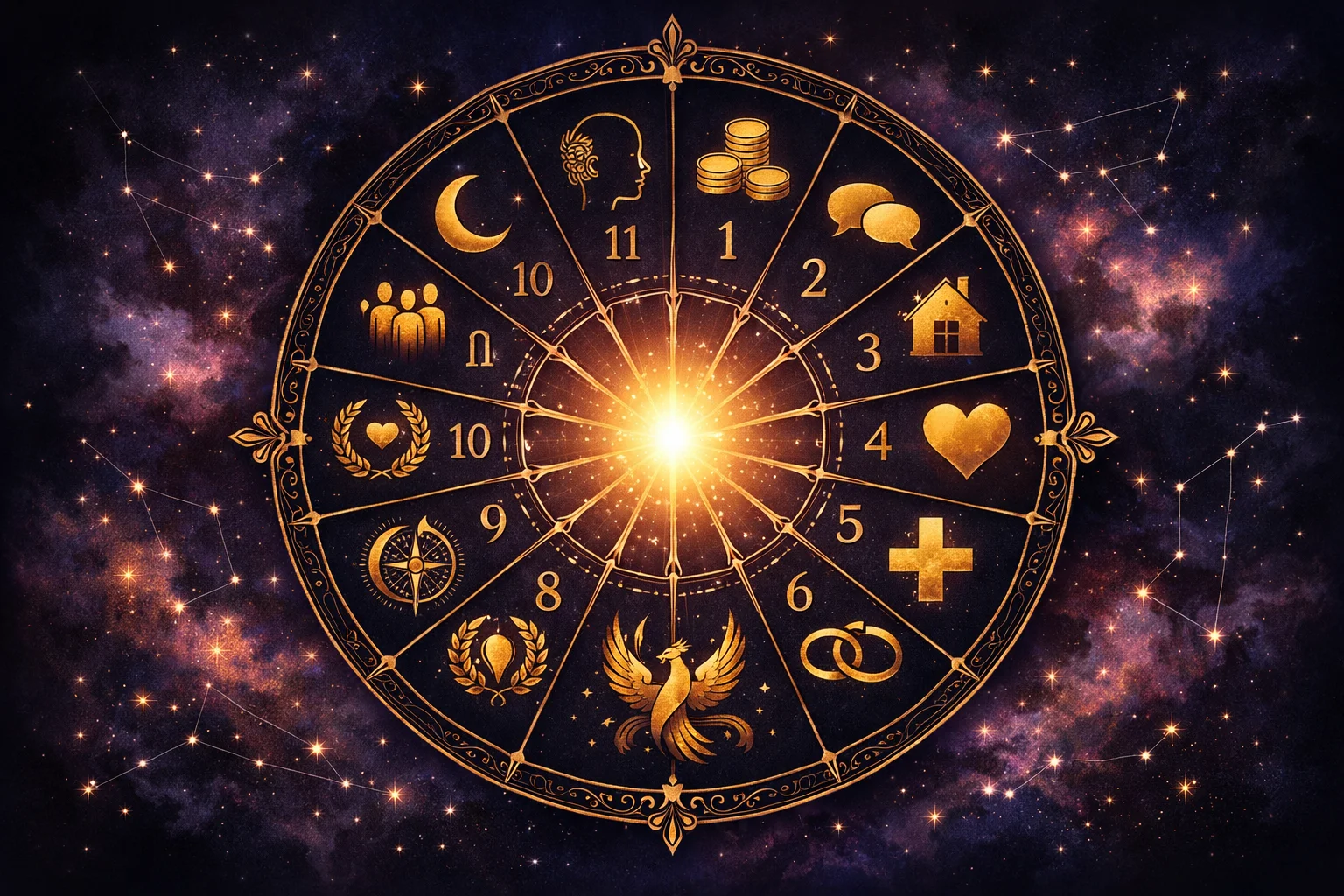
The house wheel isn't arbitrary. It starts on the left, at the 9-o'clock point, where the eastern horizon sat at your birth. That cusp is your Ascendant, or Rising sign, and it's the seed of the entire system. From there the houses run counterclockwise: the 1st below the horizon line on the left, sweeping down through the bottom of the chart and back up the right side.
The bottom of the wheel (the 4th house cusp, called the IC) was the part of the sky directly beneath you — hidden, which is exactly why it rules your roots and inner foundation. The top (the 10th cusp, the Midheaven) was the highest, most visible point, which is why it rules your public career and reputation. The geometry isn't mystical decoration; it encodes the meaning. Once you see that visible-equals-public and hidden-equals-private logic, you can almost guess a house's theme from its position.
Angular, Succedent, Cadent — The Power Tiers
This is the single most useful idea most beginner guides skip entirely. The 12 houses aren't equal in strength. Traditional astrology sorts them into three tiers, and a planet's tier tells you how loudly it operates.
| Tier | Houses | Strength | What it governs |
|---|---|---|---|
| Angular | 1, 4, 7, 10 | Loudest | Action, initiation, the cardinal points of life |
| Succedent | 2, 5, 8, 11 | Moderate | Resources, stability, what you build and hold |
| Cadent | 3, 6, 9, 12 | Subtlest | Learning, service, transition, the inner world |
Put a planet on an angle — especially the 1st or 10th — and it becomes a defining feature of your life that everyone can see. The same planet tucked into a cadent 12th house works in the background, shaping you privately. When an astrologer first opens your chart, they're scanning the angles before anything else. If you want the full picture of how angles, planets, and aspects interlock, our guide to reading a birth chart walks through it step by step.
Houses Come in Pairs: The Six Axes
Here's a layer that turns a flat list of 12 into a living system. Every house has an opposite, and the two form an axis — a single theme expressed as a tension between two poles. You can't fully understand one without the other.
- 1st–7th (Self & Other): the 1st house of self, appearance, and first impressions versus who you partner with. A loaded 7th house of marriage and partnership often means you define yourself through relationships.
- 2nd–8th (Mine & Ours): your own money and values versus the 8th house of shared resources, transformation, and intimacy.
- 3rd–9th (Local & Distant): the 3rd house of communication and everyday thinking versus higher knowledge and far travel. A loaded 9th house of travel and philosophy tilts you toward the horizon.
- 4th–10th (Private & Public): the 4th house of home, family, and roots versus your career and public face. The spine of the chart.
- 5th–11th (Me & We): the 5th house of creativity, romance, and play versus the 11th house of friendships and group goals.
- 6th–12th (Order & Surrender): the 6th house of daily routine and health versus the 12th house of retreat, dreams, and the subconscious.
Reading by axis fixes the empty-house panic. If your 7th house is empty but you have three planets in the 1st, the axis is simply tilted toward independence — you lead with self, and partnership follows your lead rather than defining you. That's information, not a missing relationship.
Every House Has a Ruler — Follow It
This technique separates people who recite house meanings from people who actually read charts. Whatever sign sits on a house's cusp, its ruling planet becomes that house's ruler — and wherever that planet lives in your chart, it carries the house's business there.
Say Capricorn is on your 2nd-house cusp of money and values. Capricorn's ruler is Saturn. Now find Saturn: if it's in your 10th house, your earning power is tied to career and long-term reputation — you make money through status and discipline, slowly but durably. The 2nd house was technically empty, yet you just got a rich, specific reading out of it by following the ruler. Do this for every empty house and the “blank” parts of your chart come alive. It's also why a single placement like your Rising sign on the 1st-house cusp ripples through the entire wheel.
Why Your Houses Change Between Websites
Ever calculated your chart twice and gotten a planet in the 9th house on one site and the 10th on another? You're not losing your mind. Astrology has competing house systems — different math for slicing the sky into 12 — and they disagree most about where the cusps fall.
| System | How it divides | Best for |
|---|---|---|
| Placidus | Unequal, time-based; the app default | Most modern Western readings; struggles at high latitudes |
| Whole Sign | Each sign = one whole house | Traditional and Hellenistic work; simple and robust |
| Equal | Exactly 30° per house from the Ascendant | A clean middle ground; keeps the Ascendant exact |
| Koch / Porphyry | Other time- and space-based math | Niche preferences; rarely the beginner's choice |
The planets' signs never change between systems — only the house framework moves. The disagreement is widest if you were born far from the equator or with a planet near a sign boundary. My honest advice for beginners: try your chart in both Placidus and Whole Sign. If a planet jumps houses, read both interpretations and trust the one that describes your life more accurately. Then commit to that system so you stop second-guessing. You can do that comparison in one pass with the planet in house calculator, which scores all ten of your placements against five systems at once and flags the ones that only agree in some of them — across 30,000 test charts, just 34% of placements landed in the same house in every system.
Stelliums, Empty Houses, and Balance
When three or more planets pile into one house, you have a stellium, and that house becomes a dominant theme of your whole life. A 4th-house stellium can make home and family the organizing force of everything you do; a 10th-house stellium often produces someone whose identity is fused with their career to the point that retirement feels like an identity crisis.
The trap with a stellium is imbalance. So much energy pours into one room that the others get neglected. If all your fire is in the 10th (career), the opposite 4th (home, rest, emotional refuge) can run on empty — and you'll feel it as burnout that no promotion fixes. The remedy isn't to fight your stellium; it's to consciously feed the houses that sit quiet, especially the one across the axis.
A Worked Reading: One Planet, Three Houses
Let's make it concrete with the Moon, the planet of emotional needs, dropped into three different houses to show how completely the house rewrites it.
- Moon in the 4th house: emotional needs are met through home, family, and privacy. This person feels safest behind their own front door, often deeply attached to a parent or their childhood roots. Moving house hits them harder than it hits most people.
- Moon in the 7th house: the same emotional needs now route through partnership. This person feels most themselves when coupled, reads a partner's moods instinctively, and can struggle with their own identity when single. Relationship, not solitude, is their comfort zone.
- Moon in the 10th house: emotions get tied to public life and achievement. This person needs to feel they matter in the world; their moods rise and fall with their career and reputation. They often have a public, nurturing role — a manager, a teacher, a familiar face.
One planet. One emotional drive. Three radically different people, decided entirely by the house. That's the whole argument for why houses deserve more of your attention than your Sun sign. To see which houses your own planets fall into, run your details through the free birth chart calculator and then come back to the wheel above to decode each placement. For a closer look at how the Moon specifically shapes your inner world, the Moon sign calculator pairs naturally with this house work.