What Is Astrology? The System Behind the Signs, in Plain English
Astrology is the practice of reading meaning into the positions of the Sun, Moon, and planets at the exact moment you were born. That's the honest one-sentence answer. But what most people picture when they ask what astrology is — the vague horoscope at the back of a magazine — is the shallowest puddle of a much deeper pool. For beginners, that's the first thing worth fixing: the daily horoscope is to astrology what a fortune cookie is to a full meal.
Astrology Is a Language, Not a Horoscope Column
Think of astrology as a symbolic language for describing human experience. The sky at your birth becomes a kind of map, and astrology is the grammar for reading it. It doesn't claim the planets beam rays down to control you. The older, saner framing is “as above, so below” — the idea that the patterns overhead mirror the patterns in a life, the way a clock face mirrors the time without causing it.
That reframe matters because it sets honest expectations. Astrology isn't a vending machine that dispenses your destiny. It's closer to a personality model with a calendar attached — a way to name the parts of yourself and notice when life tends to stir certain ones up. Once you stop expecting prophecy and start treating it as a mirror, it gets genuinely useful.
The Four Pieces Every Chart Is Built From
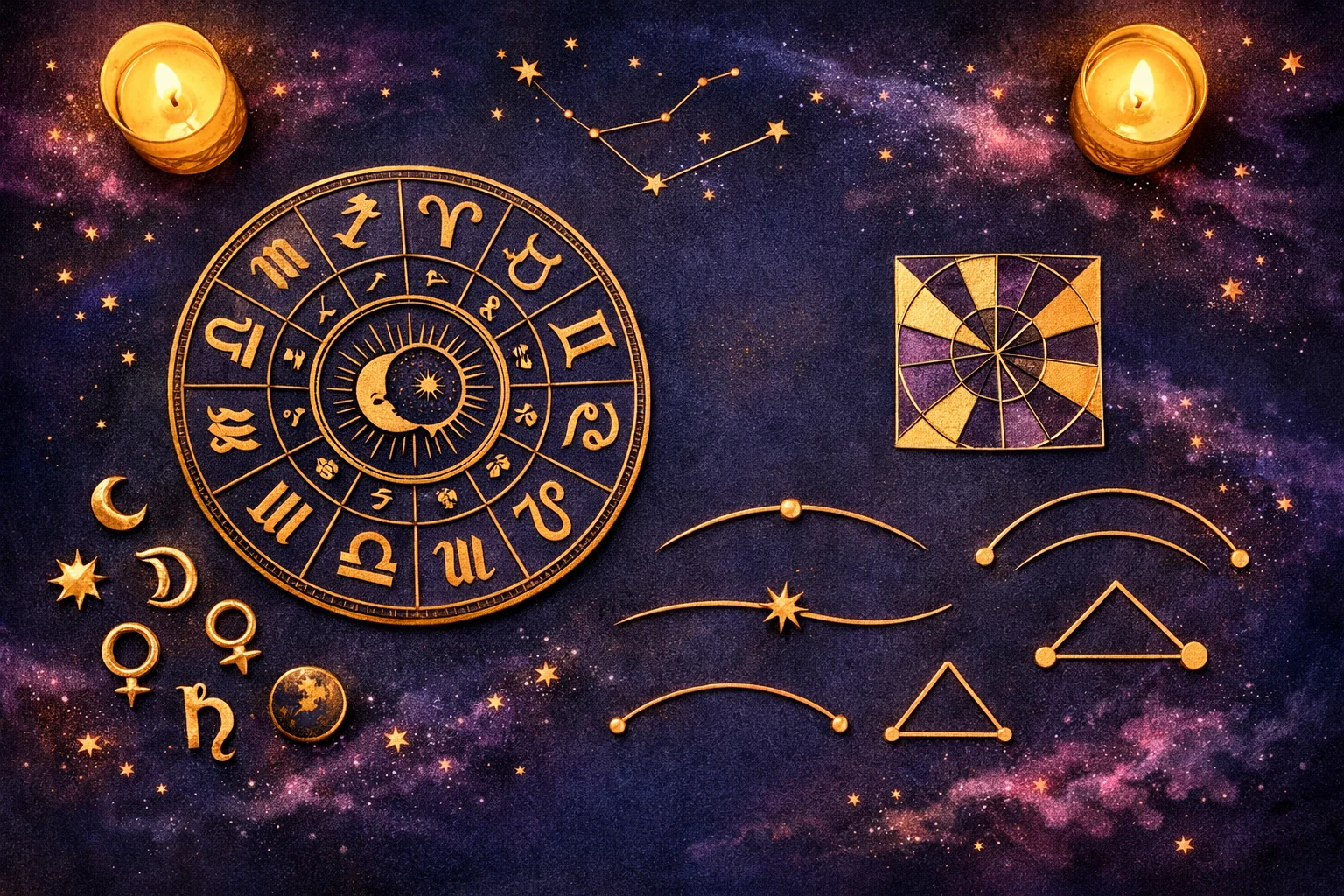
Here's the part horoscope apps skip. A real astrology reading comes from a birth chart, and every birth chart is built from the same handful of pieces. Learn these four and you understand 90% of what astrologers are doing. The cleanest way to keep them straight is to treat the chart like a sentence:
| Piece | Sentence role | What it answers | Example |
|---|---|---|---|
| Planets | The verb | Which drive? | Mars = how you pursue |
| Signs | The adjective | In what style? | Mars in Aries = fast, head-on |
| Houses | The setting | In which area of life? | 10th house = your career |
| Aspects | The conversation | Cooperating or clashing? | Mars square Saturn = friction |
Put it together and a chart says something like: “Your drive (Mars), expressed boldly (in Aries), aimed at your career (10th house), but braked by your need for security (square Saturn).” That's a real, specific read — nothing like “Aries should watch their finances today.” The interactive explorer above lets you tap through each of these pieces; the full guide to the twelve houses breaks down the “where” layer in depth, and our guide to every astrology symbol decodes the glyphs you'll see for each one.
Your Sun Sign Is One Word in a Whole Sentence
Almost everyone starts with their Sun sign, and almost everyone overrates it. Your Sun sign is just where the Sun sat in the zodiac on your birthday — your core identity, sure, but a single placement among roughly forty. It hogs the spotlight only because it's the one piece you can find from your birth date alone — and even that has edge cases. Born within a day of a sign boundary, you'll want the exact astrology sign dates for your birth year rather than a printed table.
The two placements that usually matter just as much are your Moon sign (your inner emotional world) and your Rising sign, or Ascendant (how you come across and how the whole chart is framed). Astrologers call these the “big three.” A Capricorn Sun with a Leo Rising and a Pisces Moon behaves nothing like the cautious Capricorn stereotype — the Leo makes them theatrical, the Pisces makes them soft. If a sign description has ever felt totally wrong for you, this is almost always why. You can pin down the two missing pieces with our rising sign calculator and moon sign calculator. The same layering applies when you compare two people: our guide to how astrology compatibility works shows why whole charts agree or clash in ways sun signs alone never predict.
Astrology vs. Astronomy: The Big Confusion
This trips up nearly every newcomer, so let's settle it. Astronomy is the science of what's physically out there — the mass of Jupiter, the distance to a star, the orbit of Mars. Astrology is the interpretation of where those bodies appear from Earth and what that might mean for a person. One measures the sky; the other reads it like tea leaves.
They were the same field for most of history. The Babylonian star-watchers who tracked planets for omens were doing both at once, and great names like Kepler cast horoscopes to pay the bills. The two finally divorced around the seventeenth century, when the scientific method drew a hard line between measurable prediction and symbolic meaning. So if a friend says “astrology isn't science,” they're right — and a good astrologer agrees with them. They're simply not playing the same game. For the full breakdown of where the two overlap and where they part ways, see our deep dive on astronomy vs astrology.
Does Astrology Actually Work? An Honest Answer
The honest answer is: not in the way a skeptic means, and that's fine. No controlled study has shown that birth charts predict personality or events better than chance, and astrology is correctly classified as a pseudoscience by the scientific community. If you want a tool that forecasts the future with tested accuracy, astrology isn't it, and anyone promising otherwise is selling something.
So why do millions of thoughtful people still use it? Because it works as a different kind of tool — a structured prompt for self-reflection. A chart gives you a vocabulary for parts of yourself you already sense but couldn't name, and a yearly rhythm for noticing patterns. Used that way, it sits beside journaling, the Enneagram, or a good therapist intake form: not literally true, but genuinely clarifying. The trouble only starts when someone hands their decisions over to it instead of using it to think more clearly about their own.
Where Astrology Came From — and Why It Stuck
A little history actually changes how you read a chart. Astrology grew out of ancient Mesopotamia around four thousand years ago, where priests watched the planets for signs about kings and harvests. The Greeks later personalized it, inventing the individual birth chart and the twelve houses we still use — the system you're learning is essentially Hellenistic with a few modern planets bolted on.
It stuck for two reasons. First, it was the most sophisticated model of personality and timing humans had for centuries, long before psychology existed. Second, in the twentieth century the psychologist Carl Jung gave it a second life by treating the symbols as a map of the psyche rather than literal forecasting. That's the lineage behind most modern Western astrology: ancient sky-watching, refined by the Greeks, reinterpreted as inner work. Knowing that keeps you from reading a chart too literally.
That Greek export travelled east as well as west. Around the second century CE the twelve-sign framework reached India and merged with a much older lunar tradition, producing the system covered in our Vedic astrology guide. It shares the signs and houses you're learning here, then adds 27 lunar mansions and a planetary-period clock that Western astrology never developed — which is why the same birth data can produce two very different readings.
One major tradition sits outside that family tree entirely. Chinese astrology developed on its own calendar, with no twelve signs, no houses and no planets — just paired characters counting off a 60-year cycle. Our Chinese astrology guide to the animals, elements and Four Pillars covers it, and reading it early is useful precisely because almost nothing transfers: it shows you how much of “astrology” is one culture's specific choices rather than a universal.
How to Actually Start Reading Your Chart
Don't try to swallow the whole system at once — that's how beginners burn out in a week. Here's the order that actually sticks:
- Generate your real birth chart first. You need your date, exact time, and birthplace. Eyeballing horoscope apps will only teach you the shallow version.
- Learn your big three. Sun (identity), Moon (emotions), Rising (how you show up). Sit with these for a couple of weeks before adding anything.
- Add the personal planets. Mercury, Venus, and Mars — how you think, love, and act. These flesh out the picture fast.
- Then learn the houses. Once you know your planets, seeing which life areas they fall into is what turns a list of placements into a story.
When you're ready to put it all together, our guide to reading a birth chart walks through a sample chart placement by placement. Start there, take it one layer at a time, and the wall of glyphs that looked like noise a month ago slowly turns into a portrait you can actually read.