Astrology Symbols Decoded: Every Glyph for Signs, Planets, and Aspects
Astrology symbols look like a secret alphabet the first time you open a birth chart — a ring of forty-odd glyphs that seem designed to keep you out. Here's the part nobody tells beginners: you don't memorize them one by one. Almost every planetary glyph is assembled from just three shapes, and once you can see those shapes, you're decoding the symbols instead of cramming them. The signs are even easier — they're tiny pictures of the thing they name.
The Three Shapes Hiding Inside Every Planet Glyph
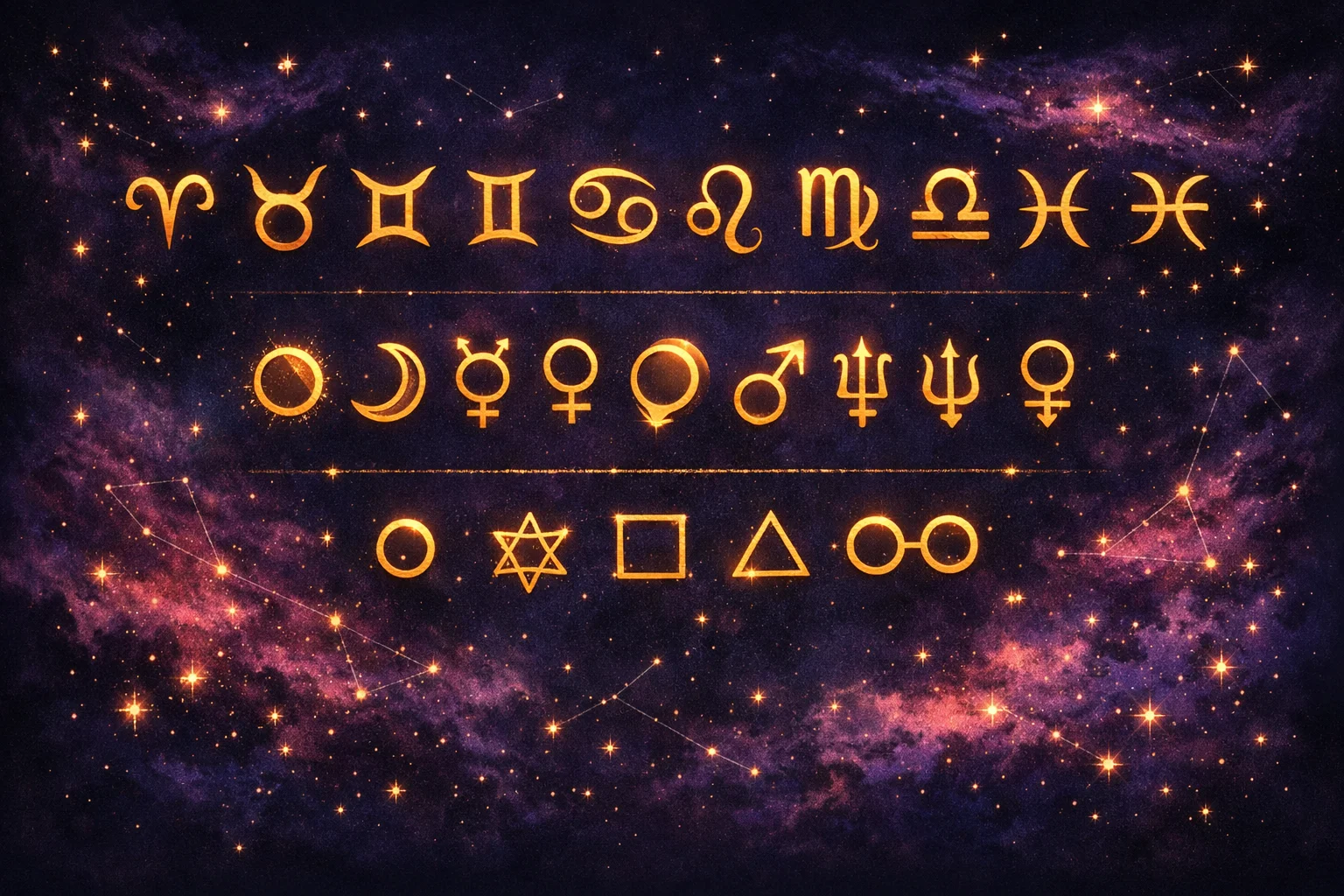
This is the single trick that turns the planet symbols from gibberish into a system. Traditional astrology builds the planetary glyphs out of three primitives, each with a fixed meaning:
| Shape | Stands for | The idea |
|---|---|---|
| Circle ○ | Spirit | Wholeness, eternity, the divine spark |
| Crescent ☽ | Soul | Feeling, receptivity, the personal mind |
| Cross + | Matter | The physical world, structure, limits |
Now watch them combine. Mercury (☿) is a crescent on top of a circle on top of a cross — soul crowning spirit, planted in matter, which is a neat picture of a mind that connects the higher and lower self. Venus (♀) is spirit (the circle) lifted above matter (the cross): values raised over the material. Saturn (♄) flips that — the cross of matter weighing down on the crescent of soul, which is exactly how Saturn feels when its lessons land. You don't have to buy the mysticism for the mnemonic to work; it's a genuinely faster way to remember ten symbols than rote flashcards. The decoder above shows the breakdown for each planet under “Built from.”
Zodiac Glyphs Are Pictures, Not Code
The twelve zodiac symbols work on a different and simpler principle: most of them are stripped-down drawings of the sign's creature or emblem. Aries (♈) is the curve of a ram's horns. Taurus (♉) is a bull's face with horns above it. Leo (♌) traces a lion's mane flowing into its tail, and Sagittarius (♐) is the archer's arrow pulled back to fire. Once you know what each glyph is a picture of, you rarely forget it.
A few are more abstract and worth a second look. Cancer (♋) is two curled claws — or, depending on who you ask, two protective forms turned inward, which suits the sign's shell-like nature. Libra (♎) is the only sign whose glyph isn't a creature at all; it's the setting sun balanced on the horizon line, a literal picture of balance. And Scorpio (♏) and Virgo (♍) look like cousins — both are an “M” shape — but Scorpio's tail flicks up into a stinger while Virgo's loops inward. That single difference is the first thing to train your eye on. If you want the exact date ranges and element breakdown behind each glyph, our complete calendar of astrology signs and dates lays out all twelve — including the boundary days where the glyph depends on your birth year.
How to Read a Line of Chart Notation
Symbols only matter once you can string them together, and chart software writes placements as compact lines of glyphs. Take a real example: ☿ ♊ 12° — 3rd ℞. Read left to right, it breaks into five pieces, and the order is always the same:
- ☿ — the planet. Mercury, so this line is about the mind and communication.
- ♊ — the sign. Gemini, the style Mercury takes on here: fast, verbal, restless.
- 12° — the degree. How far into Gemini it sits, from 0 to 29. Degrees matter once you start tracking aspects.
- 3rd — the house. The life area it plays out in — the 3rd rules communication, siblings, and short trips.
- ℞ — the mark. Retrograde, so this Mercury thinks before it speaks and revises constantly.
Put together: a quick, wordy mind, doubly emphasized (Mercury rules both Gemini and the 3rd house), turned inward by the retrograde. That's a specific, usable read pulled from five glyphs. The notation reader in the tool above lets you walk through each token. When you're ready to see which wedge a planet falls into, the full guide to the twelve houses maps every numbered slice of the wheel.
The Glyphs Beginners Mix Up Most
A handful of symbols trip up almost everyone, and confusing them quietly wrecks a reading. These are the pairs to drill until they're automatic:
- Mars (♂) vs. Venus (♀). Both start with a circle. Mars shoots an arrow up and to the right (action, outward); Venus sits on a downward cross (values, inward). Mix these up and you read someone's love life as their fighting style.
- Jupiter (♃) vs. Saturn (♄). Jupiter's crescent opens upward and expands; Saturn's cross presses down. One says “more,” the other says “enough.” They're astrology's gas pedal and brake, so swapping them inverts the whole tone.
- Scorpio (♏) vs. Virgo (♍). Look only at the third leg: Scorpio's flicks outward into a stinger, Virgo's curls inward.
- The Sun (☉) vs. a plain circle. The Sun always has that center dot. A bare circle with nothing inside isn't a standard planet glyph — it's usually a degree mark or a decorative ring.
One more honest warning: some glyphs genuinely have more than one accepted form. Pluto appears both as a P-L monogram (♇) and as a symbolic stack of circle, crescent, and cross. Uranus shows up as an “H” with a circle (for astronomer William Herschel) or as a circle-cross-dot in older texts. If your chart looks different from a screenshot online, you're probably not wrong — your software just chose the other convention. Many of these glyphs trace back to the early sky-watchers who practiced both crafts at once, a history we untangle in our guide to astronomy vs astrology.
Aspect Symbols: The Lines Across the Chart
The colored lines slicing through the middle of a chart wheel are aspects — the angles between planets — and each angle has its own glyph. These tell you whether two drives cooperate or grind against each other, and they're the difference between a list of placements and an actual story. Here are the five major ones:
| Glyph | Aspect | Angle | Feels like |
|---|---|---|---|
| ☌ | Conjunction | 0° | Fused — energies blend into one |
| ⚹ | Sextile | 60° | Opportunity you have to act on |
| □ | Square | 90° | Friction that forces growth |
| △ | Trine | 120° | Effortless, natural flow |
| ☍ | Opposition | 180° | A tug-of-war between two needs |
A quick shortcut: the pointy, hard-edged glyphs (the square and the opposition) tend to mark the challenging aspects, while the open, rounded ones (the trine and sextile) mark the easy ones. Charts usually reinforce this with color — red lines for tension, blue or green for harmony — so you can read the emotional temperature of a chart before you decode a single planet. To see aspects woven into a full reading, our walkthrough of a complete birth chart shows them in action.
Nodes, Chiron, and the Other Marks
Beyond planets and signs, most modern charts include a few extra symbols that confuse newcomers because they aren't planets at all. The two horseshoe-shaped glyphs are the lunar nodes: the North Node (☊), the “head of the dragon,” points to where you're growing, while the South Node (☋), its mirror image, marks the patterns you already over-rely on. They always sit exactly opposite each other.
You'll also meet Chiron (⚷), drawn like a small key — the “wounded healer” that marks a tender spot you eventually learn to help others through. Two abbreviations round things out: AC (the Ascendant or Rising sign, the chart's starting line on the left) and MC (the Midheaven, the high point tied to career and reputation). These two angles are calculated from your exact birth time, which is why an unknown birth time leaves a chart half-blank. If you know yours, our rising sign calculator will place your AC for you. For the deeper history of how these marks were standardized, the record of astrological symbols and their origins traces each glyph back to its medieval and Hellenistic roots. Learn the ten planets first, then the signs, and the rest of the marks fall into place faster than you'd expect.