Astronomy vs Astrology: Where Science Ends and Cosmic Interpretation Begins
Astronomy vs astrology comes down to one clean distinction: astronomy measures the universe, astrology reads meaning into it. One is a science built on instruments, math, and repeatable proof. The other is a symbolic tradition that takes the same stars and asks what they say about you. They sound alike, they sprang from the same source, and people swap the words constantly — but the work behind each could not be more different.
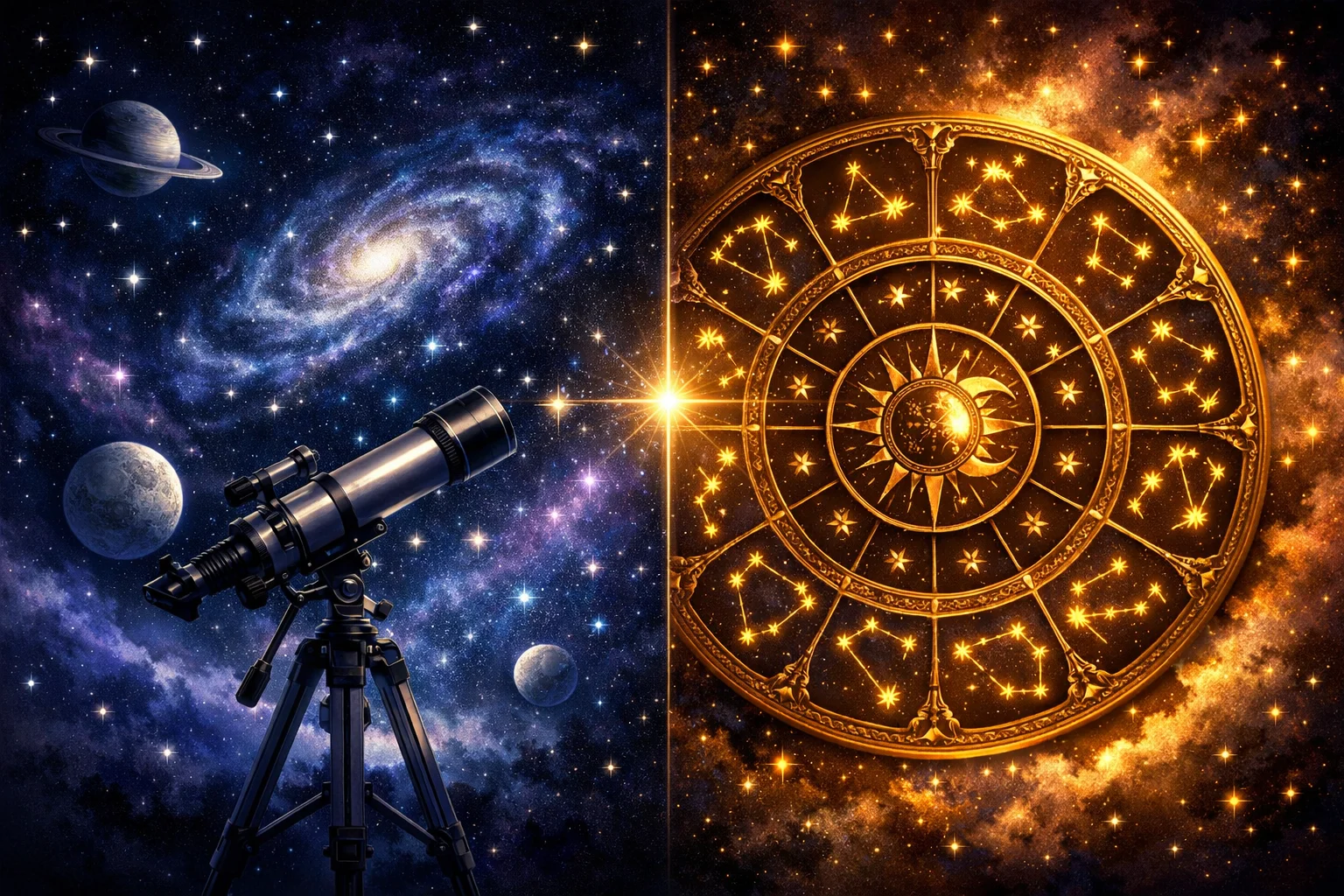
The Same Sky, Two Completely Different Jobs
Picture two people on a rooftop at midnight, both staring at Mars. The astronomer wants to know how far away it is, what its atmosphere is made of, and exactly where it'll be next Tuesday. The astrologer wants to know what Mars sitting in your seventh house says about your love life. Same red dot, two questions that never overlap.
That's the cleanest way to hold the difference in your head. Astronomy is descriptive — it tells you what is. Astrology is interpretive — it tells you what it means. An astronomer can prove their answer with a telescope and a calculator. An astrologer offers a reading, the way a critic reads a film. If you're newer to the second half of that pair, our plain-English guide to what astrology actually is breaks down the interpretive side without the jargon.
They Were One Craft for Two Thousand Years
Here's what surprises most people: for the bulk of recorded history, astronomy and astrology were the same job. In ancient Babylon around 1800 BCE, the priests who tracked Venus across the horizon did it to forecast harvests, wars, and the fate of the king — the original horoscopes. But to make those forecasts, they had to keep obsessively accurate records of where the planets actually went. That record-keeping was early astronomy.
The overlap ran deep right into the scientific revolution. Johannes Kepler, the man who worked out that planets move in ellipses, cast horoscopes for wealthy patrons to fund his research. Galileo drew up birth charts too. According to the documented history of astrology, the two only became truly separate disciplines around the 17th and 18th centuries, once the scientific method demanded that claims be tested rather than simply believed. Astrology couldn't pass that test, and the fork in the road appeared.
Where the Split Actually Happened
The break wasn't a single dramatic moment — it was the slow arrival of testing. Once scientists started demanding that a claim predict something measurable and then checking whether it did, astronomy and astrology drifted apart fast.
Astronomy kept everything that survived the test: orbits, distances, the chemical makeup of stars, the expansion of the universe. Astrology kept the meaning-making that testing couldn't confirm: the idea that a planet's position shapes personality and events. Neither erased the other. They just stopped being the same pursuit. One became a physical science; the other became a system of symbols — closer to the glyph-based language you'll find in our guide to astrology symbols and their meanings.
Astronomy vs Astrology at a Glance
When the two blur together, this side-by-side usually snaps them back apart:
| Astronomy | Astrology | |
|---|---|---|
| What it is | A natural science | A symbolic interpretive system |
| Goal | Explain the physical universe | Find meaning for human life |
| Method | Observation, math, peer review | Tradition, symbolism, interpretation |
| Tested? | Yes — predictions are verifiable | No — claims fail controlled trials |
| The zodiac | 13 uneven real constellations | 12 equal signs tied to the seasons |
| Practitioner | Astronomer (scientist) | Astrologer (interpreter) |
Is Astrology a Science? The Honest Answer
No — and pretending otherwise does astrology no favors. Astrology is classified as a pseudoscience because its central claims, when put through controlled studies, don't outperform chance. The most famous test came from researcher Shawn Carlson in 1985: professional astrologers were asked to match birth charts to personality profiles under blind conditions, and they scored no better than random guessing.
But “not a science” isn't the same as “worthless.” Poetry isn't a science either. Astrology works for millions as a language for self-reflection, a prompt for thinking about your patterns, a shared vocabulary for relationships. The honest position is simply this: enjoy it as a mirror, not as a physics engine. The problem only starts when symbolic claims get dressed up as measurable, physical facts. Astronomy is what you turn to for the measurable part — like the real planetary data behind a birth chart calculator, which pulls genuine astronomical positions before astrology ever adds a single interpretation.
Why Astrologers Still Lean on Astronomy
Here's the irony: astrology can't function without astronomy. Every birth chart starts with a set of cold, hard astronomical facts — the exact longitude of each planet at your moment of birth, pulled from an ephemeris that astronomers built. Get the astronomy wrong and the astrology collapses, because you'd be reading the wrong sky.
That dependence runs through the whole practice. The houses in a chart are calculated from the rotation of the Earth and your exact location on it — raw geometry. The aspects between planets are literal angles measured in degrees. So when you read about the anatomy of a birth chart, remember that the skeleton underneath is pure astronomy. Astrology is the interpretation painted on top of an astronomical frame.
Mercury retrograde is the cleanest example of this handoff. The backward drift is a real, predictable optical effect of orbital speed — astronomers can chart it to the minute. The meaning laid on top (review, slow down, double-check) is the astrology. Our Mercury retrograde 2026 tracker shows both halves side by side: the exact station dates from the ephemeris, and the symbolic read each window invites.
The Moon works the same way. A lunar eclipse or a supermoon is fixed orbital geometry an astronomer can predict decades out; what those moments mean for release, endings, or emotional peaks is the astrology layered on top. Our 2026 full moon calendar pairs each exact date with that symbolic read the same way.
Three Mix-Ups That Trip People Up
- Thinking your “star sign” matches the real stars. It doesn't, and that's not a mistake. Earth's axis wobbles over a 26,000-year cycle (precession), so the constellations have slid about one whole sign out of sync with the astrological calendar. Western astrology uses the tropical zodiac, fixed to the seasons, not the visible stars. NASA spelled this out plainly in its note on the constellations and the zodiac. The same drift quietly expires any fixed-star coordinate somebody wrote down decades ago — the starseed birth chart calculator shows the Pleiades leaving Taurus in September 2000.
- Believing astronomers “debunked” a 13th sign. The Sun really does pass through Ophiuchus — that's astronomy. But astrology never claimed to track the uneven real constellations; it uses twelve equal slices by design. The two systems aren't in conflict, they're just measuring different things. If you want to see the gap for your own birth data, the sidereal birth chart calculator prints all thirteen real constellations beside both zodiacs — and roughly four charts in ten turn out to have a planet sitting in Ophiuchus.
- Calling an astrologer an astronomer (or vice versa). An astronomer might spend a career studying galaxy collisions and never once think about your Sun sign. An astrologer interprets meaning and never needs a telescope. Same Greek root, same night sky, entirely separate professions.
Hold onto the core test and you'll never mix them up again: if a claim can be measured and proven, that's astronomy. If it assigns meaning to what's up there, that's astrology. The night sky is big enough for both — as long as you know which one you're looking through.