Full Moon Calendar 2026: Every Date, Name, Zodiac Sign, and What It Means
This full moon calendar for 2026 tracks all thirteen full moons of the year, and thirteen is the giveaway: most years get twelve. The extra one shows up on May 31 as a Blue Moon, the second full moon crammed into a single month. Beyond the count, 2026 is a genuinely busy lunar year — three supermoons, one micromoon, and two lunar eclipses that turn otherwise routine full moons into hard pivots. Below you'll find every date, its traditional name, the zodiac sign it lands in, and what each one is actually good for.
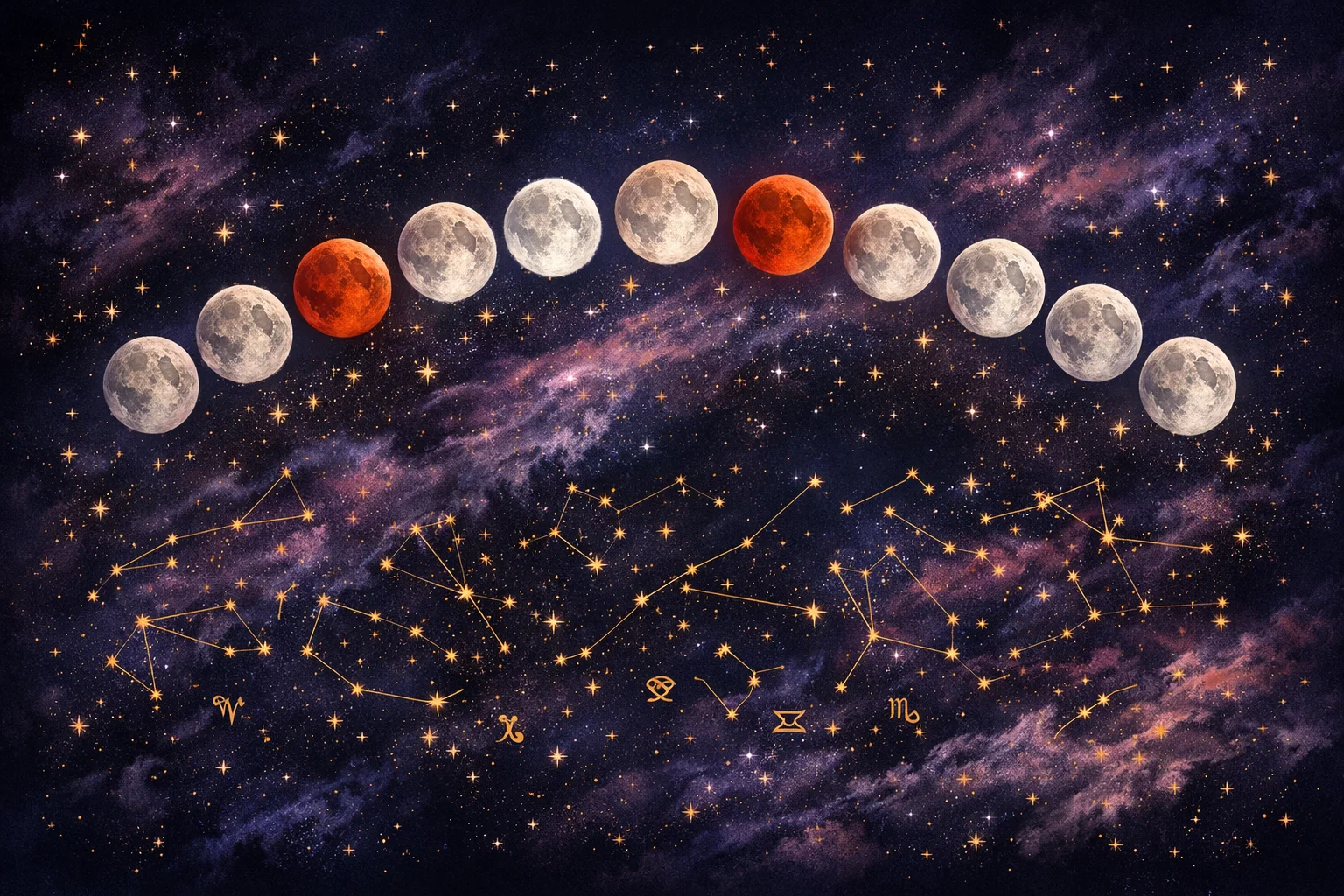
Here's the whole year in one table. Times are US Eastern; the full moon itself happens at the same instant everywhere, so shift the clock to your own zone.
| Date | Name | Zodiac Sign | Notable |
|---|---|---|---|
| Jan 3 | Wolf Moon | ♋ Cancer | Supermoon |
| Feb 1 | Snow Moon | ♌ Leo | — |
| Mar 3 | Worm Moon | ♍ Virgo | Total Lunar Eclipse |
| Apr 1 | Pink Moon | ♎ Libra | — |
| May 1 | Flower Moon | ♏ Scorpio | — |
| May 31 | Blue Moon | ♐ Sagittarius | Blue Moon |
| Jun 29 | Strawberry Moon | ♑ Capricorn | Micromoon |
| Jul 29 | Buck Moon | ♒ Aquarius | — |
| Aug 28 | Sturgeon Moon | ♓ Pisces | Partial Lunar Eclipse |
| Sep 26 | Corn Moon | ♈ Aries | Harvest Moon |
| Oct 26 | Hunter's Moon | ♉ Taurus | — |
| Nov 24 | Beaver Moon | ♊ Gemini | Supermoon |
| Dec 23 | Cold Moon | ♋ Cancer | Supermoon |
Where the Full Moon Names Actually Come From
The Wolf Moon, the Snow Moon, the Strawberry Moon — these names sound poetic, but they started as a practical calendar. Long before printed almanacs, communities across North America and Europe tracked the months by the full moon and named each one after whatever was happening on the ground. January's Wolf Moon marked the season you actually heard wolves howling from hunger. June's Strawberry Moon flagged the brief window to gather ripe wild strawberries. It was less spirituality and more a shared farming and hunting schedule written in the sky.
That's why the names are so seasonal and so specific. The Worm Moon in March points to earthworms surfacing as the ground thaws. The Buck Moon in July marks when male deer regrow their antlers. The Beaver Moon in November is named for the last stretch to trap beavers before the water froze. Most of the names we use in English trace to a blend of Native American, Colonial American, and old European traditions, later popularized by the Old Farmer's Almanac. When you learn them, the calendar stops being abstract — each full moon literally tells you what month it is and what the land was doing.
Two Eclipses Turn 2026 Into Turning Points
Two of 2026's full moons aren't ordinary full moons at all — they're lunar eclipses, and they behave very differently. On March 3, the Worm Moon becomes a total lunar eclipse in Virgo, the kind where the moon slides fully into Earth's shadow and can turn a coppery red. On August 28, the Sturgeon Moon becomes a partial lunar eclipse in Pisces. A lunar eclipse only happens at a full moon, when the Sun, Earth, and Moon line up almost perfectly — the astronomy behind it is precise enough that agencies like NASA publish the exact timing years ahead.
Astrologically, eclipse full moons act like the volume knob turned all the way up. Where a normal full moon offers a gentle nudge to release something, an eclipse tends to rip the bandage off — a job ends, a relationship clarifies, a truth you've been dodging lands in your lap. The Virgo eclipse in March pushes on perfectionism and burnout; the Pisces eclipse in August dissolves illusions and blurry boundaries. Together they form an eclipse axis running through the mutable signs, so Geminis, Virgos, Sagittarians, and Pisces feel these two hardest. If you know your natal Moon placement from your birth chart, check whether either eclipse hits a personal degree — that's where the turning point shows up in your own life.
What It Means When the Full Moon Is in Your Sign
A full moon is never random about its sign. By definition, the full moon sits directly opposite the Sun — that's what makes it fully lit from our view. So in early January, with the Sun in Capricorn, the full moon lands in Cancer. A month later the Sun has moved to Aquarius and the full moon shifts to Leo. Follow that logic all the way around and the full moon walks backward through the zodiac, one sign per month, which is exactly what the 2026 calendar shows.
Because it's an opposition, every full moon lights up an axis — a pair of opposite signs and the life themes they govern. The Cancer full moons in January and December activate the home-versus-career tension. The Libra Pink Moon in April spotlights the self-versus-relationship balance. When a full moon falls in your Sun sign or your Moon sign, that axis becomes deeply personal, and feelings you've been managing quietly tend to demand attention. Here's the quick reference for which axis each 2026 full moon works:
| Full Moon Sign | Axis | Core Tension |
|---|---|---|
| ♋ Cancer | Cancer–Capricorn | Home & feelings vs. career & ambition |
| ♌ Leo | Leo–Aquarius | Personal shine vs. the collective |
| ♍ Virgo | Virgo–Pisces | Order & routine vs. surrender & faith |
| ♎ Libra | Libra–Aries | Partnership vs. independence |
| ♏ Scorpio | Scorpio–Taurus | Depth & intimacy vs. comfort & security |
| ♐ Sagittarius | Sagittarius–Gemini | Big-picture meaning vs. day-to-day detail |
| ♑ Capricorn | Capricorn–Cancer | Public ambition vs. private life |
Supermoon, Micromoon, Blue Moon: Reading the Labels
The extra labels on the calendar aren't marketing. A supermoon is a full moon that lines up with perigee, the point where the Moon's slightly elliptical orbit brings it closest to Earth. That proximity makes it look about 7% wider and up to 15% brighter than average. 2026 gives you three, and they cluster at the ends of the year: the Wolf Moon (January 3), the Beaver Moon (November 24), and the Cold Moon (December 23). If you only photograph one full moon all year, make it one of those.
A micromoon is the mirror image — a full moon near apogee, its farthest point, so it looks a touch smaller and dimmer. The June 29 Strawberry Moon is 2026's micromoon. The difference between a supermoon and a micromoon is real but subtle; side by side you'd notice it, but on any single night most people wouldn't. The Blue Moon label is different again — it's purely about the calendar, not the Moon's distance or color. May 31 earns it simply for being the month's second full moon. If you want the full breakdown of the astronomy versus the astrology behind these labels, our guide on astronomy versus astrology takes it apart.
Worth knowing while you have the dates in front of you: the gap between two full moons on this list is never the same twice. Lunations run anywhere from 29d 6h to 29d 20h, which is why the times below jump around instead of landing on a neat 29½-day rhythm. That variability is also why a full moon you remember from a specific date — a birthday, say — may not have been quite as full as you were told. The birth moon phase calculator reads the exact Sun-to-Moon angle for any past date, and it will tell you how far off the peak you actually were — the Moon stays over 95% lit for more than four days either side, so "full moon baby" covers a lot of ground.
How to Work a Full Moon Release Without the Woo Overload
You don't need candles, a crystal grid, or a specific tradition to use a full moon. The reason full moons pair so naturally with letting go is structural: the moon has reached peak illumination and is about to start waning, so it mirrors the moment a project or feeling crests and begins winding down. The trick that most guides skip is to read the sign first, then choose what you release. A Scorpio full moon is the night to release control and jealousy; a Gemini one is better aimed at mental clutter and doom-scrolling. Generic "release what no longer serves you" is weak. Specific is what works.
A simple version: on the night of the full moon (or within a day either side), write down the one thing this particular sign is asking you to put down. Read it once, out loud. Then close the loop physically — tear the paper, delete the draft, box up the object. The act matters more than the words. One firm exception: skip this on the March 3 and August 28 eclipses. Eclipse energy forces its own endings, and trying to steer it usually backfires. On those two nights, rest and watch instead of working. And before you commit to anything big at a full moon, it's worth glancing at the 2026 Mercury retrograde calendar — a full moon during a retrograde is a signal to revise rather than launch.
The Harvest Moon Isn't Always in September
Most people assume the Harvest Moon is just September's full moon, but it's defined differently: it's the full moon closest to the autumn equinox, whichever month that lands in. Usually that's September, occasionally October. In 2026 the equinox falls around September 23, so the September 26 Corn Moon wins the Harvest Moon title by just three days. Some years the October full moon is actually closer, and then October gets the crown instead.
What made the Harvest Moon matter to farmers is a quirk of geometry. Around the equinox, the Moon rises only about 25 to 30 minutes later each night instead of the usual 50, so for several evenings in a row a bright, near-full moon comes up soon after sunset. That gave crews extra light to keep bringing in the harvest after dark. The Hunter's Moon on October 26 does the same thing a month later, which is how it got its name. If you want to keep tracking the cycle between these big moments, the live moon phase tracker shows tonight's exact illumination and moon sign on any date you pick.