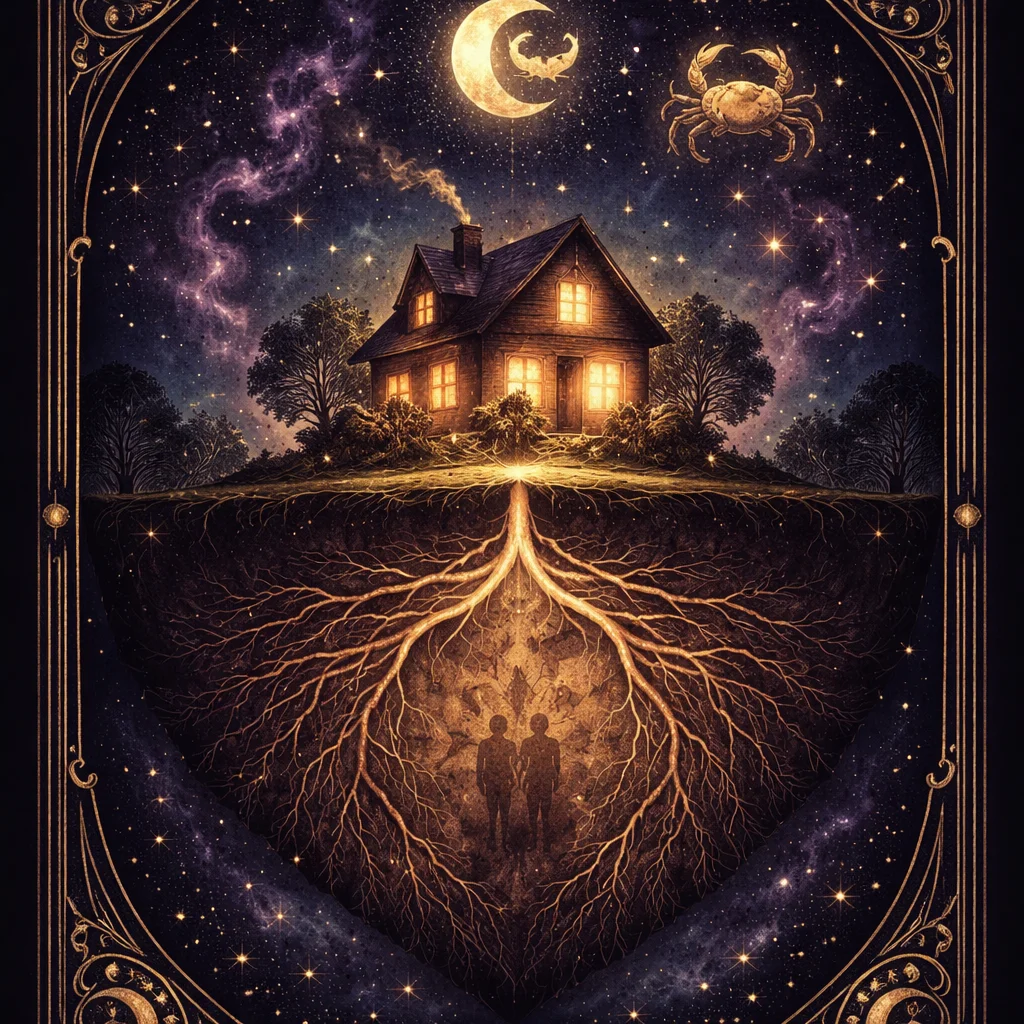
4th House in Astrology: Your Emotional Roots, Family Karma, and the Home You Build
The 4th house in astrology is the part of your chart that decides whether a place ever truly feels like home. A friend of mine finally bought the apartment she'd been dreaming about for years — right light, right street, everything on the checklist — and spent the first month feeling vaguely, persistently unsettled in it. Nothing was wrong on paper. Everything was wrong in her gut. That gap between a good house and a home that holds you is exactly what the 4th house governs, and it runs far deeper than four walls.

When Your Dream Home Still Feels Wrong
Here's what my friend was missing. The 4th house isn't about the building — it's about emotional foundation. It's the felt sense of having somewhere to land, roots that hold you, a base you can fall apart in and put yourself back together. You can satisfy every item on the listing and still feel rootless if the deeper thing isn't there. Her IC was in Cancer, the most home-hungry sign there is, and she'd bought a slick, minimalist place that gave her nowhere to nest. The chart was practically shouting it.
That's the 4th house in a nutshell: not where you live, but what you need home to feel like. Get that wrong and no amount of square footage fixes it. Get it right and a tiny rented room can feel like the safest place on earth.
The IC: The Lowest Point Holds Everything Up
The 4th house begins at one of the four most important points in any chart: the IC, or Imum Coeli — Latin for “the bottom of the sky.” It sits at the very base of the wheel, directly opposite the Midheaven at the top. If you picture your chart as a clock, the IC is roughly the six o'clock position: the deepest, most hidden point, the patch of sky that was directly beneath your feet at the moment you were born.
That location isn't a metaphor by accident. The IC is the foundation everything else is built on — the private, unguarded self that exists when no one's watching, the emotional bedrock you stand on without thinking about it. Because the 4th is one of the four angular houses (alongside the 1st, 7th, and 10th), it carries real weight. Angular houses are the load-bearing walls of the chart, and a planet sitting on the IC is as powerful as one on the Ascendant — it just works underground, in private, rather than out in the open. If the whole wheel is still new to you, our guide to all twelve astrological houses shows where the 4th sits and why its angular position matters so much.
What the 4th House Actually Rules
People tend to file the 4th house under “home” and stop there. Its real job description is wider and more layered than that:
- Home and your living space — the physical place you live, how you make it yours, and what “home” has to feel like before you can relax in it.
- Family and family of origin — the household you grew up in, the patterns you absorbed there, and one of your parents in particular.
- Roots and ancestry — your lineage, your heritage, and the inherited emotional patterns that get passed down a family line whether anyone talks about them or not.
- Emotional security — your deepest sense of belonging and safety, the private inner core you rarely show.
- Real estate and land — property, the actual earth and buildings you own or long to own.
- The end of matters — in traditional astrology, old age, the final chapter of life, and what you return to when everything else falls away.
Notice the thread running through all of it: origins and endings. The 4th house is where you come from and, eventually, where you come back to. That's why the same house that describes your childhood bedroom also describes your old age — both are about roots.

Which Parent Is the 4th House?
This is where astrologers genuinely argue, and it's worth knowing why before you take any single answer as gospel. The old tradition assigns the 4th house to the father and the 10th to the mother. Plenty of modern astrologers flip it — reading the 4th as the nurturing parent (often the mother) and the 10th as the authority figure who sent you out into the world. You'll find confident sources claiming each version.
My advice after years of looking at charts: don't lock it to a gender at all. Read the 4th house as whichever parent shaped your sense of home and emotional foundation — the one whose mood set the temperature of the house, the one whose approval or absence you still feel in your body. Sometimes that's mum, sometimes that's dad, sometimes it's a grandparent who raised you. The sign on the IC and any planet in the 4th describe that person and that early atmosphere far more accurately than any rigid rule about which parent “belongs” to which house.
Reading a Planet in Your 4th House
A planet in the 4th house doesn't change what the house covers — it colors your roots, your home life, and your emotional security with that planet's nature. The interactive reader above works from your IC sign; this table layers in what a planet adds on top. Read the sign first, then the planet, and blend the two.
| Planet in 4th | What it does to your roots | Watch out for |
|---|---|---|
| ☉ Sun | Identity rooted in home and family | Hard to leave the nest, family-defined |
| ☽ Moon | At home: deep nesting instinct, strong family bond | Moods swing with the home, clinging |
| ☿ Mercury | A busy, talkative, idea-filled household | Restlessness, work-from-home overload |
| ♀ Venus | A beautiful, harmonious, loving home | Avoiding family conflict, over-comfort |
| ♂ Mars | An energetic or combative early home | Family friction, anger rooted in childhood |
| ♃ Jupiter | A generous, expansive, lucky home base | Overdoing it, a home that's never enough |
| ♄ Saturn | A strict, heavy, or responsibility-laden upbringing | Early coldness, feeling you earned safety |
| ♅ Uranus | An unconventional or disrupted home life | Frequent moves, instability, upheaval |
| ♆ Neptune | A dreamy, porous, sanctuary-like home | Foggy boundaries, idealized or absent parent |
| ♇ Pluto | An intense home with hidden power dynamics | Family secrets, control struggles, upheaval |
If you find a planet here, it's usually a big deal — an angular planet shapes the whole chart. The Moon and Saturn in the 4th are especially loud, since one is the natural ruler of home and the other is the planet of foundations and burdens. To find which planets actually fall in your 4th, run your details through the free birth chart calculator — and bring your real placements back to the reader above.
Home, Roots, and the Ancestry You Inherit
The most overlooked layer of the 4th house is ancestry — the emotional inheritance handed down a family line. Not money or property, but patterns: the way a family handles fear, money, closeness, or grief, passed quietly from one generation to the next until someone notices and changes it. Astrologers read the 4th house as the root system feeding all of that, which is why it ties so directly to your deepest, least conscious emotional habits.
This is also where the “family karma” idea comes from. A heavy planet on the IC — Saturn, Pluto, sometimes a wounded Moon — often describes someone who inherits a difficult family pattern and spends their life either repeating it or being the one who finally breaks it. The traditional house system placed the 4th at the foundation of the chart for exactly this reason: everything you build stands on the roots you started with. Once your private foundation is steady, the next house out — the 5th house of creativity, romance, and self-expression — is where that secure base finally gets to play and create.
Roots and Ambition: The 4th-10th Axis
You can't fully read the 4th house without its opposite, the 10th house of career, status, and public reputation. They sit directly across the wheel on the IC–MC axis, and together they form the spine of your chart: the 4th is your private base, the 10th is your public peak. The 4th is home, family, and who you are behind closed doors; the 10th is career, status, and how the world sees you. One is the roots, the other is the visible tree.
The crucial insight most guides miss is how dependent these two are on each other. Your public success in the 10th is only as stable as the private foundation in the 4th holding it up. People who burn out at the top of their careers very often have a neglected 4th house — all tree, no roots. And people who can't seem to launch sometimes have the opposite problem: so much pull toward home and safety in the 4th that the climb toward the 10th never gets going. The reader above shows your own version of this tension by deriving your Midheaven sign from your IC. The 4th house also sits right beside the 3rd house of communication and the everyday mind, which handles how you process the world your 4th house gave you.
Worked Reading: Moon in the 4th with Cancer on the IC
Let's make it concrete with the most home-saturated combination there is. Say you have the Moon in the 4th house and Cancer on the IC. The Moon is the natural ruler of home and emotional security, so it's powerfully at home in the 4th; Cancer is the Moon's own sign and the IC's home sign too. That's a triple dose of the same theme, and it reads loud and clear.
In practice, this person feels their home in their body. Their mood rises and falls with their living situation — a chaotic home means a chaotic inner life, a peaceful nest means genuine calm. There's almost always a deep, sometimes complicated bond with the mother or the one who nurtured them, and a strong pull to recreate (or repair) the family they grew up in. They remember every home they've lived in, keep heirlooms, and show love by feeding people.
The growth edge is just as clear once you name it. With this much watery 4th-house emphasis, the risk is clinging — staying too close to the past, to the family home, to old emotional patterns long after they stop serving. The Capricorn Midheaven sitting opposite this Cancer IC shows the way out: structure, responsibility, and a public role give this person the backbone to feel safe out in the world, not just at home. To read your own version, find your Moon sign with the moon sign calculator and bring it back to the Home & Roots Reader above.