
The Judgement Tarot Card: Gabriel's Trumpet, the Reckoning, and the Call to Rise
The Judgement tarot card meaning is the most misnamed idea in the entire deck. People see the word “Judgement,” glance at the angel in the clouds, and brace for a verdict handed down from on high — some cosmic authority weighing their sins. That's not what card XX is about. The judgement here isn't being passed on you by anyone. It's the moment you sit up, look honestly at your own life, and decide whether to answer the call to rise. This is a card of self-reckoning and rebirth, not punishment — and once you see that, the whole card reads differently.
Why “Judgement” Is the Most Misread Name in the Deck
Start with the fear, because almost everyone brings it. The word alone sounds like a courtroom — guilt, sentencing, someone deciding whether you measure up. So people pull Judgement in a spread and their stomach drops, expecting the tarot equivalent of a bad report card. But the imagery tells a completely different story. Nobody in the picture is being condemned. The figures rising from their coffins have their arms open, faces lifted, greeting the sound. They're not cowering. They're waking up.
The card is better understood as an awakening than a verdict. Its truest keyword is “calling” — a summons to rise toward something you've been putting off, avoiding, or telling yourself you weren't ready for. The only judge in the picture is you. Judgement asks you to be honest about where you've been, take what's genuinely yours to own, forgive the rest, and then step into a truer version of yourself. That's the reckoning — and it's a release, not a sentence.
What Gabriel's Trumpet Is Actually Announcing
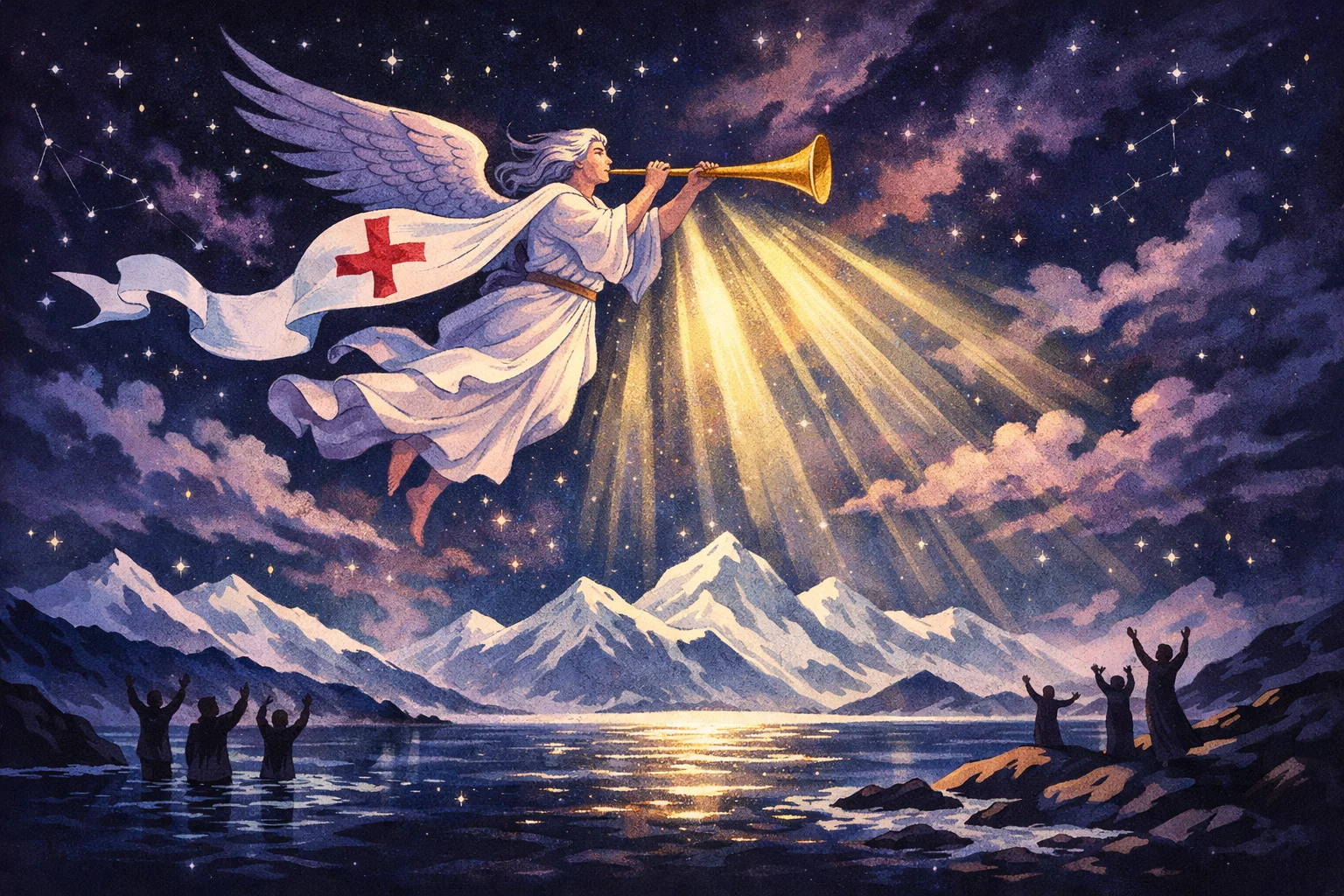
Every symbol on this card points the same direction, so it's worth decoding the picture piece by piece. Up in the clouds is the archangel Gabriel, the messenger, blowing a great trumpet. The trumpet is the call itself — the summons you can't un-hear once it sounds. That's the crucial detail people miss: a calling doesn't get quieter when you ignore it. It gets louder, and heavier, until you finally turn and face it.
Hanging from the trumpet is a white banner with a red cross — an equal-armed cross, the kind that symbolizes balance and the union of opposites, not religious dogma. Its presence tells you the awakening being announced is a reconciliation: a bringing-together of parts of yourself that had been split, buried, or at war. Below, the naked figures — classically a man, a woman, and a child — rise from open grey coffins floating on water. Nakedness is honesty here; there's nothing left to hide when the trumpet sounds. The coffins are the dormant life you'd written off, coming back awake. And the water beneath them is the deep emotional, unconscious layer this awakening rises out of.
One more detail worth catching: the snow-capped mountains in the far background are the same range that appears behind the Death card and its imagery of endings. Pamela Colman Smith painted them there on purpose. They're the peaks of the abstract and the eternal — the reminder that this awakening happens against the backdrop of something permanent. If you want the historical thread, the Rider-Waite-Smith Judgement card drew directly on the Christian image of the Last Judgment and the resurrection of the dead, reworked by Smith in 1909 into a card about personal, chosen rebirth rather than final divine sentencing.
Rise or Repeat: The Only Choice the Card Offers
Here's the interpretive key I come back to more than any other with this card. Judgement always presents a binary, and it's not good-or-bad — it's rise or repeat. The trumpet has sounded. A part of you already knows exactly what it's being called to do. You either answer that call and rise into a new chapter, or you hit snooze, roll over, and repeat the cycle you were in — only now with the added weight of knowing you heard the call and declined it.
This is why Judgement so often shows up at genuine turning points: the job you know you need to leave, the apology you know you need to make, the calling you've been circling for years, the version of yourself you keep promising you'll finally become. The card doesn't make the choice for you. It just makes the choice unavoidable. Once you understand card XX, you stop asking “what does Judgement predict?” and start asking the better question: what have I already been called to do that I keep pretending I didn't hear?

Pluto, Fire, and the Number of Awakening
Judgement's astrological and numerical correspondences aren't trivia — they sharpen the reading. In modern astrology the card is ruled by Pluto, the planet of death, rebirth, and total transformation. That's a near-perfect fit: Pluto tears down what has outlived its purpose so something truer can be reborn, which is exactly the arc of figures rising renewed from their coffins. In the older Golden Dawn tradition the card was assigned to elemental Fire — the primal, purifying fire of spirit that burns away the dross. Both associations converge on the same message: an awakening that clears out the old self.
| Correspondence | Judgement (XX) |
|---|---|
| Ruling planet | Pluto — death, rebirth, transformation |
| Element (Golden Dawn) | Fire — the primal, purifying fire of spirit |
| Number | 20 — reduces to 2, awakening reached through relationship and reconciliation |
| Yes / No | Yes upright — a calling worth answering |
| Key symbol | Gabriel's trumpet and the red-cross banner |
The number matters too. Judgement is XX — twenty, the second-to-last card of the Major Arcana, and its position tells a story. It comes right after the joy and clarity of the Sun (XIX) and right before the completion of the World (XXI). Read as a sequence, it's the near-final beat of the Fool's journey: you've found the light (the Sun), and now you're called to a last reckoning and rebirth before the circle can close (the World). Twenty also reduces to two — the number of duality and union — which is why the card's awakening so often comes through reconciliation, whether with another person, with your past, or with a part of yourself you'd disowned.
Upright or Reversed: Answering the Call or Silencing It
Upright, Judgement is the call answered. It's awakening, absolution, and a fresh start you've earned the right to take — self-forgiveness that actually lands, a vocation stepped into, a relationship reconciled on honest terms. It tends to be a hopeful card upright, even though it looks solemn, because it means you're rising rather than staying stuck. When it appears this way, the reading is essentially telling you the door is open and you're ready to walk through it.
Reversed, the trumpet still sounds — you've just got your hands over your ears. This is the calling ignored, the reckoning postponed, the fresh start refused out of fear. Its most common flavor is harsh self-judgment: being so brutal with yourself about the past that guilt calcifies into paralysis, and you can't forgive yourself enough to move. Sometimes it's plain self-doubt drowning out a genuine calling; occasionally it's the opposite, refusing any honest self-examination at all so you can stay comfortably asleep. The reversal's medicine is always the same: soften the verdict you've been handing yourself. Awakening asks for honesty, not cruelty. You're allowed to answer the call without first serving a life sentence for the mistake that made you hesitate.
Judgement in Love, Career, and the Reckonings We Avoid
In a love reading, Judgement is one of the deck's strongest cards for reconciliation and second chances. It frequently marks an old flame resurfacing, a couple forgiving each other and rebuilding on honest ground, or a single person finally releasing a heartbreak they'd been carrying like a verdict. But it always asks for the honest conversation first — the reckoning — rather than a quiet drift back together. A reconciliation the card blesses is one where the past has actually been faced, not one where two people agree to never mention it again. That's the difference between rising into something new and repeating the thing that broke.
At work, Judgement is the wake-up call that redirects a whole career. It shows up when the path you're on stops fitting and a truer vocation starts calling — a summons toward meaningful work you've been talking yourself out of. It can mark recognition finally arriving, a decision to answer a calling over a paycheck, or forgiving yourself for a professional failure so you can begin again. In every arena, the card's energy rhymes with the sudden, structure-shattering awakening of the Tower — except where the Tower forces the change on you from outside, Judgement invites you to choose it from within. That's the whole gift of card XX. The trumpet sounds for everyone. Rising is the part only you can do.
Card Combinations That Name What You're Being Called To
Judgement is always a call toward something, and the cards around it name it. These are the pairings that come up most at the table:
| Paired Card | Combined Meaning |
|---|---|
| Death (XIII) | A full death-and-rebirth cycle. The ending has already happened; now you're called to consciously rise into the new life it cleared room for. Powerful transformation, fully underway. |
| The World (XXI) | The awakening completes the journey. You answer the call and it carries you straight into fulfillment and closure — one of the deck's most satisfying endings. |
| Three of Swords | The reckoning is a heartbreak. You're being called to forgive and finally release an old wound — the rising here is emotional, and absolution is the whole assignment. |
| The Sun (XIX) | Clarity, then calling. The Sun's joy shows you what's true, and Judgement asks you to rise and live by it. An unusually bright, affirming pair. |
| The Tower (XVI) | Two awakenings, opposite doors. The Tower breaks the old structure from outside; Judgement calls you to rebuild by choice. Together: a shake-up that becomes a genuine rebirth if you answer it. |
The pairing I flag most is Judgement beside Death. On their own, one looks like an ending and the other like a summons. Together they tell a single, complete story: the old chapter has closed, the ground is cleared, and now the trumpet is sounding to call you up out of it. Death did the burying. Judgement does the rising. And the one thing neither card can do for you is make the choice — that part, always, is yours.