Death Tarot Card: Why the Most Feared Card in the Deck Is Really About Rebirth
The Death tarot card meaning sends more people into a quiet panic than any other card in the deck, and I've watched it happen at the table more times than I can count. A woman once pulled it in a reading about her marriage, went pale, and asked me if her husband was going to die. He wasn't. What was dying was the silent, decade-old arrangement they'd both stopped questioning — and eighteen months later she told me it was the best thing that ever happened to the relationship.
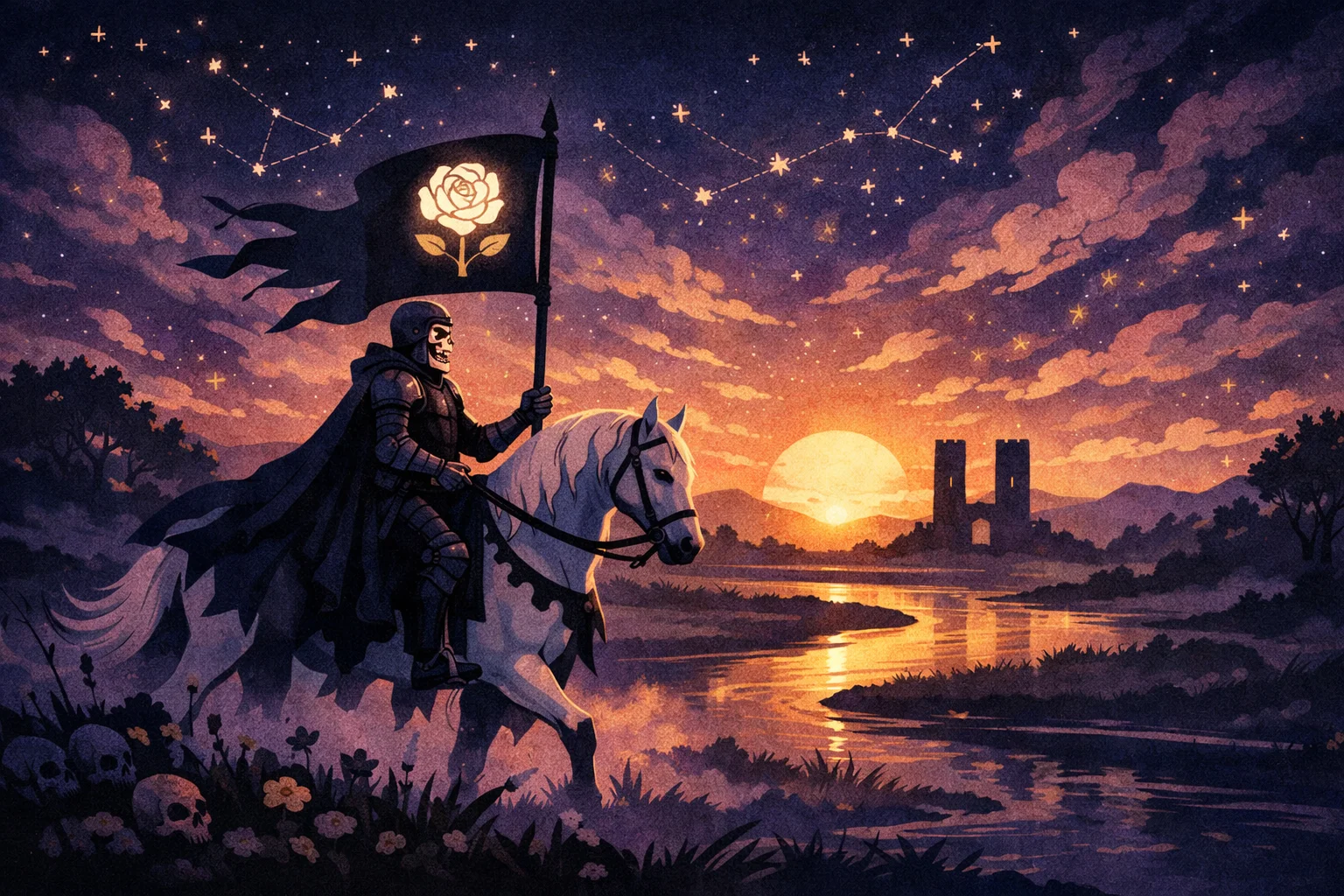
That reaction — the dropped stomach, the jump straight to literal death — is the single biggest obstacle to actually reading this card. Death (XIII) is the most misunderstood card in tarot, and almost everything the misunderstanding gets wrong points in the same direction: people read an ending as a tragedy when the card is really describing a transition. Let's clear the fear out of the way first, then get into what Death is actually telling you.
The Card Everyone Dreads Pulling
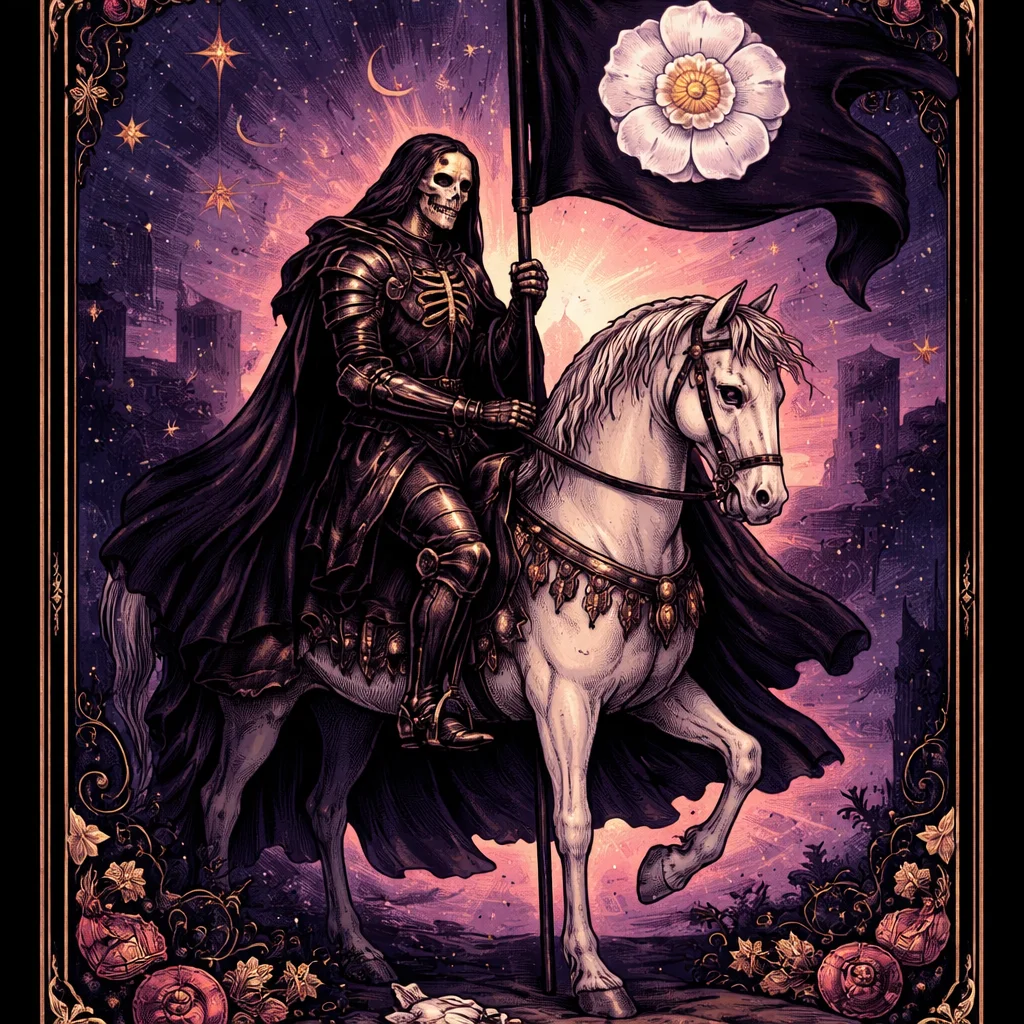
Part of the dread is the imagery. A skeleton in black armor on a pale horse is hard to spin as good news at first glance. But the fear runs older than the picture. For centuries, Death has been the card people point to when they want to call tarot morbid or dangerous. Films use it as a jump scare. People who've never touched a deck still “know” it's the bad one.
Here's what experienced readers learn fast: the cards that look gentle often carry the heavier warnings, and the cards that look frightening are frequently the kind ones. Death belongs firmly in the second group. It doesn't sneak up on you, it doesn't punish you, and it doesn't gloat. It just tells the truth about something you've probably already sensed — a chapter is closing.
Does Death Mean an Actual Death? Almost Never
Let me be as direct as a reader can be: in the overwhelming majority of readings, the Death card has nothing to do with physical death. I've drawn this card thousands of times across years at the table, and it has never once predicted that someone would die. Tarot doesn't work as an oracle that names dates and bodies. It works as a mirror for what's shifting in your life right now.
When Death shows up, it's pointing at endings of a different kind: a job you've outgrown, a relationship changing shape, a belief you're shedding, an identity that no longer fits. The reason readers are so confident about this isn't blind optimism — it's structural. The deck has 78 cards and plenty of imagery for grief and hard loss already (the Three of Swords, the Five of Cups, the Ten of Swords). Death, by contrast, almost always reads as transformation, because that's the specific energy it was built to carry. If you want to understand why the same card can mean different things depending on where it falls, our guide to tarot spreads and layouts breaks down how position reshapes a reading.
Scorpio, Pluto, and the Engine of Transformation
Death is associated with Scorpio, the fixed water sign, and its modern ruling planet Pluto — the planet astrologers tie to death, rebirth, and everything buried beneath the surface. This pairing explains why the card's energy feels so total. Scorpio doesn't do casual endings; it goes all the way down. And in astrology, Pluto only ever tears something apart in order to regenerate it. Nothing Pluto touches comes back the same — but it does come back.
That's the engine underneath the card. Read Death as “Scorpio-Pluto energy applied to your situation” and the meaning sharpens: something is being composted so something else can grow in the same soil. If you have prominent Scorpio placements or a strongly aspected Pluto in your natal birth chart, Death's energy will feel familiar — you tend to live in cycles of intense ending and rebuilding rather than slow, even change.
The White Rose, the Rising Sun, and the Four Figures
The Rider-Waite-Smith Death card is dense with symbols, but three of them carry the real meaning. Skip the rest if you're reading quickly — these are the ones that change interpretations.
The white rose on the black flag is the single most important detail. In a card dominated by black armor and a pale horse, the rose is the only living, blooming thing — a five-petaled white rose, a traditional symbol of purity, life, and the promise that something survives the ending. The flag isn't a banner of death's victory over life. It's the opposite: life persisting right in the middle of death's procession. When this card scares you, look at the rose.
The sun rising between two towers in the background is the second key symbol. It's the same dawn that lights other cards, and here it's placed deliberately on the horizon Death is riding toward. The ending and the new dawn are part of one continuous landscape, not two separate events. You don't finish grieving and then, later, get a sunrise. The sunrise is already happening while the ending unfolds.
The four figures — a fallen king, a praying bishop, a young woman looking away, and a child offering flowers — show four responses to the same inevitable change. The king resists and is toppled. The bishop tries to negotiate. The woman can't look at it directly. Only the child meets Death openly, without fear. The lesson is built into the picture: you don't get to avoid the transition, but you do get to choose how you meet it.
Death Upright: The Ending You Can See Coming
An upright Death card describes a transformation that's natural, necessary, and usually already underway. Unlike the sudden cards, Death rarely blindsides you. By the time it shows up in a reading, some part of you already knows the chapter is ending — you just haven't said it out loud yet.
In practice, upright Death readings cluster around a few situations. A relationship transformation, where a dynamic dies even though the relationship survives. A career or identity shift, where the role you built your sense of self around stops fitting. A belief or habit dissolving, where you outgrow a way of thinking you used to defend. In all of them the advice is the same: stop trying to preserve the old form. Cooperate with the ending instead of bracing against it, and the transition moves faster and hurts less.
The mistake I see most often with upright Death is treating it as purely about loss. It isn't. The card is genuinely two-sided — which is exactly why the reader above frames every area as an ending paired with a rebirth. If you only read the loss, you've read half the card. Death handles the ending; its counterpart in the Major Arcana — the rebirth and calling of Judgement — is the conscious rising that can follow once the old chapter is truly buried.
Reversed — When You Refuse to Let the Chapter Close
Reversed, Death loses none of its meaning — it just describes a transformation you're fighting. The ending is still happening. You're simply standing in the doorway with your arms out, trying to hold open a room that's already empty.
This shows up as stagnation: the dead-end job you won't leave, the relationship you keep resuscitating, the version of yourself you've outgrown but can't bring yourself to bury. There's a quieter reading too — sometimes reversed Death means the transformation is happening internally, in private, before it's visible to anyone else. You've made the decision; you just haven't acted on it.
Either way, the reversed card's message is uncomfortable and accurate: the cost of clinging is higher than the cost of the loss. Resisting a Death transit doesn't cancel it. It just drags it out and adds the exhaustion of denial to whatever you were going to feel anyway.
Death vs. The Tower: Two Very Different Endings
Death and The Tower share the “scariest cards in the deck” reputation, and beginners mix them up constantly. They're both about endings — but they end things in almost opposite ways, and confusing them will send a reading off the rails.
| Quality | Death (XIII) | The Tower (XVI) |
|---|---|---|
| Speed | Gradual, often anticipated | Sudden, instant, no warning |
| Your role | You participate in the ending | It happens to you, no consent |
| What ends | A chapter, phase, or identity | A false structure or illusion |
| Emotional tone | Grief, acceptance, bittersweet | Shock, disorientation, raw |
| Ruling force | Scorpio / Pluto (transformation) | Mars (force, ignition) |
| What follows | Temperance — slow rebalancing | The Star — immediate hope |
The simplest way to hold the difference: Death is the season turning, and the Tower is the lightning strike. One you can prepare for and walk into; the other arrives without asking. When both appear in the same reading, you're usually looking at a sudden event (Tower) that forces a transformation you'd been putting off (Death).
What Death Really Means for Love and Career
In love, Death is one of the most misread cards at the table. People see it and assume breakup. Sometimes that's right — but far more often Death in a love reading means the relationship is changing form, not ending. The honeymoon phase dies and something steadier replaces it. A long-distance era closes as a couple finally moves in together. A people-pleasing dynamic dies so two people can stop performing and start being real. It only reads as an actual breakup when it's surrounded by other separation cards.
For singles, Death in love almost always points at a pattern, not a person — the type you keep choosing that keeps failing you, the story you tell yourself about why it never works. Death is the card that finally buries the pattern, which is uncomfortable because the pattern feels like part of who you are. It isn't. It's just an old self the card is asking you to release. When that pattern is rooted in an old fear you keep replaying, The Moon's lessons on fear and the subconscious pair powerfully with Death's work of release.
In career, Death is rarely the dramatic firing people fear. It's the quieter, more honest realization that you can't keep doing this — the role you've outgrown, the field that stopped fitting, the title you built your identity around that now feels like a costume. The readers I trust most all say the same thing about career Death: the people who cooperate with it (retrain, pivot, finally leap) tend to look back on the ending as the start of their real work. When Death sits beside The Devil's chains of attachment, the ending is the real thing rather than a relapse — the bond isn't loosening, it's being cut for good. If you want a direct read on a single decision, pull a yes-or-no tarot reading and let Death tell you specifically what to release.
Card Pairings That Change Death's Message
Death alone says “something is ending.” The card beside it tells you what is ending and what grows back. These are the combinations that shift a reading the most:
| Paired With | Combined Meaning |
|---|---|
| Temperance (XIV) | The full transformation cycle in two cards — the ending of Death followed by the patient healing of Temperance. This pairing says the loss is real but the rebalancing is already in motion. Don't rush the recovery. |
| The Hanged Man (XII) | Surrender precedes the ending. The Hanged Man sits right before Death in the Major Arcana for a reason — together they say you've already let go internally, and now the external change can complete. The hardest part is behind you. |
| The Tower (XVI) | A sudden shock forces a transformation you'd been delaying. The Tower kicks the door down; Death walks you through the change that follows. Intense, but rarely as catastrophic as it feels in the moment. |
| The Sun (XIX) | One of tarot's most reassuring pairings. Death clears the old, and the Sun confirms what replaces it is genuinely brighter. When someone pulls this combo about a painful ending, I tell them the worst is already behind them. |
| Three of Swords | Here Death's ending does carry real heartbreak. This is the pairing that points toward an actual separation or loss, not just a change of form. The grief is the work; the rebirth arrives later than usual. |
| Wheel of Fortune (X) | Fate and transformation align. The Wheel turns a cycle to its close and Death ends the chapter — a strong sign the ending was always going to happen and resisting it is wasted energy. |
One last reframe worth carrying out of this card: Death isn't the end of the story. It's the page turning. Every time it's shown up in your life — the relationship that ended, the version of you that didn't survive a hard year — something grew back in the cleared ground. That's not wishful thinking. It's the single most reliable pattern in tarot, and it's the reason readers stop fearing this card the longer they work with it.