
Temperance Tarot Card: The Quiet Art of Getting the Mix Right
The Temperance tarot card meaning comes down to one quietly powerful idea: getting the proportion right. Card XIV doesn't shout the way The Tower or Death do, and it doesn't flatter you the way The Sun does. It just shows a calm angel mixing water between two cups — and most people's eyes slide right past it. That's a mistake. Temperance is the card that quietly fixes what the dramatic cards break, and once you understand what it's actually saying, it becomes one of the most useful pulls in the whole deck.
Here's the short version before we go deep: Temperance means balance, patience, moderation, and the slow blending of opposites into something better than either one alone. It's a card of healing and flow, ruled by Sagittarius, and it almost always asks the same thing of you — stop forcing, stop swinging to extremes, and find the steady middle. Simple to say. Genuinely hard to live. That gap is exactly why this card keeps showing up.
Why Temperance Is the Most Underrated Card in the Deck
Watch people's faces when they pull Temperance. There's often a flicker of disappointment, like they were hoping for something with more juice. No lovers, no money, no dramatic warning — just an angel and some cups. But that reaction misreads what the card does. Temperance sits at number XIV, directly after the upheaval and clean break of Death, and its whole job is to take the rubble of a major ending and patiently rebuild it into something balanced. It's the recovery card. The card of the long, even climb back up.
Think about what actually changes most lives. Rarely a single dramatic event — usually the slow accumulation of small, well-proportioned choices repeated for years. That's Temperance. It governs the unsexy machinery of real progress: pacing yourself, blending different parts of your life, healing at the speed healing actually happens. The flashier cards get the attention, but Temperance is the one doing the work that makes lasting change possible. Underrated is exactly the right word for it. It's worth not confusing this inner balancing with the outer balance of the Justice card: Temperance harmonizes what's inside you, while Justice settles the accounts between you and other people. When this same emotional balance matures into a whole person, you get the calm, self-possessed King of Cups — Temperance as a temperament rather than a lesson.
Reading the Image: Two Cups, One Path, a Distant Sun
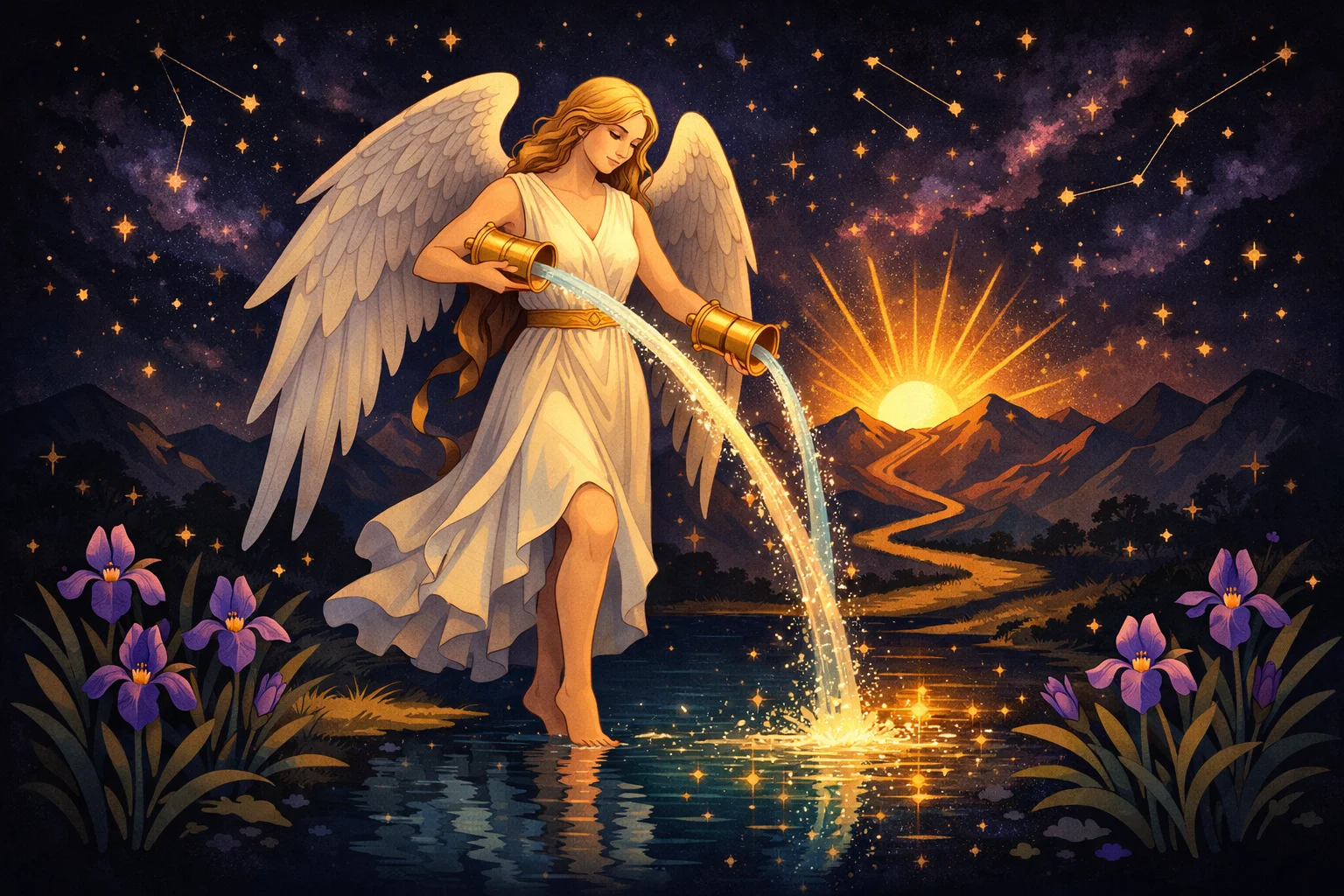
Every detail in the Rider-Waite-Smith image points back to balance and patient blending. A winged angel stands at the water's edge, pouring liquid between two golden cups. Look closely and the water flows at an impossible diagonal — it shouldn't move that way under normal physics. That's deliberate. The pour is alchemy, a spiritual act of combining two separate things into a balanced third, transcending ordinary limits. The two cups are every pair of opposites you're trying to reconcile: conscious and unconscious, reason and emotion, past and future.
The angel's posture is the card's thesis in body language: one foot rests on dry land, the other dips into the pool. Solid ground and flowing water — the material world and the world of feeling, held in deliberate balance. On the angel's robe sits a triangle inside a square, the symbol of spirit contained within matter. And in the background, a path winds away toward a range of mountains, with a golden crown of light rising between the peaks. That distant, sunlit summit is the higher goal you're patiently working toward.
That winding path to a far-off mountain is the key to why Temperance is ruled by Sagittarius. People expect a “balance” card to belong to Libra, the scales. Instead it's the archer's card — and that makes perfect sense once you see the summit on the horizon. Sagittarius aims at distant targets and trusts the long journey toward them. Temperance carries the fire of Sagittarius, but it's a tempered fire: aimed, controlled, burning steady for the long haul rather than flaring out. If you want to see how that patient, far-aiming energy runs in a specific person, their Sagittarius and Jupiter placements in a birth chart show where they naturally play the long game.

Upright: Balance, Patience, and the Slow Mend
Upright, Temperance is reassurance written in slow ink. Whatever you're asking about is coming back into balance, healing, or finding its natural rhythm — on the condition that you stop rushing it. In love, it's the card of reconciliation and meeting in the middle: tempers cooling, two people learning each other's pace, a connection maturing into something steady. In work and money, it favors the long, even climb — consistent effort, sustainable habits, progress that compounds quietly instead of arriving in a flash.
The thread through all of it is moderation as a genuine strength rather than a consolation prize. Temperance upright is the card that says the marathon pace beats the sprint, that you heal faster by not poking the wound, that the budget held steady for two years does more than the lucky windfall. It's also a strong card of recovery — emotional, physical, financial. If you've been through something draining, this card is the deck's way of telling you the mending is underway and your only real job is to keep the pace gentle and let it work.
Reversed: When the Mix Goes Wrong
Reversed, Temperance is what happens when proportion breaks down, and it shows up in two opposite flavors. The loud one is excess — overdoing something at the cost of everything else. Burnout from work with no recovery. Overspending or lifestyle creep. Intensity that's tipped into self-harm. The quieter one is impatience — forcing a result before it's ripe, pushing for an answer the situation can't give yet, trying to skip the steady middle and pay for it later.
There's a third, subtler reading too: two things that simply won't blend. Parts of yourself at war, a relationship that can't find its rhythm no matter how much both people care, a life lived in swings between extremes rather than in flow. Whichever flavor you're looking at, the reversed cure is the same and it's rarely dramatic. Find the one area that's out of proportion, bring it back into line, and stop trying to make something happen on a timeline it can't keep. Reversed Temperance is the only major upheaval that gets fixed by doing less, not more.
Temperance vs. The Star vs. Strength
Three cards get confused with Temperance, and untangling them sharpens every reading they share. The Star is the visual twin — both show a figure pouring liquid near water. Strength is the thematic twin — both are about patient self-mastery. But each carries a distinct message.
| Card | Core Theme | How to Tell It Apart |
|---|---|---|
| Temperance (XIV) | Blending & balance | Active mixing. Pours between two cups to combine them. Asks you to find the right proportion through patient effort. |
| The Star (XVII) | Hope & renewal | Restoration after hardship. Pours onto land and into water to replenish. Asks you to trust and be replenished, not to do the balancing work. |
| Strength (VIII) | Inner courage & calm | Gentle mastery of raw instinct. The maiden soothes the lion. Patient like Temperance, but it's about taming a powerful force, not mixing two of them. |
The quickest tell between the two pouring cards: Temperance combines, The Star replenishes. If the question is “how do I get the mix right?” it's Temperance. If it's “is there hope after this?” it's The Star. To see how the suit a card belongs to colors any reading like this, the guide to the four tarot suits breaks down what Cups, Wands, Swords, and Pentacles each add to the emotional weather of a spread.
What Temperance Says About Timing
Temperance is the deck's definitive “be patient” timing card, and that's worth knowing because timing is one of the most common things people actually ask the cards. When Temperance answers a “when?” question, the honest read is: longer than you want, but it genuinely is moving. This card measures progress in seasons, not days. It rewards the slow simmer over the quick boil. Pull it about a result you're desperate to speed up, and it's practically telling you that the speeding-up is the only thing standing in your way.
If you need a concrete anchor, Temperance is tied to Sagittarius season — roughly late November through late December — so a reader might read it as “around then” for a calendar estimate. But I wouldn't lean too hard on the date. The card's deeper timing message is about ripeness, not the calendar. Something is coming together at its own pace, and your job is to keep showing up steadily while it does. Here's the practical version: if you've been tempted to make a forcing move — an ultimatum, a rushed launch, a premature commitment — Temperance is the card asking you to hold off two more beats and let it finish baking.
Is Temperance a Yes or a No?
Temperance is a soft yes — specifically a “yes, in time.” Because the whole card runs on patience and gradual blending, it almost never supports a fast or forced outcome, but it's genuinely encouraging about things that are allowed to develop at their own pace. For a question about whether something will work out if you stay steady, read it as a quiet yes. For a question about whether you should rush, push, or swing to an extreme to get there, it's a clear no — the card is pointing you back to the middle path.
So the answer depends a little on the verb in your question. “Will this heal?” — yes, with patience. “Should I force it?” — no. If you want a sharper single-word answer on one specific question rather than this whole patient landscape, a focused yes-or-no tarot pull pairs naturally with Temperance's in-time energy.
Reading Temperance Next to Other Cards
A single card sets the theme; the card beside it tells you what kind of balance you're really being asked to find. These are the pairings that shift Temperance's meaning the most.
| Paired With | Combined Meaning |
|---|---|
| Death (XIII) | The natural sequence. A major ending followed by patient rebuilding — the clean break of Death healed back into balance by Temperance's slow, steady work. |
| The Tower (XVI) | Caution meeting chaos. Temperance counsels the measured pace that prevents a Tower collapse; together they often mean “slow down now or face a sudden break later.” |
| The Hanged Man (XII) | A double dose of patience. The Hanged Man surrenders and waits; Temperance actively blends. Together they strongly favor holding off and letting a situation mature on its own. |
| The Magician (I) | Raw will tempered into sustainable flow. The Magician supplies the power; Temperance keeps it from burning out. A potent pairing for building something that lasts. |
| The Devil (XV) | Moderation against excess. Temperance is the direct antidote to The Devil's overindulgence and compulsion — together they highlight exactly where you've lost the middle and need it back. |
The thread through every one of these pairings is the same one running through the whole card. Temperance is the deck's patient craftsperson, the one quietly insisting that almost everything worth having gets built by blending the right things in the right proportion and refusing to rush the result. Pull it and the question is rarely “what dramatic thing should I do?” It's “where have I lost the balance, and can I be patient enough to get it back?” Answer that honestly and Temperance has done its quiet work.