The Justice Tarot Card: How to Read Cause, Effect, and the Truth You Already Know
The Justice tarot card meaning comes down to one principle the rest of the deck dances around: every choice has a consequence, and the consequence will be fair. Pull Justice and the cards stop asking how you feel and start asking what you did. A client once drew it in the outcome position while agonizing over whether to report a coworker who'd been cutting corners. She wanted the card to promise she'd be safe. Instead it told her something more useful — that the truth was going to surface either way, and the only real question was whether she'd be on the honest side of it when it did. That's Justice in a sentence: not what you want, but what's true and what follows from it.
Justice Is the Tarot's Cause-and-Effect Card
Strip away the courtroom imagery and Justice is really about karma in its cleanest, least mystical sense: actions have results, and the universe keeps an honest ledger. This isn't cosmic punishment. It's accounting. What you put into a situation tends to come back to you in kind — sooner if you're lucky, later if you're not, but it comes back. When Justice lands in a reading, it almost always points to a moment where a past choice is about to be settled, or a present choice is about to set a chain in motion.
That makes Justice one of the few genuinely neutral Major Arcana cards. The Sun is good news; the Ten of Swords is bad news. Justice is accurate news. It rewards fairness and exposes its absence with the same calm indifference. If you've been honest and even-handed, the card reassures. If you've been quietly getting away with something, it's a warning the books are about to balance. Justice doesn't take sides. It takes inventory.
The Scales and the Sword: Why Justice Holds Both
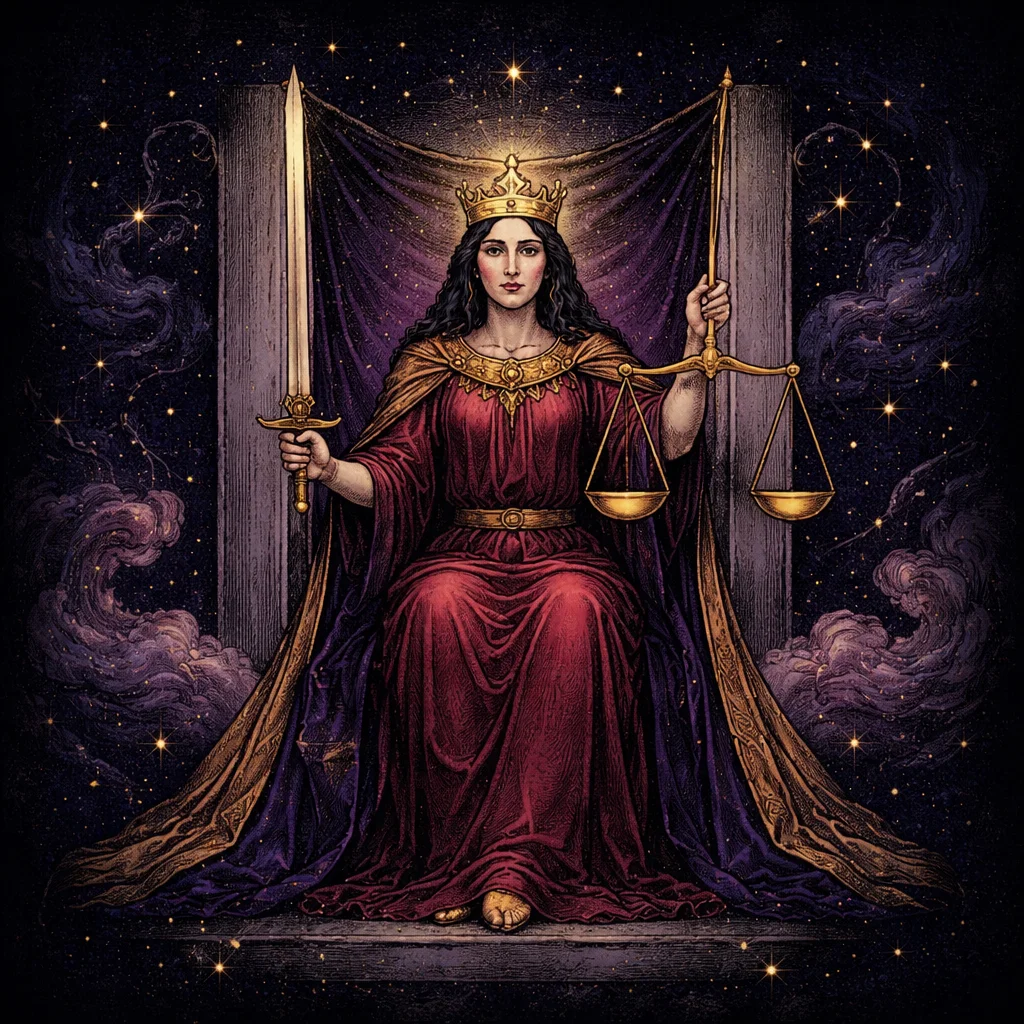
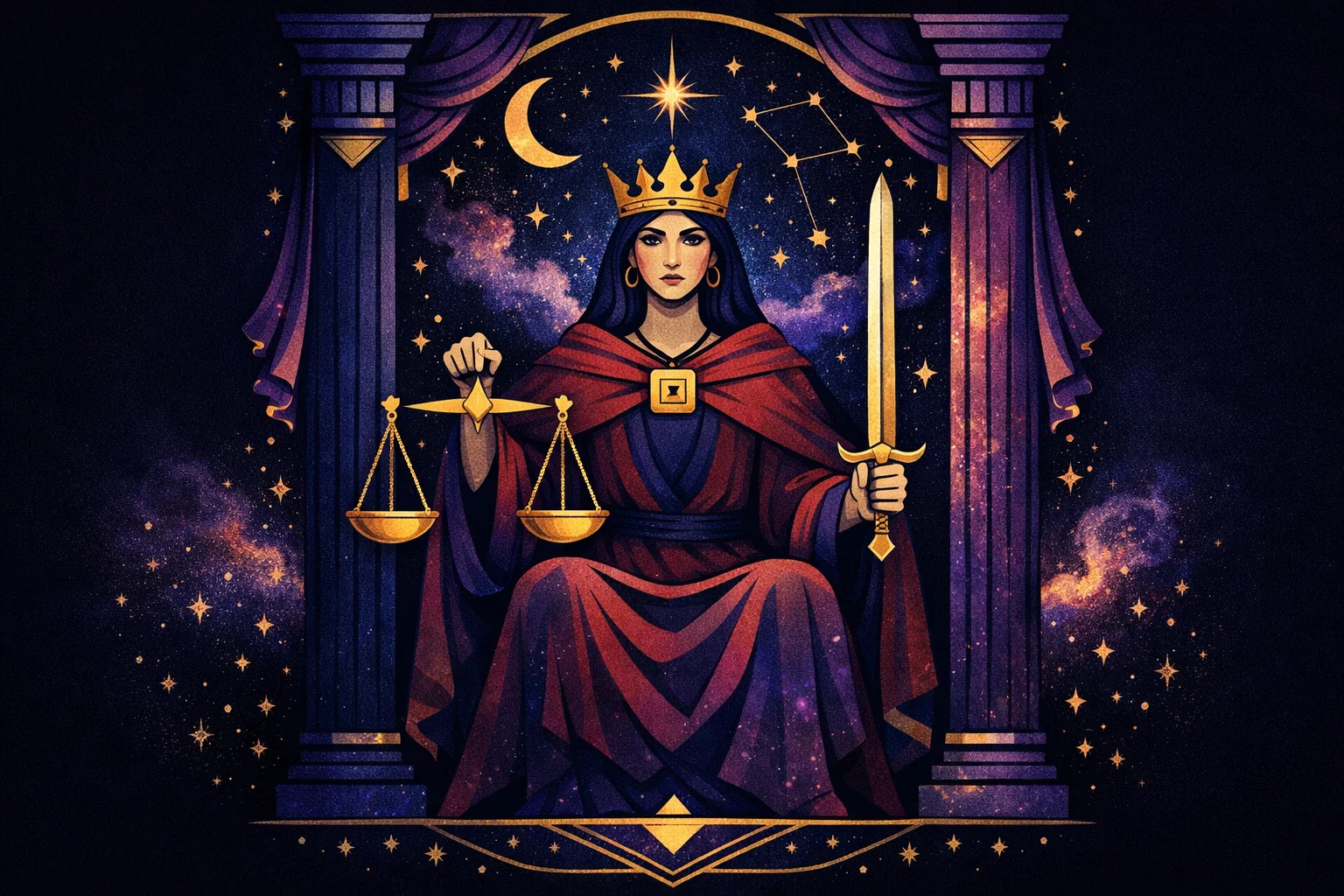
Look closely at the Rider-Waite-Smith Justice card and you'll see a crowned figure seated between two pillars, holding upright scales in the left hand and a raised, double-edged sword in the right. Both objects matter, and the pairing is the whole teaching. The scales are fairness — the careful weighing of every factor before a verdict. The sword is truth, and it's double-edged on purpose: the truth cuts in every direction, including toward you. It shows no favorites.
Notice which hand holds which. The scales sit in the receptive left hand, the sword in the active right. Justice gathers and weighs first, then acts decisively second. That order is the practical lesson of the card — understand the full picture before you swing. The square clasp at the figure's chest reinforces it: a symbol of integrity and firm structure, the idea that fair decisions rest on solid, unmoving principles rather than on whoever argues loudest.
The two pillars frame this scene the way they frame the High Priestess, but here they stand for the structure of law and consequence — the framework within which the weighing happens. Justice doesn't improvise. It applies a standard, evenly, every time.
Compare that sequence with the Two of Swords, whose figure holds two blades in balance without scales. Two arguments can demand equal attention without carrying equal evidence. Read together, the cards ask which fair standard could turn a suspended choice into a decision you can explain.
Why Justice Is XI in Your Deck but VIII in Your Grandmother's
Here's a detail that trips up almost every new reader. If you learned tarot from a modern Rider-Waite-Smith deck, Justice is card XI (11) and Strength is VIII, the card of gentle inner mastery. But pick up an older Tarot de Marseille deck and you'll find them swapped: Justice as VIII, Strength as XI. Neither deck made a mistake.
Arthur Edward Waite deliberately switched the two cards when he and Pamela Colman Smith built their deck in 1909. His reason was astrological. Waite wanted the Major Arcana to line up cleanly with the zodiac, and Justice corresponds to Libra — the cardinal air sign literally symbolized by a set of scales and ruled by Venus. Moving Justice to XI put it in the position that made the celestial correspondences flow correctly. So if your deck shows Justice as VIII, you're holding an older tradition, not a wrong one. Most decks sold today follow Waite, which is why you'll usually see Justice as eleven.
The Libra connection is worth holding onto, because it explains the card's social streak. Justice isn't abstract morality floating in a vacuum. Like Libra, it cares about fairness between people — contracts, relationships, the balance of give and take. That's why it turns up so often in readings about agreements, partnerships, and who owes what to whom.
Justice vs. Judgement: The Two Cards Everyone Confuses
These two get mixed up constantly, and it's easy to see why — both involve being “judged,” and the names are nearly identical. But they point at completely different things, and confusing them steers a reading badly off course. Justice (XI) is earthly: fairness, consequences, decisions, the law of cause and effect. Judgement (XX) is spiritual: awakening, rebirth, a higher call you can finally hear.
| Quality | Justice (XI) | Judgement (XX) |
|---|---|---|
| Domain | Earthly, practical, legal | Spiritual, transcendent |
| Core question | “Was it fair? What follows?” | “Who are you becoming?” |
| The judging is | A verdict on your actions | A calling to rise and renew |
| Element / ruler | Air · Libra | Fire · Pluto |
| Feels like | A courtroom | A resurrection |
A quick way to keep them straight: Justice weighs what you did, while Judgement calls you toward who you could be. If a reading centers on a decision, a dispute, a contract, or consequences, you're in Justice territory. If it's about a spiritual turning point, a profound second chance, or a sense of being summoned to something larger, that's Judgement.
Honest Reckoning, or Accountability Dodged?
That contrast is the entire difference between upright and reversed Justice. Upright, the card is fair dealing in motion — the truth coming out, a balanced outcome, a decision made with a clear head and a clean conscience. You acted with integrity, and the result reflects it. The scales rest level because the weight on each side is honest.
Reversed, Justice describes books that refuse to balance. Sometimes that's unfairness done to you — a biased ruling, a double standard, a situation where merit lost to politics. Just as often, it's accountability being dodged: someone (occasionally the person holding the cards) blaming circumstance, hiding the full story, or avoiding a decision they know they need to make. There's a quieter reversed meaning too — being so hard on yourself that you shoulder guilt for things that were never yours to carry. The scales tip both ways, and reversed Justice asks which direction yours have fallen.
The repair is always the same, and it's rarely comfortable: find the place the truth is being avoided and put it back on the scale. This is where Justice pairs naturally with the surrender and shift in perspective of The Hanged Man, the card numbered right after it. Sometimes you have to stop, hang upside down, and see the situation from a completely different angle before you can weigh it honestly.
Lawsuits, Love, and Decisions You Can't Unmake
Justice is the deck's literal legal-matters card, and it's unusually concrete about it. In a legal spread, upright Justice favors fair rulings, contracts that hold, and disputes resolved on their merits — but read it carefully. It promises an outcome that tracks the facts, not necessarily a win. If the truth and the documentation are on your side, that's a strong draw. If they aren't, the same card warns the verdict will reflect reality. The practical advice it always gives: keep records, read the fine print, and don't leave fairness to chance.
In love, Justice is less about passion and more about equity. It asks whether the relationship is balanced — whether both people pull their weight and the commitment matches on each side. As someone's feelings, it suggests they're weighing the connection with their head, deciding whether it's fair and worth committing to, rather than being swept off their feet. For couples facing a serious decision, it favors the choice made honestly and out loud. This is a useful contrast with the gentle inner balancing act of Temperance: Temperance blends and harmonizes within you, while Justice settles accounts between people.
In career and money, Justice rewards decisions grounded in fact over feeling — contracts, performance reviews, fair settlements, squared debts. It works hand in hand with The Emperor's structure and authority: The Emperor builds the rules, and Justice makes sure they're applied fairly. Whenever the card appears around a big choice, treat it as a nudge to pick the option you could defend out loud to anyone you respect.
Card Combinations That Sharpen the Verdict
Justice rarely reads in isolation — the cards around it tell you what's being weighed and which way the scales are tipping. These are the pairings that come up most:
| Paired Card | Combined Meaning |
|---|---|
| The Tower (XVI) | Consequences arriving fast and hard — a reckoning that topples a structure built on something dishonest. The bill comes due all at once. |
| Two of Swords | A decision you've been refusing to make. Justice says the blindfold has to come off — weigh the facts and choose, because not deciding is itself a choice with consequences. |
| Ten of Swords | A painful but fair ending — a verdict that closes a chapter for good. Hard to hear, but honest, and it clears the ground for a clean restart. |
| King of Pentacles | A favorable financial or legal settlement — a fair, solid outcome in money matters, often a contract or agreement that genuinely works in your favor. |
| The Devil (XV) | An imbalance you keep choosing — an unfair arrangement or unhealthy bargain you have more power to walk away from than you admit. Justice asks you to be honest about your own part in it. |
The combination I watch for most is Justice with the Two of Swords. On its own, Justice can feel like a verdict handed down from above — but paired with that stalled, blindfolded figure weighing two blades, it becomes personal. The message stops being “fate will decide” and becomes “you're the one holding the scales, and the longer you refuse to weigh, the heavier the consequence gets.” That's the heart of the card. Justice doesn't happen to you. You write most of it yourself.