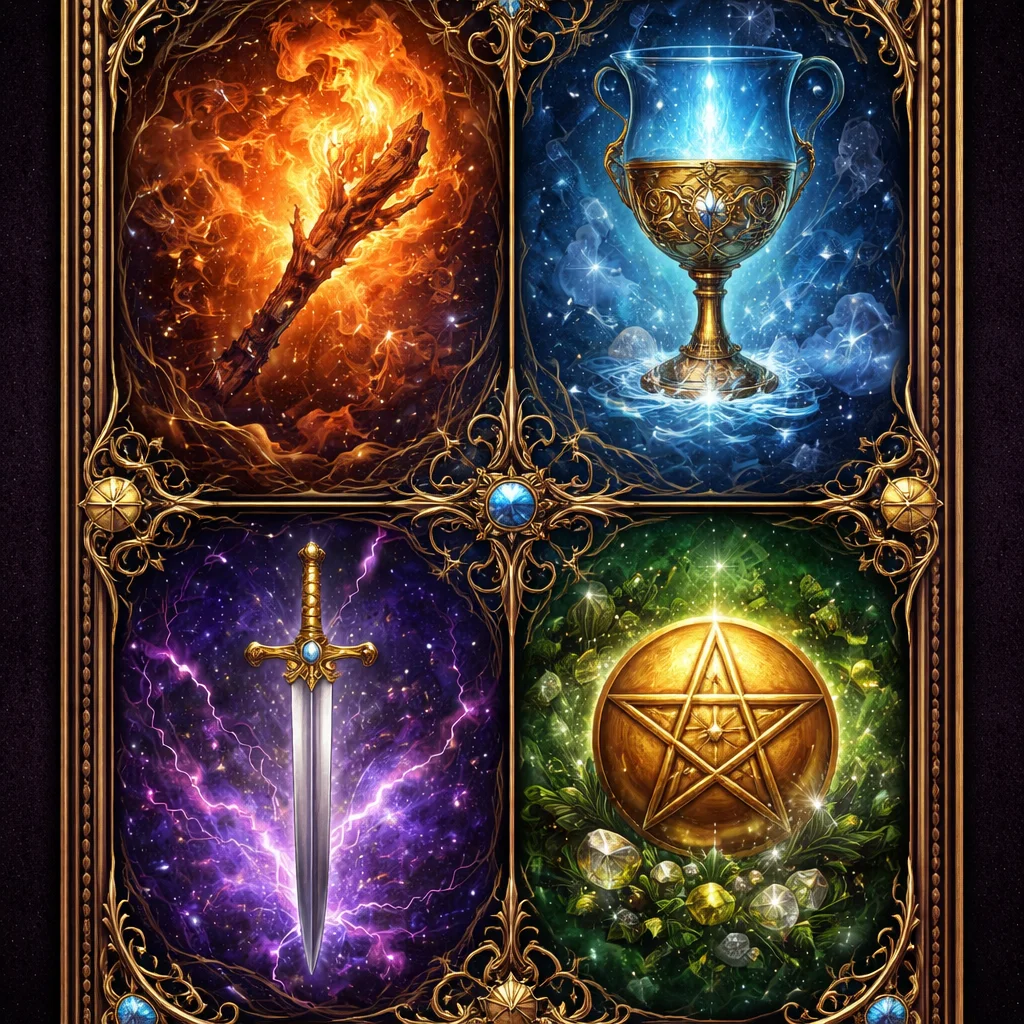
The Four Tarot Suits: Fire, Water, Air, and Earth as One Working System
The four tarot suits aren't four random categories — they're one map of human life cut into quarters. Wands, Cups, Swords, and Pentacles each take a single element and a single arena of experience, and between them they cover almost everything a person can ask about: what you want, how you feel, what you think, and what you can hold in your hands. Learn the four suits properly and the 56 Minor Arcana cards stop being a wall of memorization. They become a language you can actually read.
Most beginners learn the cards one at a time, like vocabulary words, and then panic when a spread hands them three Minor cards they haven't memorized. That's the slow road. The fast road is to learn the suits as a system first, because once you know that Cups means emotion and a Five means loss, you already know the Five of Cups is emotional loss — no flashcard required. This guide teaches the system, not the list — when you do need the list itself, the searchable tarot card meanings list of all 78 cards puts every upright and reversed keyword one search away.
The Suits Are a System, Not a List
Here's the structure underneath the whole Minor Arcana. There are four suits. Each owns one of the four classical elements — fire, water, air, earth — and each element maps to a domain of life that's genuinely distinct from the other three. Fire is drive and desire. Water is emotion and connection. Air is thought and conflict. Earth is the body, money, and the material world. Nothing overlaps, which is exactly why the system works: when a card lands, its suit instantly tells you which part of your life it's describing, before you read anything else. It's no accident that The Magician keeps all four suit symbols on the table — a wand, cup, sword, and pentacle — as a reminder that real mastery means using every element, not just your favorite one. The 22 trumps have their own architecture too — the Major Arcana journey map organizes them as three lines of seven — but the suits are where a reading's everyday detail lives.
The Minor Arcana's 56 cards split evenly — 14 per suit, made of ten numbered cards (Ace through Ten) plus four court cards (Page, Knight, Queen, King). If you want the historical roots of this four-suit structure, and why it looks so much like an ordinary playing-card deck, the documented history of the Minor Arcana traces it to 14th-century European card games. The suits we read for insight today are a spiritual layer added to a much older gaming structure.
All Four Suits Compared at a Glance
This is the table to bookmark. When a card turns up and you blank on its exact meaning, find its suit here and you already have most of the interpretation.
| Suit | Element | Zodiac Signs | Rules | Timing |
|---|---|---|---|---|
| Wands | Fire | Aries, Leo, Sagittarius | Drive, creativity, ambition | Fast (days–weeks) |
| Cups | Water | Cancer, Scorpio, Pisces | Emotion, love, intuition | Slow, flowing (weeks–months) |
| Swords | Air | Gemini, Libra, Aquarius | Thought, conflict, truth | Very fast (instant–days) |
| Pentacles | Earth | Taurus, Virgo, Capricorn | Money, work, body, home | Slow, steady (months–years) |
The timing column is the part most guides leave out, and it's genuinely useful. When someone asks me “when?” the suit of the answer card narrows it down: a Wands answer tends to move in days, a Swords answer can land before you've left the room, and a Pentacles answer asks for patience measured in seasons. Cups keep their own time — emotional things arrive when they're ready, not when you schedule them.
One honest caveat on that column, because it matters more than it looks: the list above puts Swords fastest, and a good half of the tarot world puts Wands fastest instead. The two orders disagree about exactly twenty of the forty numbered cards, and they disagree by a factor of seven. The tarot timing calculator runs both tables side by side against the Golden Dawn decan calendar, which is the only one of the systems that hands you a real date.
Wands: The Fire of Wanting Something
Wands are the suit of desire in motion — passion, ambition, creativity, and the raw energy to start. If a reading is about a project, a career move you're itching to make, or the sheer drive to chase something, Wands are doing the talking. Fire is the element here, and fire is honest about what it is: it creates and it consumes, often at the same time.
What I love about Wands is that they're the suit of before — before the plan, before the money, before anyone's sure it'll work. The Ace of Wands is a spark with no guarantee attached. That makes Wands thrilling and a little dangerous: this is the suit most likely to start five things and finish none. When the Wands run hot in a spread, the question isn't whether you have energy. It's whether you're aiming it.
Cups: The Water of How You Feel
Cups govern the emotional life: love, friendship, family, intuition, grief, and joy. Water is the element, and water's logic is completely different from the other three suits — it doesn't move in straight lines, it pools and floods and finds the low places. When you ask a practical question and the cards answer in Cups, they are quietly telling you the real issue isn't practical at all. The suit opens with the Ace of Cups and its overflowing offer of new love, then travels the full emotional arc from that first pour all the way to the settled contentment of the Ten.
Cups also covers something people miss: creative and spiritual fulfillment, the felt sense of a life that means something. The Cups are where the deck keeps its tenderness — and its heartbreak, since the Three, Five, and Eight of Cups are some of the saddest cards in tarot. If you want to understand how Cups-style feeling differs from true intuition, it's worth reading The High Priestess and her quiet inner knowing, which is a Major Arcana energy rather than a suit, but rhymes beautifully with the water cards.
Swords: The Air of What You Think
Swords are the mind — thought, communication, conflict, truth, and the decisions you keep avoiding. Air is the element, and air cuts. This is the most feared suit in the deck because its hardest cards are genuinely brutal: the Three of Swords is heartbreak made literal, the Nine is the 3 a.m. spiral of dread, and the Ten is rock bottom. New readers see a row of Swords and brace for disaster.
But Swords aren't evil — they're honest. The same element that brings anxiety also brings clarity, the clean cut that ends a bad situation. Not every Swords card cuts loudly, either: the Seven of Swords is a man slipping out of camp with five swords and leaving two behind, which reads as strategy or deception depending on who had a right to know. A Swords-heavy reading rarely means catastrophe is coming; far more often it means you are thinking yourself in circles and a single clear decision would dissolve most of the pain. When that mental pressure finally breaks open into something sudden and external, you've crossed from Swords into The Tower's territory of abrupt upheaval.
Pentacles: The Earth of What You Build
Pentacles (also called Coins or Disks in older decks) rule the material world: money, work, property, health, and the slow business of building a stable life. Earth is the element, and earth doesn't rush. This is the suit of results you can touch — the paycheck, the house keys, the body that either feels good or doesn't.
The gift of Pentacles is reliability; the trap is that the same steadiness can curdle into stagnation, the clenched grip of the Four of Pentacles, or a life so cautious it never actually changes. The Pentacles teach the longest lessons in the deck because they operate on the longest timeline. When they dominate a spread, the cards are pulling your attention down out of your feelings and ideas and into the concrete question: what are you actually building, and is it solid?
One caution that catches almost everybody: Pentacles are not the "work suit" simply because they hold the money. They report the conditions of a job while Wands report whether there is any drive left in it, and a career tarot reading that reads only the Earth half will describe your salary accurately and answer a question you never asked.
Read the Number, Then the Suit
This is the shortcut that turns 40 numbered cards into a simple formula. Every number carries the same core meaning across all four suits — learn the ten numbers once and you can decode any numbered Minor card by combining number plus element. To drill one suit at a time, filter a random tarot card generator to Wands, Cups, Swords, or Pentacles and quiz yourself until the pattern clicks.
| Number | Core Meaning | Example: in Cups |
|---|---|---|
| Ace | Pure seed of the element; a new beginning | New love or emotional opening |
| Two | Choice, balance, partnership | A mutual connection or commitment |
| Three | Growth, first results, groups | Celebration with friends — or a third party |
| Four | Stability, consolidation, sometimes stuck | Emotional boredom or withdrawal |
| Five | Conflict, loss, challenge (every Five hurts) | Grief, regret, focusing on what's lost |
| Six | Recovery, harmony, giving and receiving | Nostalgia, kindness, healing the past |
| Seven | Assessment, perseverance, illusion vs. reality | Too many options, wishful thinking |
| Eight | Movement, mastery, momentum | Walking away to seek something deeper |
| Nine | Near-fruition; the element almost full | Contentment, the “wish” card |
| Ten | Completion; the element fully expressed | Lasting emotional fulfillment, family joy |
Try it yourself. A Five always brings loss, so the Five of Pentacles is material loss (money worries, feeling left out in the cold) and the Five of Swords is a loss of peace (a fight you “win” but regret). Same number, different arena. That single trick does more for your reading speed than any deck of flashcards.
Court Cards Are People (Usually You)
The 16 court cards — a Page, Knight, Queen, and King in each suit — trip up more readers than anything else in tarot, because they're the only cards that can represent an actual human being. The simplest way to read them is as four levels of mastery over the suit's element.
- Page — the student. Curious, new to the element, often a message or an invitation to learn. The Page of Cups is a tender new feeling; the Page of Swords is a sharp idea you haven't tested yet.
- Knight — the doer. Pure action in the element's direction, sometimes overdone. The Knight of Wands charges ahead; the Knight of Pentacles plods reliably toward the goal.
- Queen — inner mastery. She embodies the element from the inside: emotionally fluent (Cups), shrewd and clear-eyed (Swords), nurturing and abundant (Pentacles), magnetic and warm (Wands).
- King — outer mastery and authority. He wields the element in the world: the King of Pentacles is the self-made provider, the King of Swords is the fair judge who rules by reason.
When a court card appears, ask three questions in order: is this a real person in my life, is it a role I'm being asked to step into, or is it a part of my own personality showing up? Nine times out of ten, if no obvious person fits, the court card is a mirror — it's you.
When Suits Fight or Feed Each Other
Here's the advanced layer almost no beginner guide teaches: elemental dignities. When two cards from different suits sit next to each other, their elements interact — some combinations amplify, some cancel out. This comes from the Golden Dawn tradition, and once you see it, side-by-side cards stop being isolated and start talking to each other.
| Pairing | Relationship | Effect in a Reading |
|---|---|---|
| Same suit (e.g. Cups + Cups) | Strengthen | The element's message gets louder and more certain. |
| Wands + Swords (Fire + Air) | Friendly | Air feeds fire — ideas fuel action. They energize each other. |
| Cups + Pentacles (Water + Earth) | Friendly | Water nourishes earth — feeling and security support each other. |
| Wands + Cups (Fire + Water) | Opposing | They weaken each other — passion and emotion pulling in different directions. |
| Swords + Pentacles (Air + Earth) | Opposing | Thought and matter clash — plans that struggle to become real. |
You don't need this on day one. But once you're comfortable with single cards, dignities are what take a reading from “here's what each card means” to “here's how these forces are actually interacting.” A Knight of Wands next to a Knight of Swords is doubly energized — bold action backed by a sharp plan. That same Knight of Wands beside a Knight of Cups is a person torn between what they want and what they feel.
What a One-Suit Spread Is Telling You
Before you interpret a single card in a spread, count the suits. The balance of elements is its own message, and it's usually the loudest one in the room. Here's a real example of why that matters.
Worth noting how unusual this four-way symmetry actually is. The other divination set on this site splits differently and far less evenly: an Elder Futhark rune cast divides its twenty-four stones into three groups of eight called aettir, and six of the nine runes that have no reversed form at all are crowded into one of them. Counting groups works there too — it just tells you something lopsided rather than something balanced.
A querent once asked me a tidy, practical question: “Should I take the new job?” She expected Pentacles — money, work, security. Instead the three-card spread came up entirely Cups, with no Pentacles at all. The cards weren't answering the question she asked; they were correcting it. The real issue had nothing to do with salary or logistics. She felt unseen and unappreciated where she was, and the new job was an emotional escape dressed up as a career move. Once we read the suit instead of forcing the cards to talk about money, the actual decision became obvious.
That's the whole point of learning suits as a system. A spread drowning in Swords says “you're stuck in your head, not your circumstances.” A relationship question with zero Cups says “there's no feeling left here, only logistics.” A sudden flood of Wands says “you have more drive than direction right now.” To see how these suit patterns shift depending on where each card lands, pair this with the guide to tarot spreads and card positions — suit tells you the arena, position tells you the role it plays. Read both together and you're no longer interpreting cards. You're reading a situation.
One caveat worth carrying into that: the suit balance skews the answer before any individual card does. Nine of the fourteen Cups read as a yes on a yes-or-no question and seven of the fourteen Swords read as a flat no, so an all-Swords spread was tilted toward bad news the moment it landed. The verdict split for the whole deck is broken down card by card in the complete guide to all 78 tarot card meanings, alongside what each card says upright, reversed and in love.