Ace of Cups: The Card That Offers Love — If You'll Take the Cup
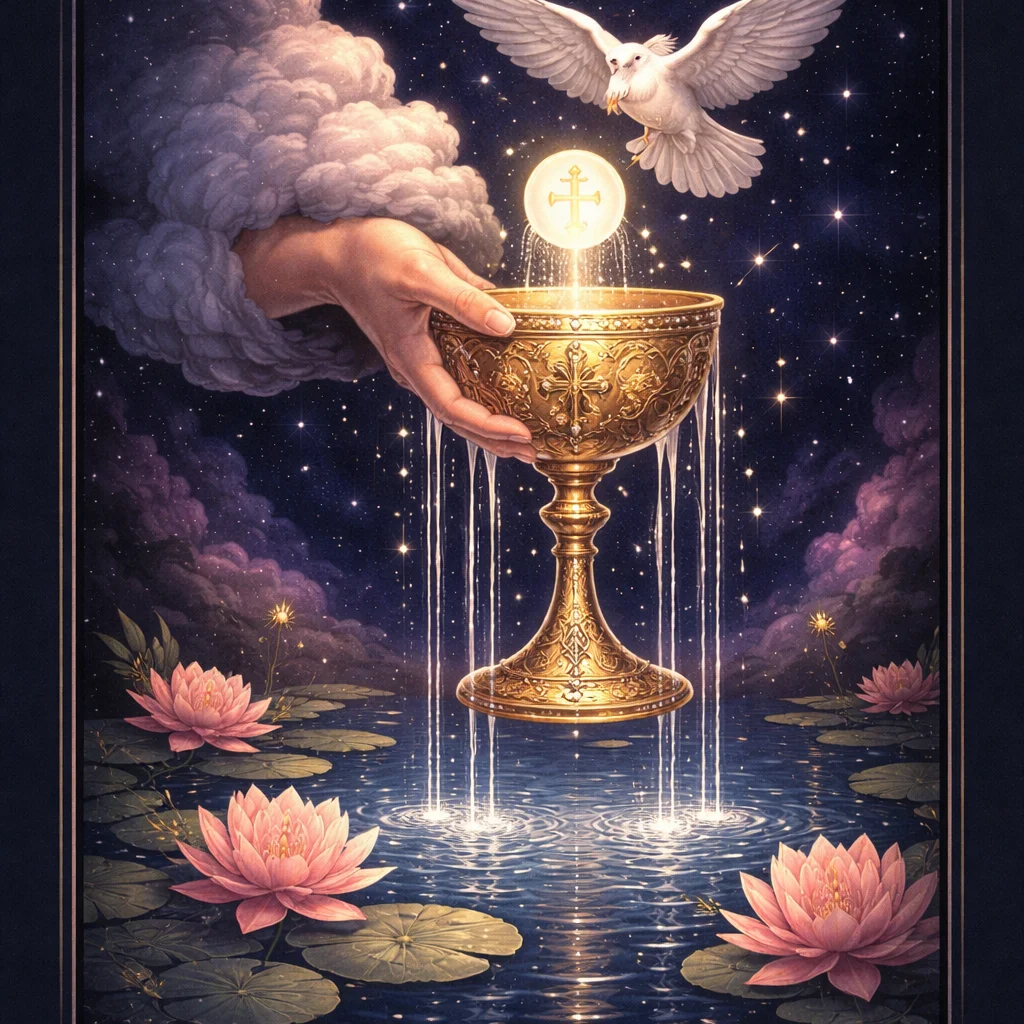
The Ace of Cups tarot card meaning almost always gets shortened to three words — “new love coming” — and that shorthand skips the single most important thing in the picture. Look at the card. A hand reaches out of a cloud and holds a golden cup toward you, brimming and spilling over. It isn't setting the cup down for you. It isn't promising you'll drink. It's offering. And an offer, unlike a fate, can be refused — which is exactly why so many people pull this beautiful card and still end up with nothing changing. The Ace of Cups isn't the guarantee of love. It's the invitation to receive it.

The Ace of Cups Is an Offer, Not a Promise
Every Ace in tarot is a seed — the pure, undiluted potential of its suit before anything has been done with it. The Ace of Cups is the seed of Water: emotion, love, intuition, compassion, the whole inner life. But notice how it's delivered. Where the Ace of Pentacles rests a coin in an open palm and the Ace of Swords stands upright and ready to be gripped, the Ace of Cups is held out, overflowing, from a hand that could withdraw at any moment. That framing is the card's real teaching. Love here is available, not assured. The feeling is being extended toward you, and the only question the card actually asks is whether you're open enough to take it.
This is why I've watched the same card mean wildly different things for two people in the same week. For the querent whose heart is open, the Ace of Cups lands like a yes — the crush that turns real, the reconciliation, the wave of feeling that finally breaks through. For the querent who's spent years guarding, it lands as a question they'd rather not answer: the love is right there — so why won't you reach for it? Same card. Same offer. Different readiness to receive. Hold onto that idea of receptivity, because it turns out to be the key that unlocks the reversed meaning, the love reading, and the shadow all at once.
What's Actually Inside the Overflowing Cup
Most guides decode this card by naming the obvious: cup means emotion, water means feeling, overflow means abundance. All true. But Pamela Colman Smith packed the Ace of Cups with specific symbols, and each one shifts the reading in a way that's worth knowing. Start with the five streams pouring over the brim. Five is the number of the senses — the card is telling you this emotion won't stay abstract; it spills into the physical, tangible, felt world. Love you can touch, not just think about.
Then look at the white dove descending into the cup, carrying a round wafer marked with a cross. That's the communion host — the descent of divine love, grace pouring down from something larger than you. It's the detail that makes the Ace of Cups more than a romance card: it's spiritual love, self-love, and compassion as much as it is a new relationship. The drops falling around the cup are yods, the Hebrew letter that stands for a spark of divine will — grace raining down whether or not you earned it. Below, the cup hovers over a still lake covered in lotus flowers. Lotuses bloom out of dark, quiet water, which is the whole promise in miniature: feeling rises from the depths of the subconscious and flowers on the surface. Even the letter on the cup's face — read variously as a W for water or an inverted M — keeps pointing back to the element. Put it together and the “new love card” reveals itself as something wider: an overflow of feeling, sacred and sensory at once, offered from above and blooming from below.
New Love, Offered — and Why You Might Not Take It
In a love reading, the Ace of Cups is about as warm a card as the deck holds. For singles it points to new love arriving or, more precisely, the readiness to let it in — a spark worth following, a first date that actually means something, a connection that begins in the heart rather than the head. For couples it's renewal: falling for each other a second time, a proposal, a reconciliation, the feelings running deep again after a dry spell. Read as how someone feels about you, it's one of the most romantic answers you can get — new, tender, overflowing emotion, a heart genuinely opening, unfiltered and sincere precisely because it's early. If the Ace of Cups is the offer of love, the Lovers and its card of conscious choice and union is the moment you actually decide to drink from the cup — which is why the two so often travel together in a spread.
Here's the part the cheerful interpretations leave out, though. Because the Ace is an offer, the love reading has a catch: plenty of people won't take the cup. They idealize the new person from a safe distance, brace for the heartbreak before there's been any, or reach for the spark to plug an emptiness rather than to share a fullness. When that happens, the beautiful card sits there unclaimed. So when the Ace of Cups shows up in your love reading, the honest follow-up question isn't “when will love arrive?” It's “when it's offered — and it will be — will I actually let it in, or will I find a clever reason to leave it on the table?” A love tarot reading built around your actual situation answers that better than the Ace alone can, because its single spread contains a position for what you're carrying into the offer.

Ace of Cups Reversed: The Cup You Turned Over
Reversed, the cup tips and the water won't pour — but it stalls in two very different ways, and telling them apart changes everything. The first is the walled-off cup: blocked or held-back feeling, a heart guarding itself, love that isn't being expressed, a new connection that stalls before it can begin. This is emotional emptiness, numbness, the ache of a love that isn't returned, or the quiet habit of shutting down and calling it “being fine.” The second is the opposite leak — the flooded cup: emotion overflowing as overwhelm rather than release, feelings spilling everywhere before they've been sorted, or pouring so much into someone else that your own vessel runs dry.
Both point to the same medicine, and it's the reversed Ace's most reliable message: refill your own cup first. This is the card's famous self-love reading, and it isn't a greeting-card platitude — it's mechanical. You cannot pour from a vessel that's empty or offer from one that's turned over. Before you chase the new relationship or force the stalled feeling, the reversed Ace asks you to unblock the channel: feel what's backed up, rest, receive comfort, and let the cup empty out and refill clean. It's the same hope that the Star and its promise of renewal after a hard stretch carries — that after the cup has run dry, the water always comes back.
Root of the Powers of Water: Where the Suit of Cups Begins
The Golden Dawn gave every Ace the same title — the “Root of the Powers” of its element — and it's a useful frame. The Ace of Cups is the Root of the Powers of Water: the undivided source of everything the whole Suit of Cups and its element of Water will go on to explore. Everything downstream is contained in this single overflowing cup. The Two of Cups is the offer accepted — the connection made mutual. The later cards run through romance, celebration, disappointment, nostalgia, wishful thinking, the wish granted, and, at the very end, the Ten of Cups: emotional fulfillment, family, the rainbow of a heart fully at home. The Ace holds the seed of all of it. The water it pours is the same water the King of Cups eventually learns to master without being ruled by — the Ace begins the river, the King commands the sea.
Because Aces are pure elemental energy, they aren't tied to a single zodiac sign the way the court cards are. Instead the Ace of Cups carries the feeling-first, intuitive current of all three Water signs. Here's how the correspondences line up:
| Correspondence | Ace of Cups |
|---|---|
| Suit / Element | Cups — Water (emotion, love, intuition, the subconscious) |
| Rank | Ace — the seed, the pure potential, the beginning of the suit |
| Golden Dawn title | Root of the Powers of Water |
| Zodiac energy | All Water signs — Cancer, Scorpio, Pisces (tender, receptive, intuitive) |
| Yes / No | Yes upright — a warm, feeling-rich “yes,” strongest for love and reconciliation |
| Key symbols | The offered hand, five overflowing streams, the descending dove and host, the lotus lake |
When the Ace Shows Up: How to Actually Accept the Cup
Knowing the Ace of Cups is an offer only helps if you know what to do with it, so here's the practical part. When this card lands upright, treat it as a green light to lead with feeling rather than strategy — to say the vulnerable thing, take the first date seriously, reopen a door you shut after a hurt, or simply let a kindness land without immediately calculating what you owe for it. The Ace rewards receptivity. The worst thing you can do with an offered cup is overthink whether you deserve it. On timing, the Ace often marks the very start of an emotional cycle, so read it as “this is beginning now” rather than “this is finished.”
There's also a moment the Ace of Cups is not the card to force, and it's worth naming. If it arrives reversed, or heavily crossed by harder cards, the honest move isn't to go hunting for new love — it's to refill first. Pushing a fresh relationship on top of an empty cup is how the reversed meaning comes true. And when the Ace pairs with the intuition-and-inner-knowing of the High Priestess and her still, subconscious waters, take it as a specific instruction: the answer about this feeling is already inside you — stop analyzing it and listen to what the water is telling you. The Ace of Cups trusts the heart's first honest answer over the head's carefully managed one.
The Cards That Change What the Cup Holds
Because the Ace of Cups is a seed, the cards around it decide what it grows into. These are the pairings that come up most at the table:
| Paired Card | Combined Meaning |
|---|---|
| Two of Cups | The offer accepted. The Ace's single overflowing cup becomes a shared one — mutual attraction, a bond made real, the spark turning into a genuine two-way connection. |
| The Lovers (VI) | New feeling deepening into a real choice. The Ace opens the heart; the Lovers asks you to commit to what it opened — a significant, values-level union rather than a passing spark. |
| Ten of Cups | The whole arc in one spread. The Ace's first drop and the Ten's full rainbow together promise lasting emotional fulfillment — a home, a family, a happiness that stays. |
| Three of Swords | The offered cup meets old heartbreak. Either a warning the tender new feeling could get hurt, or the reason your cup is turned over — grief that has to clear before the water can pour again. |
| The Star (XVII) | Two water-blessing cards. The Ace fills the vessel and the Star keeps it flowing — hope, healing, and emotional renewal at full strength, especially after a dry or painful stretch. |
The pairing I flag most is the Ace of Cups beside the Three of Swords, because it's the exact spot where the deck shows you why an open heart feels so risky — the offered cup and the old grief in the same breath. But whichever cards surround it, the Ace keeps pointing at the same quiet instruction underneath all the romance. The love is being offered. The water is already pouring. Your only real job is to stop guarding long enough to hold the cup out and let it fill.