The Star Tarot Card: How Card XVII Restores Faith After the Tower Falls
The Star tarot card meaning lands hardest when you pull it right after everything has gone wrong. A woman once sat across from me three weeks after a divorce she didn't see coming — house sold, plans gone, the whole structure of her life flattened. She shuffled, drew one card for “what now,” and turned over the Star. She actually laughed, the bitter kind. But that card was the single most accurate thing the deck could have said to her. The Star isn't about things being fine. It's about hope returning to a place that just got leveled — quiet, unhurried faith that the ground can be rebuilt. Card seventeen is what the night sky looks like after the storm finally passes.
The Star Only Makes Sense After the Tower Falls
Here's the key most quick-reference guides skip: the Star is numbered XVII, immediately after the sudden upheaval of the Tower (XVI), and that order is the entire point. The Major Arcana tells a story in sequence, and the Star is the chapter that comes because the Tower happened. Lightning strikes, the false structure collapses, the figures fall — and then the smoke clears and the stars come out. You can't see them while the building's on fire. You only see them once it's gone.
That's why pulling the Star feels so different depending on where you are. Drawn after a stable stretch, it's a gentle promise. Drawn after a Tower moment — a breakup, a layoff, a loss that knocked the wind out of you — it's something closer to mercy. It says the destruction had a purpose, that it cleared away what was built on sand, and that what comes next can rest on something truer. The Star never pretends the Tower didn't hurt. It just refuses to let the hurt be the end of the sentence.
Reading the Imagery: Two Pitchers, One Bare Sky
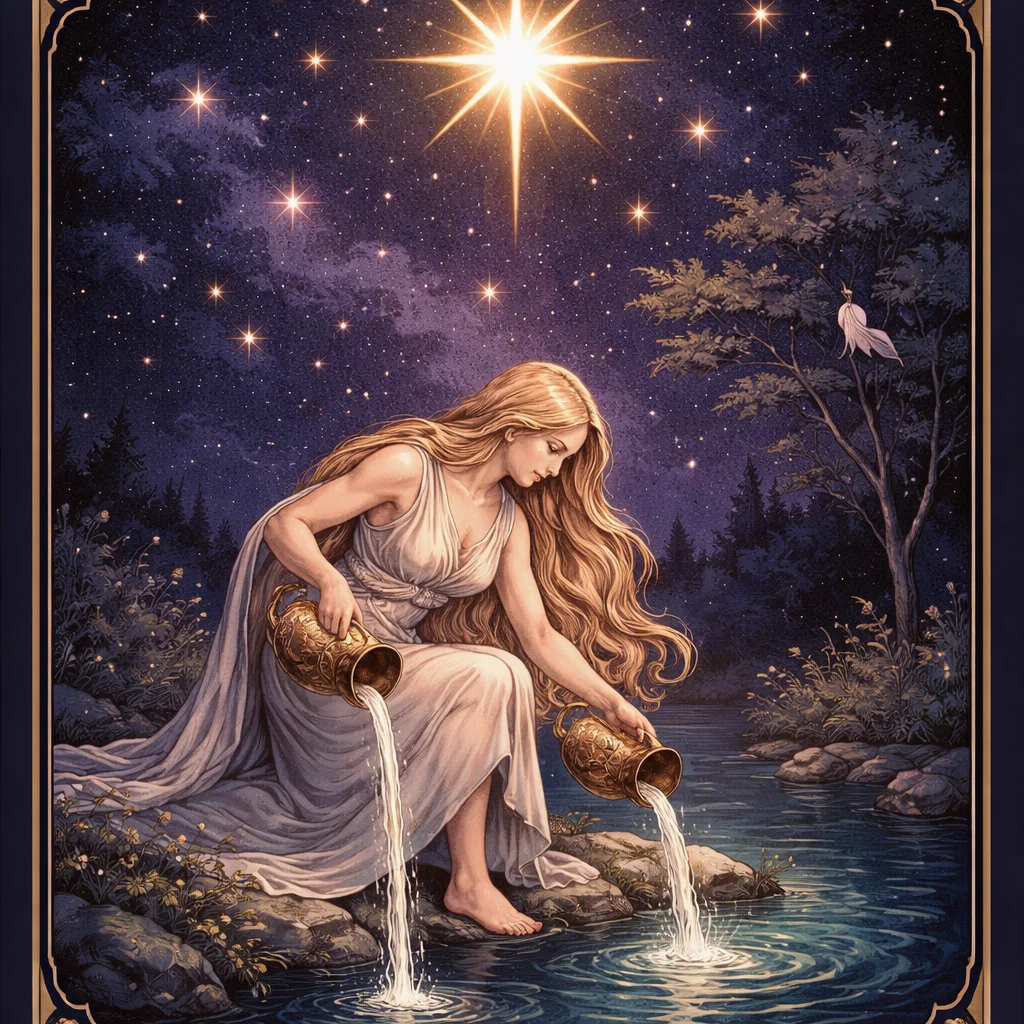
Look closely at the Rider-Waite-Smith Star card and you'll see a figure kneeling at the edge of a pool. One knee rests on the land, one foot touches the water. She holds two pitchers and pours from both at once — one stream onto the dry earth, the other back into the pool. That double pour is the card's quiet genius. The water on land nourishes the practical, visible world. The water into the pool replenishes the emotional, unconscious one. The Star tends both at the same time, and it pours from a source that never seems to run dry.
Her bareness matters too. After the Tower stripped everything away, she has nothing left to hide and no armor left to wear — and the card frames that not as humiliation but as freedom. This is total openness, total vulnerability, and the Star says that's exactly the posture hope requires. You can't receive the water with your fists clenched. The foot on land and the foot in water carry the same message as Temperance's stance: one part of you stays grounded in reality while the other stays fluid and intuitive. It's no accident the two cards rhyme — both are about the patient flow and gentle balancing of Temperance, just at different points in the journey.
What the Eight Stars Actually Stand For
Count the stars and there are eight: one large central star and seven smaller ones arranged around it. This isn't decorative. The seven smaller stars are most commonly read as the seven chakras or the seven classical planets — the moving parts of body and cosmos — while the large eight-pointed star is the central organizing force, the higher self or guiding light that holds the rest in orbit. There's a tidy numerological echo here too: the Star is card 17, and 1 + 7 reduces to 8, the number of balance and infinity, which is exactly how many stars are in the sky above her.
| Symbol | What It Carries in a Reading |
|---|---|
| Large central star | Your guiding light or higher self — the core hope the reading is pointing you toward. |
| Seven smaller stars | The chakras / classical planets — the many parts of you that are realigning back into balance. |
| Two pitchers | Tending outer life (land) and inner life (water) at once; an unending, generous source. |
| The bird in the tree | Often an ibis, sacred to Thoth — wisdom and the soul, watching over the renewal. |
Why Readers Call It the Wish Card
Sit at enough tarot tables and you'll hear the Star called the “wish card,” and the nickname earns itself. When someone asks about a goal, a dream, or a thing they're quietly hoping for and the Star turns up nearby, it reads like the universe nodding. Keep wishing. It's supported. The Aquarian roots are part of why — the Star corresponds to Aquarius, the Water Bearer, the sign that pours its vision toward a better future. Hope here isn't naïve; it's directional.
But the wish card comes with honest fine print, and good readers say it out loud: the Star promises the outcome, not the timing. It's slow magic. It tells you the wish is worth holding and that conditions are turning, but it won't tell you it's tomorrow. The figure pours water steadily, drop by drop, not in a flood. If you need a faster, more direct read on whether something will land, that's the job of a focused yes-or-no tarot pull. The Star answers “is it worth hoping for?” with a confident yes — it just leaves “when?” to other cards.
The Minor Arcana has a wish card of its own. The Nine of Cups grants a wish in the form it was worded, which is a different promise from the Star's. The Star says the hope is worth keeping; the Nine says the thing asked for arrives, and asks whether the wording was right.
Star, Moon, Sun: Tarot's Celestial Trio
The Star doesn't travel alone. Cards XVII, XVIII, and XIX form a run of three night-and-sky cards — the Star, the Moon, and the Sun — and reading them as a set sharpens each one. They trace a journey from first hope, through confusion, into full daylight clarity. Knowing where the Star sits in that arc stops you from over-reading it as the finish line. It's the dawn's first light, not the noon.
| Card | The Energy | What It Asks of You |
|---|---|---|
| The Star (XVII) | Quiet hope, healing, faith renewed | Keep believing while it rebuilds |
| The Moon (XVIII) | Illusion, fear, the unclear path | Trust intuition through the fog |
| The Sun (XIX) | Joy, success, full clarity | Celebrate; the work paid off |
The practical takeaway: when the Star shows up, you're early in a good arc, not at the end of one. There may still be a Moon stretch of uncertainty between you and the Sun's full payoff. That's not bad news — it's a map. The Star is telling you the destination is worth the walk.
When the Light Dims: Upright vs. Reversed
Upright, everything above holds: hope, healing, renewed faith, the felt sense that the worst has passed and the well is refilling. The Star upright is one of the cards I'm always glad to see in a recovery, grief, or burnout reading, because it speaks the exact thing those moments need — not “you're fixed,” but “the light is coming back.”
Reversed, the stars haven't gone out — the clouds have just rolled in. Reversed Star is discouragement, lost faith, spiritual disconnection, the flat grayness of someone who's stopped believing things can improve. Notice the distinction: it rarely means the situation is hopeless. It means you've lost sight of the hope, which is a very different and far more workable problem. The medicine is gentle and unforced — rest, small rituals, honesty about the emptiness, time literally spent under a night sky. Reversed, the Star isn't condemning you to the dark. It's reminding you the dark is weather, not climate.
Card Combinations That Shape the Hope
The Star takes on different shades depending on its neighbors. These are the pairings that come up most at the table:
| Paired Card | Combined Meaning |
|---|---|
| The Tower (XVI) | The signature sequence — upheaval followed by healing. Hard loss that genuinely clears the way for something better. The most reassuring “bad” pairing in the deck. |
| Three of Swords | Heartbreak that's beginning to mend. The grief was real, but the Star says the wound is closing and faith in love can return. |
| Ace of Cups | Emotional renewal at full strength — a fresh start in love or creativity, the well not just refilled but overflowing. A beautiful draw. |
| The Moon (XVIII) | Hope tested by uncertainty. The faith is real but the path isn't clear yet — keep believing while you feel your way through the fog. |
| Eight of Cups | Walking away from what no longer serves you toward something more hopeful. The Star lights the road out of a draining situation. |
The combination I always pause on is the Tower and the Star together. On their own, the Tower frightens people and the Star comforts them. Side by side they tell the truest story the tarot knows: that the thing which fell apart and the hope that follows it are not two separate events. They're one motion. The roof had to come off before she could see the stars. If you remember nothing else about card XVII, remember that — the Star is the proof that the wreckage was clearing the view.