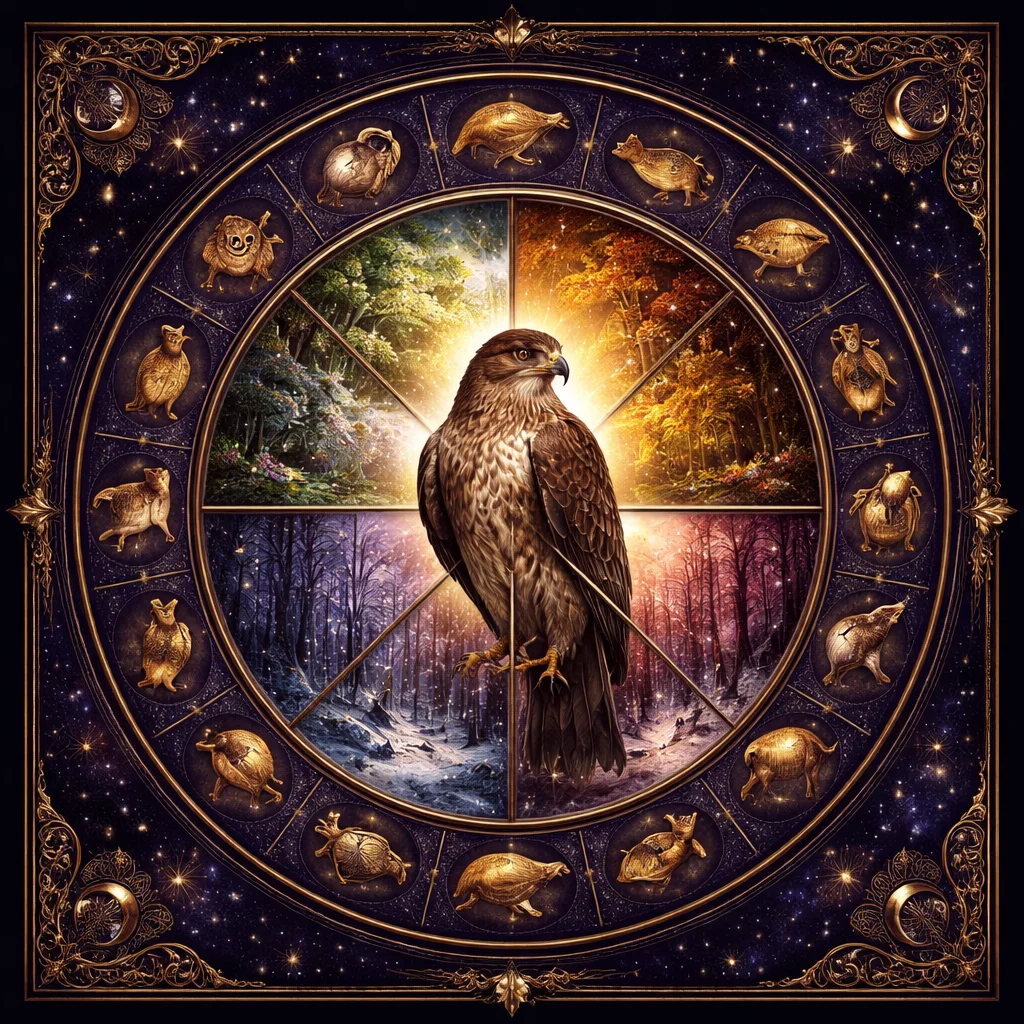
Twelve Birth Totems, Twelve Zodiac Signs, and One Calendar Between Them
The Native American zodiac you find online has twelve animals, and every one of them occupies the same block of the calendar as a Western star sign. Not roughly. Measurably. Run the wheel's own boundaries against the Sun's real position across a century of birthdays and the two point at the paired answer 98.02% of the time. The four clans turn out to be the four Greek elements. The four sacred directions turn out to be the four seasons. What you are being handed is the zodiac with animal names on it, and nobody selling it says so.
Where the Twelve Totems Actually Came From
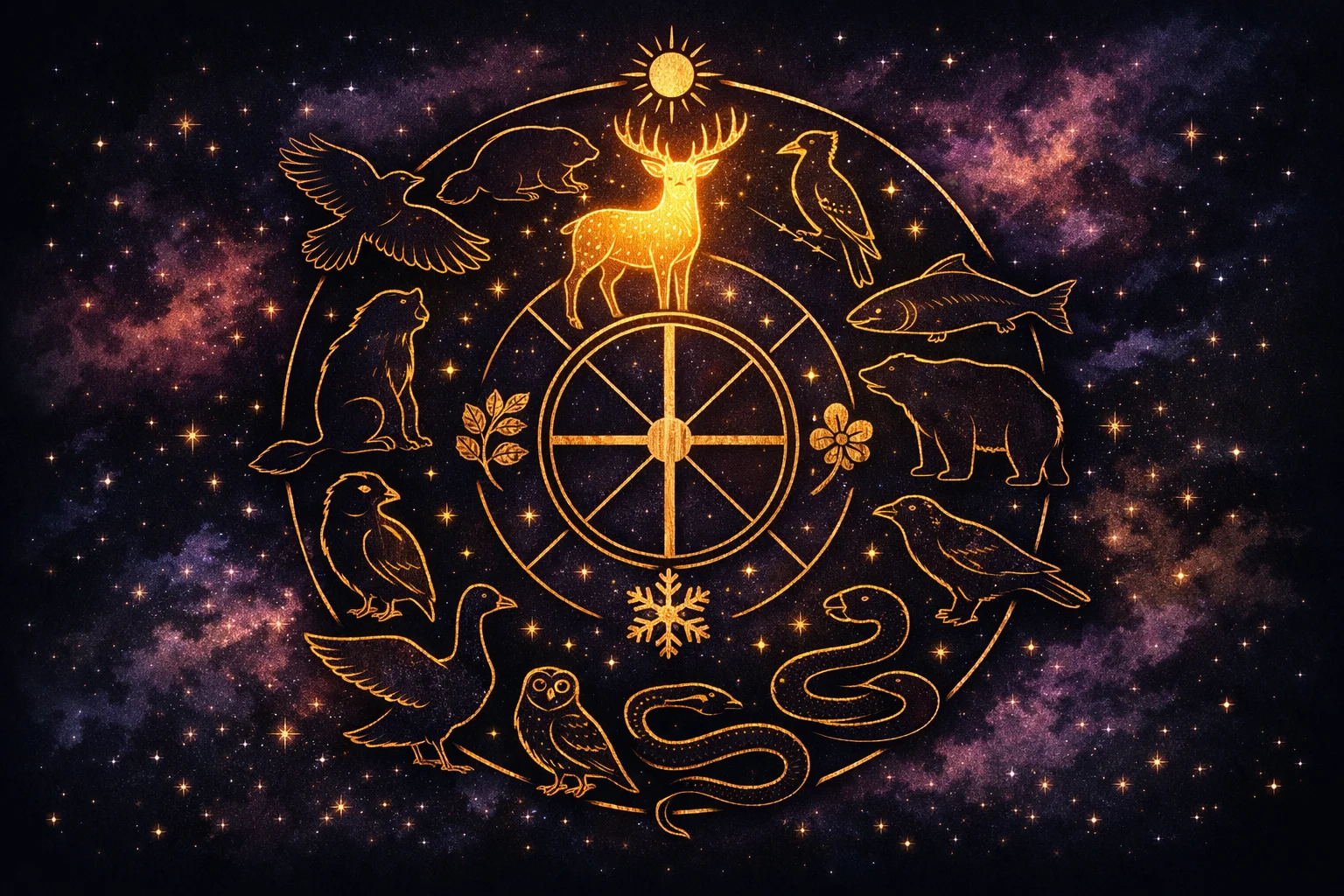
Short version: the twentieth century. The twelve-totem wheel spread through popular medicine-wheel books published from around 1980 onward, most influentially by the author who wrote as Sun Bear, and it drew on a mixture of earlier occult writing, general Plains-nation symbolism and a good deal of invention. It is not the astrology of the Anishinaabe or the Lakota or the Cherokee or anybody else. There isn't a single "Native American astrology" any more than there is a single European one — hundreds of distinct peoples across North America hold their own cosmologies, and those traditions are not interchangeable with each other, never mind with a twelve-slot birthday chart.
I'm not saying this to be difficult about it. I'm saying it because it changes what the wheel is good for. A modern folk system can be genuinely useful — the tarot most people read is a nineteenth-century reconstruction and it works fine — but you read it differently once you know it's modern. And in this case, knowing it's modern is what lets you spot where it was copied from.
The Four Clans Are the Four Greek Elements
The wheel sorts its twelve animals into four clans: Thunderbird, Turtle, Butterfly and Frog. Sounds like a different vocabulary entirely. Then you look at what those clans are made of.
- Thunderbird — Fire: Red Hawk, Salmon, Owl
- Turtle — Earth: Beaver, Brown Bear, Snow Goose
- Butterfly — Air: Deer, Crow, Otter
- Frog — Water: Woodpecker, Snake, Wolf
Now put the paired star signs next to them. Thunderbird holds Aries, Leo and Sagittarius. Turtle holds Taurus, Virgo and Capricorn. Butterfly holds Gemini, Libra and Aquarius. Frog holds Cancer, Scorpio and Pisces. Those are the four classical triplicities, unchanged, in the correct order, with no exceptions: 12 of 12 totems carry the element of the sign underneath them. That figure is derived from the tables on this page rather than typed into it, so if a totem were ever reassigned the number would move.
Twelve out of twelve is not a family resemblance. Two systems that developed separately would not agree on which animals belong together, in what groups of three, in what order, using the same four categories a Greek writing in the second century would recognise.
Why Do the Directions Line Up With the Solstices?
Second test, and it is the one that gives the game away completely. Each totem sits in one of four compass directions on the wheel, and each direction owns a season. East is spring, South is summer, West is autumn, North is winter.
Here is the thing about that. East holds exactly the three totems whose date ranges run from the March equinox to the June solstice. South holds exactly the three from the June solstice to the September equinox. And so on round. The direction isn't an independent piece of information at all — it is a restatement of which quarter of the solar year you were born in, which is precisely what the tropical zodiac's four quadrants encode. All 12 of 12 land correctly, and again that count is computed from the table rather than asserted.
The tell is that the wheel is anchored to the equinoxes and solstices. A calendar built by people watching a different sky, or counting a different cycle, has no reason to start its year on 21 March. The Chinese year starts at a new moon. The Mayan Tzolkin count doesn't track the solar year at all. This one starts at the vernal equinox, which is exactly where the Babylonian-Greek zodiac starts, because that is where it was copied from.
Your Totem Is Your Star Sign Wearing a Coat
Third test, and the strictest, because it doesn't compare the wheel to another website's table — it compares the wheel to the sky. For every totem boundary in every year from 1930 to 2029, this page solves the moment the Sun genuinely entered that sign and measures the gap. Across all 1200 boundary-years the average gap is 0.65 days, and the worst single case anywhere in the century is 2.14 days, on the Brown Bear boundary.
Under two and a bit days, worst case, on all twelve. That is not what independent calendars look like next to each other. That is what a transcription looks like.
And the population figures fall into line the same way. Because the twelve blocks vary in length — the Earth moves faster near perihelion, so the winter signs are shorter — birthdays are not spread evenly across the zodiac. The true solar signs run a spread of 1.068× between the commonest and the rarest. The fixed totem table, which knows nothing about orbital mechanics and is just a list of dates, reproduces that at 1.069×, with no individual totem more than 0.17 percentage points off its paired sign. A copy inherits the original's fingerprints.
The Only New Information Is the Mistakes
So how much is a birth totem actually worth, given you already know your star sign? That question has a real answer, and it is the most useful thing on this page.
A twelve-way split looks like 3.5847 bits of information — that's just what twelve roughly equal outcomes are worth. But the number that matters is how much is left once your Sun sign is already on the table. Measured across all 36,525 dates in the century, that comes to 0.1362 bits. So 96.20% of your birth totem reading is your star sign restated.
The control is what makes that a finding rather than a shrug. A genuinely independent twelve-slot system scores the full 3.5847 bits there, because knowing your Sun sign tells you nothing whatsoever about it. Run the Chinese animal that way and any Sun sign can still land on all twelve. Run the totem wheel and a given Sun sign reaches only 2 or 3 of them.
Now the part I genuinely didn't expect. That leftover 0.1362 bits is not a residue of some independent tradition surviving inside the copy. It is error. The wheel's boundaries were copied from a zodiac date list once and then frozen, while the real ingress moves around by a day or so with the leap cycle, so on 1.98% of birthdays — 725 dates out of 36,525 — the two disagree. That mismatch is the entire novel content of a Native American zodiac reading. The only information in it that isn't your star sign is the transcription drift.
Worse, in a tidy way: every single one of those 725 mismatched dates delivers the wrong element. All of them, exactly, with no exceptions — because the element cycle runs fire, earth, air, water, so two neighbouring signs are never the same element and a one-slot error is always an element error. Someone born on the boundary isn't handed a slightly different flavour of the same thing. They are handed the opposite temperament with total confidence.
What an Actual Alternative Zodiac Looks Like
It would be easy to read all this as cynicism about non-Western systems. It's the reverse. The reason the totem wheel stands out is that the other traditions on this site pass the test it fails.
| System | Possible answers | Reachable if your Sun sign is fixed | What it is keyed to |
|---|---|---|---|
| Native American birth totem | 12 | 2–3 | Keyed to the same day-of-year the Sun sign is keyed to |
| Chinese zodiac animal | 12 | 12 | Keyed to the birth YEAR on a 12-year cycle |
| Mayan Tzolkin day sign | 260 | 260 | A 260-day cycle that never lines up with a 365-day year |
| Thai birth-day sign | 8 | 8 | Keyed to the weekday, cut at Wednesday dusk |
A Chinese zodiac animal is set by your birth year on a twelve-year cycle, so it is very nearly independent of the day of the year — two Leos born a year apart get different animals, which is the whole point. The Tzolkin runs a 260-day count with no common factor worth speaking of against 365. The Thai birth-day system is keyed to the weekday and cuts Wednesday in half at dusk, which the zodiac has no concept of at all. Each of those adds something. The totem wheel adds a name.
One last piece of internal evidence, which I like because it costs nothing to check. Each totem is called a moon — Long Snows Moon, Budding Trees Moon. But every one of them runs 29 to 31 days and stays welded to the equinoxes, and no lunar calendar can do that. Twelve real lunations come to about 354 days, so a genuinely lunar birthday slides backwards through the seasons by nearly eleven days a year. These moons are solar months in borrowed clothing, which is a small thing that tells you the same story as everything above.
Read the Animal, Not the Astrology
Here is the turn, and it is a genuine one. Everything above says the astrology of the wheel is empty. It says nothing at all about the animals, and the animals are the good part.
Take the Beaver, in the Taurus slot. A conventional reading gives you stubbornness, comfort, money. What a beaver actually does is repair. The dam is never finished; the sound of running water is what triggers the patching, so relentlessly that a beaver will pack mud around a loudspeaker playing a recording of a stream. That is a much better description of how a certain kind of person holds their life together than "likes nice things", and it can't be swapped onto any other animal on the wheel.
Or the Snake, in the Scorpio slot. Everyone reaches for the shed skin as a symbol of transformation. Almost nobody mentions that for several days before the shed the eye caps cloud over, the animal is effectively blind, and it hides. The famous part is the part everyone can see. The part that actually costs something happens in the dark, and that asymmetry is the reading.
That is how to use this page. Ignore the clan and the direction, which you already knew. Read what the creature does. If you want the astrology done properly, the placements that actually differ between two people born a month apart are in the full birth chart, not in a twelve-slot wheel of any flavour.
When This Reading Isn't Worth Running
Three cases, and I'd rather say them than pad the page.
If you already know your Sun sign and its element, the totem adds 0.14 bits and one animal name. Skip it. If your birthday falls on a sign boundary — roughly one in thirty do — do not take the wheel's answer at all, because it will hand you a confident totem on a day when the underlying astronomy is genuinely undecided without a birth time. Go and resolve the cusp properly first. And if what you actually wanted was an animal that matches your temperament rather than your calendar slot, the wheel is answering a question you didn't ask — that one belongs to the spirit animal quiz, which takes behaviour as its input and never looks at your birth date.
The worked example loaded above is 20 March 1976, and it is there because it fires every one of these at once. The wheel says Wolf, because the wheel opens Red Hawk on 21 March and always has. In 1976 the Sun reached 0° Aries at 11:44 UT, so a baby born that morning was Pisces and one born that evening was Aries — and 1976 happens to be the first year in the sampled century where 20 March is already Aries by noon. One birthday, one confident animal, and a sky that had genuinely not made up its mind.