Thai Astrology Reads the Weekday You Were Born — and Its Week Has Eight Days
A Thai astrology calculator wants one thing no Western tool ever asks for: the day of the week. Walk through a government office in Bangkok on a Monday and the pale yellow is impossible to miss — shirts, blouses, the occasional cardigan, all in the same soft cream-yellow. It is not a uniform and nobody enforces it. Monday belongs to the Moon, the Moon's colour is yellow, and both King Bhumibol and King Vajiralongkorn were born on a Monday. Come back on a Tuesday and the same building has turned pink.
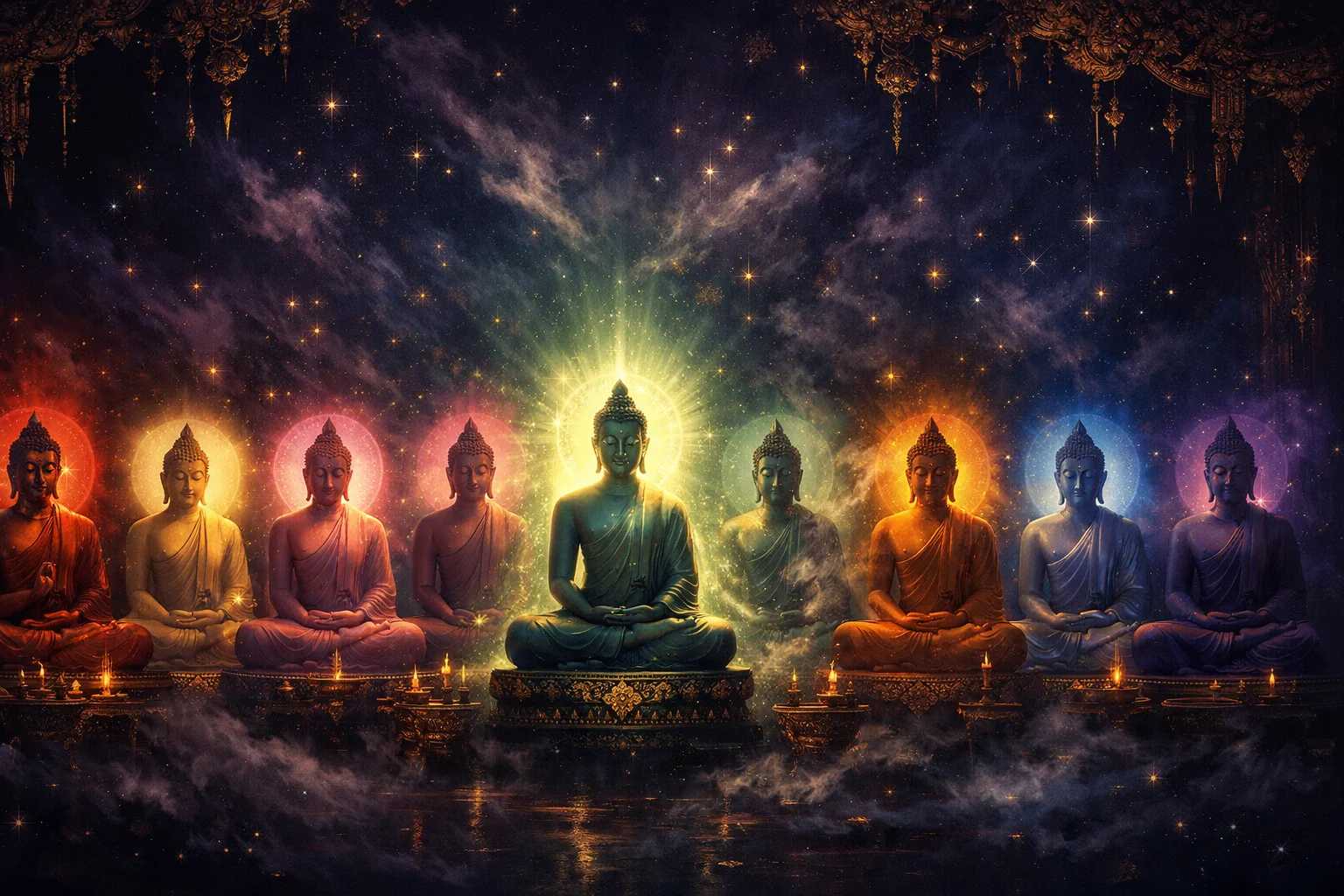
So this is a living system rather than a folklore exhibit, and it runs off a single fact printed on your birth certificate. What follows is how it actually works, including the two things English-language summaries almost always leave out: the eighth day, and the diagram that quietly generates every lucky-colour list you have ever seen.
Why a Thai Person Will Ask What Day You Were Born
Ask a Thai friend their sun sign and you will usually get an answer. Ask what day of the week they were born and you will get it instantly, without counting, the way you know your own phone number. That is the real tell that these are different kinds of knowledge. The weekday is on the birth certificate, it goes on the temple record, and it decides which of the eight Buddha images the family keeps.
Each weekday carries a planet, a colour, a number, a Buddha posture and a short protective chant. The planets are the Indian set that arrived with Brahmin court astrology centuries ago — Sun, Moon, Mars, Mercury, Jupiter, Venus, Saturn — plus one that is not a planet at all. Their Thai numbers run 1 through 8 in that order, which is why a Thai chart is written as digits rather than glyphs.
The colours are the visible part. King Chulalongkorn was born on a Tuesday, which is Mars, which is pink — and that is why pink turns up everywhere around Chulalongkorn Day rather than any national colour. Queen Sirikit was born on a Friday, which is Venus, which is light blue. None of this is invented for tourists. It is the ordinary consequence of a system that assigns a colour to a weekday and then remembers which weekday people were born on.
Wednesday Is Two Signs, and the Second One Is Rare
Here is the structural oddity that makes Thai astrology worth your time even if you already have a birth chart. The week has seven days. The system has eight signs. Wednesday is cut in half at six in the evening: before the cut you belong to Mercury, after it you belong to Phra Rahu.
Rahu is the odd one out in every sense. In the Indian tradition Thai astrology inherited, Rahu is not a body but a point — the shadow that swallows the sun during an eclipse, imagined as the severed head of an asura who drank the nectar of immortality and got caught. It has no light of its own, no orbit you can watch, and it is the only one of the eight that governs reversal rather than a quality. Thai practice keeps it at arm's length and on a separate schedule: Rahu offerings are made at night, in black, in sets of eight.
The arithmetic consequence is the part nobody mentions. Six weekdays get a full twenty-four hours each. Wednesday splits eighteen hours to Mercury and six to Rahu. Brute-forced across every minute of every date from 1930 to 2029 — 52,596,000 birth moments — the shares come out like this:
| Sign | Window | Share of births |
|---|---|---|
| Each of the six full days | 24 hours | 14.29% |
| Wednesday Day (Mercury) | midnight to 6 p.m. | 10.71% |
| Wednesday Night (Rahu) | 6 p.m. to midnight | 3.57% |
Rahu is a quarter as common as an ordinary weekday sign. And before you assume the calendar is doing something clever, it is not: run the same hundred years and count plain weekdays, and Sunday through Saturday come out within 0.0027 percentage points of each other, a ratio of 1.0002 to one. The Gregorian calendar is exactly uniform over a full cycle — 146,097 days is precisely 20,871 weeks, so each weekday occurs exactly 20,871 times per 400 years. All of the lopsidedness in Thai astrology comes from the Wednesday split and none of it comes from the calendar.
One Diagram Generates Every Colour Rule You've Read
Search for Thai lucky colours and you will find the same flat table everywhere: Sunday red, Monday yellow, Tuesday pink, and a matching list of colours to avoid. Nobody explains the second list. It looks arbitrary — why would a Sunday person specifically need to avoid blue?
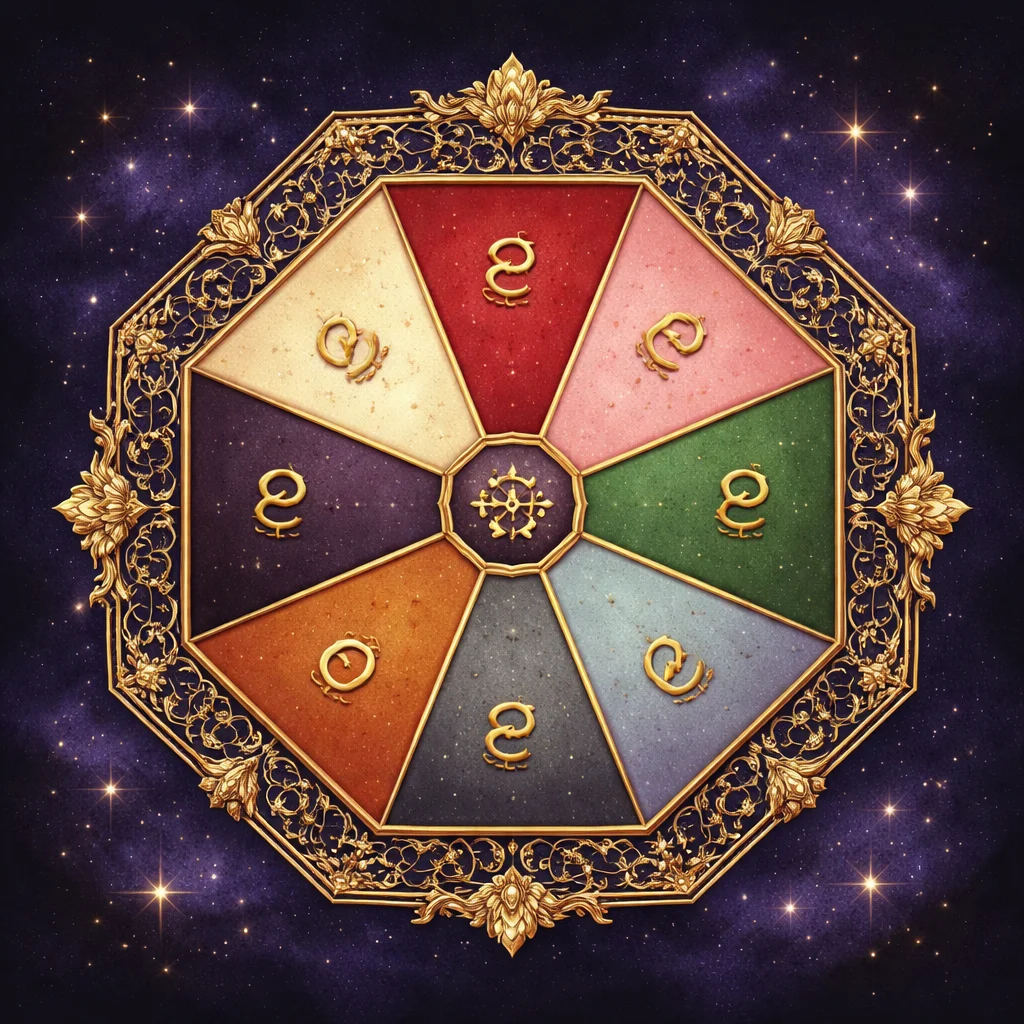
They are not two lists. They are one ring. The eight planets are arranged in a fixed octagon, and the order is not what you would guess from their numbers — it runs 1, 2, 3, 4, 7, 5, 8, 6. Sun, Moon, Mars, Mercury, then Saturn, then Jupiter, then Rahu, then Venus. Your own planet sits at your position. Your kalakini, the colour to keep off your body, is always the planet one step behind you in that ring. That single rule reproduces the entire avoid-list:
| Born | Planet | Wear | Avoid — and whose colour that is |
|---|---|---|---|
| Sunday | Sun (1) | Red | Light blue — Friday's |
| Monday | Moon (2) | Cream yellow | Red — Sunday's |
| Tuesday | Mars (3) | Pink | Cream yellow — Monday's |
| Wednesday Day | Mercury (4) | Green | Pink — Tuesday's |
| Saturday | Saturn (7) | Black or deep purple | Green — Wednesday Day's |
| Thursday | Jupiter (5) | Orange | Black or deep purple — Saturday's |
| Wednesday Night | Rahu (8) | Smoke green | Orange — Thursday's |
| Friday | Venus (6) | Light blue | Smoke green — Wednesday Night's |
Read the last column downward and something falls out that no lucky-colour listicle mentions: this is a single closed loop, not a set of mutual grudges. Sunday avoids Friday's blue, Friday avoids Rahu's smoke green, Rahu avoids Thursday's orange, and if you keep following the chain you visit all eight days exactly once and arrive back at Sunday. No colour is forbidden to two different days. No two days share a lucky colour. And the relationship is one-directional — the day you avoid does not avoid you back, which is why Thai colour lore has no concept of two signs being incompatible. That is a real structural difference from Western astrology, where every opposition runs both ways.
Read Your Eight Houses, Not Just Your Colour
The ring does more work than colours. Counting around it from your own planet assigns each of the eight positions a department of life — the thaksa system, and the part of Thai astrology that practitioners actually charge for. Your own planet always takes the first house, boriwan, and kalakini always lands in the eighth, which is the same rule as before seen from the other end.
Take a Saturday birth as a worked example. Saturn sits at position five in the ring, so counting forward from there gives boriwan to Saturn itself, vitality to Jupiter, authority to Rahu, grace to Venus, foundations to the Sun, effort to the Moon, patrons to Mars, and misfortune to Mercury — which is why Saturday people are told to avoid green. But look at what else that produces. A Saturday person's authority is governed by Rahu, the eclipse shadow. Their patrons are Mars. Read as a character sketch, that is someone whose public standing arrives in sudden lurches and whose useful allies are combative ones. You get none of that from a colour chart.
The eight houses are: boriwan (your circle), ayu (vitality), det (authority), si (grace and fortune), mula (foundations and property), utsaha (sustainable effort), montri (patrons above you) and kalakini (the weak seam). Two people born on adjacent days share every house in the same order but shifted by one planet, which is the Thai equivalent of a whole-sign house shift — and if that idea interests you, the nakshatra calculator runs the Indian parent system this one descends from, where Rahu returns as one of the nine grahas ruling a stretch of the dasha timeline.
This Is Also Why Thai Parents Buy a Name Consultation
Now the part that convinced me the octagon is older and more load-bearing than the colour lore built on top of it. Each of the eight planets governs a group of Thai consonants, and a name is considered auspicious if it draws on your favourable groups and contains no letter from your kalakini group. This is not a museum practice: Thai parents routinely pay a monk or an astrologer to check a proposed name, and adults who feel their luck has stalled sometimes legally change theirs.
Here is the thing. Line up the eight planetary consonant groups and you get the vowels, then ก–ง, then จ–ญ, then ฎ–ณ, then ด–น, then บ–ม, then ย–ว, then ศ–ฮ. That is simply the Thai alphabet in its standard order, class by class. And the planets attached to those groups, read in the same order, are Sun, Moon, Mars, Mercury, Saturn, Jupiter, Rahu, Venus — the octagon, exactly. The ring that decides which colour you must not wear and the sequence that decides which letters may appear in your name are the same sequence. That is why one diagram serves both practices, and it is a much better reason for the odd 1-2-3-4-7-5-8-6 planetary order than anything the colour charts offer.
| Ring position | Planet | Consonant class | Where it sits in the alphabet |
|---|---|---|---|
| 1 | Sun | อ and all vowel signs | the Sun governs the vowels, which is why they head the list |
| 2 | Moon | ก ข ฃ ค ฅ ฆ ง | the velar class, first consonants in the alphabet |
| 3 | Mars | จ ฉ ช ซ ฌ ญ | the palatal class |
| 4 | Mercury | ฎ ฏ ฐ ฑ ฒ ณ | the retroflex class |
| 5 | Saturn | ด ต ถ ท ธ น | the dental class |
| 6 | Jupiter | บ ป ผ ฝ พ ฟ ภ ม | the labial class |
| 7 | Rahu | ย ร ล ว | the semivowels |
| 8 | Venus | ศ ษ ส ห ฬ ฮ | the sibilants and h, last in the alphabet |
One more small piece of internal evidence that this system was designed rather than assembled. Each day carries a protective chant recited a fixed number of times — six for Sunday, fifteen for Monday, eight for Tuesday, seventeen for Wednesday day, nineteen for Thursday, twenty-one for Friday, ten for Saturday and twelve for Rahu. Add them up. They come to exactly 108, the number of beads on a Buddhist mala. Eight arbitrary-looking numbers that happen to sum to the most-repeated figure in Buddhist practice is not a coincidence anyone stumbled into.
The Day Turns at Sunrise, Not at Midnight
Everything above assumed your weekday is the one on the calendar. Strict Thai astrology disagrees, and this is the single most common reason someone gets a different answer from a temple than from a website.
Following the older Indian reckoning, the day changes at dawn. A birth at three in the morning on Thursday still belongs to Wednesday — and because Wednesday after 6 p.m. is Rahu, that 3 a.m. Thursday baby is a Rahu child. Their birth certificate says Thursday. Their sign is the eighth one.
The calculator above computes real Bangkok sunrise for your birth date rather than assuming a flat six o'clock, because Bangkok sunrise is not fixed: across 2026 it runs from 05:49 on 2 June to 06:46 on 24 January, a spread of 56 minutes, with a mean of 06:14. Using a flat 06:00 instead of the true figure changes the sign for 1.22% of birth moments — small, but it is precisely the population who are already on a boundary, so it is the wrong 1.22% to get wrong.
Across the same 52.6 million birth moments, the two conventions disagree for 26.01% of them, and every single disagreement is a pre-dawn birth. The effect on Rahu specifically is dramatic. Under the calendar rule Rahu's window is six hours; under the sunrise rule it runs from 6 p.m. Wednesday until dawn on Thursday, roughly twelve. Rahu goes from 3.57% of births to 7.29% — a factor of 2.04 — and Wednesday day drops from 10.71% to 7.00%. The consequence worth remembering: 50.99% of everyone the strict rule calls a Rahu child has "Thursday" written on their birth certificate.
Which should you use? Popular practice, every temple market and every Thai person you ask will use the calendar weekday, so that is what this page shows as the primary answer. The sunrise reading is shown alongside it whenever you supply a birth time and the two differ, rather than silently picking a winner — the same way our Chinese zodiac calculator handles the Lunar New Year boundary that catches out anyone born in January or early February.
One deliberate limitation: this page asks for no birth location. The sunrise boundary is defined at Bangkok, where the convention itself is defined, and the honest thing is to say so rather than pretend that computing dawn in Manchester makes a Thai reading more accurate.
Eight Buddhas, Eight Ways of Handling Trouble
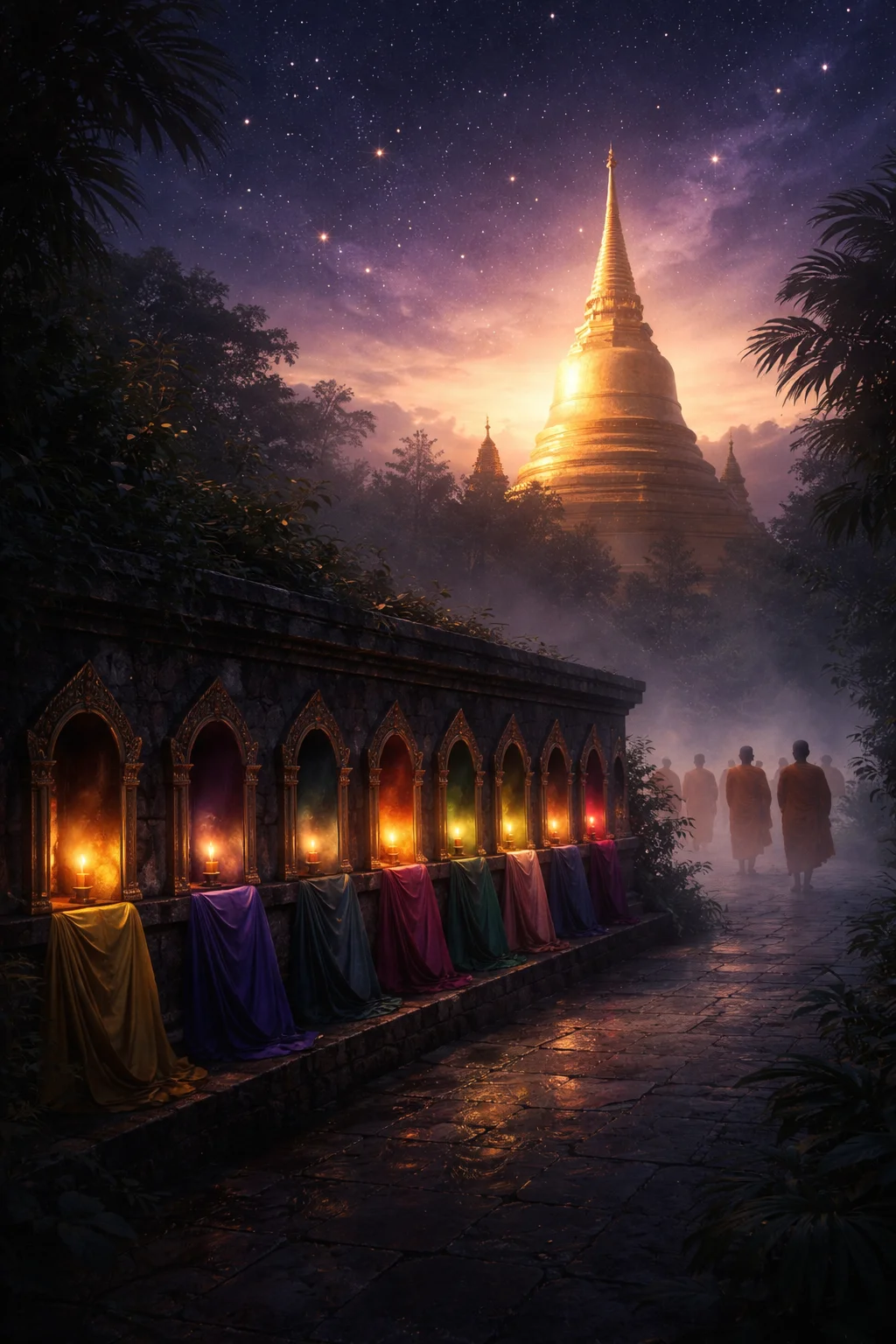
The Buddha images are where the day signs stop being a colour code and start being a character reading, because each posture illustrates a specific incident and each incident is a different response to pressure. Read the eight together and the pattern is unmistakable.
Monday's Buddha stands with one palm raised between two armed clans arguing over river water — he steps into the quarrel. Wednesday night's Buddha did the opposite: when the monks of Kosambi fell to bickering he left, spent the rains alone in a forest, and was brought water by an elephant and a honeycomb by a monkey. Same problem, opposite instinct, and the two are placed on the same weekday, twelve hours apart. Nothing in a Western chart does that.
Saturday's is the one you will recognise on sight: the Buddha seated on the coils of the naga king Mucalinda, seven cobra heads spread overhead as a roof through a seven-day storm. Sheltered by the thing everyone else in the story is frightened of. Tuesday, the day of Mars, gets the only reclining image in the set — the Buddha subduing a boastful giant not by fighting him but by lying down and becoming impossibly large, so the giant had to look up anyway. Friday's stands with arms folded across the chest, weighing whether the dharma could be explained to anyone at all and nearly deciding it could not.
When you buy one — and every temple market sells all eight, usually in a row — you are buying the posture, not a generic Buddha. Getting the wrong one is the Thai equivalent of a birthday card with the wrong name in it. Ask for it by the day rather than the posture name and you will be understood instantly.
Wearing the Colour Without Looking Like a Tourist
Two separate practices get muddled together in English write-ups, and keeping them apart is most of what you need.
The first is today's colour, worn by everyone regardless of birthday. That is the office turning yellow on Monday and pink on Tuesday. It is public, mildly patriotic, entirely optional, and nobody minds if you join in. The second is your colour, worn on days that matter to you personally — the interview shirt, the exam bracelet, the sash for a hospital visit. That one is private and closer to a superstition than a custom.
The kalakini rule is the only part treated as a hard prohibition, and it applies every day of the week rather than on your own day. If you're Thursday-born, black is out — which is genuinely inconvenient in a country where a lot of formal wear is black, and the usual workaround is deep navy or charcoal, close enough to read as formal without being Saturn's colour outright. A thread bracelet or a hidden layer in your own colour is the standard hedge when the outer garment cannot be helped.
Where the system stops being useful is anywhere it starts making decisions for you. Nobody in Thailand refuses a job because it starts on a Saturday. Treat the day sign the way you would treat a rising sign: one true thing about the moment you were born, worth knowing, not worth organising your life around. And if you want the date-based reading that Thai practice deliberately does not supply — the stone rather than the colour — our birthstone calculator runs the three competing gemstone lists side by side, and Mayan astrology is the third great day-sign tradition, running twenty signs against thirteen numbers and ignoring the month just as thoroughly.