Astrology Compatibility: Beyond Sun Signs to the Real Chemistry Between Charts
Astrology compatibility has a credibility problem, and it starts with a twelve-by-twelve table. A reader once told me she nearly ended a good relationship because a magazine grid scored Aries and Cancer at two stars. Two years in, the actual relationship was calm, funny, weirdly easy — and the grid said run. She wasn't asking whether astrology works. She was asking why it disagreed with her life. The honest answer: the table wasn't reading her relationship. It was reading one angle between two points and ignoring the several dozen contacts an astrologer would check before saying anything at all.
Why the Sun-Sign Table Keeps Getting It Wrong
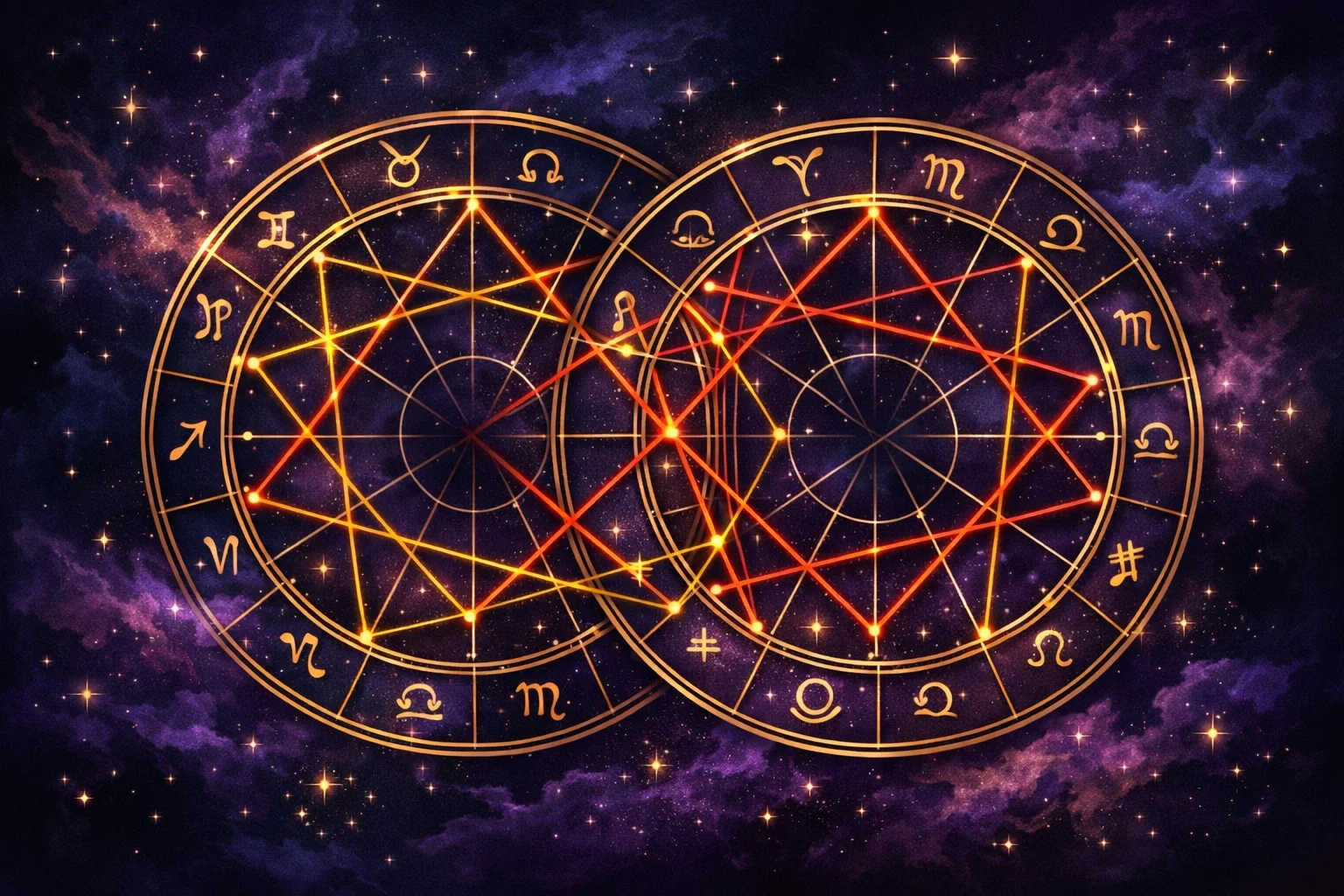
The compatibility grid you've seen in a hundred magazines does exactly one calculation: it takes the angle between two zodiac signs and converts it into a rating. Same element? Harmonious. Ninety degrees apart? Tense. It compresses each person — chart, childhood, nervous system and all — into a single data point, then grades the geometry between the two points.
That baseline isn't worthless. Elements and modalities really do describe a first-contact texture, which is why our zodiac compatibility quiz uses them as a starting line before weighing how you actually treat each other. The problem is proportion. The Sun is one of ten planets in each chart. Treating the Sun-to-Sun angle as the whole answer is like judging a marriage by the couple's surnames — related to the people involved, wildly short of describing them.
Aspects Are Angles, Not Vibes
Everything in chart comparison runs on aspects: measured angles between two planets. The classical doctrine is old — it's laid out in Ptolemy's aspect system from the 2nd century — and it's precise. Five major aspects do most of the work:
| Aspect | Exact angle | Typical orb | What it does between two charts |
|---|---|---|---|
| Conjunction | 0° | ±8° | Fusion — the two planets act as one, for better or worse |
| Sextile | 60° | ±4° | Opportunity — cooperation that works when you choose to use it |
| Square | 90° | ±7° | Friction — a recurring grind that keeps both parties engaged |
| Trine | 120° | ±8° | Flow — support you get for free, and can take for granted |
| Opposition | 180° | ±8° | Polarity — strong attraction that runs on a seesaw |
The orb is the tolerance: how far from exact an angle can drift and still function. Most astrologers allow 6–8 degrees for major aspects and stretch to 10 when the Sun or Moon is involved. Orbs are also where the sun-sign table quietly falls apart. A Sun at 28° Aries and a Sun at 2° Leo are "trine" by sign — same element, five stars — but they sit 94° apart, which is a square by measurement, and it behaves like one. Flip it around: 29° Pisces and 1° Aries are adjacent signs the table calls a non-event, yet they're two degrees from an exact conjunction — the strongest contact there is. Sign boundaries are exact, datable moments, but aspects don't care about the boundary at all. They only care about the distance.
What Actually Gets Compared When Two Charts Meet?
The technique is called synastry, and it's simpler than the name suggests: lay both birth charts on one wheel and measure every aspect from each planet in chart A to each planet in chart B. Ten planets a side gives you a hundred possible cross-contacts before you've looked at anything else. Most land nowhere. The ones that fall within orb form a map of where two lives snag on each other — pleasantly, productively, or painfully.
How many land somewhere is almost entirely a question of the orb you allow, which is why two websites will hand you two different contact counts for one couple. The synastry chart calculator runs the full cross-aspect grid for two real birth records and puts a denominator on it — it scores a hundred and twenty invented couples born in the same two years and tells you how many of them share each of your contacts. A tight Neptune-to-Neptune turns out to be shared by everyone your age.
Then come house overlays: drop one person's planets into the other's houses and see which department of life they light up. A partner whose Sun lands in your 7th house registers as partner-shaped almost immediately; the same Sun in your 11th makes a brilliant friend you keep almost dating. There's also the composite chart — a midpoint chart of the relationship itself — but that's a different tool answering a different question, and synastry comes first.
One practical warning: precision needs birth times. The Moon moves about 13 degrees per day and can change sign before dinner, and the Ascendant shifts a full degree every four minutes, so house overlays without a birth time are decoration. If you don't yet know your own placements, start with how to read a birth chart — synastry is that skill, doubled.
Which Contacts Carry the Most Weight?
Not all hundred cells of the grid matter equally. When I compare charts for a couple, the reading order is close to fixed. Cross Sun–Moon contacts come first — one person's identity feeding the other's emotional needs is the oldest partnership signature in the tradition. Moon–Moon aspects come next, because they predict what sharing a home feels like at 11 pm on an ordinary Tuesday: matched Moons make the silence comfortable, clashing Moons make it loaded.
Venus–Mars contacts are the spark plugs — conjunctions and oppositions especially. Mercury aspects are chronically undervalued; you will talk to your partner more than you will do anything else with them, and a supported Mercury line is the difference between conversation as nourishment and conversation as admin. And then there's Saturn. Nobody swoons over Saturn, but Saturn–Sun and Saturn–Moon contacts are what show up again and again in couples who are still together decades on. Saturn is weight. A synastry with plenty of spark and zero Saturn tends to stay a beautiful guest in both lives — welcome, luminous, and gone when the weather turns.
The Case Against Easy
Here's the take that surprises people: an all-trine synastry is not the prize. It's gorgeous and low-grip. Nothing in it forces negotiation, so nothing builds the negotiating muscle, and couples with only soft contacts can drift apart on good terms without ever knowing why. A working square between personal planets does the opposite — it names the argument you'll have on a loop, and a named, predictable argument is one you can build technique around.
The aspect describes the pattern, never the outcome. I've seen the same Mars–Moon square calcify one couple into flinch and resentment, and teach another couple the fastest repair ritual I've ever watched. Same geometry, opposite results. When I read for couples, a clean square worries me far less than a chart comparison made entirely of flow: the first is a hill they can learn to climb, the second is a floor with no walls.
The Couple the Table Rejected
Run the numbers on the first case file in the tool above and you can see the whole argument in one couple. Her Sun sits at 8° Aries, his at 5° Cancer — 87 degrees, a cardinal square three degrees from exact. That's the two-star verdict, and the friction it describes is real: she charges at problems, he encircles them, and they do collide about whose move comes first.
But her Moon at 7° Virgo trines his at 11° Taurus, so their default evenings want the same thing. His Cancer Sun sextiles her Moon inside two degrees — his fussing reads as care, not control. Her Venus at 19° Taurus sits conjunct his Mars at 22°, which is the classic attraction contact, running steady in earth. And his Saturn at 6° Sagittarius trines her Sun within two degrees: his structure backs her fire instead of fencing it. Every collision the square produces lands on that mattress. The table read one line of this chart comparison and called it doomed; the other four layers outvote it. If you want the full-length treatment of any specific pairing, we've written individual compatibility reports for all 144 sign combinations — each one reads the layers, not just the grid.
The Verdict Is the Wrong Product
Most compatibility guides get one thing wrong before they write a single interpretation: they sell a verdict. A score, a star count, a pass/fail. But synastry's honest output is a texture map — here is where you'll grind, here is where you'll coast, here is what binds, here is what nothing binds. A map like that is useful for exactly one purpose: knowing which patterns are structural so you can stop taking them personally.
And the map has limits worth saying out loud. No aspect excuses contempt, and no trine survives it. Charts describe the default weather between two people; behaviour decides what gets built in that weather. A difficult synastry between two people who repair well will outrun a soft one between two people who don't — every time, in my experience, without exception. Learn your own chart, learn theirs, read the contacts honestly, and then treat the whole thing the way a sailor treats a forecast: seriously, and as no substitute for steering.