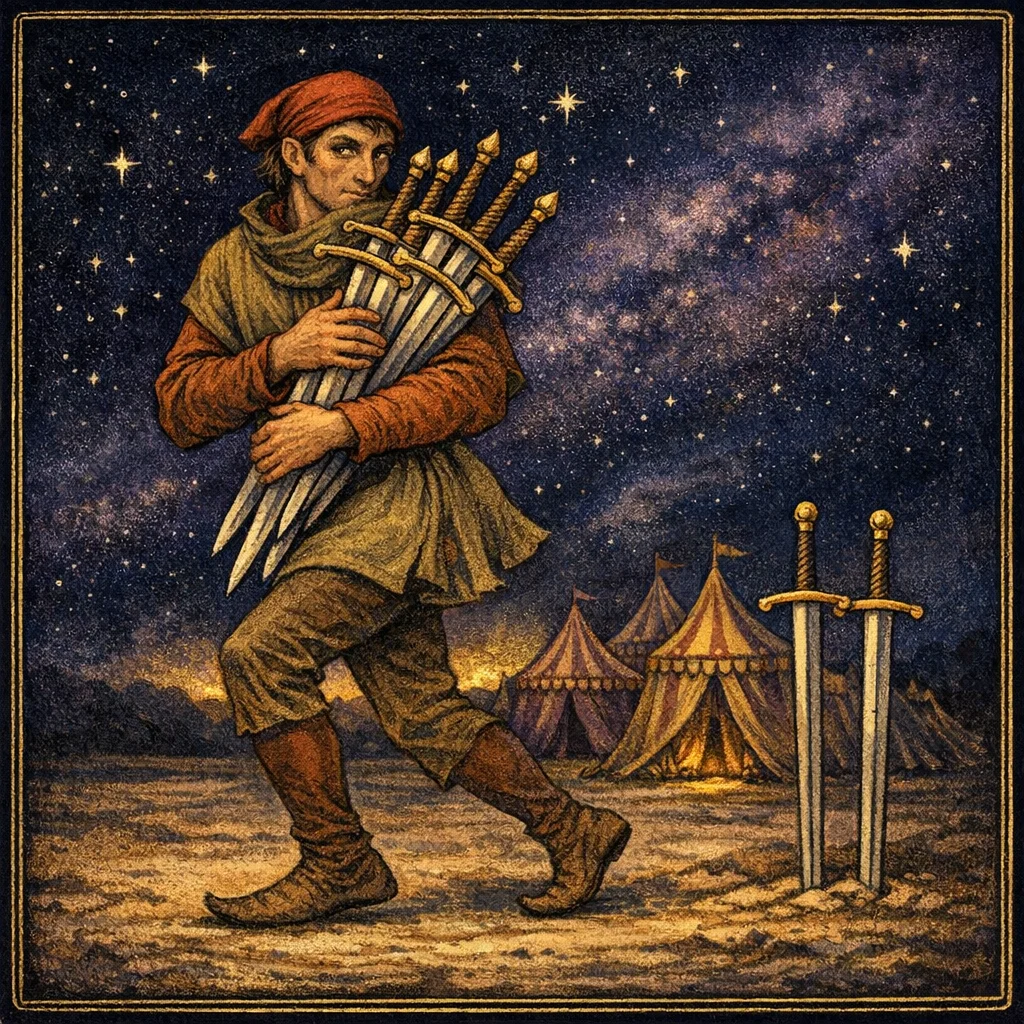
He Takes Five Swords and Leaves Two. The Card Is About the Two.
Count before you read. In the Seven of Swords a man carries five swords away from a camp on tiptoe, and two more stand upright in the ground behind him. That ratio is the card. The Seven of Swords tarot card meaning is a plan carried out quietly: strategy, stealth, acting alone, and, in its shadow, deception and getting away with something. Reversed, the quiet ends, because someone comes clean or is found out. What the picture adds, and what the books that came before it insist on, is that the job is unfinished. He took five. He left two. Waite's own list for the card is "design, attempt, wish, hope, confidence," a list of intentions, and the Golden Dawn's older title is the Lord of Unstable Effort. Neither says thief. Both say the plan is incomplete, and the two swords in the ground are the part that decides how it ends.
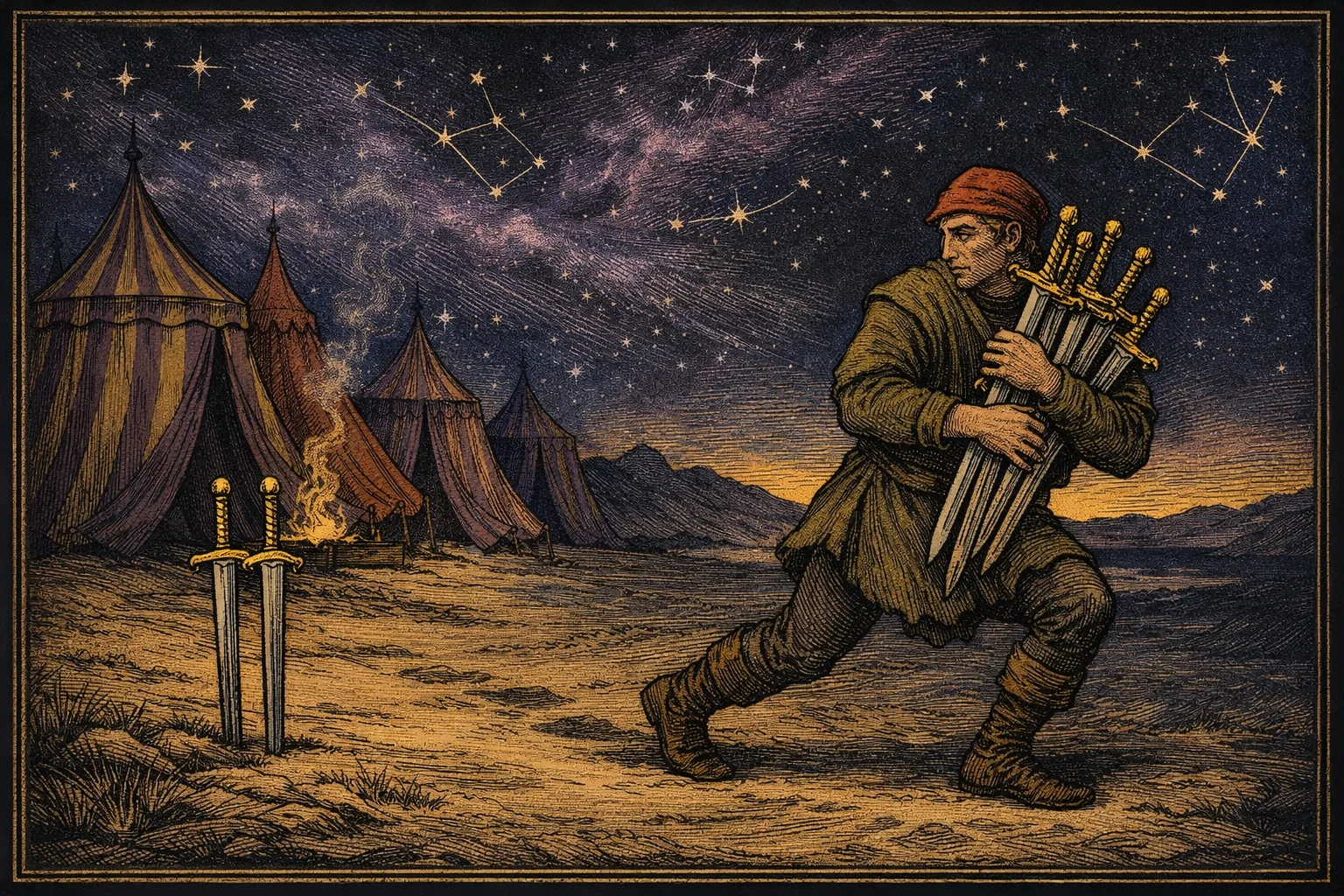
Upright: a plan carried out quietly, five-sevenths done
Upright, the Seven of Swords means someone is acting alone and without announcement. A plan is in motion that not everyone in the situation knows about. That covers a quiet job search, an exit being prepared, a side route around an argument, a strategy that would fail if it were declared, and, at the darker end, a lie in progress or something being got away with. Modern keyword lists put the dark end first. Waite put it last, and hedged it: "Design, attempt, wish, hope, confidence; also quarrelling, a plan that may fail, annoyance."
Then he added a sentence most card pages skip: "The design is uncertain in its import, because the significations are widely at variance with each other." The author of the deck is telling you the card's meanings pull in opposite directions, hope on one side and a plan that may fail on the other, and that he isn't going to resolve it for you. Read literally, that is the card. The plan is real and the outcome isn't decided. Book T, the Golden Dawn text written about twenty years earlier, says the same thing from the other side: the Sevens "show a possible result which is dependent on the action then taken."
So the upright question isn't "is he a thief?" It's "will he finish?" As advice, the card says be strategic, keep your counsel, act alone if that's what the plan needs. It also says the plan is five-sevenths done, and the missing two-sevenths is where quiet plans go wrong. Everything on this page comes back to those two swords.
Count the swords before you read the face
Waite's description of the Rider-Waite-Smith Seven of Swords is three short sentences. "A man in the act of carrying away five swords rapidly; the two others of the card remain stuck in the ground. A camp is close at hand." He counts for you, and he says nothing about the man's face, his tiptoe, or his glance over the shoulder. Those are Pamela Colman Smith's, and they do most of the work in the modern reading. Read the following as an exercise rather than as Waite's instruction.
Start with the five in his arms. They're bundled awkwardly, blades up, more than one person can carry cleanly, and he's carrying them anyway. That's the plan: ambitious, improvised, moving. Then the two in the ground. They stand hilt-up in plain sight of the camp. Whether he couldn't carry them, didn't want them, or left them so the loss would be noticed, they are the evidence he didn't remove and the job he didn't complete. Book T's portrait of the card is exactly this: "Partial success, yielding when victory is within grasp, as if the last reserves of strength were used up."
Then the camp. Colourful tents, a group of figures in the far distance, nobody looking his way. He isn't escaping an enemy. He's leaving people who trust him enough to sleep. That's why the card lands so heavily in love readings: the quiet move is being made past someone who hasn't been told. And finally the glance back. It's the look of someone checking whether he's been seen, and it's also, if you want it, the look of someone who half wants to be. The face is ambiguous on purpose, or at least by good fortune, and Waite's warning that the significations are "at variance" applies to the expression as much as to the keywords.
What the books say: intentions, not a thief
Open Waite's Pictorial Key to the Tarot at the Seven of Swords and you find a list of intentions where you were expecting a crime. Design, attempt, wish, hope, confidence. The negatives that follow are "quarrelling, a plan that may fail, annoyance," and none of them is deceit. Reversed, he gives "Good advice, counsel, instruction, slander, babbling." In the book's later section of additional meanings the card gets stranger still: "Dark girl; a good card; it promises a country life after a competence has been secured," and reversed, "Good advice, probably neglected." A good card. A plan that reaches its end, and a retirement after enough has been put by.
Book T, the Golden Dawn's tarot text, attributes the card to the Moon in Aquarius and titles it the Lord of Unstable Effort. Its meaning paragraph is where the modern shadow actually comes from, and it's worth quoting whole: "Partial success, yielding when victory is within grasp, as if the last reserves of strength were used up. Inclination to lose when on the point of gaining through not continuing the effort. Love of abundance, fascinated by display, given to compliment, affronts and insolences, and to detect and spy on another. Inclined to betray confidences, not always intentional. Rather vacillating and unreliable, according to dignity as usual." The spying and the betrayed confidences are there. So is the qualifier: not always intentional. And the headline is the unfinished effort, not the betrayal.
| Source | Upright | Reversed |
|---|---|---|
| Book T (Golden Dawn, c. 1888) | Partial success; yielding when victory is within grasp; not continuing the effort; inclined to betray confidences, not always intentional; untrustworthy, vacillating | Not separately listed; the entry is read "according to dignity" |
| Waite (1911) | Design, attempt, wish, hope, confidence; also quarrelling, a plan that may fail, annoyance. Additional: a good card; a country life after a competence is secured | Good advice, counsel, instruction, slander, babbling. Additional: good advice, probably neglected |
| Common modern reading | Deception, strategy, stealth, getting away with something, acting alone | Coming clean, getting caught, confession, self-deceit unravelling |
Now look at where the modern vocabulary sits in Waite's own book, because it is there, just not on this card. The upright words modern readers use, imposture and duplicity, are Waite's list for the Two of Swords reversed: "Imposture, falsehood, duplicity, disloyalty." The reversed words, confession and coming clean, are his list for the Six of Swords reversed: "Declaration, confession, publicity." The modern Seven of Swords reads as if it were assembled from its two neighbours, with the picture of a man sneaking out of camp supplying the glue.
| Modern Seven of Swords keyword | Where Waite actually wrote it | What Waite wrote for the Seven |
|---|---|---|
| Deception, duplicity (upright) | Two of Swords reversed: "Imposture, falsehood, duplicity, disloyalty" | "Design, attempt, wish, hope, confidence" |
| Confession, coming clean (reversed) | Six of Swords reversed: "Declaration, confession, publicity" | "Good advice, counsel, instruction" |
| Getting caught (reversed) | Not in Waite's Seven; closest is Book T's "to detect and spy on another" | "Slander, babbling" |
This isn't a claim that modern readers copied the wrong entries. It's an observation about vocabulary, and the picture did most of the work honestly: a man tiptoeing out of a sleeping camp with an armful of weapons looks like theft, and readers read what they see. The point is practical. If you know the deception reading is the picture's, and the intention reading is the books', you can hold both, and you stop treating the card as a verdict on whoever it seems to describe.
Reversed: coming clean, found out, or good advice neglected
The Seven of Swords reversed has three modern shapes. The first is coming clean: the person carrying the plan puts it down and says what it was. The second is being found out: the two swords in the ground are noticed, and the camp wakes. The third is quieter and happens inside one head: the story you told yourself about why the quiet route was fine stops holding. The reading tools across this site use a short version of the first two, the quiet part getting said out loud, or surfacing before it can be said.
Waite's reversed list is more interesting than any of them: "Good advice, counsel, instruction, slander, babbling." Two constructive words, then two destructive ones, in the same breath. That's the reversal exactly. The quiet is ending, and it ends either as counsel, the plan explained by the person who made it, or as slander, the plan explained by everyone else. His additional reversed meaning, "good advice, probably neglected," names the usual reason it ends the second way. Somebody said "tell them" and the advice was left in the ground with the swords.
Take a hypothetical. Someone has been quietly interviewing for four months while their manager plans next year around them. Upright, the Seven of Swords describes those four months: a real plan, carried out alone, five-sevenths done, with the resignation letter and the handover as the two swords not yet touched. Reversed, it describes the week the quiet ends. In one version they book a meeting and say it. In the other a colleague mentions it first. The facts are identical. The card doesn't choose between the versions. It marks that the window in which you can still choose is closing.
In love and as feelings: ask the direct question
The Seven of Swords love meaning is the card's most-searched and least reliable use, because the question behind the search is usually "is my partner cheating?" and no card can answer that. Neither of the card's founding texts uses the word. What the card describes in a relationship is something being carried out quietly: a plan not shared, a doubt not voiced, a past not mentioned, a conversation taken around rather than through. Some of those are betrayals. Most are the ordinary privacy of two people, and the difference is who was entitled to know.
As feelings, the Seven of Swords says someone is keeping their real position quiet. That can be strategy, not yet showing a hand. It can be self-protection, holding back until it feels safe. And it can be the thing you're afraid it is. The picture can't tell you which, and a man leaving camp is not evidence about anyone's heart. What you can observe is whether the quiet ever becomes a plain statement when you ask for one. Our love tarot reading uses the same short version for this card, something kept quiet that is not always betrayal and sometimes self-protection, applied across a whole spread.
So ask the direct question. Not the case you've built, and not the card's keyword list, just one sentence in plain words: "Is there something about this you haven't told me?" Ask it once. Then read the shape of the answer, because a straight answer, even an incomplete one, is a different thing from a change of subject. If the answer is no and you can't accept it, the work in front of you is about trust, and no further card settles that in either direction.
If the quiet move is yours, the test runs the other way. Would you tell them if they asked tonight, with no warning? If yes, the quiet is discretion and you can pick your moment. If you'd deflect, you already know what it is. And if you are being deceived in a way that is harming you, the card is not your evidence. Observed facts are, and they are what to act on.
Work and money: the exit plan, the side route and the credit
At work the Seven of Swords is the quiet job search, the exit being prepared, the side project nobody has been told about, the process worked around instead of through, and the credit that ends up with the wrong name on it. Our career tarot reading puts it as "a side project, an exit plan, or credit taken by the wrong person." Upright, most of these are legitimate strategy. Book T's brief meaning for the card includes "journey probably by land," a move made under your own power, and Waite's "design" is a neutral word for a plan.
The card's advice at work is the count. Take the five: prepare in private, don't announce before the plan can survive it, act alone where the plan needs it. Then look at the two you're about to leave in the ground, because at work they are always the same two: the notice and the handover. A quiet exit that leaves those behind is the version colleagues remember. Book T's "not continuing the effort" is, in an office, the plan that got you out and cost you the reference.
With money, the card describes something in the numbers not being said straight, by you or to you. It is not a forecast of theft and not evidence of fraud. Waite's additional meaning is the opposite of a warning: "a country life after a competence has been secured," a plan that ends in enough put by. His tables for repeated cards give four Sevens as "intrigue" and three as "infirmity," which concern a pattern in a spread, not a sum. Base actual financial decisions on the records and appropriate advice, and if the quiet is someone else's, ask for the figures before you ask the cards.
Moon in Aquarius 20°–30°: why the effort is unstable
Book T attributes the Seven of Swords to "Moon in Aquarius, 20°-30°," the last decan of the sign, and titles it the Lord of Unstable Effort. Swords are Air, Aquarius is the fixed Air sign, and the Moon is the fastest-moving body in the sky. The attribution pairs a fixed idea with a changeable mood, which is a fair description of a plan that begins with conviction and wavers when the finish is in sight. The Sun crosses those ten degrees around the second and third weeks of February in most years, but the card is a symbolic attribution, not a transit report. Drawing it doesn't make anyone an Aquarius and doesn't say where the Moon is tonight.
The Golden Dawn's own image for the card, before Smith drew the man and the camp, explains the title better than the keyword does. "Two hands as before, each holding swords. A third hand holds a single sword in the centre. The points of all the swords do just touch one another, the central sword not altogether dividing them. The rose of the previous symbols of this suit is held by the hand which holds the central Sword, as if the Victory were in its disposal." Seven swords, points touching, and the rose, the suit's emblem of peace, still in the hand of whoever holds the middle blade. Victory is available. It hasn't been taken. That is what unstable means here: not doomed, just undecided.
Book T's paragraph on the Sevens as a number says the rest: they show "a force, transcending the material plane, and is like unto a crown which is indeed powerful but requireth one capable of wearing it. The sevens then show a possible result which is dependent on the action then taken." A Seven is a result you could have if you keep going. In Swords, where the effort is mental and the temptation is to think the plan finished because it has been thought through, that is the card's whole warning. Smith's two swords in the ground are the same idea drawn instead of written.
Read the Seven next to the Two, the Five and the High Priestess
Beside the Two of Swords, you have the pause and the move. The Two holds a decision in balance behind a blindfold; the Seven has decided and is acting on it quietly. Together they often describe the moment a long stalemate ends by one person simply leaving it, and the pairing asks whether the other person knew the pause was over. It's also worth remembering that Waite's Two reversed is where his deception vocabulary lives, so a reversed Two next to an upright Seven is a heavier combination than either card alone.
The Five of Swords is the Seven's nearest relative and its opposite. Waite's Five: "A disdainful man looks after two retreating and dejected figures. Their swords lie upon the ground. He carries two others on his left shoulder, and a third sword is in his right hand. He is the master in possession of the field." The Five fought, won badly, and stayed. The Seven never fought. He took what he could carry and left before the argument. Waite's Five reads "degradation, destruction, revocation, infamy, dishonour, loss." His Seven reads "design, attempt, wish, hope, confidence." When both appear, the reading is about whether the quiet route was chosen to avoid a fight that would have looked like the Five.
Beside the High Priestess, two kinds of secret are on the table. She keeps hers by sitting still between the pillars; the Seven carries his out of camp. Our High Priestess page reads the pair as deception confirmed, and that is a fair reading when the secret belongs to someone who was entitled to know. It can also be a kept confidence next to a plan in progress. Ask whose secret it is before you decide which.
Beside the Moon, the deception turns inward. The Moon is illusion, the story that feels true in the dark, and next to the Seven it usually means the person being deceived by the quiet plan is the one carrying it. Beside the Magician, compare two skilled pairs of hands: his work openly at the table, the Seven's in the dark. Both cards share Waite's word "design." The pairing asks whether the plan could be done in daylight, and if not, why not. For where the Seven sits among the four suits, the tarot suits guide explains why Swords read as thought and conflict and why a Seven is the element tested rather than completed.
Run the five-and-two check before you call anyone a thief
Before you take the Seven of Swords as an accusation, or as a no, write three short answers. They turn a card about quiet plans in general into a reading of one specific quiet, which is the only kind you can act on:
- Whose move is it? Yours, someone else's, or you don't know. Your own is the only one you can verify. If you don't know, check your own side first, because the card doesn't say which side of the table the quiet is on.
- What kind of quiet? An unannounced plan, information someone is entitled to, a confrontation avoided, or a confidence that isn't yours to tell. Only the second is deception by definition. The other three become it only when someone entitled to know is kept in the dark past the point where knowing would change their decisions.
- What are the two left behind? The part of the plan not done, the evidence not removed, the sentence not said. Name them. They are what turns a strategy into a story other people tell about you.
Then ask the direct question, once, in plain words, and read the shape of the answer instead of the card. Quick systems, including our own yes or no tarot reader, map the upright card to no and the reversed to maybe. That's a workable convention for a one-card answer. The fuller answer is "not yet, and not the whole story," which is what a plan five-sevenths done always is. Whether it ends as Waite's good card or as Book T's unstable effort depends on the two swords, and they are still in the ground.