Chinese Zodiac Compatibility: The Whole Answer Is One Subtraction
Chinese zodiac compatibility begins with a subtraction, not with your animals. Take the two birth years, subtract one from the other, and that single number has already fixed most of what the tradition is going to say about the pair of you. Four years apart? Trine, guaranteed — and it makes no difference which four animals you happen to be. Six years apart? Clash, every time. Two years apart and the entire six-relation system has nothing whatsoever to say: not one of the twelve pairings at that distance carries a name.
Start by Subtracting the Two Birth Years
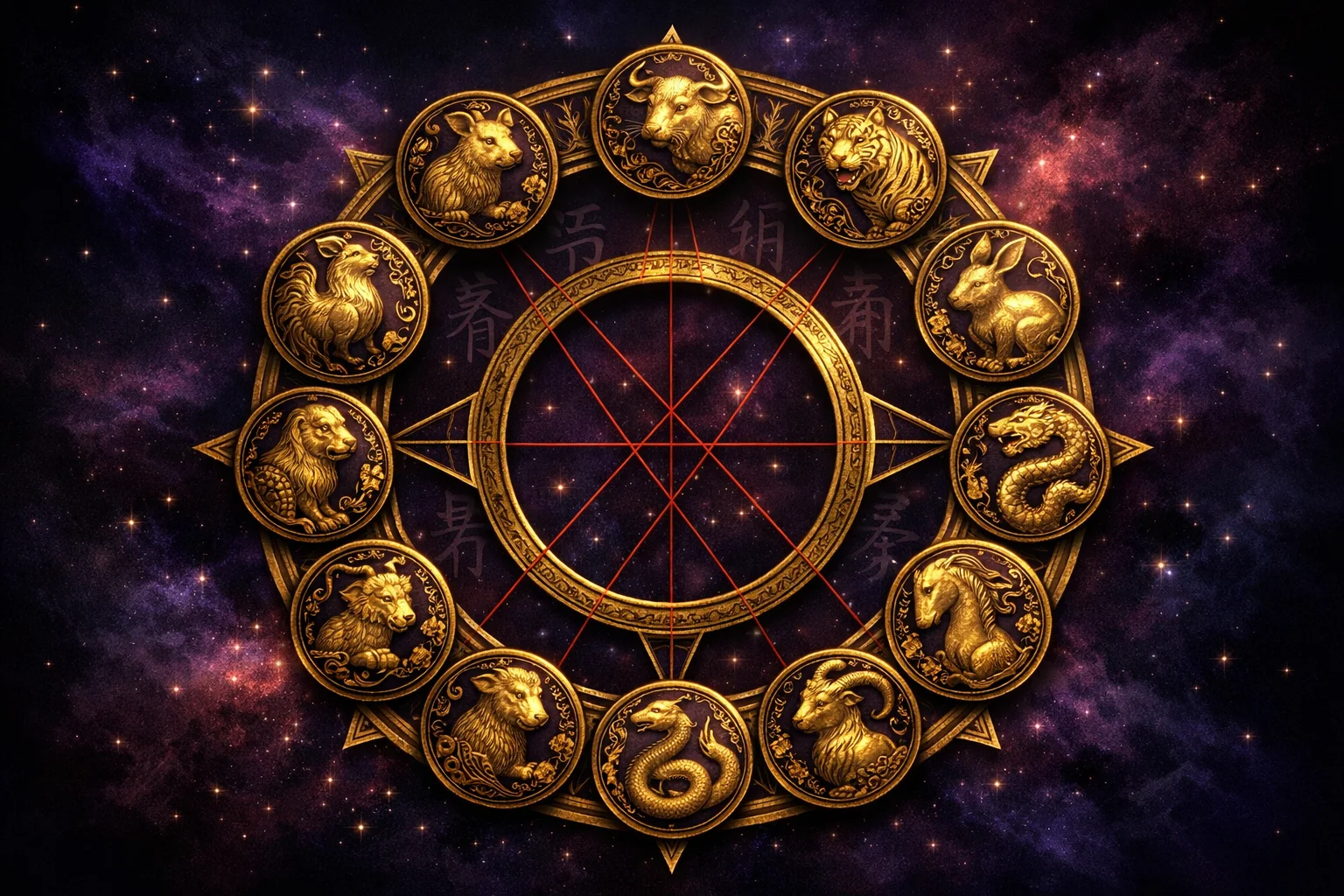
The twelve animals sit in a ring, one per year, so the distance between two people on that ring is just their year gap counted around a clock face of twelve. San He — the harmony trine — is defined as four steps. Liu Chong, the clash, is defined as six. Both are pure functions of the difference between the two positions, which means the gap decides them before anyone looks at who you are.
Run every possible pairing and the pattern is stark. Here is what each gap guarantees:
| Year gap | Steps | Named pairings | What the gap settles |
|---|---|---|---|
| 0 or 12 | 0 | 4 of 12 | Same animal; four of them punish themselves |
| 1 or 11 | 1 | 4 of 12 | Nothing — depends entirely on which animals |
| 2 or 10 | 2 | 0 of 12 | Guaranteed silence, every pairing |
| 3 or 9 | 3 | 10 of 12 | Something almost certainly fires — 8 different verdicts live here |
| 4 or 8 | 4 | 12 of 12 | Trine allies, no exceptions |
| 5 or 7 | 5 | 4 of 12 | Nothing — depends entirely on which animals |
| 6 | 6 | 6 of 6 | Direct clash, no exceptions |
The counts are of unordered pairings, which is why the clash row reads 6 rather than 12 — each animal has exactly one opposite, so there are only six clashes in existence.
Now look at the two-step row. A two-year gap is not "mildly compatible" or "neutral with potential" — the tradition has genuinely never named it, in any of its six relations, for any of the twelve pairs that sit there. Any site that gives a Rat and a Tiger a score of 62% invented that number. The same goes for the five-step row, and for eight of the twelve same-animal pairings.
What Are the Six Relations Chinese Astrology Actually Names?
Most English-language tools use two: the trine and the clash. Traditional practice names six, and the four that usually get dropped are where the interesting readings live.
- San He 三合 — the trine, four steps apart, three animals sharing one elemental bureau.
- Liu He 六合 — the secret friend, a single quiet partner for each animal.
- Liu Chong 六冲 — the clash, straight across the wheel.
- Liu Hai 六害 — harm. Not conflict; small, unnamed resentments.
- Liu Po 六破 — destruction. Erosion of something already built, always three steps apart.
- Xiang Xing 相刑 — punishment, in three groups plus four animals that punish themselves.
There is a geometric split running through that list that nobody seems to mention. San He and Liu Chong are rotations: they depend on the difference between the two branch positions, so spin the whole wheel and they survive untouched. Liu He and Liu Hai are reflections: they depend on the sum of the two positions, which pins them to a mirror axis instead. Number the branches 0 to 11 starting at Rat and every Liu He pair sums to 1, while every Liu Hai pair sums to 7. That is why each animal has two trine relatives but only ever one secret friend and one harm partner — a rotation gives you a group, a reflection gives you a single opposite number. For the wider system these sit inside, our guide to Chinese astrology walks through the branch and stem cycles from the ground up.
Your Harm Animal Is Just Your Secret Friend's Clash
Harm looks arbitrary when you read it off a table. It isn't. Take any animal, find its secret friend, then find the animal that clashes that friend — and you have landed on your harm partner. Every single time, for all twelve.
Work it through for the Rat. The Rat's secret friend is the Ox. The Ox clashes with the Goat. And the Rat's harm partner is, sure enough, the Goat. Try the Rabbit: secret friend Dog, the Dog clashes the Dragon, and Rabbit-Dragon is a harm pair. That identity holds for 12 of 12 animals with no exceptions, and it tells you what harm actually means in practice. It isn't someone who fights you. It's someone who quietly disrupts the person you lean on — which is exactly why the damage tends to surface late and get blamed on something else.
Nearly Half of All Pairings Get No Verdict at All
There are 78 possible pairings of twelve animals once you stop double-counting order. Test all six relations against every one of them and 40 come back named. The other 38 — 48.72% — carry nothing. And the named ones aren't nearly as varied as a percentage scale implies: only 12 distinct verdicts exist in the entire system, out of 64 combinations that six on-off relations could theoretically produce.
You might reasonably suspect that silence is an artifact of my test — that real couples cluster into the gaps that do carry names. They don't. Sampling real birth dates for couples born within six years of each other gives 46.03% silent, and within ten years, 46.07%. Every year-pair across 1930 to 2029 taken uniformly gives 47.32%. Those three numbers sit within a point and a half of each other, which means the silence belongs to the rule set and not to who tends to partner with whom.
One thing narrowing your search does change: the clash. Restrict yourself to partners within six years and your odds of landing on a Liu Chong pairing rise from 8.32% to 12.38%, because a six-year gap is one of only seven options in that band rather than one of twelve.
Why a Four-Year Trine and an Eight-Year Trine Aren't the Same Match
Here is the part that explains why no two calculators agree. Your animal comes from a cycle of twelve. Your element comes from the heavenly stems, a cycle of ten. Two cycles of different length running side by side drift against each other and only realign after 60 years, which is precisely why the sexagenary calendar is 60 years long rather than twelve.
The consequence is sharp enough to test. Because the element relation depends on the gap modulo ten while the animal relation depends on the gap modulo twelve, certain gaps lock both layers — in opposite directions:
| Gap | Animal layer | Element layer | Held across 1930–2025 |
|---|---|---|---|
| 2 years | Unnamed | Generating | 96 of 96 |
| 4 years | Trine | Overcoming | 96 of 96 |
| 6 years | Clash | Overcoming | 96 of 96 |
| 8 years | Trine | Generating | 96 of 96 |
| 10 years | Unnamed | Identical | 96 of 96 |
Read the two trine rows together. A couple born four years apart and a couple born eight years apart are both San He — the same headline verdict, the ideal match every guide recommends. But the four-year couple always has elements that fight, and the eight-year couple always has elements that feed each other. Same trine, opposite second opinion, decided by nothing but the gap.
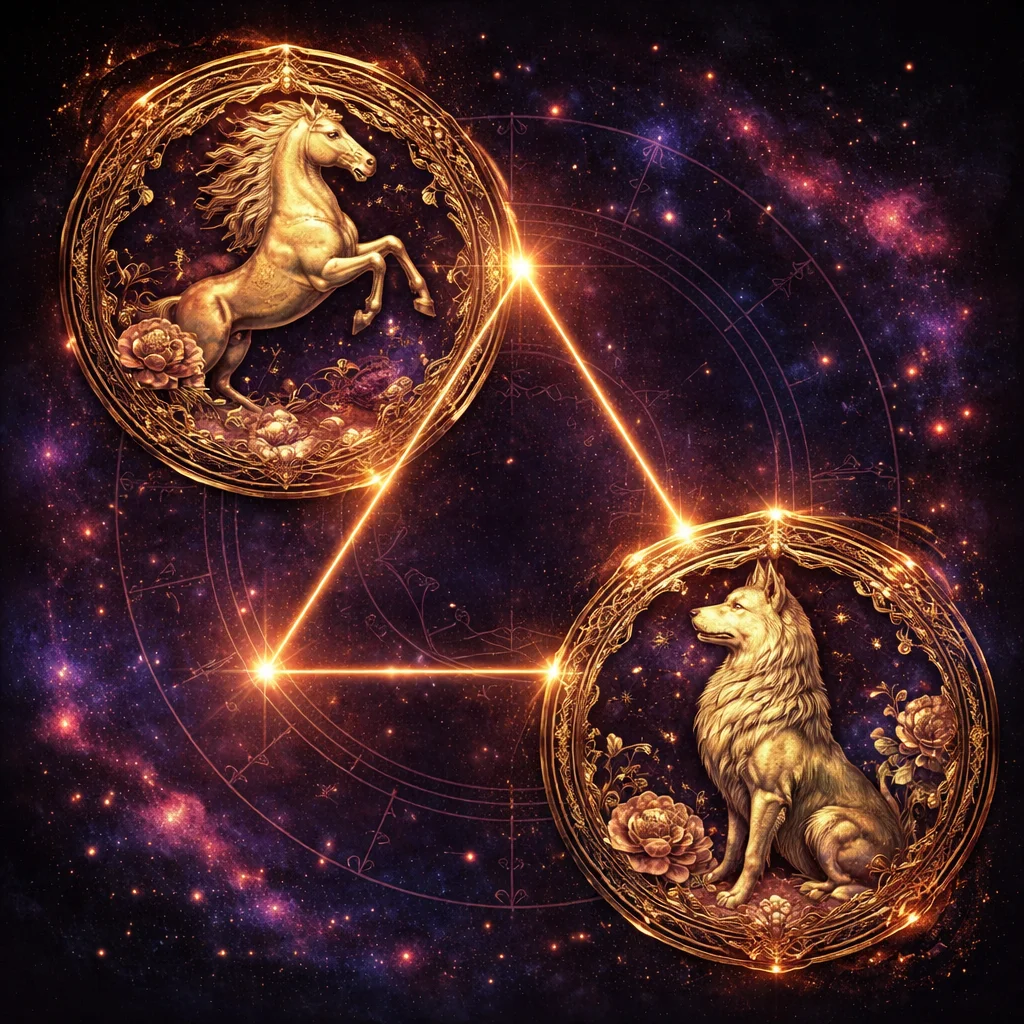
The pair loaded into the calculator above shows it working. A Metal Horse born in 1990 and a Wood Dog born in the 1994 zodiac year sit four steps apart in the Fire bureau, so the animal layer returns a clean San He. Their elements are Metal and Wood, and metal cuts wood. Two traditional layers, one couple, opposite readings — and that is the ordinary case, not an unlucky one.
Across every pairing where the animal layer says anything at all, the element layer contradicts it 53.64% of the time. More often than not, in other words. A tool that scores mostly on animals and one that scores mostly on elements will disagree about the same couple far more often than they agree, and neither will tell you which layer produced the number.
There is a further wrinkle worth knowing before you trust any element score, including this one. The element used above is the year's heavenly stem, and the 60-year cycle also assigns each year an older nayin element that disagrees with the stem for about three quarters of all years. Traditional Chinese marriage matching uses the nayin, not the stem — so if a relative has scored your relationship differently, comparing both of your Chinese birth elements will usually explain where the second opinion came from.
Two Pairings the Tradition Argues With Itself About
Of the 78 pairings, only six carry more than one relation at once. Four are unsurprising: Ox-Goat and Tiger-Monkey are both clash and punishment, Tiger-Snake is harm and punishment, Goat-Dog is destruction and punishment. All four stack bad on bad.
The remaining two are a straight contradiction. Tiger with Pig, and Snake with Monkey, are each registered as both Liu He and Liu Po — secret friend and destruction, harmony and erosion, on the same pair of animals. This is old enough to have its own term: he zhong dai po, harmony carrying destruction. The bond forms almost effortlessly and then spends its life testing itself. If you are one of those two pairings, no honest calculator can hand you a single number, and this one doesn't try — it prints both rows and leaves them standing.
The Trine Isn't Three Friends — It's One Element's Life Cycle
Every guide lists the four trines as groups of compatible animals and stops there. The classical structure is more useful than that. Each trine is one element moving through three stages: birth, peak, and storage. Monkey starts water, Rat runs it at full strength, Dragon puts it away. Tiger starts fire, Horse peaks it, Dog stores it. Pig starts wood, Rabbit peaks it, Goat stores it. Snake starts metal, Rooster peaks it, Ox stores it.
Which means "you're both in the water trine" is three different readings, not one. A Monkey with a Rat is birth meeting peak — momentum, plenty of starting, not much finishing. A Rat with a Dragon is peak meeting storage, which is the half of the cycle that consolidates: excellent at turning something already working into something durable, poor at beginning from nothing. A Monkey with a Dragon skips the peak entirely, so you get two people who agree completely on direction and argue endlessly about pace. The Horse and Dog loaded above are the fire version of that middle case — peak and storehouse, a pairing that is far better at finishing things than starting them.
Two structural details fall out of this and both are checkable. First, each of the four trines contains exactly one Earth branch — Dragon, Goat, Dog, Ox — which is why there is no Earth trine: Earth is distributed as the storehouse of the other four. Second, three of the four trines open with a branch whose own element feeds the trine's element (Monkey is Metal and metal generates water; Pig is Water and water generates wood; Tiger is Wood and wood generates fire). Metal's trine breaks the pattern — Snake is Fire, and fire melts metal rather than making it. That exception is genuinely there in the classical tables, and the tradition keeps it rather than tidying it away.
Check Whether Either of You Was Born Before the Lunar New Year
Before you trust any verdict, check the date. The Chinese zodiac year turns at the Lunar New Year, which lands anywhere from January 21 to February 20, so 9.61% of all birth dates belong to the previous year's animal. For one person that's a nuisance. For a pair it is worse, because either birthday can move: ignoring the boundary changes the couple's verdict for 15.10% of date pairs — about one couple in seven — and the animal layer alone shifts for 13.51%.
The default pair above is deliberately one of them. The second birthday is 20 January 1995, which falls eleven days before that year's Lunar New Year, so it belongs to the 1994 Dog year. Read properly, that person is a trine ally of the 1990 Horse. Read off the calendar year instead, they become a 1995 Pig — and Horse with Pig is one of the 38 pairings the tradition never names at all. A verdict of "trine allies" and a verdict of "nothing to report" separated by eleven days. If you want the mechanism rather than the effect, our Chinese zodiac calculator resolves a single birth date to its animal and element with the same boundary table this page uses, so the two tools can never disagree about who you are.
How to Read a Verdict That Says Nothing
If your pairing comes back unnamed, resist the urge to read that as lukewarm. Silence in this system means the tradition made no claim, and no claim is very different from a weak one. The clearest case is the two-year gap: unnamed on the animal layer, and a generating element pair in all 96 year-pairs tested. On the evidence that is one of the strongest positions available, and there is no traditional term for it at all.
Worth knowing too: this system is perfectly symmetric. Swap which partner you enter first and nothing moves, across all 144 ordered cells — every one of the six relations tests the same in both directions. That is not true everywhere. In Vedic Kundali matching the Varna and Vashya kootas are deliberately asymmetric, and swapping the two people changes the score for 74.44% of pairings. If you have ever wondered why Chinese compatibility has no concept of a bride's chart versus a groom's, that's why — the geometry has no room for it.
And the limit, which matters more than any of the above: this reads years. Everyone born in your zodiac year — roughly one twelfth of everyone alive — gets the identical verdict against your partner. That is a very blunt instrument to point at one relationship. Use it the way a practitioner actually does: not to decide anything, but to put a name on a friction you had already noticed. A clash pairing that says "you two want opposite things at the same moment" is useful precisely when you recognise it. When you don't recognise it, the chart is wrong and you are right.