One Birthday, Two Chinese Elements — and They Disagree Three Times in Four
In 1966 the Japanese birth rate fell off a cliff. Not gradually — in a single year, by roughly a quarter, before snapping straight back the following spring. The cause was a calendar. 1966 was hinoeuma, the Fire Horse, and a superstition held that girls born under it would be too fierce to marry. Couples across Japan simply waited. It is probably the cleanest demonstration on record of an astrological belief moving a national statistic, and it is the reason a Chinese element calculator is worth getting right: 2026 is the next Fire Horse, exactly sixty years later.
Here is the part nobody mentions. In the older layer of the same calendar, 1966 is not a Fire year at all. It is 天河水, Water of the Heavenly River. So is 2026. The Fire Horse everyone is frightened of is filed under Water by the tradition that has been doing this longest — and the years that really are Fire Horses in that system, 1918 and 1978, are the ones your calculator will cheerfully label Earth.
The Most Feared Year in the Chinese Calendar Is Water
Two things get called your Chinese element and they are not the same thing. The first comes from the year's heavenly stem, one of ten characters that cycle in pairs: two Wood years, two Fire, two Earth, two Metal, two Water, repeat. That is the element in essentially every English-language calculator, and it is why anyone born in 1966 gets told Fire.
The second is nayin (納音), literally "attached sound." It belongs to the 60-year sexagenary cycle rather than the 10-year stem cycle, and instead of naming a bare element it names an image: Gold in the Sea, Fire in the Furnace, Earth on the Rooftop. There are thirty of them, each covering exactly two consecutive years, and each carries an element of its own. This is the layer used in traditional marriage matching, and it is usually what an older Chinese relative means when they tell you what you are.
Both are correct. They are different questions asked of the same calendar. The problem is only that one of them got translated into English and the other mostly didn't.
Why Two Sites Hand You Two Different Elements
Because the two layers agree far less often than you would guess. Each nayin name spans one yang year and the yin year after it, so every one of the thirty names sits under exactly one stem element — which means this can be counted outright rather than sampled. Do it and the stem element and the nayin element match for 8 of 30 pairs. That is 26.67% of years agreeing and 73.33% disagreeing.
Roughly three people in four, then, have been given an element that a Chinese fortune teller would not recognise as theirs. Not because anyone is wrong, but because the question "what element am I?" has two answers and the internet standardised on the newer, shallower one. That is the whole reason this tool prints both, side by side, with the tradition each belongs to attached — the same call the birthstone calculator shows three competing gemstone lists rather than quietly picking one.
Born in a Year Ending in 4 or 5? You Can Never Be Wood
The 26.67% agreement figure hides something much more interesting than an average. Break it down by stem element and four of the five behave identically — Fire, Earth, Metal and Water each match their own nayin in exactly 2 of 6 pairs, a flat 33.33%.
Wood matches in 0 of 6. Zero. A Wood-stem year — those are the years ending in 4 and 5, once the New Year boundary has been applied — is never, in any cycle, assigned Wood by the nayin. It comes out Metal, Fire, Water and nothing else, so Earth is off the table too. That is one person in five walking around with an element the older system says they categorically are not.
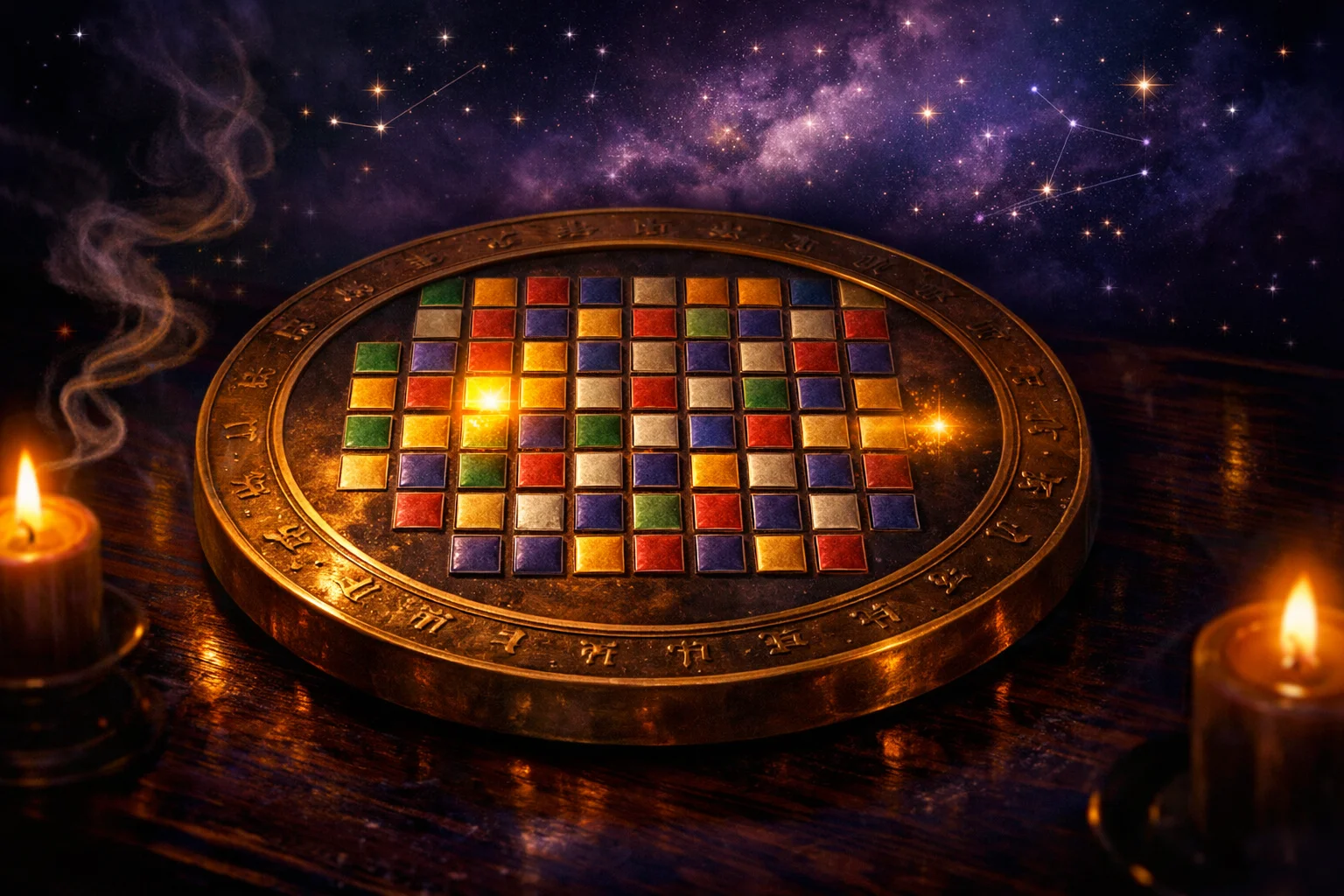
Check it on the grid in the tool. The two Wood columns hold twelve cells between them and not one of them is green. This is not a statistical tendency; it is a property of how the two wheels mesh, and it holds for every 60-year cycle that has ever run or ever will.
All Thirty Nayin Names and What Each One Reads As
Here is the complete table, in cycle order. The two years given for each are the ones nearest the present; add or subtract 60 for any other cycle. Note how physical the readings are — nayin is not five abstract qualities but thirty specific objects, and the object is the interpretation. Gold at the bottom of the sea and gold beaten into foil are both Metal, and they describe almost opposite lives.
| Nayin | Element | Stem | Years |
|---|---|---|---|
| 海中金 Gold in the Sea | Metal | Wood | 1984, 1985 |
| 爐中火 Fire in the Furnace | Fire | Fire ✓ | 1986, 1987 |
| 大林木 Wood of the Great Forest | Wood | Earth | 1988, 1989 |
| 路旁土 Earth by the Roadside | Earth | Metal | 1990, 1991 |
| 劍鋒金 Metal of the Sword Edge | Metal | Water | 1992, 1993 |
| 山頭火 Fire on the Mountaintop | Fire | Wood | 1994, 1995 |
| 澗下水 Water in the Ravine | Water | Fire | 1996, 1997 |
| 城頭土 Earth on the City Wall | Earth | Earth ✓ | 1998, 1999 |
| 白蠟金 White Wax Metal | Metal | Metal ✓ | 2000, 2001 |
| 楊柳木 Willow Wood | Wood | Water | 2002, 2003 |
| 泉中水 Water in the Spring | Water | Wood | 2004, 2005 |
| 屋上土 Earth on the Rooftop | Earth | Fire | 2006, 2007 |
| 霹靂火 Thunderbolt Fire | Fire | Earth | 2008, 2009 |
| 松柏木 Pine and Cypress Wood | Wood | Metal | 2010, 2011 |
| 長流水 Long-Flowing Water | Water | Water ✓ | 2012, 2013 |
| 沙中金 Gold in the Sand | Metal | Wood | 2014, 2015 |
| 山下火 Fire at the Foot of the Hill | Fire | Fire ✓ | 2016, 2017 |
| 平地木 Wood of the Open Plain | Wood | Earth | 2018, 2019 |
| 壁上土 Earth on the Wall | Earth | Metal | 2020, 2021 |
| 金箔金 Gold Foil | Metal | Water | 2022, 2023 |
| 覆燈火 Lamp Flame Fire | Fire | Wood | 2024, 2025 |
| 天河水 Water of the Heavenly River | Water | Fire | 2026, 2027 |
| 大驛土 Earth of the Great Post Road | Earth | Earth ✓ | 2028, 2029 |
| 釵釧金 Hairpin Gold | Metal | Metal ✓ | 2030, 2031 |
| 桑柘木 Mulberry Wood | Wood | Water | 2032, 2033 |
| 大溪水 Water of the Great Stream | Water | Wood | 2034, 2035 |
| 沙中土 Earth in the Sand | Earth | Fire | 2036, 2037 |
| 天上火 Fire in the Sky | Fire | Earth | 2038, 2039 |
| 石榴木 Pomegranate Wood | Wood | Metal | 2040, 2041 |
| 大海水 Water of the Great Sea | Water | Water ✓ | 2042, 2043 |
The ticks mark the 8 rows where the two systems land on the same element. Scan the column and the pattern from the last section is visible immediately: the ticks cluster, and the Wood rows never carry one.
Ten Combinations That Have Never Happened
Five stem elements times five nayin elements gives 25 conceivable pairings. Only 15 of them exist. Each stem element reaches exactly three of the five nayin elements — never four, never all five — so ten combinations are not rare but structurally impossible: Wood stem with Wood nayin; Wood stem with Earth nayin; Fire stem with Wood nayin, and seven more.
This matters practically. If a site tells you that you are a Wood-stem year with an Earth nayin, it has a bug, because that cell does not exist. It is the same kind of check the Chinese zodiac compatibility calculator runs when it verifies that harm is the clash of your secret friend: a system built from meshing cycles has arithmetic consequences, and those consequences are how you tell a real implementation from a lookup table somebody typed in by hand.

The Hidden Element Is the Active One
Wu xing is not five labels, it is a wiring diagram. Wood feeds Fire, Fire feeds Earth, Earth feeds Metal, Metal feeds Water, Water feeds Wood — and cutting across the middle, Wood breaks Earth, Earth dams Water, Water quenches Fire, Fire melts Metal, Metal cuts Wood. The full five element circuit is drawn out in the Chinese astrology guide; what matters here is that your two elements are wired to each other in one of five ways, and the distribution is lopsided in a way that says something.
The nayin acts on the stem — feeding or controlling it — in 46.67% of years. The stem acts on the nayin in only 26.67%. The traffic runs from the hidden layer toward the visible one at nearly two to one, which is a neat mechanical echo of what practitioners say about nayin: that it describes the substance underneath the surface personality rather than the surface itself.
The rarest relation of all is the visible element cutting the hidden one, which happens in a single combination out of 15 — Metal stem over Wood nayin, 6.67% of years. The two names it produces are 松柏木, Pine and Cypress Wood, and 石榴木, Pomegranate Wood. Both are trees. Both sit under a Metal stem, which is an axe. Whoever assembled this table in the Tang dynasty was not choosing images at random.
The Two Layers Never Argue About When
Given how much the two systems disagree about what you are, you would expect them to disagree about when you became it. They never do. Both assign elements in two-year blocks, and both blocks start on the same year: across 100 consecutive years the stem element changes over 50 times, the nayin element changes over 50 times, and they change on the same boundaries every single time.
So the disagreement is purely about naming, never about timing. If your element changed this year under one system it changed under the other too. That is a small thing, but it is the sort of internal consistency that suggests the nayin table was built on top of the stem cycle deliberately rather than bolted on afterwards.
Two New Years, a Fortnight Apart
There is a second disagreement underneath the first, and it catches people born in midwinter. The popular zodiac changes year at the Lunar New Year, which drifts anywhere between January 21 and February 20. BaZi and most professional practice change at Li Chun, the solar term that marks the start of spring and falls on February 3, 4 or 5. Across 102 years those two boundaries sit a mean 7.40 days apart, and as much as 16 days apart in 1985.
That leaves 2.03% of all birth dates sitting in the gap with two legitimate year pillars — and therefore, once you apply everything above, up to four defensible element answers. The tool loads with one on purpose: 29 January 1966. Under the popular rule the Lunar New Year had already passed on 21 January, so that birth is 丙午, a Yang Fire Horse, nayin Water of the Heavenly River. Under the BaZi rule Li Chun was still six days away, so the same birth is 乙巳, a Yin Wood Snake, nayin Lamp Flame Fire. Fire, Water, Wood and Fire again — four answers, one baby, no errors anywhere.
The honest caveat: Li Chun is an instant rather than a day. If your birthday is the Li Chun date, your year pillar depends on your birth hour, and this page will say so rather than guess, because it takes no birth time. The tightest case in the whole range is 1980, when the term landed about 5 minutes from midnight in Beijing — a margin small enough that the calendar date itself is worth checking against an almanac.
So Which Element Should You Actually Use?
Use the stem element when you are talking to anyone under about forty, reading an English-language horoscope, or pairing your element with your animal — a Fire Horse or a Water Dragon is a stem reading, and it is the one the wider culture has settled on. It also carries the yang or yin polarity, which nayin does not.
Use the nayin when you want the reading with more in it. Thirty images beat five adjectives for the same reason a specific card beats a suit: Gold in the Sea and Gold Foil are both Metal and they describe genuinely different lives, and no amount of talking about "Metal energy" will get you to that distinction. It is also the layer that shows up in Chinese marriage matching, so if a relative has ever told you your element and it contradicted the internet, this is almost certainly why.
Where I would not push either of them is as a standalone character verdict. One year gives you one of sixty cells, shared with roughly one person in sixty and with everyone born exactly sixty years before you. It is a coordinate, not a portrait. If you want the other three pillars — the month the season judges you by, the day stem that actually represents you, and the hour — the BaZi four pillars calculator takes a birth time and builds the full eight-character chart on the same Li Chun boundary this page uses. Chinese practice treats the year as the least personal of the four pillars for exactly that reason, and anyone selling you a full personality read off a birth year alone is working with 5.91 bits of information. Take the image, take the relation between your two elements, and hold the rest loosely.