Chinese Astrology: Animals, Elements, and the Four Pillars of Destiny Explained
Chinese astrology is a calendar system before it is a personality system, and almost every misunderstanding about it starts right there. The animal everyone knows — Rat, Ox, Tiger, Rabbit — is one character out of the eight a practitioner actually reads. Those eight are your BaZi (八字, literally “eight characters”), also called the Four Pillars: four stacked pairs, one each for the year, month, day and hour of your birth. Your animal is the bottom half of the first pair. It is the part that fits on a restaurant placemat.
Your Animal Is One Character Out of Eight
Every pillar is a pair: a heavenly stem on top, an earthly branchunderneath. The stem carries an element and a polarity; the branch carries the animal. Stack four pillars and you get eight characters, and the whole reading is an argument about how those eight interact.
| Pillar | What it describes | Life stage |
|---|---|---|
| Year | Ancestry, family line, the era you were born into. The animal lives here. | 0–16 |
| Month | Parents, upbringing, working environment. Sets the season — the single biggest factor in the reading. | 17–32 |
| Day | The stem is you. The branch under it is your closest partnership. | 33–48 |
| Hour | Children, the private self, what you build once the ambition cools. | 49+ |
Notice where the animal sits. It is in the year pillar — the pillar traditionally assigned to ancestry and early environment, and the one furthest from the self. That is why two people born in the same Horse year can be nothing alike. They share exactly one character out of eight, and it is the character that describes the era they arrived in rather than who arrived.
The Two Wheels That Make the 60-Year Cycle
There are ten heavenly stems and twelve earthly branches, and they advance together, one step at a time, like two gears of different sizes. Ten and twelve come back into alignment after sixty steps, which is where the famous sexagenary cycle comes from — not from sixty separate symbols, but from two small wheels refusing to line up for a long time.
Here is the detail most introductions skip. Ten stems times twelve branches gives 120 possible pairs on paper, yet only 60 exist. Both wheels start on a yang position and step in lockstep, so a yang stem can only ever meet a yang branch. Yang Fire (丙) can pair with the Horse (午, yang) but never with the Snake (巳, yin) — a Fire Snake year has to be 丁巳, yin fire. Half the combinations are structurally impossible, and that parity rule is the engine of the whole calendar.
| Stem | Element | Classical image |
|---|---|---|
| 甲 Jiǎ | Yang Wood | The standing tree — upright, slow to bend, wants to be the tallest thing in the field |
| 乙 Yǐ | Yin Wood | The vine — flexible, climbs whatever support is available, survives by adapting |
| 丙 Bǐng | Yang Fire | The sun — broadcasts warmth to everyone, impossible to hide, has no off switch |
| 丁 Dīng | Yin Fire | The lamp — focused heat that warms one room rather than a whole country |
| 戊 Wù | Yang Earth | The mountain — immovable, sheltering, slow to react to anything |
| 己 Jǐ | Yin Earth | The cultivated field — nurturing, takes the shape of whatever is planted in it |
| 庚 Gēng | Yang Metal | The axe — cuts, decides, and is blunt about having decided |
| 辛 Xīn | Yin Metal | The jewel — refined, precise, and painfully sensitive to flaws |
| 壬 Rén | Yang Water | The river — moves in bulk and carries everything downstream with it |
| 癸 Guǐ | Yin Water | The mist — quiet, permeating, gets everywhere without being noticed |
Working out a year pillar takes ten seconds. Subtract 4 from the year, then take the remainder mod 10 for the stem and mod 12 for the branch. For 2026: 2026 − 4 = 2022, and 2022 mod 10 = 2 (丙, yang fire) while 2022 mod 12 = 6 (午, Horse). That gives 丙午 — a Yang Fire Horse year. The anchor is 1984, which was 甲子, the first pair in the cycle.
Two meshing wheels is not a uniquely Chinese idea, either. The Mesoamerican Tzolkin locks a 13-tone wheel to a 20-sign wheel and produces a 260-day round on exactly the same principle — the Mayan astrology day signs and galactic tones run on gear maths that a Chinese astrologer would recognise instantly.
Why Fire Horse Years Make Demographers Nervous
2026 is a Fire Horse year, and that pairing has a documented body count in the birth statistics. In Japan the combination is called hinoeuma, and folklore held that women born under it were too fiery to marry and dangerous to their husbands. The last Fire Horse year was 1966. Japanese births dropped roughly 25 percent that year — from about 1.82 million to 1.36 million — then rebounded above 1.9 million in 1967. A superstition about two calendar characters moved half a million births.
I bring this up because it is the clearest evidence available of what these systems actually are. The hinoeuma effect did not come from fire or horses. It came from millions of people consulting the same calendar and acting on it, which is a fact about culture rather than cosmology. Worth holding on to when anyone tells you a year is dangerous.
Chinese practitioners are generally far less dramatic about 丙午 than the Japanese folk tradition. Yang fire sitting on its own fire branch reads as hot, fast and highly visible: good for launches, publicity and anything that needs momentum, hard on patience, sleep and quiet negotiation. Horses are also in their ben ming nian, their own zodiac year, which tradition treats as a defensive year rather than a lucky one. The next Fire Horse after this one arrives in 2086.
Five Elements, Two Circuits
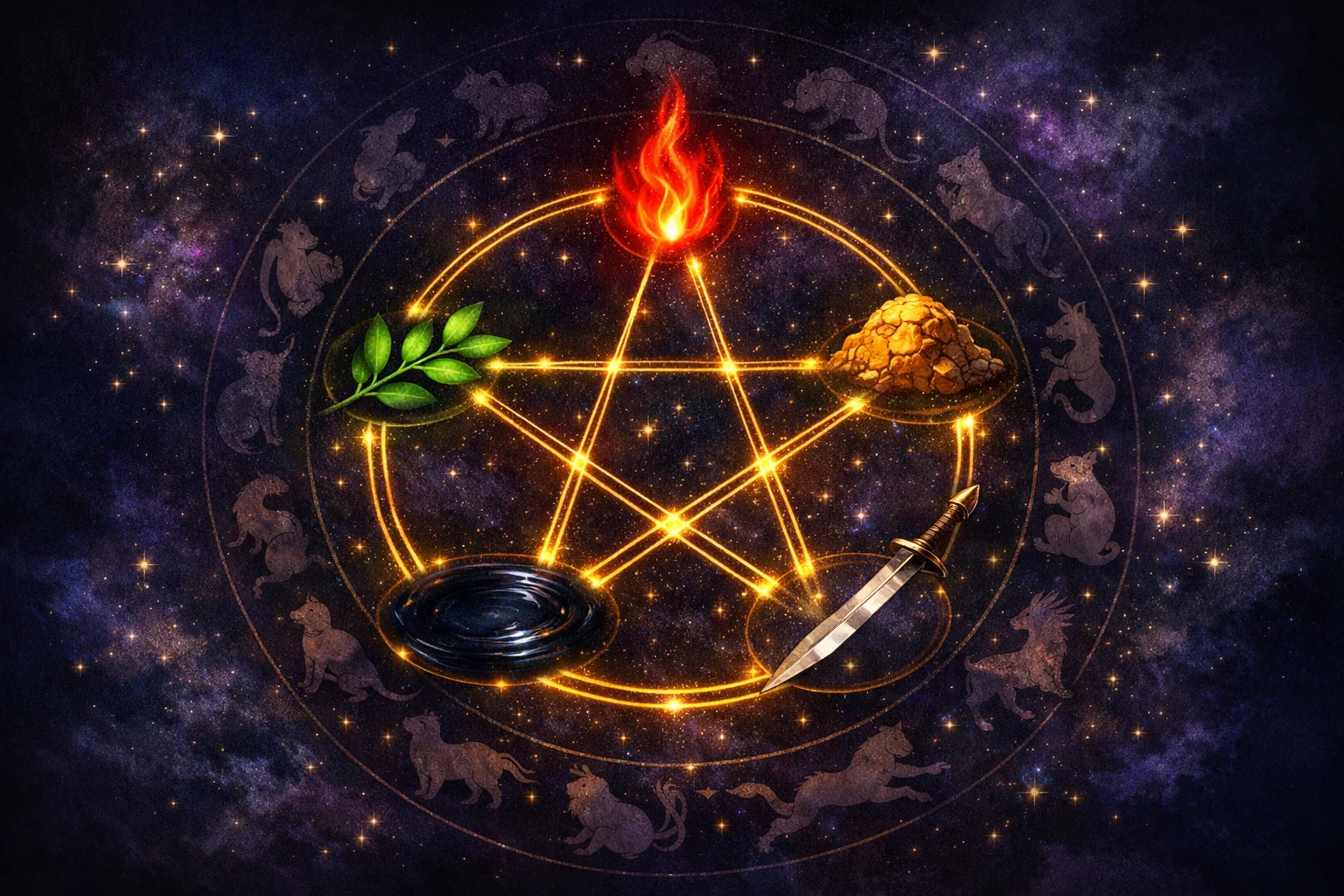
Wood, Fire, Earth, Metal and Water are not substances in Chinese astrology. They are a wiring diagram, and the wiring runs in two directions at once. The generating cycle (相生) flows Wood → Fire → Earth → Metal → Water → Wood: wood burns into fire, fire leaves ash as earth, earth condenses into metal, metal collects water, water grows wood. The controlling cycle (相克) cuts across the middle: Wood breaks Earth, Earth dams Water, Water quenches Fire, Fire melts Metal, Metal cuts Wood.
There are two reverse flows worth knowing, because they explain most bad readings. A child element drains its parent when it grows too big (泄) — enormous fire exhausts the wood feeding it. And a controlled element can insult its controller when the balance flips (侮): a trickle of water dies against a furnace instead of quenching it. This is why “more of your lucky element” is such lazy advice. Quantity without direction breaks the circuit.
One more thing the circuit is used for, which almost never survives translation into English. The 60-year cycle assigns each stem-branch pair its own nayin (納音) element on top of the stem's, and the two layers disagree for about three quarters of all years. Running both Chinese birth elements side by side shows you which pair of these five you are actually working with, and how they are wired to each other.
| Element | Too much looks like | Too little looks like |
|---|---|---|
| 木 Wood | Expands past what it can maintain. Over-plans, over-commits, and gets irritable when growth stalls. | No direction. Plenty of capability, no first move — decisions stay open until someone else closes them. |
| 火 Fire | Burns visible and burns out. Drama, over-exposure, and a poor relationship with sleep. | Cold and unseen. The work is good, nobody hears about it, and joy has to be scheduled deliberately. |
| 土 Earth | Sinks in and stops. Worry loops, hoarding, and nurturing people who did not ask for it. | No roots. Unreliable footing, no home base, and a support network nobody remembered to build. |
| 金 Metal | All edge. Rules, perfectionism, cutting remarks, and grief held long past its usefulness. | No boundary. Cannot say no, cannot finish, cannot tell which standards are actually theirs. |
| 水 Water | Floods. Fear, drifting, endless research, and secrets kept for no particular reason. | Runs dry. No reserves, no adaptability — pressure produces brittleness instead of flow. |
Read the Four Pillars in This Order
Beginners open a chart and go straight for the animals, which is like reading a balance sheet by looking at the company logo. The order practitioners actually use goes like this:
- Find the day stem. That character is you — the day master. Nothing else in the chart means anything until you know which of the ten stems you are.
- Check the month branch. It sets the season, and season decides whether your day master is strong or weak. A fire day master born in summer is supported; the same fire born in autumn is not.
- Count all eight characters by element. Include the hidden stems inside each branch. What is piled up, and what is missing entirely?
- Read everything as a relationship to the day master. The element that feeds you is Resource, what you produce is Output, what you control is Wealth, what controls you is Authority, and your own element is Peer. These five functions are the Ten Gods once yin and yang are split out.
- Only now look at the animals, for clashes, combinations and the social texture of the chart.
A worked example. Say the day master is 丁 (yin fire, the lamp) born in a 酉 Rooster month — deep autumn, peak metal season — with two water characters elsewhere in the chart. Fire is out of season, water attacks it directly, and there is no wood present to feed the flame. That is a weak day master surrounded by its own Wealth element, since fire controls metal. In practice this reads as a person who attracts opportunity constantly and cannot hold it: plenty to control, not enough self to do the controlling. The remedy in the chart is wood and fire, not more metal.
Notice how counterintuitive that Wealth definition is. Money is not what nourishes you; it is what you dominate. A chart with heavy Wealth and a weak day master is the classic burnout-entrepreneur pattern, and no amount of animal compatibility trivia would ever surface it.
If you want that read run on your own birth data rather than a worked example, the BaZi four pillars calculator does every step above: it solves the twelve solar terms so the month branch is right, opens each branch to show its hidden stems, labels the ten gods against your day master, and judges strong-or-weak under all three of the conventions practitioners actually use rather than quietly picking one.
The Boundaries Everyone Gets Wrong
Three technical traps produce most of the wrong charts online, and all three are about where one unit of time stops and the next begins.
The year does not start at Chinese New Year. Popular zodiac practice changes animals at the Lunar New Year, which drifts between January 21 and February 20. BaZi changes the year pillar at Li Chun (立春), the solar term marking the start of spring, which lands on February 3, 4 or 5 every single year. In 2026 those two dates are almost two weeks apart: Li Chun falls on February 4, Chinese New Year on February 17. Anyone born in that window is a Horse in a Four Pillars chart and a Snake in the popular system. If you want the popular-zodiac answer done properly, the free Chinese zodiac calculator applies the exact Lunar New Year date for your birth year rather than defaulting to January 1.
The day may not start at midnight. The Rat hour runs 23:00 to 01:00, straddling midnight, and schools genuinely disagree about whether the day pillar rolls over at 23:00 or waits for 00:00. For a birth at 23:20 that is not a footnote — it changes the day stem, which is the character representing you. Get both versions cast and compare them against events you actually lived through.
Clock time is not solar time. All of China runs on a single time zone (UTC+8) despite spanning about five geographic ones, so a birth in Kashgar is roughly three hours off local solar noon — enough to shift the hour pillar by one and a half branches. China also observed daylight saving from 1986 to 1991, and charts cast from uncorrected summer clock times in those years are routinely an hour wrong. Serious practitioners convert to true local solar time before anything else.
When Chinese Astrology Is the Wrong Tool
BaZi is a constitutional and timing instrument, and it is poor at the things people most often ask it for. It will not tell you about today. Its timing layer is the luck pillars (大运) — ten-year blocks that step forward from your month pillar and change the elemental weather of your whole chart. Asking a decade-scale instrument about your weekend is a category error. Nor will it answer a question, because nothing about it is a question-and-answer system: your eight characters were fixed at birth and say the same thing whatever you ask. For that, the same cosmology has a separate instrument entirely — an I Ching reading cast with coins or yarrow stalks takes a question rather than a birth date, and its changing lines give the one thing a BaZi chart structurally cannot: an answer that shows itself moving.
The animal-only compatibility grids are the weakest layer in the entire tradition. Four triangles and six clashes across twelve animals means roughly 600 million people share your verdict, and a real compatibility reading compares two full charts — day masters first, then the elements each one lacks. If you want to see how thin that layer really is, our Chinese zodiac compatibility calculator counts it out: 78 possible pairings, 12 distinct verdicts, and no name at all for 38 of them. Similarly, a missing element is not a medical finding. The organ correspondences come from Chinese medicine and function as metaphor here, not diagnosis.
For interior psychological texture — motivation, attachment style, the shape of your inner life — a Western natal chart is simply built for the job, and reading a natal chart's planets and houses gets you there faster. If it is life-stage timing you want, the closest cousin to BaZi's luck pillars is the dasha system, and Vedic astrology's planetary period clock answers the same question from a completely different direction. Both traditions have a built-in calendar of life stages; Western astrology never developed one.
If you take one thing from this page into your own chart, make it the day stem. Learn which of the ten you are, learn what your season did to it, and the animals stop being the story and become what they always were — one character out of eight.