The I Ching Gives You Two Answers: Where You Are, and Where It Is Already Going
An I Ching reading hands back two answers, and that is the part nobody warns you about. You throw six lines, you get a hexagram, and then — if any of those lines came up moving — you get a second hexagram as well. I spent an embarrassing stretch of my first year treating the second one as the future, which is the single most common way to waste the most interesting thing this oracle does. It is not the future. It is the same situation with its unstable parts resolved, and the gap between the two figures is where the reading actually lives.
A Cast Answers Twice, and the Second Answer Is the Whole Method
Pull a tarot card and you get a card. Reach into a rune bag and you get a stone. Both are static objects: whatever they mean, they will mean the same thing in an hour. A hexagram is not like that, because two of its four possible line values are marked as already tipping.
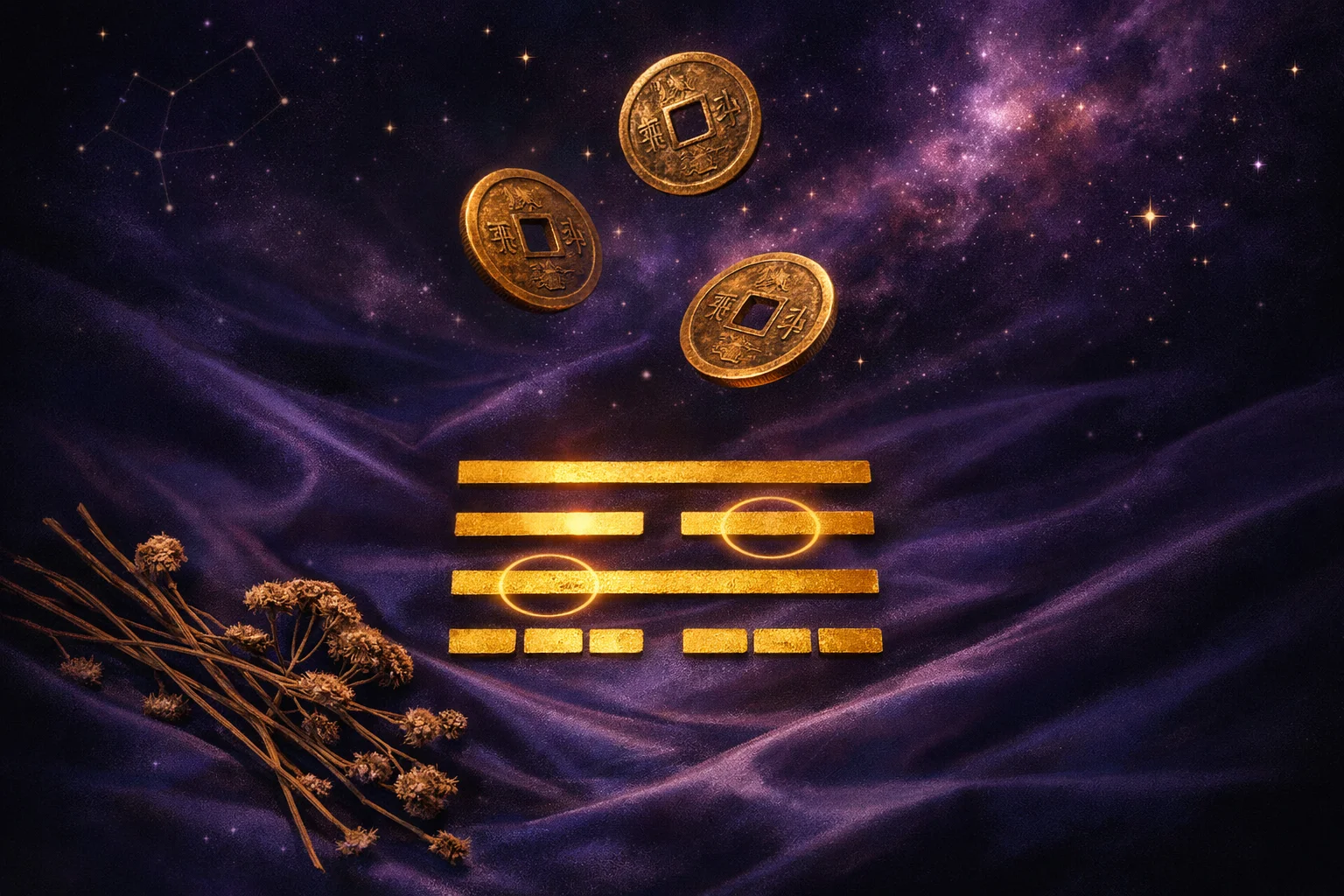
Each throw produces a total of 6, 7, 8 or 9. Seven is a settled unbroken line and eight is a settled broken one — those just sit there. Six and nine are the extremes, where all three tokens came up the same, and the tradition reads an extreme as a condition that has run out of room. Those lines flip. Flip them and you have a second figure, and the pair is the reading: this, becoming that.
Which gives the system an odd property worth stating plainly. There are 64 hexagrams, so a full cast has 4,096 possible outcomes — 64 first figures times 64 second figures, and every one of those pairs is reachable exactly once, because the moving lines are precisely the places where the two figures differ. A cast is not really a hexagram at all. It is an ordered pair of them.
Three Coins, Six Throws, and You Build It Upwards
The mechanic is unglamorous. Take three coins, decide which face is worth 3 and which is worth 2, throw all three, add them up. Do that six times. Write the first result at the bottom of the page and work upwards.
That last instruction is not decoration, and a surprising number of free tools get it wrong or simply do not say. The six places have fixed characters: the bottom line is the beginning of a situation, below ground and not yet visible to anybody; the fifth is the ruling place; the top line is what happens once the whole thing is over. Build downwards and you have not made a small error, you have read somebody else's hexagram.
| Total | Line | Moves? | Traditional mark |
|---|---|---|---|
| 6 | Old yin — broken | Yes, becomes unbroken | ✕ |
| 7 | Young yang — unbroken | No | — |
| 8 | Young yin — broken | No | — |
| 9 | Old yang — unbroken | Yes, becomes broken | ○ |
Coins and Yarrow Stalks Differ by Exactly One Number
The older method uses forty-nine yarrow stalks, split by hand and counted off in fours, three times per line. It takes about a quarter of an hour to build one hexagram. People who use it tend to say the slowness is the point, and they may well be right about that.
But structurally the two methods are the same shape. Both are three divisions, each contributing either the yang value 3 or the yin value 2, summed to 6, 7, 8 or 9. With coins, every division comes up yang half the time, because that is what a coin does. With stalks, the first of the three counts comes up yang three times in four, because the first remainder is 5 in three of the four ways the bundle can split and 9 in only one.
That is the entire difference between the two oldest ways of consulting the Book of Changes. One probability, in one of six places, moving from a half to three quarters. And look what it does:
| Line value | Three coins | Yarrow stalks |
|---|---|---|
| 6 — old yin (moves) | 12.50% | 6.25% |
| 7 — young yang | 37.50% | 31.25% |
| 8 — young yin | 37.50% | 43.75% |
| 9 — old yang (moves) | 12.50% | 18.75% |
| Any unbroken line | 50.00% | 50.00% |
| Any moving line | 25.00% | 25.00% |
| Of moving lines, share that are unbroken | 50% | 75% |
Under the stalks, an unbroken line moves 37.5% of the time and a broken one moves 12.5% of the time — a factor of exactly 3. Under the coins both move at the same rate. So the old commonplace that yang is the active, unstable principle and yin the stable one is not a philosophical gloss bolted onto the numbers. In the stalk method it is the numbers, and the coin shortcut quietly deletes it.
So Is Yarrow More Accurate? No — and Here Is the Proof
This is where the two rows in bold in the middle of that table earn their place, and it is why I put them there rather than leading with the eye-catching 75%. Both methods give a line a 50% chance of being unbroken. Both put 25% of lines in motion. Those two facts have consequences that settle the argument:
- Your first hexagram has identical odds either way. The primary figure depends only on which lines are unbroken, and that is a coin flip per line under both methods — so all 64 hexagrams sit at 1.56% each, whichever you used.
- The number of moving lines has identical odds either way. Six lines, each moving 25% of the time, under both. The table further down applies to coins and stalks alike.
What genuinely changes is the direction of travel, and therefore the second hexagram. With coins a resolved line is unbroken 50.0% of the time, so the second figure is also uniform across all 64. With stalks it is unbroken only 37.5% of the time, and the second figure is measurably pulled toward the yin end of the book. Hexagram 2, six broken lines, turns up as a result 5.9605% of the time with stalks against 1.5625% with coins — 3.81 times as often. Hexagram 1, six unbroken lines, goes the other way and is 5.62 times likelier with coins.
One more way to see it. The two methods spread the 4,096 possible casts very differently: with coins the likeliest single cast is 729 times the rarest, with stalks 117,649 times. Coins are the flatter, more even instrument; stalks concentrate. Neither of those is accuracy. Pick the method whose account of change you actually believe.
How Many of Your Lines Will Actually Be Moving?
Beginners tend to assume a moving line is a special event. It is closer to the default. Each line moves 25% of the time and there are six of them, so:
| Moving lines | Share of casts | What you get |
|---|---|---|
| 0 | 17.80% | One figure, no second hexagram |
| 1 | 35.60% | 1 line reading plus a second hexagram |
| 2 | 29.66% | 2 line readings plus a second hexagram |
| 3 | 13.18% | 3 line readings plus a second hexagram |
| 4 | 3.30% | 4 line readings plus a second hexagram |
| 5 | 0.4395% | 5 line readings plus a second hexagram |
| 6 | 0.0244% | The second figure is the exact complement of the first |
So 82.20% of casts hand back two figures and only 17.80% — about one in six — give you a single standing answer. A single moving line is the commonest outcome of all at 35.60%, two lines follow at 29.66%, and all six moving at once happens on 0.0244% of casts, which is roughly once in four thousand. If that ever comes up, the second hexagram is the exact complement of the first — every line flipped — and only 64 of the 4,096 possible casts do that.
The practical upshot: a reading with no moving lines is not a failure, and treating it as one is the mistake I see most often. It describes something that is not currently in motion. That is an answer, and quite often the answer.
Read the Moving Line Where It Sits, Not Just What It Says
Here is a problem the free tools do not mention. The received texts for the 384 individual lines are the most heavily contested part of the book — they are terse, ancient, and two respectable translations of the same line will frequently say incompatible things. Any site that hands you one without naming the translator has picked a side on your behalf.
The older way round it is to read the line by its place, and the doctrine is precise enough to compute. Odd places — first, third, fifth — suit unbroken lines; even places suit broken ones. A line in a place that suits it is called correct. The second and fifth places are the centres of their trigrams and carry extra weight. Beyond that, each place has a settled character:
| Place | Character | Suits |
|---|---|---|
| 1st | below ground, before anything is visible | unbroken |
| 2nd | the centre of the lower trigram — capable, and not in charge | broken (central) |
| 3rd | the top of the lower trigram — the exposed transition | unbroken |
| 4th | just below the seat of power, close and not in it | broken |
| 5th | the centre of the upper trigram — the ruling place | unbroken (central) |
| 6th | past the situation, out of office, above the game | broken |
Which is why the reader above tells you not only that your fourth line is moving but that the fourth place is the one adjacent to authority without holding any — and that an unbroken line there was pressing on somebody else's prerogative whether it meant to or not. That is a genuinely different piece of information from a two-line aphorism about a wild goose.
One Hexagram in Sixty-Four Gets Every Line Right
Run that correctness rule across all 64 figures and something falls out that I have never seen stated on an I Ching site, though it takes about four lines of code to check. The number of correctly placed lines per hexagram is distributed 1, 6, 15, 20, 15, 6, 1 across zero through six. Which means exactly one figure has all six lines in the place that suits them, and exactly one has none.
They are #63 After Completion and #64 Before Completion — and those are the two hexagrams the King Wen sequence ends on. The book closes not on the perfect arrangement but on the one where nothing is where it belongs, with a fox getting its tail wet a stride from the far bank. Whoever ordered these sixty-four figures knew exactly what they were doing with the last two slots.
The sequence has more structure in it than that. Its 32 pairs are built by turning each figure upside down — hexagram 3 inverted is hexagram 4, 5 inverted is 6, and so on. That leaves the 8 figures which read the same either way up (numbers 1, 2, 27, 28, 29, 30, 61, 62); those get paired with their exact complement instead. That is 28 inversions plus 4 complements — 32 of 32, with no exceptions, and it is the check this page runs on its own hexagram table before it prints anything. Assign one trigram wrongly and the pairing breaks and the count drops.
Two other counts worth having. 16 of the 64 have both central places correct — a broken second line under an unbroken fifth — which is the configuration classical commentary treats as the most favourable arrangement available. Another 8 figures are one trigram stacked on itself (numbers 1, 2, 29, 30, 51, 52, 57, 58), which is why those eight carry the trigram's own name rather than a name of their own.
Every Hexagram Has Another Hexagram Hidden Inside It
Take lines two, three and four of your figure as a new lower trigram, and lines three, four and five as a new upper one. What you get is the nuclear hexagram, and the usual gloss is that it shows the situation underneath the situation. Fine as far as it goes. What nobody mentions is what happens when you keep going.
Squeeze a hexagram, then squeeze the result, then squeeze that. Every one of the 64 figures converges, and there are only three places to land: hexagram 1, hexagram 2, or a two-step loop between 63 and 64 that never resolves. The split is 16 to 1, 16 to 2, 32 to 63 / 64. A quarter of the book to pure yang, a quarter to pure yin, and the remaining half into the loop that cannot settle — produced by an operation that is pure bookkeeping and knows nothing whatever about meaning. The commentators would have had a field day with it.
Practically, glance at it and move on. The nuclear figure is background rather than verdict, and readers who lean on it heavily tend to end up reading four hexagrams for one question, which is three too many. If you want the version of the sixty-four figures that is read structurally rather than cast, our Human Design chart calculator wraps the same hexagrams around the zodiac and reads them off planetary positions instead — no coins, no moving lines, and a completely different set of claims.
The Second Hexagram Is Not Your Future
Back to where this started. The second figure is not a prediction and it is not a timeline. If you want past, present and future laid out as three distinct moments, that is what a three-card tarot spread is built to do, and it does it far better than this. A cast has no time axis in it anywhere.
What the second hexagram actually says is narrower and more useful: this is the same situation once the parts that could not hold have let go. The two figures have to be read against each other. Moving from Waiting to Limitation is a story about a wait that ends in a boundary being drawn. Moving from Conflict to Limitation is a story about an argument that ends the same way. Same destination, entirely different reading, and the destination on its own tells you almost nothing.
Two habits worth building. First, read the moving lines before you look at the second figure — they are the mechanism, and the second hexagram is only the result. Second, do not recast the same question because you disliked the answer; the book has a famously sharp line about that in hexagram 4, which says the first response is the one that counts and pestering gets you nothing. If you want a straight binary rather than a description, our yes or no tarot reading is the honest tool for it, and if you would rather cast than deal, the Elder Futhark rune reading is the other oracle here that answers in conditions rather than pictures.
For the textual history — the Zhou-era core, the later Ten Wings, and how a divination manual ended up as one of the Five Classics — the Wikipedia entry on the I Ching is unusually good and cites the scholarship properly.