Nine of the Twenty-Four Runes Look Identical Upside Down — Which Is Why Rune Reading Isn't Tarot
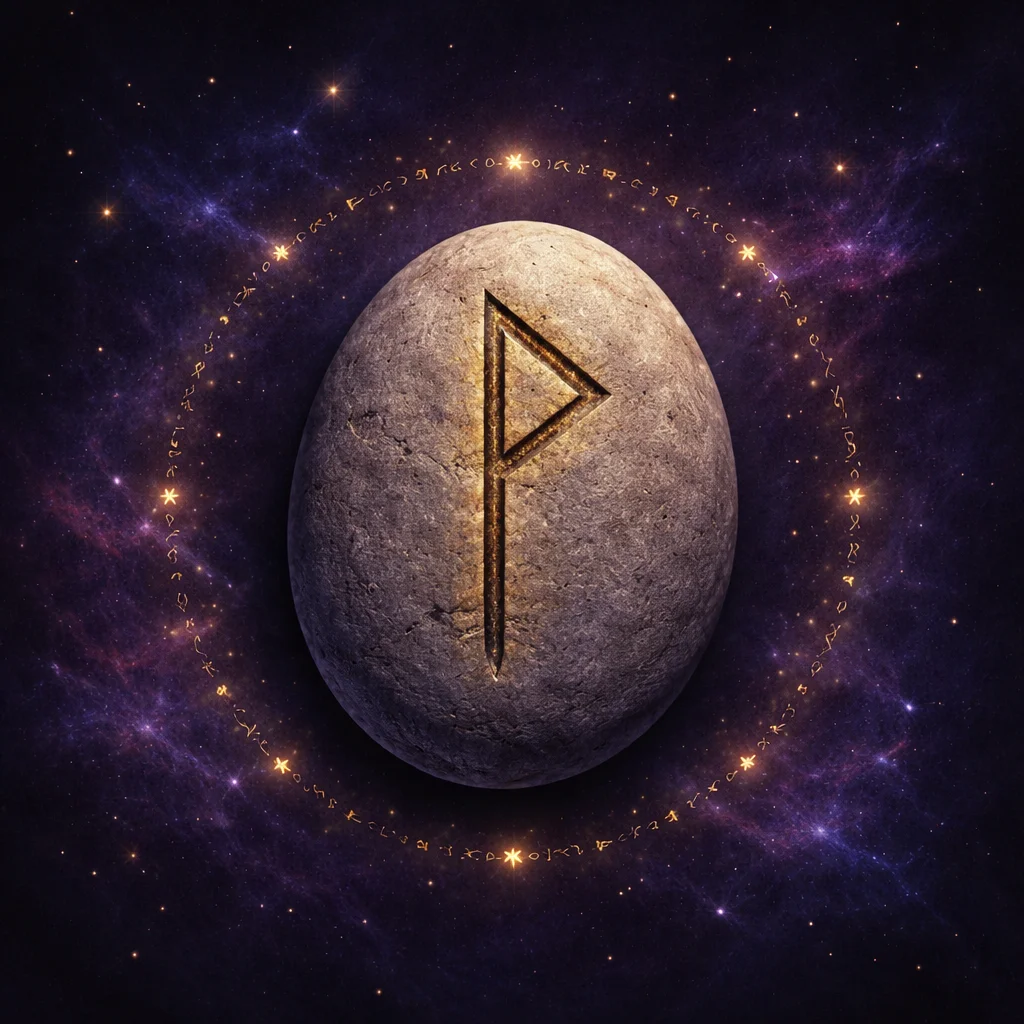
A rune reading and a tarot pull look like the same thing done with different props. You ask, you draw, you read what came up. They aren't the same thing, and the difference isn't atmosphere — it's arithmetic. Nine of the twenty-four Elder Futhark runes are exactly the same shape upside down as right way up, so nine of them cannot be reversed at all. In tarot, 0 of the 78 cards have that property, because every card is a picture and a picture always knows which way up it is. Almost everything else about how the two systems behave falls out of that one line.
Runes Aren't Norse Tarot, and the Difference Is Nine Stones
Start with what each set is for. Tarot was a card game before it was divination, and the deck it left behind is built for narrative: seventy-eight pictures, four suits with ranks running in order, and twenty-two trumps that read like a sequence of events. Pull three and you have characters, a setting and something happening to them.
The futhark is not a deck. It is a writing system — an alphabet in a fixed order, used across Northern Europe for roughly eight centuries to carve names on combs and curses on sticks. Each letter is named for a thing: cattle, hail, ice, a gift, a horse, the sun. The divinatory meanings are those objects, thought about hard. There are no suits, no ranks, no court cards and no story arc. What there is instead is a set of twenty-four conditions.
| Elder Futhark | Rider-Waite-Smith tarot | |
|---|---|---|
| Set size | 24 runes | 78 cards |
| Divisions | 3 aettir of 8, in alphabet order | 4 suits plus 22 majors |
| Can be reversed | 15 of 24 | 78 of 78 |
| Distinct states | 39 | 156 |
| How it is taken | Cast — drawn or scattered, already showing | Dealt face down, then turned |
| Reads best | Conditions and forces | Situations with people in them |
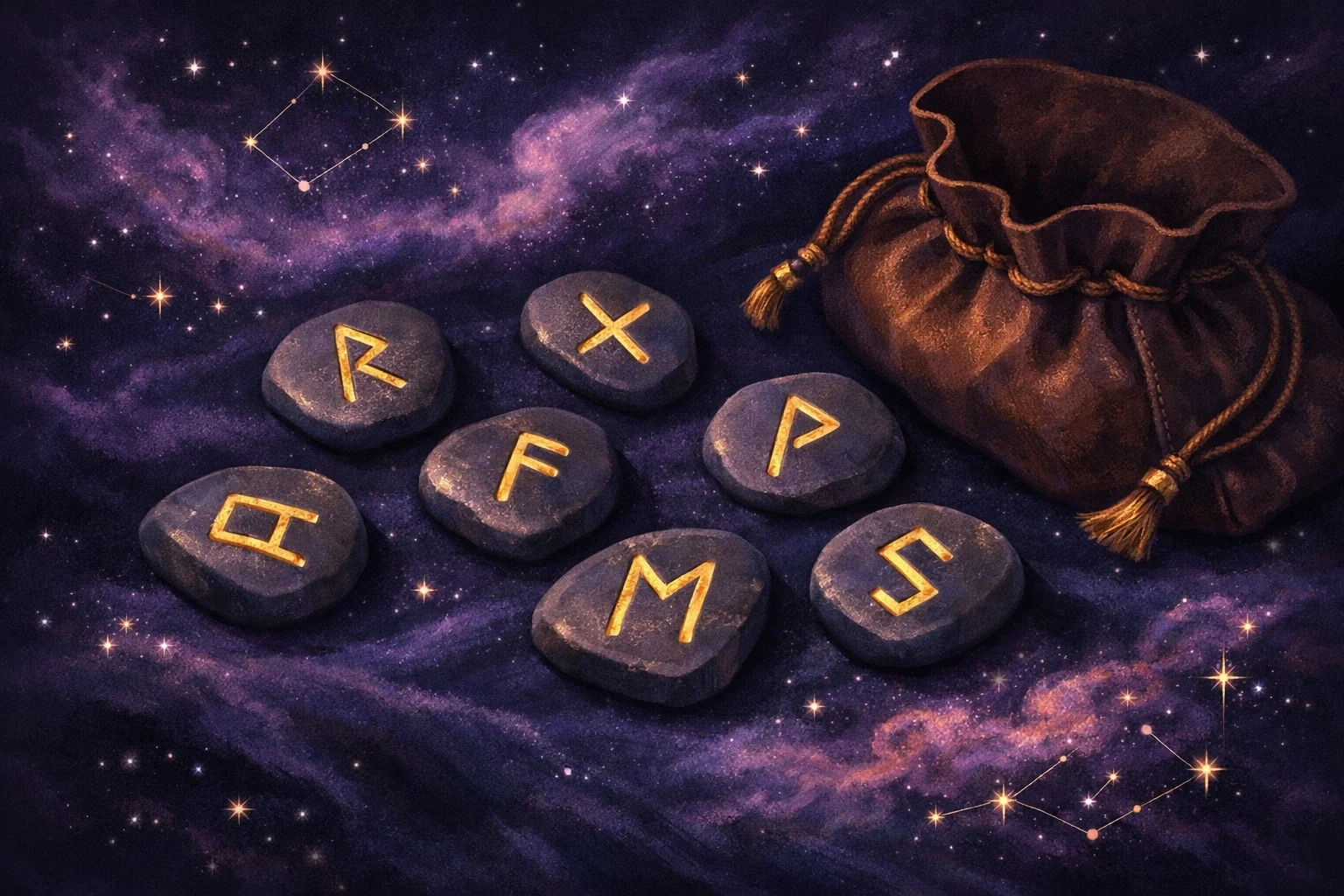
That fifth row is why this tool has no card flip in it. When you cast runes you reach into a bag or throw a handful onto cloth, and the stone is showing the instant it lands. There is no moment of holding a face-down answer, which is most of the drama in a single-card tarot pull. Runes trade that theatre for something else: you see the whole cast at once and read it as a group, which suits a set of conditions far better than it would suit a story.
Nine of the Twenty-Four Have No Upside Down
Here is the thing almost every free rune site gets wrong. Open one and you will usually find a reversed meaning listed for all twenty-four runes. Nine of those entries describe a position the stone physically cannot land in.
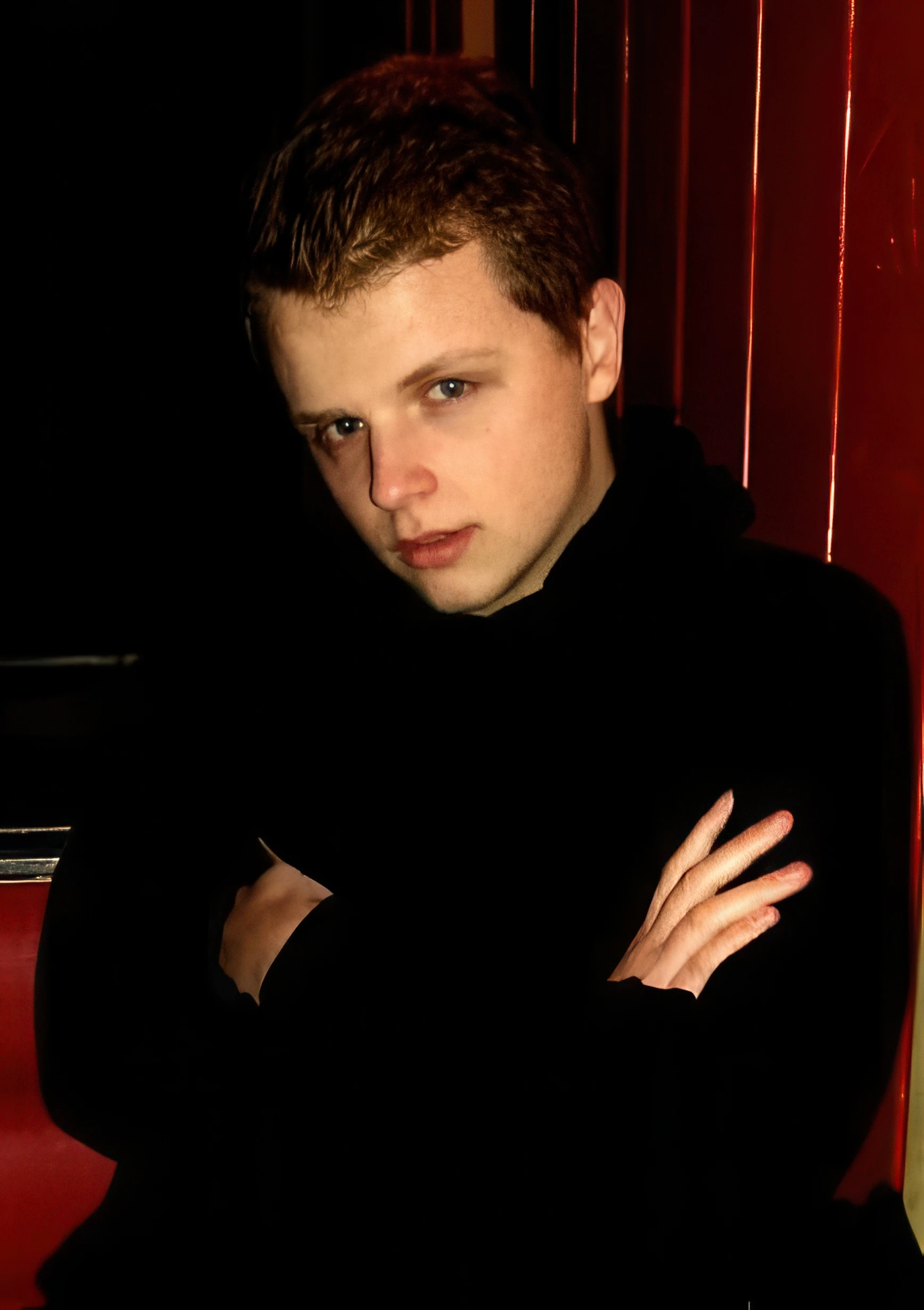
Isa is a single vertical line. Gebo is an X. Ingwaz is a diamond. Turn any of them a half turn and you have the identical mark. It is not that tradition declines to reverse them — it is that there is nothing to notice. The nine are Gebo, Hagalaz, Nauthiz, Isa, Jera, Eihwaz, Sowilo, Ingwaz, Dagaz, and this page doesn't take that list from a rune book. Every rune here is stored as its own set of carved strokes, and the tool rotates those strokes 180 degrees about the glyph's centre and checks whether they land back on themselves. The nine come out on their own. They then match the list the reading tradition already uses for 24 of 24 runes, which is the only external check the method needs.
The nine sort into four shape families once you see them. One bare stave with no branches at all (Isa). Two runes made of strokes crossing a point, so rotation just swaps the arms (Gebo, Nauthiz). Three closed or double-staved figures that are their own mirror (Hagalaz, Ingwaz, Dagaz). And three where a branch at the top is answered by an equal branch at the bottom (Jera, Eihwaz, Sowilo). Every rune outside those families hangs all its branches off one side or one end of the stave, which is exactly what makes a half turn visible.
One rune sits right on the line, and it is worth knowing about because it explains why some books list ten rather than nine. Mannaz is two upright staves joined by crossing diagonals. Draw those diagonals near the top, which is the commonest manuscript form and the one used here, and the rune has a clear right way up. Draw them centred between the staves and it becomes symmetrical. So whether Mannaz has a merkstave is a question about handwriting. That is the honest summary of this entire section: whether a rune "can be reversed" is a fact about how somebody carved it, not about what it means.
Where Did All the Unturnable Runes Go? One Aett Has Six
The futhark splits into three groups of eight called aettir, and the split is not a modern convenience — it shows up on inscribed objects and it is what the runes' fixed alphabetical order is organised around. Freyr's aett is the first eight, and it is about getting and holding: wealth, strength, craft, a gift, joy. Týr's aett is the last eight, and it is about people and obligation: oaths, growth, partnership, kin, inherited land. Hagal's aett sits in the middle and it is the hard one — hail, need, ice, the year's turning, the yew, chance, the raised guard, the sun.
If the nine unreversible runes were sprinkled evenly you would expect 3 in each aett. They are not sprinkled evenly. Freyr's aett has 1. Týr's has 2. Hagal's aett has 6 of the nine — six of its eight runes cannot be turned over at all.
I have never seen a rune book mention it, and it has a reading consequence. The aett the tradition names for hardship and constraint is also the aett with the fewest degrees of freedom in it. Hail is hail. Ice is ice. Necessity does not have a softer face you can catch it wearing. When a cast lands heavily in Hagal's aett you get less nuance and more statement, which is arguably the correct behaviour for a group of runes about forces that don't negotiate. Compare that with the four elemental tarot suits, where every one of the fifty-six minors has a reversal available and the nuance is spread evenly by design.
How Much Can a Three-Rune Cast Actually Say?
Take the three-rune Norn cast, the most common spread in modern rune practice. Twenty-four stones, three drawn, each landing either way up. A calculator that treats all twenty-four as reversible claims 97,152 distinct readings. The real number, once you only reverse the stones that can be reversed, is 51,504 — 53.01% of it.
The gap widens as you add stones, because every extra draw is another chance to pick up something shape-locked:
| Cast | Real distinct readings | If all 24 reversed | Share |
|---|---|---|---|
| One rune | 39 | 48 | 81.25% |
| Three — the Norns | 51,504 | 97,152 | 53.01% |
| Five — the Cross | 55,545,840 | 163,215,360 | 34.03% |
None of that means a rune cast says less than a tarot spread. It means the size everyone quotes is wrong, usually by about half. And it comes with a practical figure worth carrying around: 77.52% of three-rune casts contain at least one stone with no reversed form, rising to 92.93% at five. Three casts in four have something in them the reversal question simply doesn't apply to, so a reader who treats every upright stone as a deliberate positive is over-reading three quarters of their own readings.
One more, because it surprised me when I worked it out. If you flip each reversible stone at a fair 50/50 — which is what actually happens when a tile comes out of a bag — only 31.25% of drawn stones can come back merkstave, because the other nine never can. That is within a whisker of the roughly 30% reversal rate most working tarot readers apply by house convention. The futhark arrives at the same figure by shape, without anyone deciding it — and a clean, wholly upright three-rune cast turns up 31.97% of the time, which is often enough that it is not a sign of anything.
Skuld Is Not the Future, and Reading It That Way Wastes the Stone
The three-rune cast is named for the Norns, the three figures at the well at the root of the world tree. Every rune site on the internet glosses them as past, present and future. Two of those three are roughly right and the third is a straight mistranslation that costs you the most useful position in the spread.
Urðr means "that which has become" — the past as accomplished fact rather than as a date on a calendar. Verðandi means "that which is becoming", the present as an ongoing verb. Skuld means debt. It is the same root that gives English "should": obligation, what is owed, what must be. Not what will happen — what is going to be required.
The practical difference is large. Read the third stone as a forecast and you get a horoscope you can do nothing with. Read it as a bill and the question becomes specific: what is this situation going to ask for, who is going to pay it, and are you the debtor or the creditor here? Nauthiz in Skuld is not "hard times ahead", it is "this will cost you something you were hoping to keep". Gebo in Skuld is not "partnership is coming", it is "somebody is owed, and the ledger is going to be settled". If it's a genuine past-present-future timeline you want, the three-card tarot spread is built for exactly that and does it better, because a picture deck can show you a sequence and twenty-four letters cannot. And if what you actually want is a result that carries its own direction of travel, that is the one thing neither system here does — an I Ching reading returns a hexagram plus a second hexagram it turns into, which no cast of stones and no deal of cards has an equivalent for.
The Three Rune Poems Disagree About What Several of These Are
Nobody wrote down what the runes mean for divination, because as far as the evidence goes nobody in the Viking Age used them that way. What survives is three rune poems — one Old English, one Old Norwegian, one Old Icelandic — each giving a short verse per rune, mostly describing the object the rune is named for. Modern meanings are reconstructed from those verses. The problem is the poems don't agree.
| Rune | Old English | Old Norwegian | Old Icelandic |
|---|---|---|---|
| Uruz | Aurochs — a fierce wild ox | Slag, the dross from bad iron | Drizzle, a cloud shower |
| Thurisaz | Thorn — painful to grasp | Giant — torment of women | Giant — dweller of the rocks |
| Ansuz | Mouth — source of speech | Estuary — a river mouth | Odin, chieftain of Asgard |
| Algiz | Elk-sedge — cuts the hand | Yew — the winter-green bow | Yew — bent bow, brittle iron |
| Perthro | Untranslated — a game, perhaps dice | Not present | Not present |
Look at the Uruz row for a moment. A wild ox, industrial waste and light rain are not shades of one idea — they are three unrelated things, and the modern meaning "raw untamed strength" comes almost entirely from the English aurochs. That is a real choice somebody made, and the sites that publish it never mention there was a choice. Perthro is the sharpest case of all: it is the one rune whose name has never been translated, and the popular dice-cup reading is a scholarly guess from the nineteenth century that got adopted because the alternative was leaving a gap.
Merkstave Is Younger Than the Motorcycle
Two things you should know before you trust anybody's rune table, mine included.
The first is that reading runes reversed is a twentieth-century practice. There is no inscription, saga passage or manuscript in which a rune is read merkstave. The word itself — roughly "dark stave" — is genuinely old, but its use as a divinatory category is modern, borrowed fairly obviously from the tarot reversal convention that was already popular when the rune revival got going. It works, in the sense that any consistent system of contrast works. It is not ancient.
The second is the blank rune, which turns up in a lot of commercial sets as a twenty-fifth stone called Wyrd or Odin's rune. It was invented by Ralph Blum for The Book of Runes in 1982. There is no historical futhark with twenty-five letters. Plenty of readers keep it deliberately as a placeholder for the unknown, which is a perfectly reasonable thing to want, but it should be labelled as a modern addition and it usually isn't. This cast uses 24 stones and no blank.
None of that makes rune reading worthless, and I'd argue the opposite. A system whose provenance you actually know is easier to use honestly than one you have been told is five thousand years old. You can tell which parts are reconstructed, which are inherited and which somebody added in living memory — and that lets you weight them.
Learn the Futhark in Order and the Casts Get Easier
Runes have a fixed sequence, the way the Latin alphabet does, and it is the reason the system is called the futhark at all — f, u, th, a, r, k are its first six letters. Learn them in order and casts stop being lookups. You start recognising which aett a stone came from before you have finished reading its name, which is where the group-level reading begins.
| Rune | Name | Sound | Named for | Reverses |
|---|---|---|---|---|
| Fehu | F | cattle, portable property | Yes | |
| Uruz | U | aurochs — or drizzle, or slag, depending on the poem | Yes | |
| Thurisaz | Th | thorn, or giant | Yes | |
| Ansuz | A | a god, a mouth, the mouth of a river | Yes | |
| Raidho | R | riding, a road, a wheel | Yes | |
| Kenaz | K | torch, and in one poem an ulcer | Yes | |
| Gebo | G | a gift | No | |
| Wunjo | W | joy, delight | Yes | |
| Hagalaz | H | hail | No | |
| Nauthiz | N | need, constraint | No | |
| Isa | I | ice | No | |
| Jera | J | year, harvest | No | |
| Eihwaz | Ei | yew tree | No | |
| Perthro | P | unknown — probably a dice cup | Yes | |
| Algiz | Z | elk-sedge, and in the Norse poems a yew bow | Yes | |
| Sowilo | S | the sun | No | |
| Tiwaz | T | Týr, the god who put his hand in the wolf's mouth | Yes | |
| Berkano | B | birch | Yes | |
| Ehwaz | E | horse | Yes | |
| Mannaz | M | man, humankind | Yes | |
| Laguz | L | water, lake, sea | Yes | |
| Ingwaz | Ng | Ing, the god who left across the sea | No | |
| Dagaz | D | day, daylight | No | |
| Othala | O | ancestral land, property held by right | Yes |
Read down the "reverses" column and the pattern from earlier is visible without any arithmetic: one No in the first eight, six in the middle eight, two in the last eight.
Three Ways a Rune Cast Goes Wrong
Asking a yes-or-no question. It is the commonest thing people bring to the bag and the futhark handles it badly. The usual workaround — upright means yes, merkstave means no — is unavailable for 9 of the 24 stones, which means more than a third of your possible answers come back as a shrug. Runes describe conditions. Ask what a situation is and they are excellent; ask whether it will happen and they have nothing to work with. Keep the binary questions for a yes or no tarot pull, which was built for them.
Reading five stones one at a time. A five-rune cross read left to right as five separate paragraphs is five single-rune readings stapled together, and it will be worse than any one of them alone. The information in a bigger cast is in the relationships: which aett it leans on, whether the counsel stone actually answers the cross-current, how much of it is shape-locked and therefore not up for interpretation. Read the group, then go back for the individuals.
Recasting until you like it. This one is universal across divination and it is worth naming plainly. The second cast on the same question is not a second opinion; it is the first one with the inconvenient stone removed. If a cast lands badly, the useful move is to sit with it and ask a genuinely different question next time — one about a different part of the problem rather than the same part in a better mood.