
Free Tarot Reading Online: How to Ask So the Cards Can Answer
Every free tarot reading online pulls from the same 78 cards, so the difference between a reading that lands and one that reads like a fortune cookie is almost never the website. It's the sentence you typed before you hit draw. I've been laying cards for long enough to notice the pattern: people who get useful readings ask narrow, answerable questions, and people who walk away calling tarot nonsense usually asked something the cards were never able to answer. Same deck. Same odds. Completely different outcome.
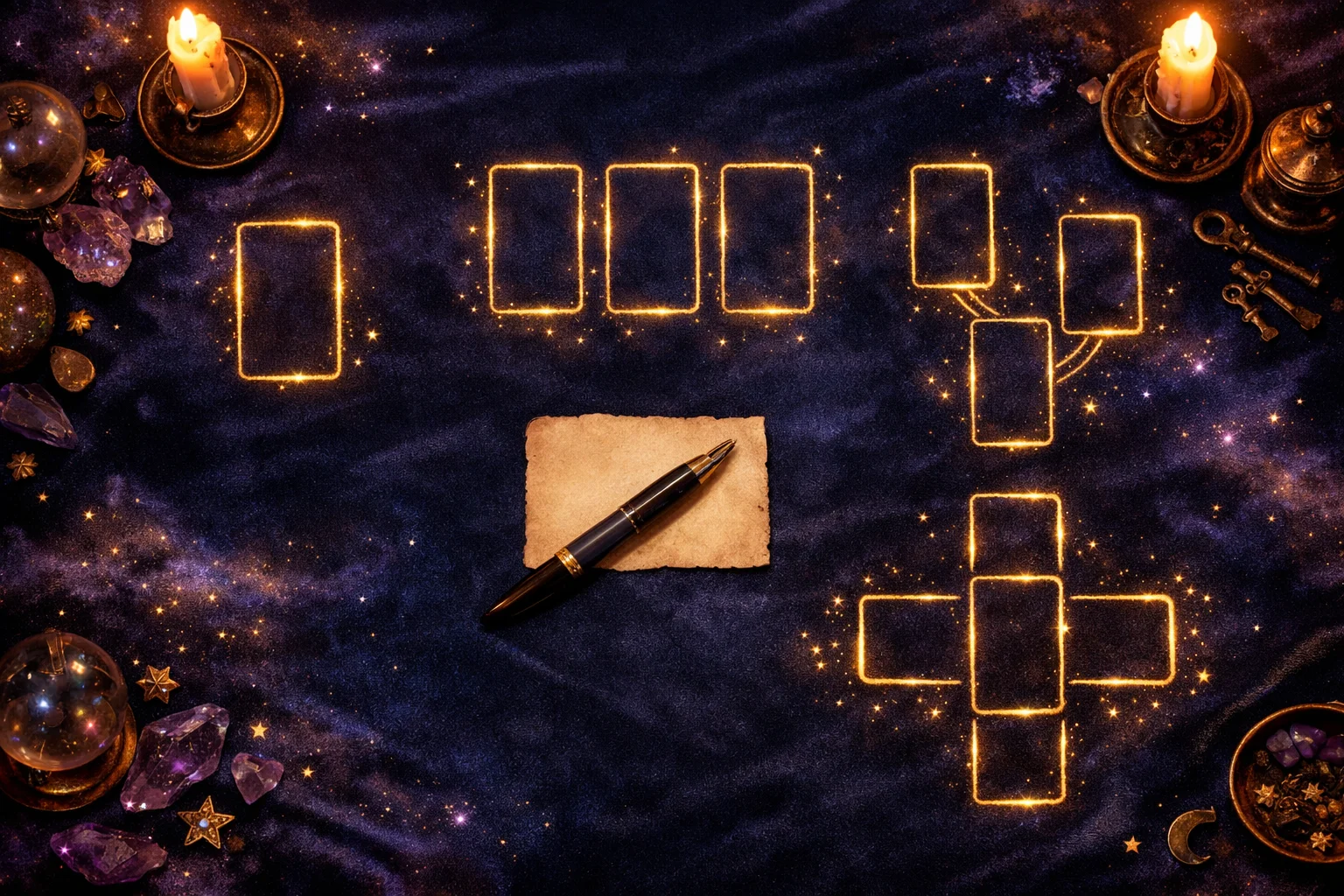
Your Question Picks the Spread
Most sites do this backwards. You land on a page, pick a pretty layout, then squeeze your actual problem into whatever positions that layout happens to have. It works fine when the fit is lucky and produces garbage when it isn't. A past-present-future timeline is superb for "where is this heading" and useless for "which of these two flats should I take," because a timeline has nowhere to put the second flat.
So the reader above inverts the order. You write the question, it gets sorted into one of six shapes, and the spread is built to fit. A choice between two options gets a fork with a road for each and a fourth card for the factor you left off your list. A timing question gets positions about conditions rather than dates, because tarot is honestly bad at calendars and honestly good at describing what has to be true first. A question about another person gets three cards all pointed back at you — more on why that isn't a cop-out further down.
Match the Spread to the Question
If you'd rather do this by hand with your own deck, here's the routing table I use. It fits on an index card and it's the single fastest improvement most self-readers can make.
| Your question sounds like | Cards | Use positions for | Don't |
|---|---|---|---|
| "Will this happen?" | 1 | The answer, read as a condition rather than a prophecy | Add cards until you like it |
| "This one or that one?" | 4 | Your position, each road, and the factor you're not weighing | Ask which is "better" |
| "When will…?" | 3 | What isn't ready, what moves it, how it arrives | Expect a month or a date |
| "What do they feel?" | 3 | What's yours, your blind spot, your move | Read their mind |
| "Why do I keep…?" | 3 | What you think it's about, what it's about, what unties it | Ask two things at once |
| "Everything needs to change" | 5–10 | Position, history, baggage, offer, price | Try to fit it in three |
The right-hand column matters more than the others. Nearly every disappointing reading I've seen committed one of those six errors, and none of them are about card knowledge. If your question really is binary, the yes or no tarot reading gives you a cleaner verdict than any multi-card spread will, and if it's genuinely about where something is heading, the 3-card past, present and future spread reads the movement between the cards rather than each one alone. And if the fork turns out to be about work — stay or go, ask for more, start something — the five-card career tarot reading shapes its positions around which of those four decisions you're actually making.
Six Questions That Break a Reading
These are the phrasings that come up again and again, along with what to ask instead. The rewrites aren't softer — several are harder to sit with. They're just answerable.
| What people ask | Why it fails | Ask instead |
|---|---|---|
| "Does he still love me?" | You're the one shuffling, so it returns your hope in card form | "What is this connection actually doing?" |
| "Should I quit?" | Hands the decision to the deck and keeps the consequences with you | "What does staying cost, and what does leaving cost?" |
| "When will I meet someone?" | Asks for a date from a system with no clock in it | "What's in the way of me meeting someone?" |
| "My future?" | Too wide to aim at — every card reads as vaguely true | "What do I need to see about the next three months?" |
| "Will I get the job and will he text?" | You'll assign each card to whichever half suits you | Draw them separately, job first |
| "Am I cursed?" | Asks the cards to confirm a frame instead of examine it | "What keeps repeating, and what feeds it?" |
The second row deserves a note, because "should I" feels like the most reasonable question in the world. The trouble is what it does to the reading afterwards. Ask "should I quit?" and pull the Eight of Cups, and you've been handed a mandate you can point at when it goes badly. Ask what each road costs, pull the same card, and you learn that leaving is the honest option and you still have to choose it yourself. Same card, same draw, entirely different relationship to the outcome.
When the Cards Answer Something Else
Here's the part nobody builds into an online reader, and it's the most useful diagnostic I know. Every question is asked in a register — a decision, a timing, a feeling, a practical problem — and every draw answers in one too, which you can read off the dominant suit. Wands answer in action and momentum. Cups answer in feeling. Swords answer in truth, information and conflict. Pentacles answer in money, work and logistics. When more than half the spread is Major Arcana, the deck has declined the whole frame and gone up a level.
The interesting readings are the ones where those two don't match. Ask a timing question and get a spread of Cups: the wait isn't logistical, it's that somebody involved hasn't felt ready to move, and no amount of chasing dates will shift it — and if you want the traditional correspondences themselves, with all four of them run side by side, that is what the tarot timing calculator is for. Ask about a relationship and get three Pentacles: the connection isn't failing emotionally, it's failing because nothing is being built — no plans, no logistics, no future with a date on it. Ask which of two jobs to take and draw nothing but Majors: neither job is really the question, and the thing you actually need to decide is a size larger than employment.
That mismatch is the closest tarot gets to telling you that you asked the wrong question, and it's why the synthesis panel above reports it explicitly rather than quietly averaging the cards into something pleasant. If you want to check what a suit is saying on its own terms, the guide to the four tarot suits breaks down what each one governs and how the numbers modify it.
One Routed Reading, Line by Line
A worked example, because the abstract version of this is easy to nod along to and hard to use. Someone types: "Should I move back to my hometown or stay here?"
That contains "or" and a decision verb, so it routes to the fork rather than a yes-or-no. Four positions. Say the draw comes out: Four of Wands in Where You Stand, Six of Cups for the first road, Eight of Pentacles reversed for the second, and The Moon in What You're Not Weighing.
Read individually that's pleasant and slightly mushy. Read as a routed spread it's pointed. Four of Wands says the current position is more stable than the person feels it is — they're not fleeing a fire. Six of Cups on the hometown road is the nostalgia card, and in a decision position it isn't endorsement, it's a warning that the road is being evaluated on memory rather than on what's there now. Eight of Pentacles reversed on the stay-here road says the work has gone stale: motions without craft. So far, honest and unhelpful — both roads have a problem.
Then the fourth position does the work. The Moon in What You're Not Weighing says the decision is being made on a distorted picture, and given the Six of Cups sitting on the other road, we can name which distortion. The reading isn't "move" or "stay." It's: you're comparing a remembered version of one place against a burnt-out version of the other, and neither is accurate. Go and spend a real week in the hometown before deciding. Now check the synthesis — one Wand, one Cup, one Pentacle, one Major, no dominant suit and no clean register. A genuinely split table like this one usually means the situation is still forming, which is itself an answer: not yet.
What Free Actually Costs You
Worth being straight about the mechanics, since "free" and "online" make some people assume the cards are decorative. The draw here uses the browser's pseudorandom number generator over all 78 cards with no weighting, which means the Tower and the Ten of Swords turn up at their natural odds instead of being quietly suppressed the way they are on sites optimising for repeat visits. Roughly 30% come out reversed. Whether that randomness carries meaning is a question about tarot itself, not about the software — a hand shuffle is a randomiser too, just a slower one with better theatre.
One thing this router deliberately won't do is send you outside the deck, so it is worth saying here. Some questions aren't really about people and events at all — they're about a condition you are already in, and a picture deck keeps handing you a cast of characters for it. That is what an Elder Futhark rune cast is good at: twenty-four carved conditions, no narrative, and nine of them with no reversed form at all, so roughly a third less of the reading is conditional on how things fell.
If you'd rather use your own deck and only want help with the interpretation, that's a different tool entirely. The AI tarot reading interpreter takes cards as input rather than dealing them, and reads the combination — which is also where you can see why most chatbot readings quietly smooth away the contradictions that make a spread worth reading.
What you lose is real, though. A human reader asks follow-up questions, notices when your voice changes on the third card, and catches the thing you're circling but haven't said. No online reader does that, and any site claiming otherwise is selling something. The honest split: use a free reading for the everyday questions where you mainly need a prompt to think against, and pay someone when the stakes are high enough that you'd want a second person in the room. If you want to build the habit rather than answer a specific question, the daily tarot card is the better ritual — one locked card per day, tracked over time.
Redrawing Won't Change the Answer
The most common way people ruin a free reading is volume. Draw, dislike it, refresh, draw again. By the fourth attempt you're not reading tarot, you're shopping for a sentence you already decided you wanted, and you'll find it eventually — there are 78 cards and a generous enough interpretation of any of them will say what you need to hear.
My rule is one spread per question, and no repeat until something in the actual situation changes: a conversation happens, a decision gets made, a week passes and gives you new information. If a reading genuinely made no sense, the fault is nearly always upstream in the question, so rewrite it and route it again rather than redrawing the same one. And if you keep pulling about a person several times a day, the honest read is that you're managing anxiety rather than seeking information — which the cards will tell you, repeatedly, until you listen.