How to Read a Tarot Spread While You're Still Learning the Cards
Tarot card spreads look far more complicated than they are. The layout does most of the heavy lifting for you — once a card lands in a labeled spot, that spot tells you how to read it. That's the trick most beginners miss. You're not decoding 78 cards from memory all at once; you're reading one card through the lens of one question at a time. Draw a three-card spread and you've already been handed a beginning, a middle, and an end.
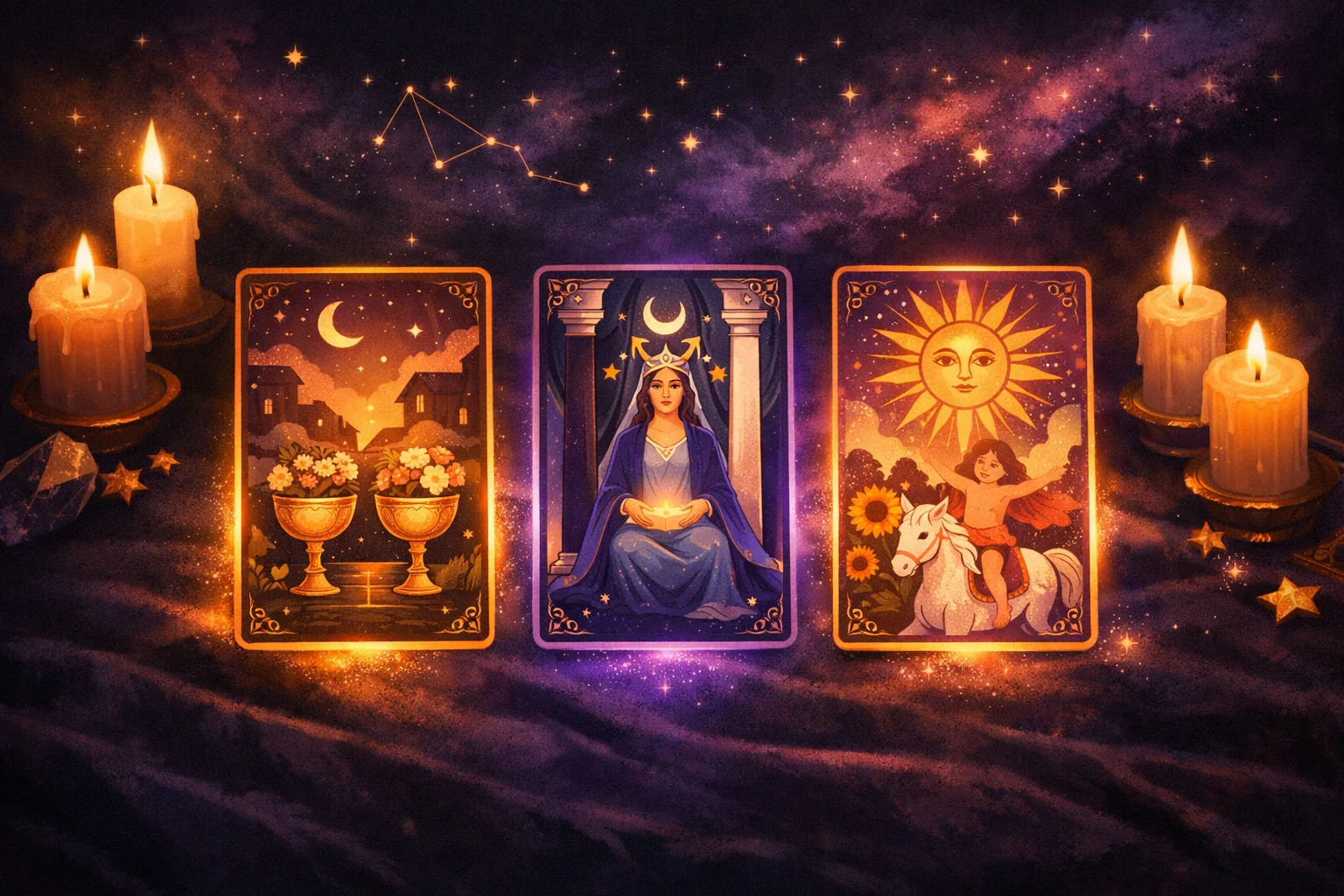
The reader above pulls real cards so you can practice this immediately. But knowing how to read what you drew is the part no shuffle button can do for you. So let's walk through it the way I'd teach a friend at the kitchen table — which spread to reach for, how to turn three separate cards into one clear message, and where new readers reliably get stuck. If you'd rather have that first decision made for you, the free tarot reading online takes your question in your own words and routes it to the spread that matches it.
Start With Three Cards, Skip the Ten
Almost every beginner wants to start with the Celtic Cross because it's the spread they've seen in movies. Don't. Ten cards create dozens of relationships to track at once, and you'll drown before you've learned to swim. A three-card spread teaches the one skill everything else is built on: reading a card through a position. Master that with three cards and the ten-card Celtic Cross later becomes just more of the same, not a different sport.
There's no shame in staying small, either. Plenty of professional readers run three-card spreads all day and only break out larger layouts for genuinely tangled situations. If your question fits in a sentence, three cards can usually answer it. If it fits in a word — yes, no, stay, go — even a single-card pull will do the job better than a sprawling spread that gives you ten places to hide from the answer.
Four Three-Card Frameworks That Cover Almost Everything
The magic of the three-card spread is that you assign what each position means before you shuffle. Same three cards on the table, completely different reading depending on the jobs you gave those three spots. Here are the four framings I lean on most, and when each one earns its place:
| Framework | The Three Positions | Reach for it when… |
|---|---|---|
| Past · Present · Future | Where it came from, where it is, where it's going | You want to see how a situation is evolving over time |
| Situation · Obstacle · Advice | What's happening, what's blocking it, what to do | You know the problem but not the solution |
| You · Them · The Connection | Your energy, their energy, the bond itself | You're trying to understand a relationship |
| Mind · Body · Spirit | Your thoughts, your physical state, your inner life | You need a general check-in rather than a specific answer |
Notice that none of these needs more than three cards to be genuinely useful. The reader on this page runs the first three live; the fourth, Mind · Body · Spirit, works exactly the same way if you reassign the positions in your head. And if the timeline framing is the one you keep reaching for, the dedicated past, present and future tarot spread goes deeper on it — you pick your own cards and it reads the movement between them, not just the cards themselves. For every layout laid out position by position, plus a couple of larger options, the full tarot spreads reference guide is the companion to this reader.
Read the Spread as One Sentence, Not Three
Here's where beginners plateau. They flip three cards, read each one in isolation, and stop — three mini-readings stapled together. But a spread isn't three answers. It's one answer told in three beats. The cards are talking to each other, and the conversation between them usually says more than any single card does.
The habit to build is simple: read each card alone first, then ask what changes when you line them up. Does the story move from bad to good, or good to bad? Do two cards share a suit — three Cups or Swords in a row tells you the whole situation is emotional or mental? Is there a jump from a heavy Major Arcana card to a light everyday Minor? That movement is the reading. A card doesn't just mean what it means; it means what it means coming after the card before it.
A Three-Card Reading, Card by Card
Let me show you the whole process with an actual Past · Present · Future draw, because a real example teaches more than any list of rules. Say you asked about a breakup you're still carrying, and you turned over the Three of Swords, then the Six of Swords, then the Ten of Cups.
Past — Three of Swords. On its own this is heartbreak, plain and sharp: three blades through a heart. But it's sitting in the Past position, and that reframes everything. A painful card in “Past” is usually good news — the worst of it is behind you, not ahead. The reading opens by naming the wound honestly rather than pretending it didn't happen.
Present — Six of Swords. A figure ferried across still water toward a far shore. This is transition, the deliberate move away from turbulence toward somewhere calmer. In the Present slot it says you're already in the boat. You're not stuck in the heartbreak anymore; you're actively, if quietly, moving on. This middle card is the pivot the whole spread turns on.
Future — Ten of Cups. A rainbow over a family, the deck's picture of emotional fulfillment. As the Future forecast, it's telling you where this trajectory leads if you keep going: not just recovery, but genuine warmth and belonging on the other side. Read alone, it's a nice card. Read as the end of this sentence — heartbreak, then crossing, then home — it lands with real weight.
That's the difference between reading cards and reading a spread. Three of Swords, Six of Swords, Ten of Cups aren't three separate verdicts. They're one arc: the pain is behind you, the healing is already in motion, and it's carrying you somewhere good. The position gave each card its job, and the sequence gave the reading its meaning.
What Changes When a Card Lands Reversed
Roughly a third of the cards you draw here will come out reversed — upside down — and reversals throw new readers more than almost anything. The key misconception is that a reversed card means the opposite of its upright meaning. It rarely does. Far more often a reversal signals the same energy turned inward, blocked, delayed, or running low.
Take the Knight of Cups — upright, a romantic offer riding toward you. Land it reversed in a Future position and it doesn't flip to hatred; it dims. The offer arrives lukewarm, or later than you hoped, or from someone whose sweet words outrun their follow-through. Position and orientation stack: a reversed card still has to do the job its slot assigns, just in a muted or complicated key. If reversals overwhelm you at first, it's completely fine to read every card upright while you learn — you'll add the nuance back once the upright meanings feel automatic.
When Two Cards Seem to Argue
Sooner or later you'll draw a spread that seems to contradict itself — a warm, open card next to a cold, guarded one — and your instinct will be that you did it wrong. You didn't. The tension is the message. When your Present card is the Ace of Cups (an emotional heart flung wide open) and your Advice card is the Queen of Swords (clear-eyed, unsentimental detachment), the spread isn't broken. It's telling you the situation feels like all heart while the wise move is to keep a cool head.
Elements make this easy to spot. A Cups card (Water) sitting beside a Swords card (Air) frequently marks the classic heart-versus-head split; Fire next to Water can mean passion meeting emotion, or being doused by it. Reading a dramatic card like the Tower against a calm one isn't a glitch to reshuffle away — it's the whole point. Resist the urge to redraw until you get a “tidy” spread. The messy one is almost always the honest one, and honest is what you came for.
Graduating to Bigger Spreads
Once three-card spreads feel natural — once you can flip three cards and hear the sentence they make without straining — you're ready to add positions. The five-card decision cross on this page is the logical next rung: it keeps the three-card habit of reading by position but adds a “what helps,” a “what blocks,” and a root cause, so you can actually weigh a choice instead of just watching a timeline. Tarot has a long, well-documented history as a tool for reflection rather than fortune-telling, and the modern position-based spread is a relatively recent refinement of that tradition (the history of the tarot deck is worth a read if you're curious how it got here).
Move up only when the smaller spread stops giving you room to think, not because bigger feels more serious. The best readers I know reach for the simplest spread that can answer the question, then stop. Draw a few three-card spreads this week, read each one as a single sentence, and you'll feel the moment you're ready for more. Your deck will tell you — you just have to be reading the spread, not only the cards.