Your Mars Can Be in Any Sign. It Just Usually Isn't.
Your Mars sign can be any of the twelve, and almost every guide stops there. It is true, and it is the least useful true thing anyone will tell you about this placement. Mercury never gets more than 28 degrees from the Sun and Venus never more than 47, so for both of those the distance is effectively a constant. Mars is the first body in the chart where it is a real variable — anywhere from nought to 180 degrees. That freedom is genuine. It is also wildly lopsided, and nobody seems to mention it.
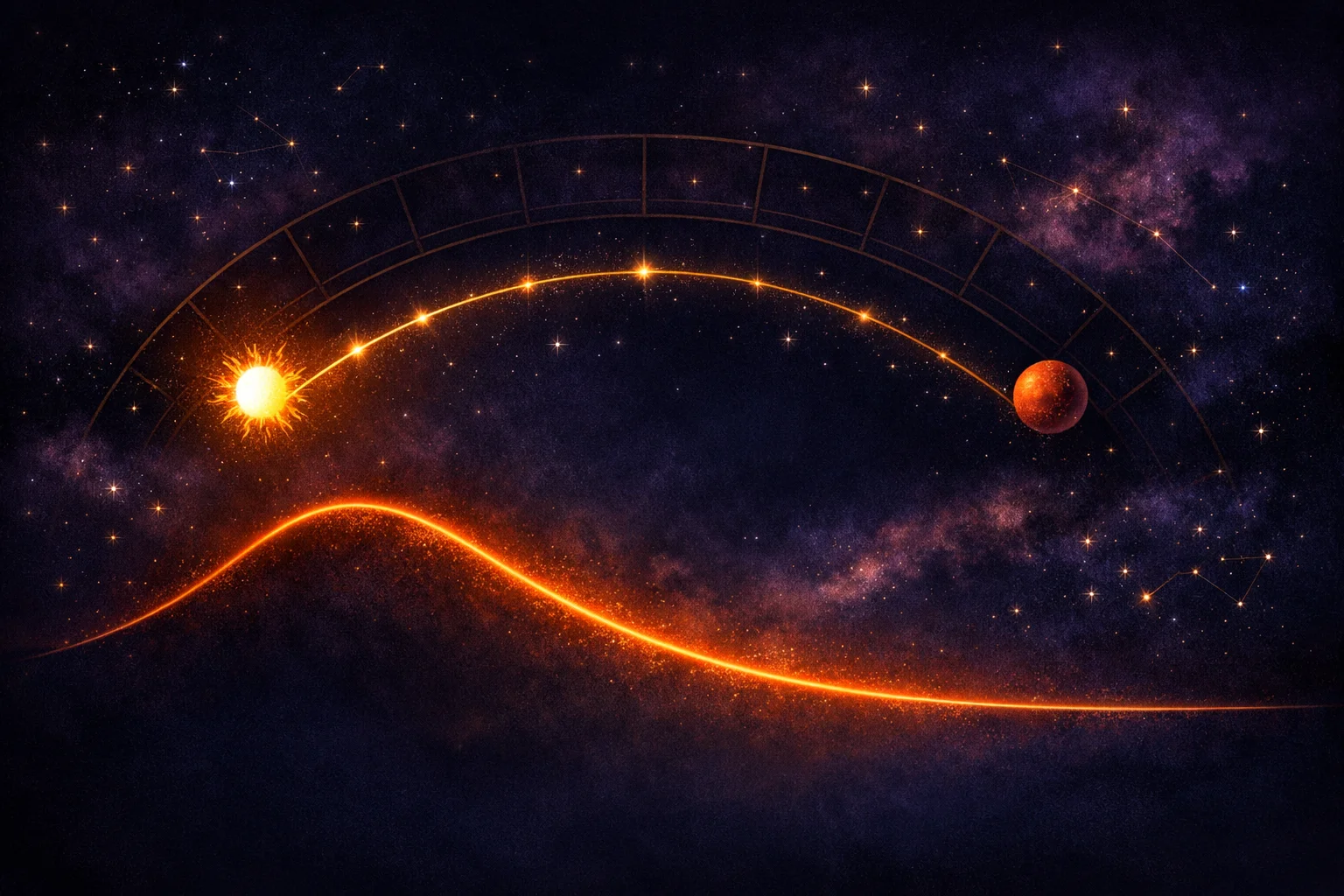
Mars Can Sit in Any Sign. Here Is How Often It Actually Does.
I ran the numbers over every birth date from 1930 to 2029 — 36,525 of them — and counted how many signs sat between the Sun and Mars in each chart. If Mars were genuinely free, each of the twelve gaps would come in at about 8.3%. They do not come close.
| Gap | Share of births | Against an even 8.3% |
|---|---|---|
| Same sign | 13.73% | 1.65× commoner |
| One sign apart | 13.41% / 13.17% | 1.60× commoner |
| Two signs apart | 11.53% / 11.63% | 1.39× commoner |
| Three signs apart | 8.28% / 8.31% | dead level |
| Four signs apart | 5.05% / 5.07% | 1.65× rarer |
| Five signs apart | 3.45% / 3.43% | 2.42× rarer |
| Opposite sign | 2.92% | 2.85× rarer |
Same sign beats opposite sign by 4.70 to one, and the fall between them is smooth — no bump, no plateau, nothing that looks like an artefact. The giveaway that this is real rather than a quirk of my sample: the pairs match. Mars one sign ahead of the Sun comes in at 13.41% and one sign behind at 13.17%. Four ahead is 5.05% and four behind is 5.07%. A distribution that symmetric did not happen by accident.
So the honest version of the standard claim is this. Mars is unchained from your Sun in the way that Venus and Mercury never are — the twelve-sign spread that a Capricorn man's Mars placement demonstrates so well is not a fiction. But freedom is not the same as randomness, and your Mars was always more likely to end up near your Sun than far from it.
Why Mars Crawls Past the Sun and Sprints Through Opposition
The cause is not mystical, and it is worth understanding because it makes the whole pattern obvious in hindsight. Watch how fast the gap between Mars and the Sun actually opens, and the shape falls out on its own:
- While Mars is within 30 degrees of the Sun, the gap widens by 0.278 degrees a day. Both are moving forward through the zodiac, and the Sun is only a little quicker.
- Beyond 150 degrees, the gap changes at 1.271 degrees a day. Mars has turned retrograde near opposition while the Sun keeps going, so the two are now pulling apart from both ends at once.
That is a ratio of 4.57 to one. And the measured density ratio — how many births land within 30 degrees of the Sun versus beyond 150 — is 4.55 to one. Those two numbers come from completely separate calculations and they agree to within half a per cent. Mars simply spends longer in the sky positions near the Sun because it moves through them slowly, and any given birth is more likely to catch it there.
One consequence worth sitting with: a Mars directly opposite your Sun means Mars was at opposition when you were born, which is the moment it is closest to Earth and brightest in the night sky. Roughly one birth in twenty-six. If you have it, Mars was a red lamp overhead at midnight on the day you arrived.
What a Welded Mars Does That a Counterpoise Mars Never Will
Separation is worth reading because it answers a different question from the sign. The sign tells you the flavour of your drive. The distance from your Sun tells you whether that drive and your sense of self are pulling as one animal or as two.
A welded Mars — inside 20 degrees, 18.29% of people — cannot tell the difference between what it wants and who it is. That is why these people are so hard to negotiate with and so impossible to fake: talk them out of the goal and you have talked them out of themselves. The cost is that when the drive stalls, everything stalls. There is no second engine.
A counterpoise Mars — beyond 160 degrees, 3.89% — runs the opposite way. The drive is a long way from the self-image, and a long arm moves more weight than a short one. These are people who pursue things nobody who knows them would have predicted, and who describe themselves as inconsistent while everyone else calls it range. The friction is not a bug in the chart. It is the power source.
Most people, of course, are somewhere in the middle: 34.49% in step, 33.20% crosswise. Two thirds of the population sit in the unglamorous bands, which is worth saying because astrology writing has a habit of implying everyone is an outlier.
Every Mars Sign Is Two Instructions, Not One
Here is a thing experienced readers do automatically and beginners never get told. A Mars sign is a modality and an element bolted together, and in a real argument those two halves do different jobs. The modality is how the engine starts. The element is what it burns.
Take Mars in Virgo — mutable earth. The mutable half means you do not open the fight, you reshape it; you will not win the argument on the table, you will change which argument is on the table. The earth half means the thing that actually set you off was security, something being taken or eroded. Now compare Mars in Gemini, also mutable but air. Same opening move — redirect rather than confront — but the trigger is entirely different. Gemini is not defending territory, it is defending being right.
Read them separately and the tool's grid becomes genuinely useful: you can see the two other Mars signs that start fights the way you do, and the two that burn on the same fuel. Mars in Taurus and Mars in Capricorn will both look immovable to you, but only Capricorn shares your appetite for a deadline. That is the kind of distinction a full birth chart calculation gives you room to make once Mars stops being a single word on a list.
Eight Days of Mars in Pisces
In late October 1988, Mars did something that shows exactly how strange this placement can get. It was retrograde, moving backwards through early Aries, and on 24 October it slipped back across the boundary into Pisces at 29 degrees 57 minutes — three arcminutes inside the sign. Four days later it stationed direct at 29 degrees 54 minutes. On 1 November it crossed forward into Aries again and never returned.
Anyone born in that eight-day window has Mars in Pisces. Six arcminutes of arc — a tenth of a degree — separates them from a chart that reads Aries instead, and those two placements could hardly be less alike. It is the shortest Mars-in-sign visit in the whole century I measured.
The other end of the range is Mars in Virgo from 11 November 2011 to 3 July 2012: 236 days, thirty times longer, because a retrograde loop happened to land in the middle of it. The typical visit is 45 days. Where your own birth falls inside that range is something the calculator works out and reports back, and it is not a trivial detail — 23.6% of people were born during a stint that a retrograde stretched out.
One Birth in Ten Has Mars Running Backwards
9.54% of births happen with Mars retrograde. You will read in a lot of places that this makes it the rarest of the personal-planet retrogrades, and it does not — running the same test on the same 36,525 dates puts Venus retrograde at 7.20% and Mercury retrograde at birth at 19.18%. Mars sits in the middle. It only feels rarer because Mars retrogrades come around once every 25.6 months rather than three times a year, so most people have never been through one as an adult twice.
When they do come, they last 60 to 81 days — a median of 77 — and cover 10 to 19.5 degrees of backward arc. That is a much bigger, slower loop than a Venus retrograde in the natal chart, and it does something different. A natal Mars retrograde tends to mean the drive turns inward before it turns outward. You rehearse arguments you never have. You start late and finish properly. Advice to trust your first instinct works badly here, because your first instinct is a draft.
Mars in Virgo Beats Mars in Pisces by Half Again, and Always Has
The twelve Mars signs are not equally common either. Virgo takes 10.38% of births and Pisces only 6.66% — a spread of 1.56 to one. The obvious guess is that this is a quirk of the century I sampled, and for Venus that guess would be right. For Mars it is wrong, and the reason is a genuinely permanent feature of the solar system.
I ran the same count over 1630–1729, 1830–1929 and 2030–2129. The spread comes out at 1.57, 1.45 and 1.41 to one, with the same signs on top every single time. Five hundred years does not shift it, because the cause is Kepler's second law working on the most eccentric orbit of the inner planets. Mars's orbital eccentricity is 0.0934, which NASA's planetary fact sheet puts at roughly six times Earth's. A planet on an eccentric orbit moves fastest when it is closest to the Sun and slowest when it is furthest away.
Measure Mars's average distance from the Sun sign by sign and the whole thing resolves. In Pisces it averages 1.3999 AU, near perihelion, so Mars is sprinting. In Virgo it averages 1.6443 AU, near aphelion, so Mars is crawling. Rank the twelve signs by distance and you get exactly the order you get ranking them by share of births. Mars in Virgo is commoner than Mars in Pisces for the same reason a car covers less ground going uphill, and it will still be true in the year 2500.
None of which changes what your Mars means. It does change what a good report should tell you about it — and if you want to watch the same planet move against your finished chart rather than sit still inside it, that is what a current transit calculator is for.
The separation curve measured above is not a fact about Mars alone, either. Every body outside Earth's orbit spends longer near the Sun than near opposition, for the same geometric reason, and it quietly contaminates any claim that two of them "keep turning up together". The Juno sign calculator borrows this finding to dismantle one such claim — that Juno conjunct Venus is fated — and shows the effect is the Sun's, not Venus's.