Every Venus Placement Has Two Halves. Most Calculators Give You One.
Any Venus sign calculator can tell you that your Venus is in Libra. Almost none will tell you which Libra — whether Venus was climbing out of the dawn ahead of the Sun that morning, or trailing it down into the dusk that evening. That second fact is not a footnote. It splits everyone born with Venus in Libra into two groups of roughly equal size who behave differently, and it has been part of the tradition for about three thousand years. It just does not survive the trip into most free calculators.
The Half Your Venus Sign Report Left Out
Venus orbits inside us. From where we stand it can never wander far from the Sun — the furthest it gets is somewhere between 45.3° and 47.2°, depending on where both planets sit in their slightly elliptical orbits. Everything else about how Venus behaves in a chart follows from that one constraint.
The most useful consequence is a hard binary. Venus is either at a lower zodiacal degree than the Sun or a higher one. Lower means it rises first, before dawn, and the ancients called it Phosphorus, the light-bringer. Higher means it sets last, after dusk, and they called it Hesperus. The Greeks took two centuries to work out these were the same object. The two names survived long after the astronomy was settled, which tells you something about how differently the two apparitions read to people watching the sky every night.
Across every birth date from 1930 to 2029, the split is 49.7% morning star and 50.3% evening star. It is almost exactly half the human race each way, and it is invisible in a report that gives you a sign and stops.
Morning Star or Evening Star?
Here is the mechanical reading, and I want to be clear that it is derived from the geometry rather than decorated onto it.
A morning-star Venus occupies a degree the Sun has not reached yet. Whatever your Venus wants, it gets there before your solar identity does. In practice that looks like appetite running ahead of judgement — you are already leaning in, already generous, already committed to the trip, and the part of you that has opinions about all that catches up a beat later. People with this placement often describe their own attractions as something that happened to them.
An evening-star Venus occupies a degree the Sun has already crossed. The identity is established first and the wanting is filtered through it on the way out. That is not coldness, though it can look like it for the first month. It is sequence. An evening-star Venus has usually decided what kind of thing this is before it admits to feeling anything about it, which is why these people are so often accused of playing games when they are simply running the steps in the other order.
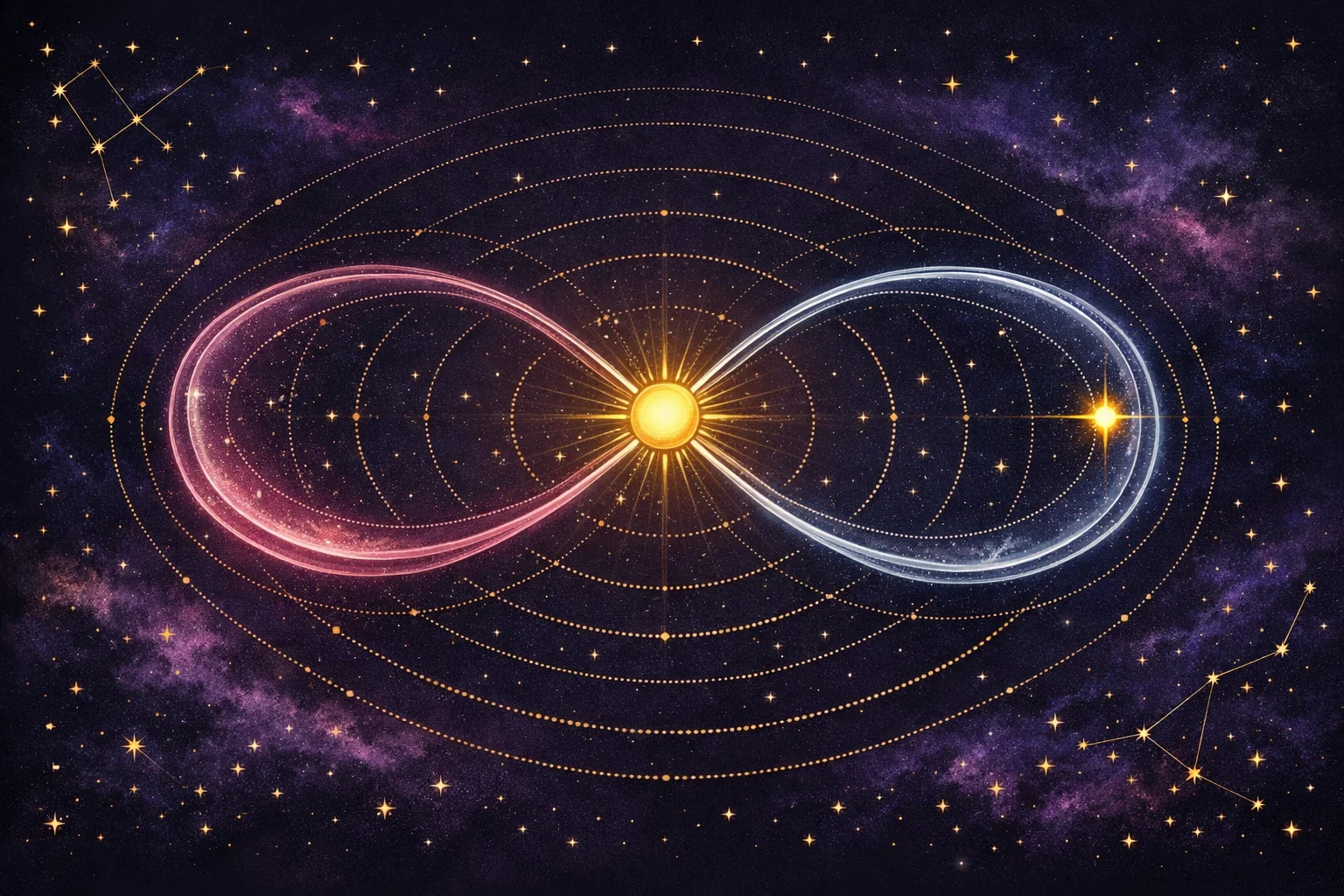
The apparition lasts about 292 days on each side — measured over a century, the median evening run is 292 days and the median morning run is 291. Then Venus passes behind or in front of the Sun and switches. That is the 584-day synodic cycle the tool above draws as two lobes.
Reading the Sign and the Apparition Together
The sign says what your Venus is after. The apparition says whether it arrives before or after you have ruled on it. You need both, and the combination is genuinely different from either half alone. A worked pair makes this concrete.
There is a third thing the same 47-degree leash produces, and it belongs to a different page. Because Venus can never stray far from the Sun, a Venus sitting on your Ascendant drags the Sun to the horizon with it — so "Venus rising", the placement the whole beauty-in-astrology genre is built on, turns out to be a statement about being born near dawn. Every mid-latitude chart tested came in within five hours of actual sunrise. The physical appearance astrology calculator measures that, and reads Venus on the Ascendant rather than Venus by sign.
| Venus in Scorpio | As morning star | As evening star |
|---|---|---|
| First contact | Hit hard and immediately. Alarming, because it arrived before any assessment could stop it. | Nothing visible for weeks. The assessment ran first and quietly. |
| The testing | Comes after the attachment, as damage control. | Comes before it, as entry criteria. |
| What it looks like from outside | Intense, then suddenly guarded. | Guarded, then suddenly total. |
| Where it breaks | Retroactive suspicion of a choice already made. | The test is invisible and nobody knows they are sitting it. |
Same sign. Same three drives. Opposite running order, and if you have ever read a Venus in Scorpio description and thought "half of that is me and half is nothing like me," this is usually why. If you want the wider picture around it, the full birth chart calculator places Venus among all ten bodies, and the guide to astrological compatibility and synastry aspects explains what happens when your Venus meets someone else's.
Your Venus Twins Were Born Eight Years to the Day From You
Five Venus cycles take 2,919.7 days. Eight of our years take 2,921.9. Those two numbers are so close that Venus is back within about half a degree of where it was on your birthday every eight years, which produces one of the few genuinely checkable predictions in astrology.
Take every birth date between 1935 and 2020 and compare each one to the same calendar date eight years later. The Venus sign matches 97.3% of the time. Sixteen years, 94.6%. Twenty-four years, 92.0%. Now the control, which is the part that makes the number mean anything: at seven years the match rate is 6.6%, and at four years it is 5.9%. Pure chance would be 8.3%. So this is not "Venus moves slowly" — a seven-year gap is worse than random. It is specifically the eight-year resonance.
The 2.6% that miss are not scattered. 84% of them are births within 1.5° of a sign boundary, where a half-degree of drift is enough to tip the answer over. The drift runs at about +0.38° per eight-year step, so the pattern would need roughly six centuries to slip a whole sign.
One Person in Fourteen Has Venus Running Backwards
Venus is retrograde on 7.2% of all birth dates. That is rarer than a natal Mercury retrograde by a wide margin — Mercury manages 19.17% — and it is the one Venus condition worth flagging on its own, because it puts Venus close to Earth and close to the Sun at the same time.
What that tends to produce is a late-arriving relationship with your own taste. Not an absence of taste — a revised one. Retrograde Venus people very often start out wanting what they were handed, notice at some point that it does not fit, and construct the real preferences afterwards, usually in their twenties or thirties and usually with some embarrassment about the earlier version. It also tends to mean the standard advice lands badly. Being told to "trust your instincts" is not useful when the instincts were installed by someone else.
If Venus was retrograde when you were born, it will also be worth watching what happens when Venus goes retrograde in the sky, which the transit calculator for your natal chart will place against your own planets.
Twenty-Three Days, or a Hundred and Twenty-Six
Venus does not move at a steady pace, and this has a consequence nobody mentions: some Venus placements are much rarer than others, and it has nothing to do with the sign.
When Venus crosses a sign without interruption, it takes between 23 and 33 days, and the median is 25. When it turns retrograde partway through, the same crossing can take up to 126 days — Venus goes in, stops, backs out, stops again, and finishes the job months later. Over a century that happens 97 times, and 83 of those visits run past 90 days. The median retrograde-touched visit lasts 121 days, nearly five times an ordinary one.
Which means 26.8% of people are born inside a long visit rather than a short one. If your result above says Venus stayed 121 days, you belong to a cohort roughly five times larger than the one born during an ordinary 25-day crossing of the same sign. That is a slightly deflating thing to learn about a placement, and a genuinely useful one if you have been trying to work out why the standard description of your Venus sign feels so generic.
Some Venus Signs Are Simply Commoner Right Now
Sun signs are close to evenly distributed, because the Sun takes about 30 days over each one. Venus signs are not. Among people born between 1930 and 2029, Venus in Aries and Venus in Scorpio each account for 9.62% of births, while Venus in Pisces accounts for 7.15%. That is a 1.35 to 1 spread.
| Venus sign | Share of births 1930–2029 | Share over 1600–2399 |
|---|---|---|
| Aries | 9.62% | 8.29% |
| Scorpio | 9.62% | 8.11% |
| Gemini | 9.48% | 8.46% |
| Virgo | 8.88% | 8.41% |
| Pisces | 7.15% | 8.32% |
| Sagittarius | 7.22% | 8.23% |
| Libra | 7.26% | 8.32% |
Widen the window to eight hundred years and the spread collapses to 1.07 to 1 — essentially flat. So this is not a property of the zodiac. It is a property of the people currently alive. Venus's five retrograde loops sit at five points around the circle and creep backwards slowly, so any given century gets a lopsided sample of them. Yours is a century where Aries and Scorpio got two extra loops and Pisces got none.
Mars does the same thing for the opposite reason, which is what makes the comparison worth drawing. Its signs are uneven too — Virgo 10.38% against Pisces 6.66% — but that spread survives five hundred years of resampling untouched, because it comes from orbital eccentricity rather than from where a few retrograde loops happen to be parked. The Mars sign calculator works through that case in full. Same-looking statistic, entirely different cause.
One more distinction worth holding onto, because it is the one readers most often collapse. Venus is attraction — who you notice, what draws you across a room. It is not the same faculty as whatever makes you stay, and the asteroid Juno is the body traditionally read for that. The Juno sign calculator covers the terms of a commitment rather than the pull toward one — and it also takes apart the popular claim that Juno conjunct Venus is meaningful, which turns out to be the Sun's doing rather than Venus's.
Venus Turns Retrograde on 3 October 2026
Venus stations retrograde at 8°30' Scorpio on 3 October 2026 and turns direct again at 22°52' Libra on 14 November. It backs out of Scorpio on 25 October and spends the next twenty days re-crossing the last degrees of Libra, ground it already covered in the first week of September.
Two things follow from that. If your natal Venus sits anywhere in the 15.6° between 22°52 ' Libra and 8°30' Scorpio, transiting Venus will cross your natal degree three times in six weeks rather than once — the same triple-hit structure that makes a Saturn return arrive in three instalments, compressed from years into weeks. And if you have a child born in that window, they join the 7.2%: check the box above, because the sign boundary at 0° Scorpio gets crossed three times and the birth hour will matter far more than usual.
Anyone whose Venus lands in the last degrees of Libra this year is worth watching twice. It is the cleanest live demonstration of everything on this page — the elongation shrinking, the apparition flipping from evening to morning at inferior conjunction on 24 October, and a sign span stretching out to four times its usual length while it happens.