Every Hold Has a Bill. The Four of Pentacles Asks Whether You Have Read It.
An emergency fund is a Four of Pentacles. So is refusing to let a partner see the bank statement. The Four of Pentacles tarot card meaning is the same in both cases, a person holding tightly to what they have, and the difference lies entirely in the bill. One hold buys sleep. The other buys distance. The card shows you the grip and leaves the accounting to you.
Upright: holding on is a strategy with a bill
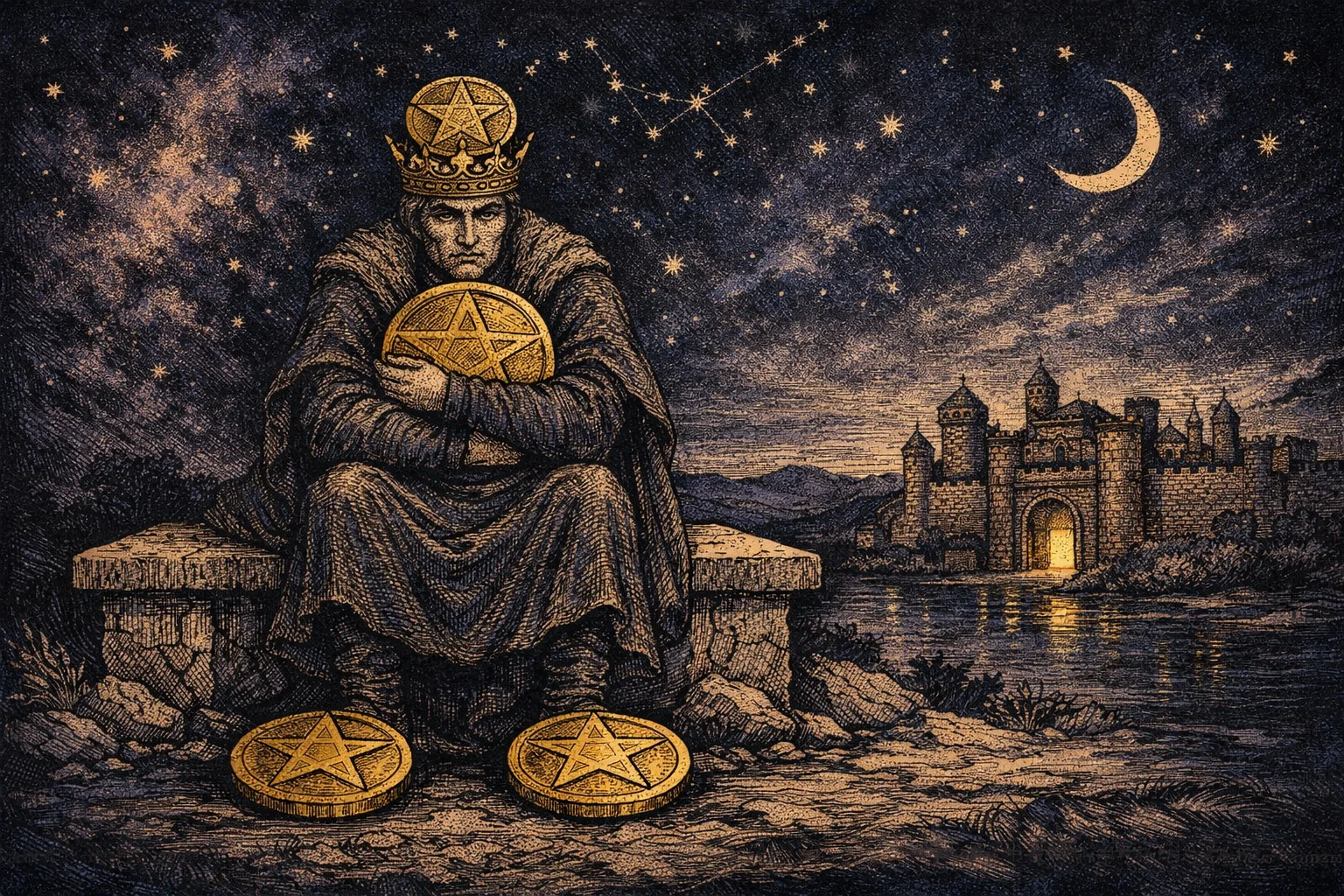
Upright, the Four of Pentacles means security that has been achieved and is now being protected: savings, ownership, a stable position, a settled routine. Nothing in the picture is moving. That stillness is the card's strength and its whole problem. Money that stays put can't be lost; it also can't be used, shared or grown.
The lazy reading calls the man a miser. The useful reading asks what his hold is costing him relative to what it protects. Someone rebuilding after a redundancy who refuses to spend is holding wisely. Someone who has held the same amount for a decade and still won't take a holiday is paying for a safety they reached years ago. Same card, same grip, different bill.
Two questions separate the two. What would the held thing actually be for, if it were ever released? And when was the last time the hold was checked against that purpose? A hold that can answer both is a plan. A hold that can't has become an end in itself, which is the moment the Four of Pentacles stops describing security and starts describing a cage with a comfortable seat.
Count the coins: crown, arms, feet
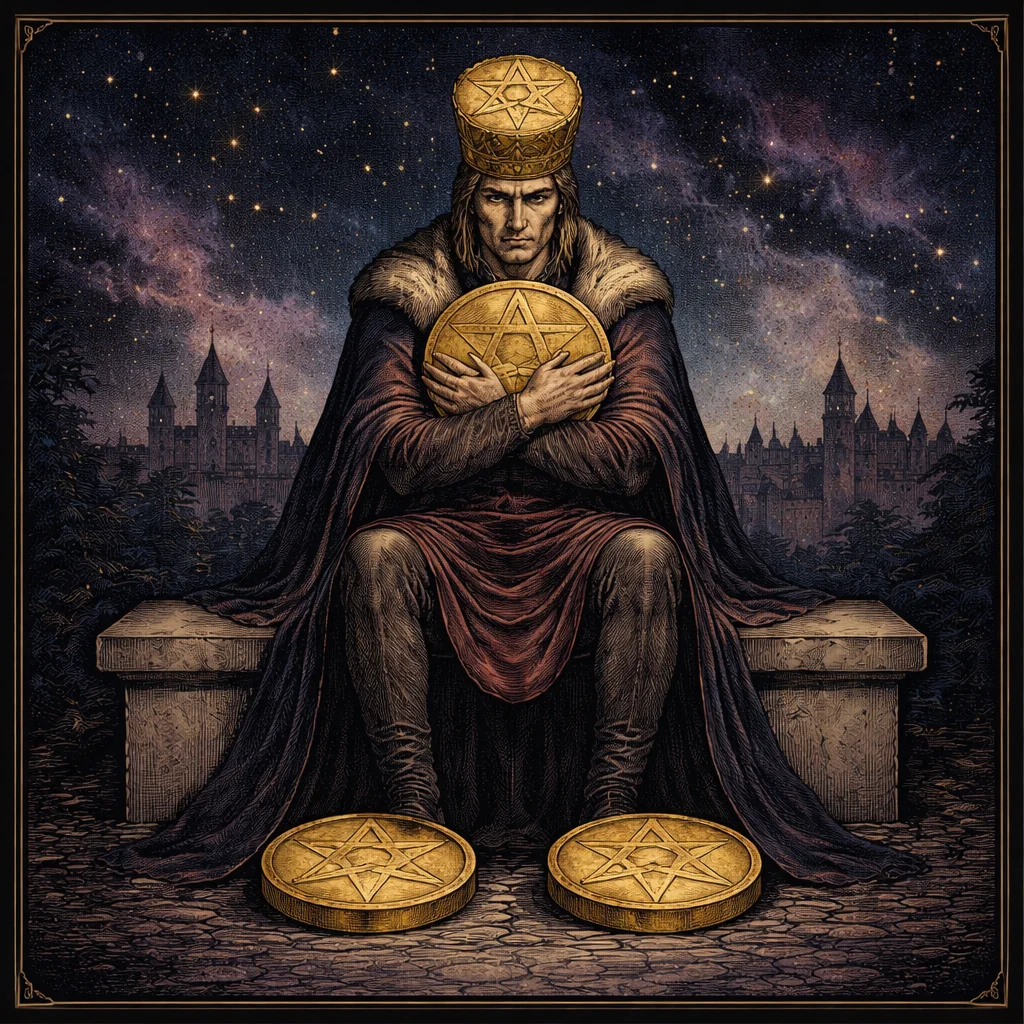
The Rider-Waite-Smith Four of Pentacles shows a crowned figure on a plain stone seat with a town some distance behind him. Waite's own description is brief: a pentacle over his crown, another clasped with hands and arms, two under his feet. Where the coins sit is worth reading before anything else, because the position tells you what kind of hold is being pictured.
The coin on the crown sits where he thinks. A hold can be mental: an identity, a reputation, a fixed idea of how life must go. The coin at the chest is what he clutches, the money or person or position he can feel. The two underfoot are what he stands on, the foundation he has stopped noticing because it never moves. Treat this as a reading exercise rather than an instruction from the artist, and it gives you three different questions for one card: what am I defending in my head, what am I gripping, and what am I standing on so firmly I've stopped looking at it?
Then notice what the picture leaves out. He isn't chained, walled in or threatened. He could stand up at any moment, but standing would mean putting a coin down, and the two underfoot would be left behind. The town behind him is where other people are. The card doesn't say he was banished from it. It shows him choosing the bench.
Waite's list is kinder than the meme
Ask around and you'll hear that the Four of Pentacles means greed. Open Waite's 1911 Pictorial Key and the upright list reads: "The surety of possessions, cleaving to that which one has, gift, legacy, inheritance." His reversed list is "Suspense, delay, opposition," not generosity. A second list later in the same book adds "pleasant news from a lady" for a bachelor and "observation, hindrances" for the reversal. The card the deck's own author described is about possession being made secure, and its reversal is about that security being blocked.
The Golden Dawn's earlier Book T, from the order Waite had belonged to, titles the card the Lord of Earthly Power and gives it both faces at once: "Assured material gain, success, rank, dominion, earthly power completed, but leading to nothing beyond. Prejudiced, covetous, suspicious, careful and orderly, but discontented. Little enterprise or originality." That is the most honest description of the card I know. The gain is real. So is the ceiling.
| Source | Upright | Reversed |
|---|---|---|
| Book T (Golden Dawn, c. 1888) | Assured material gain, rank, earthly power completed but leading to nothing beyond | Not separately listed; the covetous, suspicious, discontented side sits in the same entry |
| Waite (1911) | Surety of possessions, cleaving to what one has, gift, legacy, inheritance | Suspense, delay, opposition |
| Common modern reading | Saving, security, control, hoarding, fear of loss | Letting go, generosity, overspending, a grip failing |
The modern list isn't wrong; it's the shadow side of Waite's list, promoted to the headline. Knowing both lets you read the card by cost instead of by mood. When the hold protects more than it costs, you're in Waite's territory: legacy, surety, possessions kept. When the cost has overtaken the protection, you're in the modern one. The picture is identical. The bill isn't.
Reversed: releasing on purpose, or losing your grip?
The Four of Pentacles reversed is usually read as the grip loosening, and that reading needs a second question straight away. Loosened by whom? A hold released on purpose looks like planned spending, delegated work, a partner given room, a rule changed because the conditions changed. A hold that simply failed looks like the same money leaving without a plan, a role abandoned mid-task, or a relationship dropped because holding it had become unbearable.
Both feel like relief for about a week. The difference shows up afterwards. Chosen release leaves something in its place: a purchase you can point to, a person who now knows a task, a new rule. A slip leaves a gap, and the gap tends to fill with the thing the hold was built to prevent. Waite's reversed keywords, suspense and delay, describe a third case: the hold hasn't loosened at all, it has been blocked from outside, and what you're feeling is the strain of holding against resistance.
So don't read the reversal as an automatic good sign or an automatic loss. Look for the visible change. If you can name what replaced the hold, the reversal is release. If you can only name a mood, keep the ledger open and check again in a month.
Four of Pentacles in love: loyalty and possessiveness share a hand
The Four of Pentacles love meaning is where the card gets its worst reputation, and where the ledger matters most. Holding a relationship can be loyalty: staying through a bad year, keeping a promise, not leaving at the first hard conversation. Holding a person is different. It shows up as checking, testing, needing to know where someone is, and calling the supervision love. The card can picture either. The other person's experience tells you which.
As feelings, the card describes guarded attachment: someone who wants the security of the relationship and is reluctant to risk it, who may hold back affection to avoid the exposure of giving it. It cannot confirm what a partner privately feels, and a clenched coin is not evidence that someone is stingy with love. Read what they do with the hold. Sharing plans, money and time is holding the relationship. Controlling them is holding the person.
For singles, upright often describes a heart kept in reserve, sometimes wisely after a loss and sometimes long past the point where the reserve is protecting anything. For reconciliation, distinguish holding onto the relationship from holding onto the ex. The first can be worked on with the other person; the second is done alone and doesn't need their participation, which is usually the tell. Reversed, the two branches from the previous section apply: opening up and giving space, or detaching and leaving first. And if contact is unwanted or unsafe, no card asks you to hold on.
Money and work: the emergency fund and the missed raise
Take a hypothetical saver. She has six months of expenses set aside, adds to it every month, and hasn't touched it in four years. Upright, the Four of Pentacles describes her accurately and approvingly. Now add one detail: she has turned down a course that would have raised her income because it meant spending from the fund. The card still describes her. It has also started describing the cost, and the coin on her crown, the fixed idea that the fund must never shrink, is the one doing the damage.
At work the card is the safe role held past its usefulness. No raise request, because asking might risk the position. No new project, because it might fail publicly. The role stays, the reputation stays, and the career underneath them stops moving. Upright, the question is whether the security is still buying what it was meant to buy. If the answer is time and options, the hold is fine. If the answer is only more of the same, the hold has become the ceiling that Book T describes.
With actual money, the card predicts neither profit nor loss. Waite's "gift, legacy, inheritance" describes money being held safely once it arrives, not a payment on its way. Reversed can describe spending that was planned, spending that slipped, or a hold blocked by an outside delay. A tarot card is not a reason to move, spend or refuse money; use records, the actual terms and appropriate advice for that.
Sun in Capricorn and the 'nothing beyond' clause
Book T attributes the Four of Pentacles to the Sun in the last ten degrees of Capricorn, twenty to thirty, the sign's third decan. The Sun passes through those degrees in roughly the second and third weeks of January in most years, though the card is a symbolic attribution, not a transit report. It doesn't say where the Sun is today, and drawing the card doesn't make anyone a Capricorn.
What the attribution does explain is the card's temperature. Capricorn is the sign of the achieved position, and the Sun in its final degrees is that achievement at full strength with nowhere left to climb. Read Book T's phrase again: "earthly power completed, but leading to nothing beyond." That clause is the card. The Four of Pentacles is what security looks like once it has been won, and the warning is that winning it was the last move in the plan.
The Golden Dawn image for the card, before Pamela Colman Smith drew the seated man, was a hand holding a rose branch with a single fully open white rose and no buds. One finished flower, nothing coming. It makes the same point as the crowned figure without a coin in sight.
Read the card next to its neighbours
Beside the Devil, ask whether the hold is still a choice. The Devil's figures wear chains; the Four's man is only holding coins and could stand up. The pairing asks when a hold stopped being something you do and became something done to you, which is usually the moment you can no longer imagine putting the thing down.
Beside the Emperor, compare what the structure is for. The Emperor holds a throne on behalf of a territory; his order exists for other people. The Four holds a bench on behalf of himself. Structure that serves others can be handed on. Security that serves only its holder can only be defended.
Beside the King of Pentacles, the question is distribution. The King gives from what he holds and builds with it; his shadow is turning provision into control. The Four doesn't give at all. When the two appear together, ask what the held resource would look like if it were being stewarded rather than kept.
Beside the Two of Swords, look at the arms. Both figures cross them over the chest; one holds a decision, the other a possession. Together they describe a person guarding both what they have and what they haven't decided, which is a lot to carry on one bench. For where the Four sits in its suit, the tarot suits guide explains why Pentacles read as money, work and the body, and why a Four feels heavy here and festive in Wands.
Run the ledger before you pull again
Before you ask the Four of Pentacles for a yes or no, write three short answers. They turn a card about holding into a card about a specific hold, which is the only kind you can do anything with:
- What am I holding? Name the actual thing: the fund, the person, the role, the routine. "Security" isn't an answer; it's the feeling the answer produces.
- What does the hold protect, and what does it cost? Both columns, in writing. A ledger with one column is a justification.
- What is the smallest reversible test? One planned spend, one delegated task, one weekend without checking. Something you can undo, that tells you which column is heavier.
The test matters more than the interpretation. Loosening a grip in your head changes nothing; loosening it by one small, recoverable step tells you whether the fear was accurate. Relief says the hold was too tight. Real harm says it was doing its job, and now you can keep it without apologising.
Quick systems, including our own yes or no tarot reader, map the upright card to no and the reversed to yes. That's a workable convention for a one-card answer. The fuller reading is conditional: yes to keeping what you have, not yet to anything that requires open hands, until you've read the bill.