Major Arcana Meanings: 22 Cards That Were Never Meant to Be Read Alone
Major Arcana meanings are usually taught as 22 separate definitions — flashcard style, one card at a time. That's the slowest possible way to learn them, and it's also how the cards end up scaring people. Last winter I read for a friend who pulled the Devil, the Tower, and Death together in a five-card spread. She went quiet, then asked how bad it was. Three "dark" cards, sure. But numbered, they read 15, 16, 13 — three stations from one short stretch of a single story, the stretch where something false gets dismantled. Her spread wasn't stacking three separate disasters. It was describing one demolition, and most of it had already happened.
The Majors Are a Story, Not a Vocabulary List
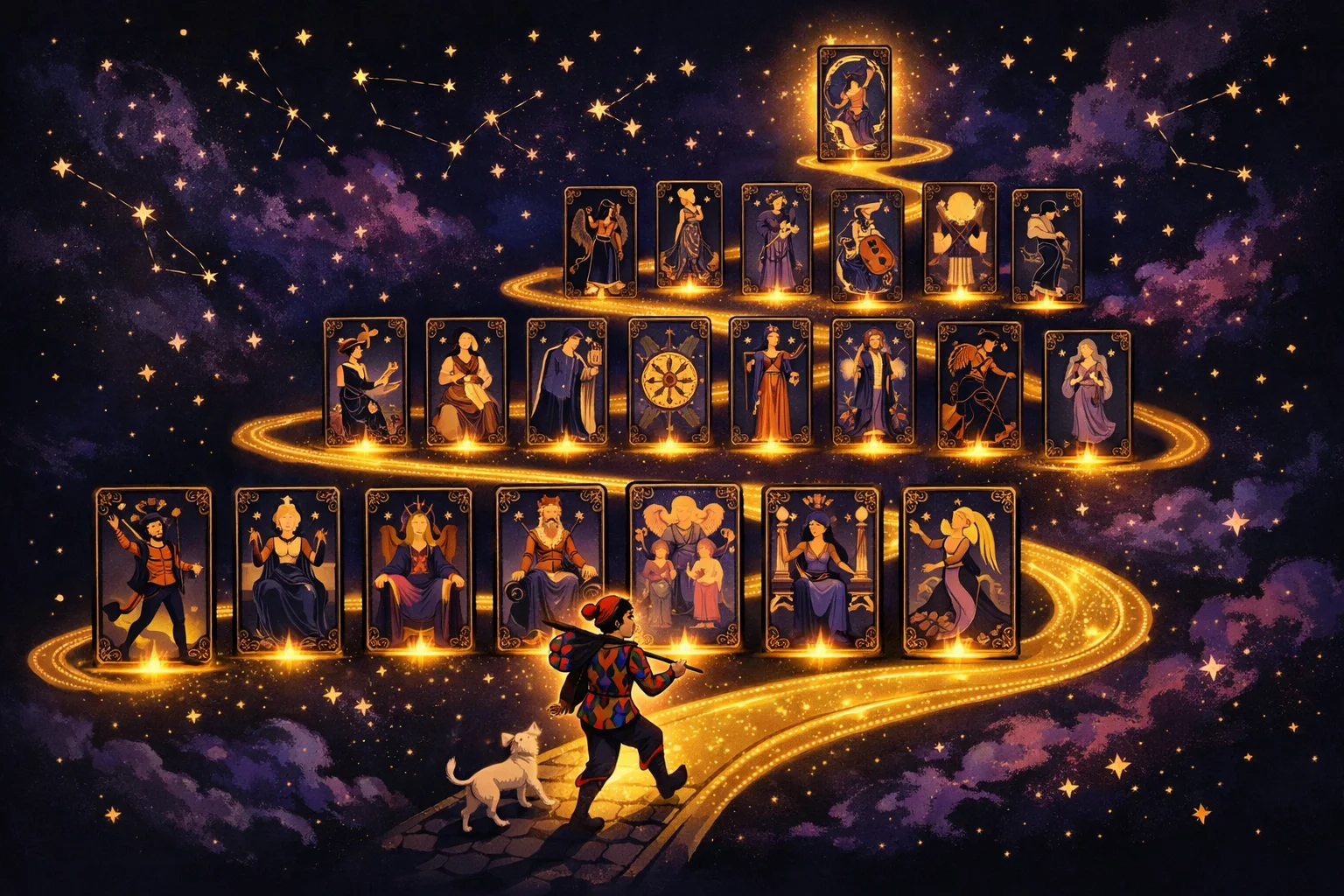
The sequence isn't decoration. The trumps were born ordered — in the 15th-century Italian game of trionfi, the "triumphs" that gave trump cards their name, each card outranked the one before it, the way figures in a triumphal procession did. Five centuries of occult tradition kept the procession and turned it into a biography: the Fool, card 0, walks through all 21 numbered stations and comes out the other side as the World. Readers call it the Fool's Journey, and it's the single most useful frame for actually remembering what these cards mean — because a story is memorable and a glossary isn't.
It also divides the labor inside the deck. The 56 Minor cards are the weather — arguments, invoices, small wins, moods. The 22 Majors are the climate changing. When one turns up, the deck has stopped commenting on your Tuesday and started commenting on your chapter. That's why this page reads them as a connected arc; for every card's standalone meanings across upright, reversed, love, and yes-or-no questions, the full 78-card meanings reader does that job card by card, and the tarot suits guide covers the Minor Arcana's own system of elements and numbers.
The Three Lines of Seven
Take the Fool off the top and 21 cards remain — three rows of seven, and the rows have personalities. Line one (I–VII) is the outer world: building an identity, learning skill, structure, love, and drive. It ends with the Chariot, the trophy for winning at visible life. Line two (VIII–XIV) turns inward and starts taking things away: solitude, fate, stillness, endings. It closes on Temperance, a quieter kind of victory. Line three (XV–XXI) is the deep water — shadow, collapse, hope, illusion, joy, reckoning — finishing at the World, the only card with nothing left to prove.
| # | Card | Line | The lesson, in one line |
|---|---|---|---|
| 0 | The Fool | — | Leap before you feel ready — that's the only schedule offered |
| I | The Magician | 1 | You already have the tools |
| II | The High Priestess | 1 | Some knowledge arrives only in silence |
| III | The Empress | 1 | Tend it; don't force it |
| IV | The Emperor | 1 | Structure keeps growth alive through winter |
| V | The Hierophant | 1 | Tradition is compressed experience |
| VI | The Lovers | 1 | Choose — and pay for it willingly |
| VII | The Chariot | 1 | Willpower wins the outer game |
| VIII | Strength | 2 | Steady the lion; don't slay it |
| IX | The Hermit | 2 | Withdraw on purpose, with a lamp |
| X | Wheel of Fortune | 2 | You control timing less than you think |
| XI | Justice | 2 | What you set in motion comes due |
| XII | The Hanged Man | 2 | Progress by stopping |
| XIII | Death | 2 | Prune what the journey no longer needs |
| XIV | Temperance | 2 | Blend what survived into something new |
| XV | The Devil | 3 | The chains are loose enough to lift off |
| XVI | The Tower | 3 | Lightning only breaks what was hollow |
| XVII | The Star | 3 | Hope without armor |
| XVIII | The Moon | 3 | Walk the last stretch of night anyway |
| XIX | The Sun | 3 | Joy, plainly, with nothing hidden |
| XX | Judgement | 3 | Rise and own the whole road |
| XXI | The World | 3 | Complete the circle; hand the Fool a new zero |
Notice what the three endings have in common. The Chariot, Temperance, and the World are all victories — every line of the journey closes on a win. That's not sentimentality; it's the structure making a claim about how growth works. The hard cards never get the last word in their own row, which is worth remembering the next time one of them lands face up in front of you.
Read the Columns, Not Just the Rows
Here's where the map earns its keep. Stack the three lines and read vertically: cards exactly seven apart share a theme, replayed at a deeper level each time. Column one is power — the Magician directs it, Strength steadies it, the Devil shows it corrupted into compulsion. Column two is hidden knowledge — the High Priestess intuits it, the Hermit goes looking for it, and the Tower is what happens when a truth nobody would face announces itself. Once you see the columns, pairs of Majors in a spread stop being coincidences and start being cross-references.
In practice: when two cards from the same column land in one spread, read the third, absent card silently. The Magician next to the Devil is the power column with its middle term missing — talent and compulsion present, patience absent — and that missing Strength is usually the actual advice of the reading. I've seen this land with uncomfortable precision in a three-card spread, where there's no room for filler and every card has to pull weight.
Columns of seven aren't the only vertical read available. Group the Majors by digit root instead and you get nine families — The Magician, Wheel of Fortune and The Sun all reduce to 1, so they share a constellation. That grouping is the backbone of the tarot birth card system, which assigns everyone one of those families from their birth date. Two different geometries laid over the same 22 cards, and both of them hold up.
What a Majors-Heavy Spread Is Telling You
The Majors are 22 cards out of 78 — about 28% of a shuffled deck. In a five-card spread, one or two is just math. Three or more is a message: whatever you asked about, the deck has reclassified it as a chapter event. My working rule is simple. One Major anchors the spread — read the Minors as circumstances orbiting it. Three or more Majors, and I stop reading cards individually and start looking up their positions on the map, because the spread has become a fragment of the journey itself.
A worked example. Career question, three cards: the Chariot, the Hanged Man, the Star — stations 7, 12, and 17, one from each line. Read as isolated meanings you get "victory, stalling, hope," which is mush. Read as positions, the story is exact: line one's driving style got you here, line two is imposing a pause you didn't order, and line three is offering the quieter thing that comes after — a career being rebuilt around meaning instead of momentum. That was my friend's spread, too. Her Devil–Tower–Death cluster read in walking order as: the trap named (15), the false structure down (16) — and Death behind both of them at 13, meaning the ending had already happened before the collapse made it visible. She wasn't staring at doom. She was paying rent on a building that had already been condemned.
The Scary Cards Sit in the Middle of the Story
Every card people fear is mid-line, and every one is followed immediately by its own medicine. Death is 13 of 21 — squarely the middle of the journey, with Temperance, the recovery card, at its shoulder. The Devil opens line three at 15, but the Star waits two doors down at 17. The Moon's long night at 18 breaks into the Sun at 19. The sequence is a promise with receipts: nothing frightening in the Major Arcana is terminal, because the deck's own architecture puts relief one or two steps behind every rupture.
This is also the honest answer to whether the Death card means something terrible. It means what station 13 always means — a pruning that line two demands before line three will open. The journey frame doesn't soften the card. It locates it, which is more useful than comfort.
When the Journey Frame Gets in the Way
The map isn't the right tool for every pull, and pretending otherwise would make it less trustworthy where it shines. Skip the journey frame for single-card daily draws — a daily card is a mood for the next 16 hours, not a life chapter, and treating every Tuesday's Tower as an era of demolition will burn you out on the deck entirely. Skip it for yes-or-no questions, where a Major's arc position says nothing about the verdict. And skip it when your question is about a specific person — the journey describes one traveler's road, and mapping someone else onto your stations flatters the reading into a story about you.
Two footnotes before you trust the map completely. First, numbering: this page follows the Rider-Waite-Smith order, which placed Strength at 8 and Justice at 11 in 1909. Marseille-pattern decks reverse those two. If your deck says Justice VIII, swap the pair mentally — the lines still hold. Second, the journey was never a straight line you walk once. You'll re-enter it dozens of times from different doors: a new job starts you back at the Fool's cliff edge while your marriage sits at Temperance and an old grief finishes its business at Judgement. The map isn't a timeline of your life. It's a diagram of how change moves — and once you can locate yourself on it, all 22 Major Arcana meanings stop being vocabulary and start being directions.