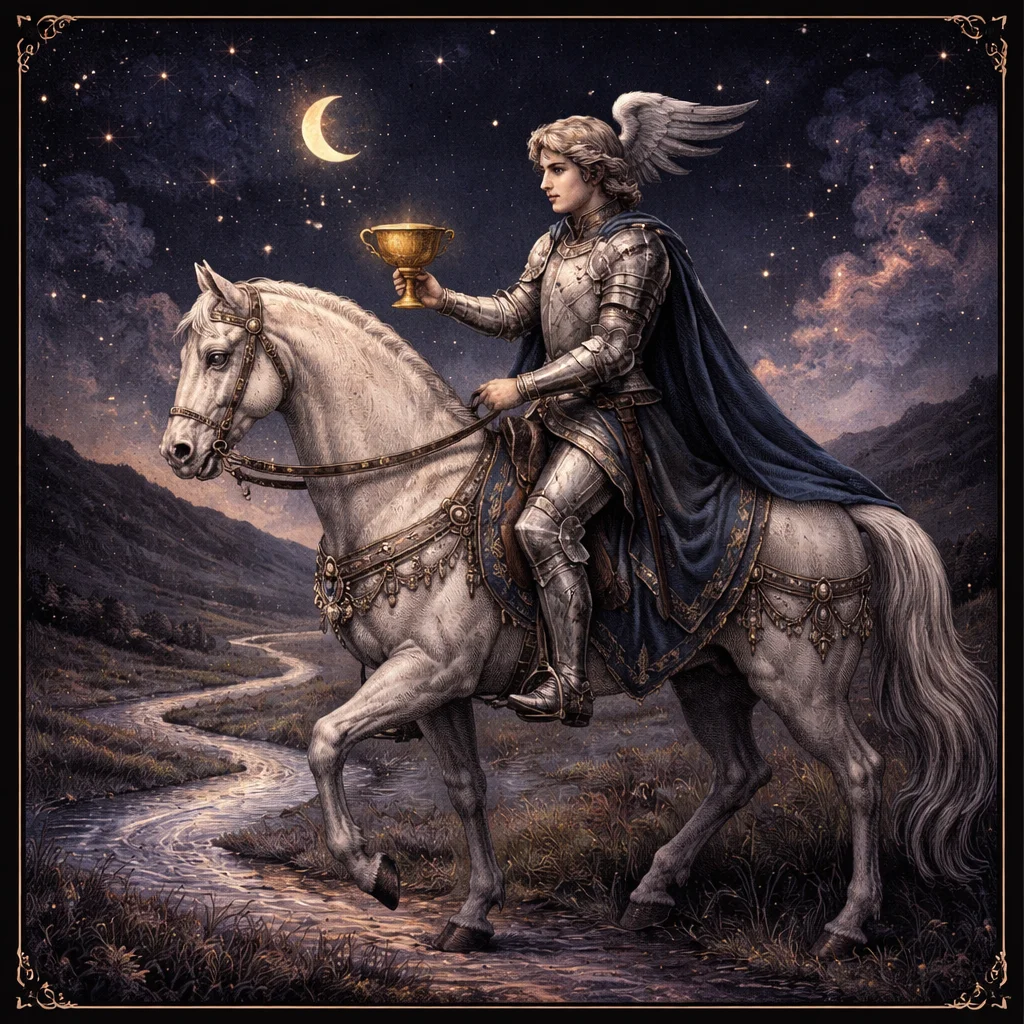
The Knight of Cups Carries the Offer. Delivery Is a Different Card.
Four knights ride through the Rider-Waite-Smith deck, and Waite describes each one by the pace of his horse. The Knight of Wands moves in "the precipitate mood." The Knight of Swords rides "in full course." The Knight of Pentacles sits on "a slow, enduring, heavy horse." The Knight of Cups is "riding quietly." That walk is the Knight of Cups tarot card meaning in one word. He is the deck's courier, arriving unhurried with a cup held out in front of him. What he carries is an offer. What he doesn't carry is any proof that it will be delivered.
Upright: an approach, an invitation, a proposition
Upright, the Knight of Cups means an approach is being made. Someone is coming toward you with feeling: a message, an invitation, a declaration, a proposal, a creative pitch, an apology that means it. Waite's own list for the card is short and entirely about motion toward the querent: "Arrival, approach, sometimes that of a messenger; advances, proposition, demeanour, invitation, incitement." Every word describes the offer. None of them describes the outcome.
That distinction is the card's whole use. Beginners read the Knight of Cups as "romance is coming" and then feel cheated when the romance turns out to be three warm messages and a cancelled dinner. The card wasn't wrong. It pictured an approach, and an approach is what arrived. The reader's job is to notice which stage the offer has actually reached, words, gesture, dated plan or pattern, and to respond to that stage rather than to the feeling the card gives off.
Read this way, the upright Knight is good news with a footnote. Something is being offered, sincerely, at a walk. Say yes to the approach. Decide about the offer when it has a date on it.
Four knights, four gaits: read the horse first
Waite's Pictorial Key to the Tarot gives away more about the four knights through their horses than through their riders. He says so himself in the Wands entry: "The motion of the horse is a key to the character of its rider." Put the four side by side and each knight's temperament is already on the page before you read a single keyword.
| Knight | Waite on the horse | Waite's upright meaning |
|---|---|---|
| Wands | Its motion "suggests the precipitate mood" | Departure, absence, flight, emigration |
| Cups | "Graceful, but not warlike; riding quietly" | Arrival, approach, proposition, invitation |
| Swords | "Riding in full course, as if scattering his enemies" | Skill, bravery, defence, enmity, wrath, war |
| Pentacles | "A slow, enduring, heavy horse" | Utility, serviceableness, responsibility, rectitude |
Two things stand out. First, the two romantic knights ride in opposite directions: Wands means departure and Cups means arrival. When both appear in one spread, someone is arriving and leaving at once, or arriving quickly and leaving quicker, which the tarot suits guide describes as a person torn between what they want and what they feel. Second, the Cups horse is the only one whose pace matches a courier's errand. He isn't charging, and he isn't standing still. He is bringing something, at the speed of someone who wants to be seen bringing it.
The walk cuts both ways. It makes the approach sincere and unforced, and it makes it easy to mistake for hesitation. If you've been reading a slow approach as ambivalence, the card offers another reading: this is simply the pace at which this person makes offers.
The winged helmet, the river and the cup held out
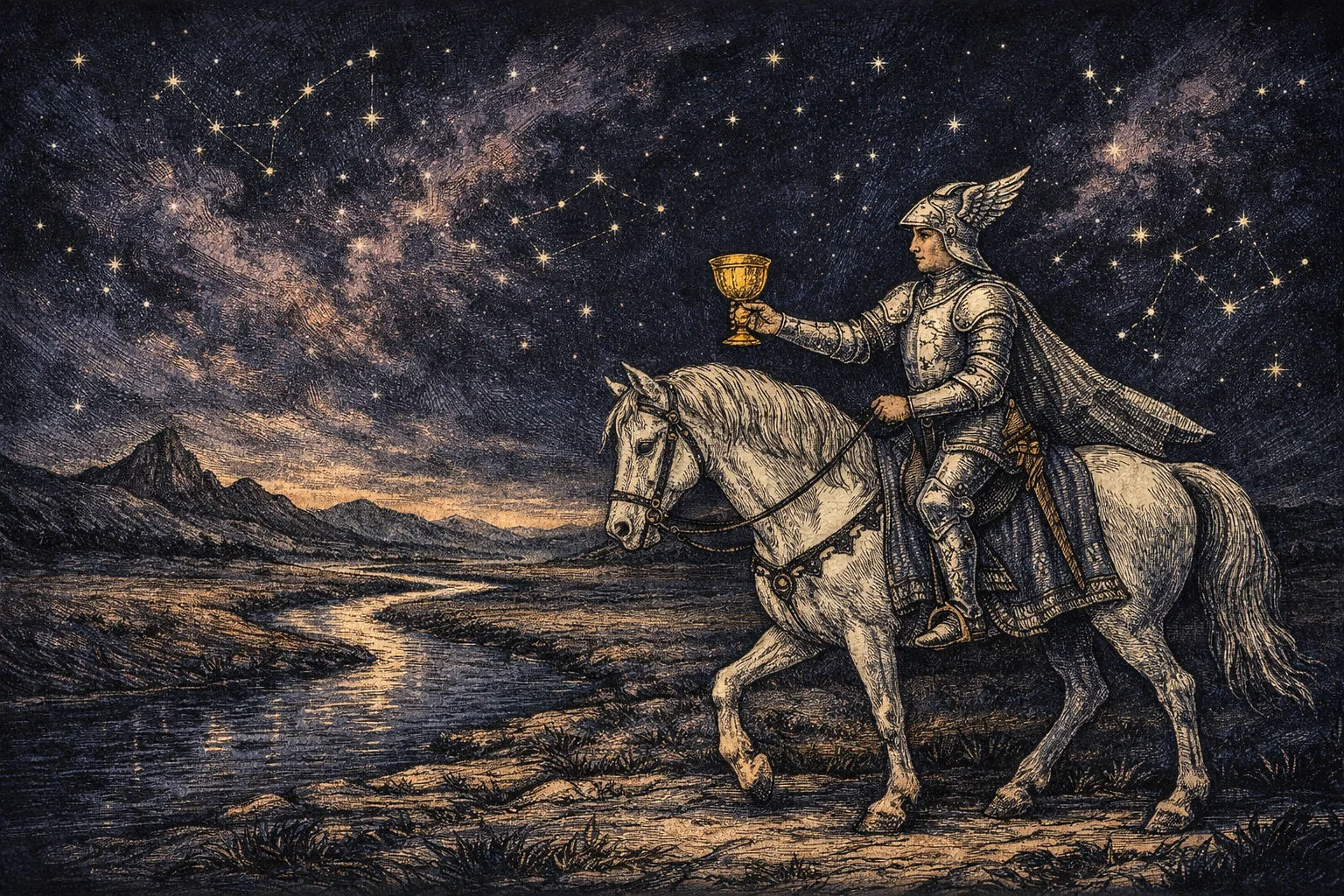
Waite's description of the Rider-Waite-Smith Knight of Cups is one sentence long, and it explains the helmet: the knight is "wearing a winged helmet, referring to those higher graces of the imagination which sometimes characterize this card." Wings on a helmet are an old sign for the messenger, and imagination is what makes this messenger's offers so persuasive. He can describe the trip, the future, the feeling, better than most people can live it.
Then Waite adds the line most guides skip: "He too is a dreamer, but the images of the side of sense haunt him in his vision." A dreamer whose dreams are pulled toward the senses is the exact profile of the reversed card: someone whose imagination makes beautiful plans and whose appetites keep changing them. The upright and reversed meanings aren't two different people. They are one rider, read by whether the dream reaches the ground.
The rest of the picture is worth reading as an exercise rather than as Waite's instruction, since he doesn't comment on it. The cup is held out in front of the rider, level, not raised in a toast and not clutched to the chest. That is the gesture of an offer. The horse walks toward a narrow river that has to be crossed before the knight reaches whoever he's riding to, which is a fair picture of the follow-through the card leaves out. And the plain around him is dry and empty. Nothing in the landscape helps him or blocks him. Whether the cup arrives depends entirely on the rider.
Book T built the fading into the rank
The Golden Dawn's Book T, the order's tarot text from the years before Waite designed his deck, doesn't use Waite's ranks. Its mounted figures are Kings, its charioteers are Princes, and it states the mapping plainly: "The Knight of Cups is The Lord of the Waves and the Waters, and The King of the Hosts of the Sea," while "The King of Cups is The Prince of the Chariot of the Waters." So the card in your hand, the one Waite's deck labels Knight, is Book T's King on horseback.
That matters because of what Book T says the mounted rank is. The four Kings represent "a force swift and violent in action, but whose effect soon passes away, and therefore symbolised by a figure on a steed riding swiftly." The fading was built into the horse before Waite ever slowed it to a walk. Book T's portrait of this particular rider follows from it: "Graceful, poetic, Venusian, indolent, but enthusiastic if roused. Ill-dignified, he is sensual, idle, and untruthful." Enthusiastic if roused, indolent otherwise. That is the Knight of Cups' reputation, written down in the 1880s.
| Source | Upright / well-dignified | Reversed / ill-dignified |
|---|---|---|
| Book T (Golden Dawn, c. 1888) | Graceful, poetic, Venusian, indolent, but enthusiastic if roused | Sensual, idle, and untruthful |
| Waite (1911) | Arrival, approach, a messenger; advances, proposition, invitation. Additional: a visit from a friend who brings unexpected money | Trickery, artifice, subtlety, swindling, duplicity, fraud. Additional: irregularity |
| Common modern reading | Romance, an offer from the heart, charm, idealism, creativity | Moodiness, empty charm, unrealistic promises, emotional immaturity |
Notice how much harsher Waite's reversed list is than the modern one. Modern readers say "moody" and "unreliable." Waite says fraud. The honest position is between them. Most reversed Knights of Cups are dreamers whose plans didn't reach the ground, not swindlers. But the card's own author kept the swindler in the list, and a reader who never considers that branch will eventually be charmed by it.
Reversed: the offer without a delivery date
The Knight of Cups reversed is an approach that stalls. The three usual shapes, from mildest to worst, are the sincere offer that never gets scheduled, the warmth that switches on and off with the person's moods, and Waite's charm used as a method. From the receiving end they look identical for the first few weeks, because all three consist of beautiful words. The difference shows up in the calendar.
Take a hypothetical: someone has said, three times, that they want to take you somewhere. Upright, that is an approach at the words stage, and the right response is warmth without commitment. Reversed, the same three sentences are the reading: three offers, zero dates. You don't need to decide whether the person is a dreamer or an operator. You need to notice that nothing has been delivered and stop counting the words as if it had.
Reversed as advice, the card turns around and asks about your own offers. If you've promised to call, plan, visit or commit and none of it has a time attached, you are the reversed Knight, and the fix is not another promise. It's delivering one thing already promised, plainly, before saying anything new. The reversal doesn't flip the card to rejection or cruelty. It marks the gap between the offer and its delivery and asks who is going to close it.
As feelings and in love: sincere is not the same as scheduled
The Knight of Cups as feelings describes attraction that wants to be expressed. This person is drawn to you and inclined to say so. In a love reading that is the good news, and it's real. The card can't verify anyone's private feelings, though, and it can't tell you the feeling will last. What it can do is tell you what kind of feeling it is: the kind that leads with the approach. Expect messages before plans, gestures before routines, and a romantic version of you before the ordinary one.
For singles, upright often means the approach is coming from someone else, or that it's your turn to make one. For couples, the card usually points to the courtship layer of the relationship, either alive and worth protecting or missing and worth restoring with one deliberate gesture. For someone hoping an ex will return, be careful: the Knight of Cups describes an approach, and an approach from an ex is a message, not a reconciliation. Read the stage, not the feeling. And if contact is unwanted, no card asks you to receive it.
The one test that separates a sincere Knight from a stalled one is the same in every love reading: does the next step come with a date? A person can be entirely genuine at the words stage. They become an offer at the plan stage. Our love tarot reading names the Knight among the classic arrival cards and warns against reading arrivals as delivery dates, which is the same rule applied to a whole spread.
As a person: the one who makes beautiful beginnings
As a person, the Knight of Cups is the romantic, the artist, the one who writes the message everyone else only drafts. He proposes the trip, plans the surprise, remembers the small thing you said in passing. Court cards describe a role, not a gender, so this can be a woman, a friend, a colleague, or a side of yourself. What identifies the person is the sequence: feeling first, expression immediately, logistics eventually or never.
Whether this person is a good sign depends on a question the card refuses to answer for you. Do the plans they propose acquire dates? A Knight of Cups who books the trip is one of the warmest people you will meet. A Knight of Cups who only proposes it is Book T's figure, enthusiastic if roused and indolent otherwise, and living with that pattern means doing the logistics for two. Neither version is lying. One of them has simply learned to cross the river.
It helps to compare him with the card he grows into. The King of Cups sits still with the same cup and has learned to hold feeling without being carried by it. The Knight is still carrying. When the two appear together, the reading is often about a person, or a relationship, somewhere between making offers and keeping them.
Work and money: the warm offer and the visiting friend
At work the Knight of Cups is the offer made with warmth: a recruiter who wants you specifically, an invitation to collaborate, a creative pitch, a client who leads with enthusiasm. Upright, take the approach seriously and read the terms separately. The card describes how the offer arrives, not what it contains. Reversed, it's the pitch with nothing behind it, the collaborator who is wonderful in the first meeting and absent by the third, or your own habit of proposing projects you don't finish.
Waite's additional meaning for the card is oddly specific and worth knowing: "A visit from a friend, who will bring unexpected money to the Querent." Reversed, simply "Irregularity." The pattern holds. Upright, something arrives through someone else's approach; reversed, the arrival is uneven. Neither reading is a forecast. The card can't predict a payment, name a person or set a date, and it isn't a basis for accepting or refusing actual money or work. Use the terms, the record and appropriate advice for that.
Fire of Water or Air of Water, and 20° Aquarius to 20° Pisces
Ask which element the Knight of Cups carries and you will get two answers, because two systems are in use. Book T assigns its mounted King of Cups to "Fire of Water," the active, driving quality of Fire applied to the feeling-suit of Water, and rules him "from above 20° of Aquarius to 20° Pisces." Many modern guides built on Waite's ranks give the Knight Air of Water instead, having moved Fire to the throned King, which is how our own King of Cups page reads him. Neither is wrong. They are different maps of the same four cards, and the practical reading is the same: a knight is feeling in motion.
The zodiac attribution deserves the same care. Twenty degrees of Aquarius to twenty of Pisces is a symbolic assignment used in tarot, not a claim about the sky or about anyone's birth chart. Drawing the card doesn't make the person a Pisces, and it doesn't tell you where the Sun is today. What the attribution does capture is the card's temperature: Pisces' imagination and receptivity with a share of Aquarius' detachment, a dreamer who can go cool. That is a fair portrait of the rider.
Read the Knight next to his neighbours
Beside the Ace of Cups, ask where the cup came from. The Ace is feeling offered from nowhere in particular; the Knight is feeling carried by someone. Together they often describe an offer that is both genuine and personal, and the question shifts from whether it's real to whether you can receive it.
Beside the Lovers, the approach has become a choice. The Knight rides toward the Lovers; the Lovers is what happens when the cup is accepted and the two people have to decide what the acceptance means. If the Lovers comes first in the spread, the choice was made and the Knight describes how it is being courted.
Beside the Four of Pentacles, an open hand meets a closed one. The Knight holds the cup out; the Four clutches its coin. The pairing usually describes an offer arriving where something is being guarded, and the reading depends on which figure is you.
Beside the Two of Swords, an approach meets a stalemate. Someone is riding toward a person who has crossed their arms and put on the blindfold. Read whether the approach is what could end the pause, or whether it's one more thing the blindfold is refusing to see.
Run the courier check before you answer
Before you take the Knight of Cups as a yes or no, write three short answers. They turn a card about approaches into a reading of one specific offer, which is the only kind you can respond to well:
- Who is the Knight? Someone approaching you, a person the card describes, you being told to make the approach, or the shape of what's coming. The same card reads differently through each door.
- What has actually arrived? Words, a gesture, a plan with a date, or a pattern over time. Name the furthest stage the offer has reached, not the stage the feeling suggests.
- What is the next observable follow-through? A message with a date in it, a plain call after a grand gesture, a plan confirmed the day before. One event, not a judgement of anyone's heart.
The follow-through matters more than the interpretation. The Knight of Cups will always read as romantic, and romance is not the question. Delivery is. An offer that reaches its next stage is becoming real. An offer that keeps restating its first stage is the reversed card, however warm it sounds.
Quick systems, including our own yes or no tarot reader, map the upright card to yes and the reversed to no. That is a workable convention for a one-card answer. The fuller reading is conditional: yes to the approach, not yet to the outcome, until the courier has crossed the river.