Seven Cards Is the Last Spread Where the Patterns Still Mean Something
A 7 card tarot reading sits at the one point on the spread ladder where the patterns still carry information. That is not a nice way of saying it is a compromise between three cards and ten. It is arithmetic, and it is checkable: seven is the largest spread size at which all three of the signals readers treat as meaningful — a Major-heavy spread, one suit weighting the table, all four suits turning up together — are still minority events. Deal one more card and the first of them crosses a half.
Seven Cards or Ten? Ask Whether Your Situation Has an Opponent in It
Most guides frame this as a difficulty ladder: three cards for beginners, seven when you want more, ten when you are serious. That framing is wrong and it sends people to the wrong spread constantly. The real difference between a horseshoe and a Celtic Cross tarot spread is structural, and you can see it in the layout without reading a word of either: the Celtic Cross has a card laid sideways across another one. The horseshoe has no crossing card anywhere.
That single difference decides what each spread can answer. A crossing card is a spread saying "this thing is being opposed by that thing" — it is built for conflict, for a situation with two forces pushing against each other. The horseshoe is an arc. It runs in one direction, from where this came from to where it is going, and everything in between is a stage rather than an opponent.
So the honest rule is: if you can name the thing standing in your way, deal ten. If the situation is more of a drift — something that has been developing for a while and you want to see its shape — deal seven. Reaching for the Celtic Cross because your question feels important is how people end up staring at a crossing card that has nothing to cross.
Where the Seven Cards Sit, and Why the Arc Folds in Half
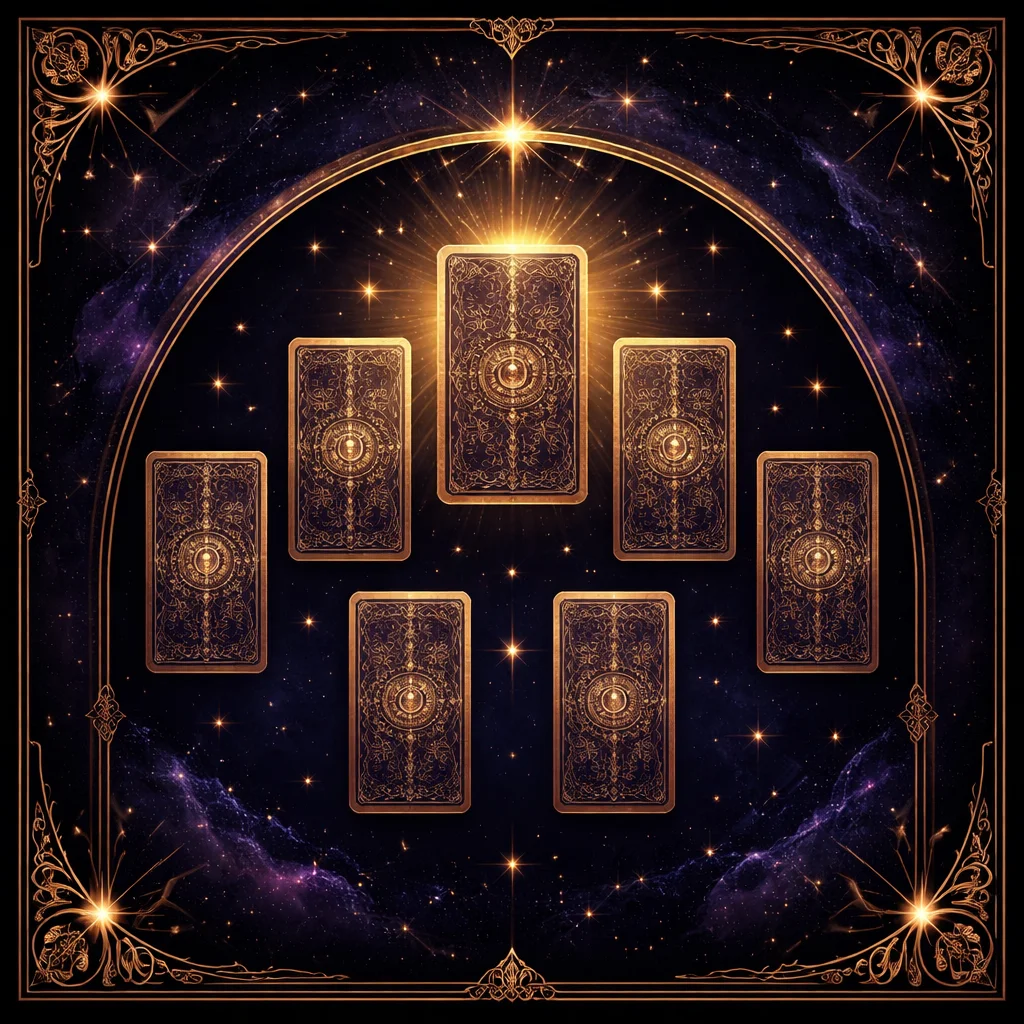
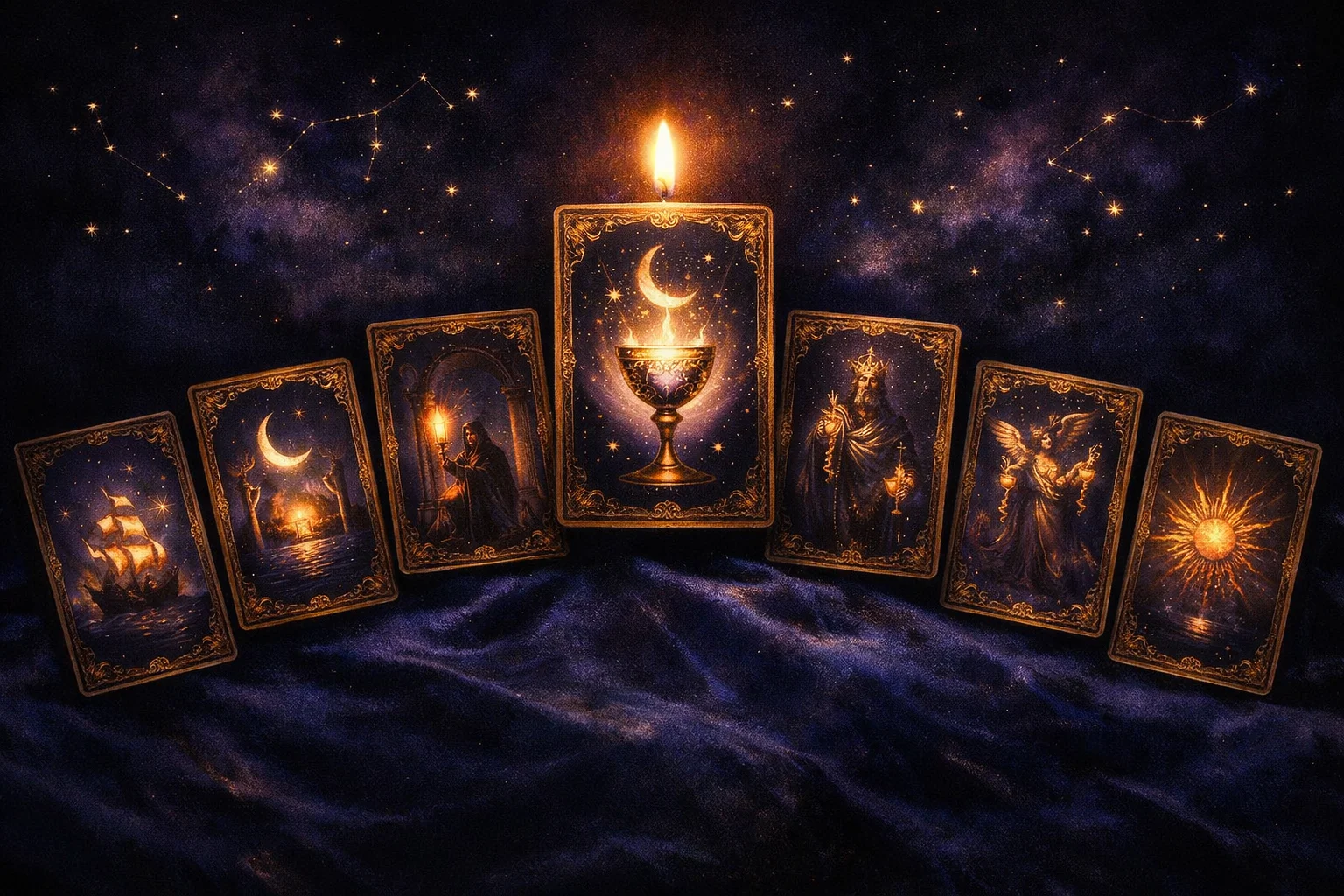
Left to right along the arch: the past, the present, the hidden influence, the advice, the external influence, hopes and fears, the outcome. You will find layouts elsewhere that swap positions four and six. This one keeps the advice at the centre on purpose, and the reason is a property of the number seven that nobody seems to mention.
Seven is odd, so the spread has a true middle, and the six remaining cards fold into three mirrored pairs around it. Positions one and seven are origin and destination. Positions two and six are the situation and how you feel about the situation. Positions three and five are the influence you cannot see inside this and the influence you cannot see outside it. Those pairings are not decorative — they are how the spread is meant to be read after you have gone along it once.
The two-and-six pair is the one worth learning first. When the present card and the hopes-and-fears card agree, you are seeing the situation clearly. When they disagree, the gap between them is usually the single most useful thing on the table, and it is invisible if you only read the arc in order. A three-card line cannot do this and a ten-card cross does not try to; an even count has no centre to fold around.
A pair "echoes" when both cards are Major or both belong to the same suit, and that is the moment a mirror actually rhymes rather than just sitting opposite. Worth knowing the baseline before you get excited: any two cards echo 19.81% of the time, so 0.59 echoes per horseshoe is par, and 51.54% of spreads produce none at all. Two echoes in one spread is the first genuinely uncommon result.
Card Four Is the Only One Telling You to Do Anything
Count the positions again and notice what kind of statement each one makes. Past, present, hidden influence, external influence, hopes and fears, outcome — six reports. Advice — one instruction. Six sevenths of this spread describes and one seventh prescribes, and the prescriptive card happens to sit at the apex.
Readers who have come from a 3-card tarot spread usually arrive with the habit of weighting the middle card double, which is good advice there for a different reason. In a past-present-future line the middle is where you currently are, so it carries the most information. In a horseshoe the middle is the only thing you can act on. The rule survives the move; the reason for it inverts completely.
Practically, this means you read the arc twice. First left to right for the story, then back to card four and ask what it is actually asking you to do given everything either side of it. A Four of Swords at the apex of a spread full of Wands is telling you to stop, and that instruction only makes sense once you have seen the rest.
How Often Do Seven Random Cards Produce a Sign?
Here is the thing that changed how I read spreads, and I have never seen a tarot site state it. Every pattern readers treat as significant gets more likely as the spread gets bigger, and it gets more likely fast — because you are drawing more cards from the same deck, not because anything about the cards or the querent changed.
Take the most-quoted one. Three or more Major Arcana in a reading is traditionally read as the situation being larger than you, driven by forces outside your control. In a three-card pull that happens 2.02% of the time, which genuinely is unusual. In a seven-card horseshoe it happens 30.78% of the time. In a ten-card Celtic Cross it happens 57.85% of the time — more often than not.
The same omen is 15.2 times likelier at seven cards than at three, and the control that makes this a finding rather than a curiosity is this: a Major Arcana card is 28.21% of the deck at every one of those sizes. Flat. Nothing about the deck moves. The entire ladder is a consequence of how many cards you decided to deal.
Which is why the useful figure is not the count but the density. Seven cards contain 1.97 Majors on average, so three is barely above par. What actually stands out at this size is five or more, which turns up in 1.70% of draws — and a spread with no Majors at all, which happens 8.78% of the time and means every single thing on the table is something you can put your hands on.
The Same Three Omens, Priced at Four Spread Sizes
Every figure below is an exact share rather than a simulation — there are 2,641,902,120 possible seven-card hands and the arithmetic counts them rather than sampling them.
| Pattern | 3 cards | 5 cards | 7 cards | 10 cards |
|---|---|---|---|---|
| Three or more Major Arcana | 2.0% | 13.3% | 30.8% | 57.8% |
| One suit appears three or more times | 1.9% | 15.2% | 40.3% | 79.0% |
| All four suits present | 0.0% | 8.7% | 27.4% | 56.7% |
| Three or more reversed | 2.7% | 16.3% | 35.3% | 61.7% |
| No Major Arcana at all | 36.4% | 18.1% | 8.8% | 2.8% |
Read down the seven-card column and you will notice every entry in the top three rows is under a half. That is the whole case for this spread size, and it stops being true immediately: at 8 cards, a dominant suit turns up 54.6% of the time, and by ten cards two of the three omens are the default outcome rather than the exception. 7 is the last size where all three still mean something when you see them.
The reversal row is the one people are least prepared for. At the standard convention, 35.29% of seven-card spreads come back with three or more cards upside down and only 8.24% come back entirely upright. If a heavily reversed horseshoe feels like a warning, it is worth remembering that a third of all horseshoes look like that — and that a completely clean one is the genuinely unusual result.
None of this makes a Celtic Cross a worse spread. It makes suit-weight and Major-density readings a worse tool inside one, which is a much narrower claim and a much more useful one. In a ten-card spread, read the positions. In a seven-card spread, you can also read the shape.
One Missing Suit Is the Most Ordinary Result There Is
The other thing readers over-interpret at this size is a blank. If your horseshoe comes back with no Cups in it, the standard line is that the situation has no emotional content, or that feeling is being withheld from you. Before you run with that: exactly 3 of the four suits show up in 52.45% of all seven-card draws, which makes one missing suit the single most common shape this spread produces. All four together appear in only 27.37%.
Suit weight behaves the same way. A largest block of exactly two cards is the most likely outcome at 53.08%, three of one suit comes in at 33.35%, and four or more — the genuinely lopsided spread — only reaches 6.96%. At the other end, a horseshoe with no repeated suit at all is rarer than most readers assume, at 6.61%. If you want to know what each suit governs before weighing any of this, the tarot suits guide covers the system the whole reading rests on.
The constructive version: a blank only means something when the question was about that suit's territory. A money question that returns no Pentacles is a real signal, because the deck declined to discuss the exact thing you asked about. A general "how is my life going" question that returns no Pentacles is not a signal at all — it is Tuesday. The career tarot reading applies the same logic to a five-card work spread, where the blanks are more common still.
Seven Cards About a House Move, Read Along the Arc
A friend of mine spent eight months deciding whether to leave a city she had lived in for a decade. She asked for a horseshoe rather than a yes-or-no, because the question was not really a decision yet. What came up:
- 1. The Past — Six of Cups. The place, and the version of herself she had been in it.
- 2. The Present — Four of Cups. Bored. Something on offer and no interest in it.
- 3. Hidden Influence — Eight of Swords. Stuck in a room whose door was not locked.
- 4. The Advice — Seven of Pentacles. Check whether it is actually growing.
- 5. External Influence — Ten of Pentacles. Family, money, the arrangement that outlasts you.
- 6. Hopes & Fears — The Star. Wanting to want something again.
- 7. The Outcome — Two of Wands. The plan drawn and the step not taken.
Read in order it looks like a stalemate. Read as mirrors it stops being one. Positions two and six are Four of Cups against The Star — flat interest against a live wish to feel something, which is not indecision, it is a person who already knows and has not said it. Positions three and five are Eight of Swords against Ten of Pentacles: the unlocked door on the inside, family expectation on the outside, and one of those is doing more work than she was admitting.
The apex made the reading. Seven of Pentacles is not "go" or "stay" — it is an instruction to check the yield, which was the one thing she had been carefully not doing for eight months. She moved the following spring. The Two of Wands as outcome was accurate and, in hindsight, generous: the plan really was drawn, and it really did sit there for another six months first.
Four Ways a Horseshoe Reading Goes Wrong
Reading position seven as a verdict. The outcome card is where this lands if nothing changes, which is precisely what card four exists to prevent. A spread containing advice cannot also contain a fixed future; the two positions would contradict each other. Treat seven as the current trajectory and four as the lever.
Narrating someone else's hopes and fears. Position six is the only place in this spread that reports on the querent's private weather. Reading for another person, hand that card back as a question rather than a statement — ask what they were hoping for and see whether it matches.
Counting Majors without counting cards. The whole point of the ladder above. Three Majors in seven cards is the second most likely outcome the deck produces. If you want the Major density to mean something, compare it against 1.97 rather than against zero. When they do stack up, the Major Arcana meanings read best as one sequence rather than as separate cards.
Redrawing. There are 2,641,902,120 possible seven-card hands and 13,315,186,684,800 once you count which position each card lands in. You will never see the same horseshoe twice, so a second draw is not a second opinion on the first — it is an entirely fresh random sample, and reading it as confirmation or contradiction is reading noise.
When Seven Cards Are Too Many
Do not lay a horseshoe for a question with a yes or a no in it. Seven positions will happily generate seven-sevenths of an answer to a question that needed one card, and the extra six will be read as nuance when they are really just more deck. The same applies to timing: none of these positions is a date, and no amount of cards turns a spread into a calendar.
Do not lay one for a decision you have already made either. Position six will tell you what you want, position seven will tell you what happens if you do nothing, and you will spend twenty minutes negotiating with a piece of card. That is a conversation with yourself, and it is cheaper to have it without the deck.
Where seven earns its place is the slow tangle: a job that has been gradually souring, a friendship that changed shape without an argument, a move you have been circling for a year. Situations with a history, a present, an unseen half and a direction of travel. The Rider-Waite-Smith deck this reading uses was designed in 1909 with fully illustrated pip cards precisely so that spreads like this could be read as scenes rather than as numbers — which is the whole reason a seven-card arc tells a story at all.