
The Nine of Cups Grants the Wish as Worded. Check the Wording First.
The Nine of Cups tarot card meaning is the easiest in the deck to state and the easiest to misuse: you get what you asked for. Readers call it the wish card, and the nickname is older than the picture. Waite's 1911 entry for the card never uses the word "wish." The Golden Dawn's Book T, written roughly twenty years earlier, does: its one-line summary reads "Complete success, pleasure, happiness, wish fulfilled." The sentences just before it describe the same card as "self-praise, vanity, conceit, much talking of self." The wish and the smugness arrived in one paragraph, and they have travelled together ever since. That is the whole problem with the card and the whole use of it. It grants the wish as worded. It doesn't check the wording.
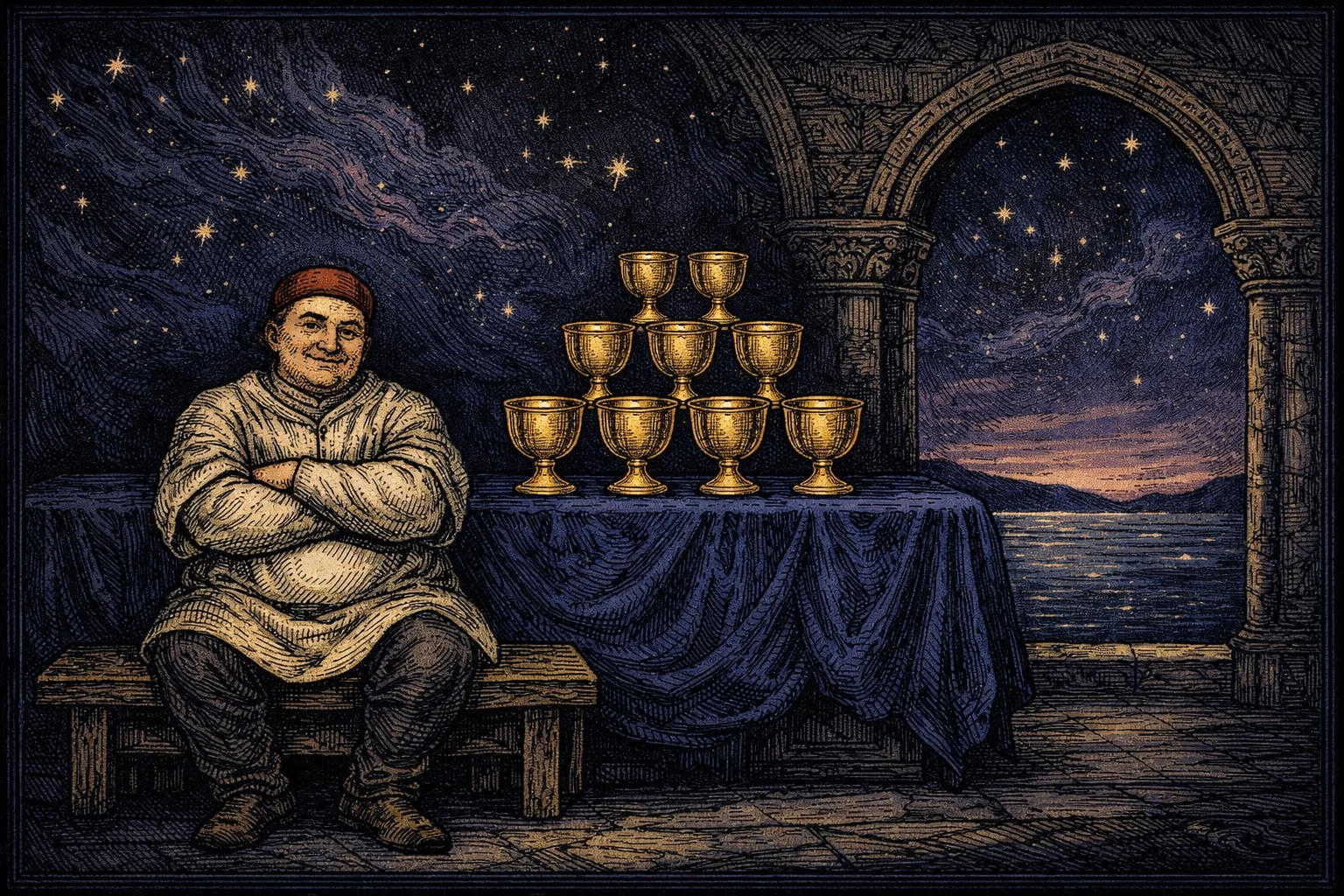
Upright: you get what you asked for, as you asked for it
Upright, the Nine of Cups means satisfaction: something wanted has arrived, and the person who wanted it is sitting in front of it. Waite's divinatory list is "Concord, contentment, physical bien-être; also victory, success, advantage; satisfaction for the Querent or person for whom the consultation is made." Every word describes a state already reached. Nothing in it is about a journey, a struggle or a choice. That is what makes it the deck's best card for a wish question and its most misleading one for a happiness question.
The distinction sounds pedantic until you've watched it cost someone a reading. Ask "will I get the job?" and the Nine of Cups is a plain, cheerful answer: the form of the thing you asked for arrives. Ask "will I be happy?" and the same card can only answer with things, because Waite says of the picture, "The picture offers the material side only, but there are other aspects." The material side is what the card delivers. The other aspects are the part you supply, and a reader who doesn't know that will keep drawing the wish card and keep wondering why the wishes feel smaller in the hand than they did in the asking.
Read this way, the upright Nine of Cups is good news with one instruction attached. The wish is answered as worded. Before you count it, check the wording.
Nine cups on a shelf behind him: read the picture before the nickname
Waite's description of the Rider-Waite-Smith Nine of Cups is two sentences long. "A goodly personage has feasted to his heart's content, and abundant refreshment of wine is on the arched counter behind him, seeming to indicate that the future is also assured." Then the caveat: material side only, other aspects. Everything a careful reader needs is in the first sentence, and most of it is in one word. The cups are behind him.
He isn't drinking. He isn't pouring for anyone. The nine cups stand on a curved counter draped in blue, arranged in a row at the height of a display. Waite reads the arrangement as the future assured: the cellar is stocked. Read as an exercise rather than as Waite's instruction, it is also a picture of a wish that has been granted and turned into furniture. The cups are no longer the thing he wanted. They are the thing he has, arranged where a visitor can see them, while he faces the visitor with his arms folded.
The folded arms are Pamela Colman Smith's, not Waite's; he doesn't mention them. Notice, though, that they repeat a posture from two other cards on this site, the Two of Swords and the Four of Pentacles: a closed chest. In the Two it holds a decision, in the Four a coin, and here it holds nothing at all, because everything is already on the shelf. Satisfaction that has stopped reaching for anything is the card's whole mood, and whether that reads as peace or as complacency depends on how long he has been sitting there.
Where 'wish card' comes from, and what came with it
Open Waite's Pictorial Key to the Tarot and search the Nine of Cups entry for the word "wish." It isn't there. The divinatory meanings are contentment and success, the reversed meanings are "Truth, loyalty, liberty," and the additional meanings in the book's later list are "Of good augury for military men" upright and "Good business" reversed. The most quoted nickname in the Minor Arcana does not appear in the book written to accompany the deck.
It does appear in Book T, the Golden Dawn's tarot text from the years before Waite designed his deck. Book T titles the card the Lord of Material Happiness, attributes it to Jupiter in Pisces, and gives it this portrait: "Complete and perfect realisation of pleasure and happiness almost perfect. Self-praise, vanity, conceit, much talking of self, yet kind and lovable, and may be self-denying therewith. High minded, not easily satisfied with small and limited ideas. Apt to be maligned through too much self-assumption. A good, generous, but, maybe, foolish nature." Its bracketed summary is the line the nickname grew from: "Complete success, pleasure, happiness, wish fulfilled."
Read that paragraph twice and you can see what modern tarot did with it. It kept "wish fulfilled" for the upright card and moved "self-praise, vanity, conceit" to the reversed one. Book T never separated them. The vanity is in the upright entry, in the same breath as the kindness. That is why the man in the picture looks smug rather than joyful, and why the honest reading of the upright card has always carried a small warning inside the good news.
| Source | Upright | Reversed |
|---|---|---|
| Book T (Golden Dawn, c. 1888) | Complete realisation of pleasure and happiness; wish fulfilled; self-praise and vanity, yet kind and lovable | Not separately listed; the conceited, foolish side sits in the same entry |
| Waite (1911) | Concord, contentment, physical well-being; victory, success, advantage; satisfaction for the Querent. Additional: of good augury for military men | Truth, loyalty, liberty; with mistakes and imperfections as a variant. Additional: good business |
| Common modern reading | Wishes fulfilled, satisfaction, contentment, indulgence; the wish card | Smugness, hollow pleasure, wanting more, overindulgence |
The table shows something the meme version hides. Waite's reversed Nine of Cups is not a bad card. Truth, loyalty and liberty are three of the better words in his whole book, and "good business" is hardly a warning. The modern reversed reading, hollow and smug, is Book T's vanity clause relocated. Both are legitimate traditions. But if you only know the modern one, you'll read a reversed Nine of Cups as a disappointment when the card's own author read it as honesty.
Reversed: hollow, wanting more, or Waite's truth, loyalty, liberty
The Nine of Cups reversed has three modern shapes, and the reading tools across this site use the same short version of them: you get it, and the feeling doesn't arrive with it. The first shape is the hollow wish, granted exactly as worded and found to be smaller than the wanting. The second is appetite, the wish satisfied and immediately replaced by the next one, which is Book T's "not easily satisfied with small and limited ideas" seen from inside. The third is the vanity clause proper: satisfaction displayed until it costs you the people it was displayed to.
Take a hypothetical. Someone wished, for a year, for one particular promotion. It came. Three weeks later they're drawing cards about why they feel nothing. Upright, the Nine of Cups would have described the promotion arriving. Reversed, it describes the three weeks after, and the question it asks is not "was the wish wrong?" but "what was the promotion standing in for?" Usually the honest answer is a feeling: respect, safety, being finished. The card delivered the material side of it, exactly as Waite warned, while the other aspects went unaddressed.
Then hold Waite's reversed list against that story. Truth, loyalty, liberty. A hollow wish is the moment you can finally tell the truth about what you wanted. The reversal doesn't cancel the grant. It removes the display, and what's left, once the cups have stopped mattering, is a clearer sentence than the one you wished with. Read the reversed card as the wording being corrected, not the wish being refused.
In love and as feelings: satisfied is not the same as settled
The Nine of Cups love meaning is contentment: a relationship in which the wish has been granted, the person is here, the arrangement works, and nobody is reaching. For couples it is one of the warmest Minor cards, and it is worth enjoying as what it is. For singles it usually describes a wish about a person arriving in its outer form: the date, the message, the yes. It doesn't describe what is behind the form, and a wish granted in this suit is famous for arriving as the shape of the thing before the substance.
As feelings, the Nine of Cups says someone is satisfied with how things stand. Read that word carefully. It can mean happy with you, and it can mean happy with the arrangement, and from the outside the two look identical for a long time. The card can't verify what anyone privately feels, and a picture of a comfortable man is not evidence about another person's heart. What you can observe is whether the satisfaction ever spends anything: whether the person who is "content" still makes plans, still asks, still risks. Contentment that stops reaching is the folded arms, and the folded arms are the card's shadow. Our love tarot reading uses the same short version, getting what you wanted emotionally upright and the wish granted but not felt the way you expected reversed, applied to a whole spread.
For someone hoping an ex will return, be precise about the wish. "That they'll come back" is a wish about someone else's choice, and the card can't reach into it. What it can picture is the return as it would look in your life, which is not the same as the return you meant. If the wish is really "to feel chosen," say so, because that wish has a version that only needs you. And if contact is unwanted or unsafe, no card asks you to receive it.
Work and money: 'good augury' and 'good business'
At work the Nine of Cups is the result you asked for: the offer, the sale, the project that landed, the review that said what you hoped. Waite's list has "victory, success, advantage" in it, and his additional meaning, "Of good augury for military men," is recognition in its oldest form, the honour after the campaign. Upright, take the result as real and read the terms separately. The card describes the satisfaction of a result, not its contents.
Reversed at work, the card is the promotion that came with nothing inside it, the target hit and immediately raised, or the display of success that has started to cost you colleagues. Waite's reversed addition, "Good business," is worth keeping in view, because it says the reversal is not a loss. Something was done well. The question is what the wish for it was standing in for, and whether the next target has been set by you or by the appetite.
With actual money, the card predicts neither income nor loss. "Wish fulfilled" is not a forecast, and a satisfied man in front of nine cups is not a payment on its way. Waite's tables for repeated cards give three Nines as "success" upright and "imprudence" reversed, which is as close as he comes to a money warning, and it concerns a pattern in a spread, not a sum. Base actual financial decisions on the figures and appropriate advice, not on the wish card.
Jupiter in Pisces and the Lord of Material Happiness
Book T attributes the Nine of Cups to "Jupiter in Pisces, 10°-20°," the middle decan of Pisces, and titles it the Lord of Material Happiness. Jupiter is the traditional ruler of Pisces, so the attribution is the planet of abundance at home in its own sign, which explains the card's generosity better than any keyword. The Sun crosses those ten degrees in roughly the first third of March in most years, but the card is a symbolic attribution, not a transit report. Drawing it doesn't make anyone a Pisces and doesn't say where Jupiter is today.
What the attribution explains is the card's temperature. Jupiter enlarges whatever it touches, and in Pisces it enlarges feeling, appetite and imagination at once. That is Book T's portrait exactly: "kind and lovable," "generous," "high minded," and also "much talking of self" and "maybe, foolish." Abundance without a limit is what the picture shows, and Jupiter has never been the planet that supplies the limit.
The Golden Dawn's own image for the card, before Smith drew the seated man, was "Hand from cloud holding Lotuses or water lilies, one flower of which overhangs each cup, and from which water pours. All the cups are full and running over." Nine cups overflowing from above. Smith's version put the cups on a shelf and a man in front of them, which turned a picture of supply into a picture of possession. That change is most of the distance between "wish fulfilled" and "wish card."
Book T's paragraph on the Nines as a number is short and useful: "Generally they show very great fundamental force. Executive power, because they rest on a firm basis, powerful for good or evil." A Nine is the suit almost complete and standing on everything below it. In Cups that is satisfaction resting on eight cards' worth of feeling, which is why it holds, and why it can also hold too long.
Nine or Ten: the wish delivered versus the state that doesn't need one
The Nine and the Ten of Cups are the two happiest cards in the suit, and the traditions are unusually clear about the difference. Book T, describing the Ten, says it is "Not sensual as Nine of Cups, 'The Lord of Material Happiness,' yet almost more truly happy," because its happiness is "inspired from above." Waite gives the Nine "physical bien-être" and the Ten "Contentment, repose of the entire heart; the perfection of that state." Same word, contentment, in both. One is physical. The other is entire.
| Reading | Nine of Cups | Ten of Cups |
|---|---|---|
| Book T on the feeling | "Sensual"; pleasure and happiness "almost perfect" | "Almost more truly happy"; "inspired from above" |
| Waite upright | Concord, contentment, physical well-being | Contentment, repose of the entire heart |
| Waite reversed | Truth, loyalty, liberty | Repose of the false heart, indignation, violence |
| What it grants | The wish, as worded | A state that no longer depends on a wish |
The practical difference is the one this page keeps returning to. The Nine grants the wish. The Ten is what people are actually wishing for when they say "to be happy," and it can't be granted as a wish, because it isn't a thing. If you draw the Nine when you wanted the Ten, you haven't been shortchanged. You've been shown that the wording pointed at a cup when the wish was about the whole heart.
Read the Nine next to its neighbours
Beside the Star, you have both wish cards on the table, and they answer different questions. The Star is hope held over time, and Waite's own entry for it is startlingly bleak, "Loss, theft, privation, abandonment," with "hope and bright prospects" offered only as "another reading." The Nine is the thing arriving. Together they usually mean the wish is both worth keeping and about to be answered in some form, and the reading is about whether the form matches the hope.
Beside the Sun, compare where the joy comes from. The Sun's is unconditional; the Nine's depends on the wish having been granted. When both appear, the satisfaction has a source outside the cups, and it is the Sun's, not the Nine's, that lasts.
Beside the Ace of Cups, ask what happened between the offer and the shelf. The Ace is one cup held out, overflowing, before anyone asked. The Nine is nine cups arranged behind a man who stopped asking. The suit runs from receptivity to possession, and the pair asks whether the feeling that was offered is still being received or has been put on display.
Beside the Devil, Book T's word "sensual" does the work. Pleasure that keeps needing more of itself is the road from the Nine's bench to the Devil's chain. The pairing is a question about appetite: is the wish granted, or has the granting become the wish?
The card just before it in the suit is the Eight of Cups, in which Waite's "man of dejected aspect is deserting the cups of his felicity." The Nine's man sits in front of exactly the kind of feast the Eight's walked away from. Read in sequence, the suit admits that the same cups can be a wish fulfilled or a reason to leave, depending on whether they are still wanted. For where the Nine sits among the four suits, the tarot suits guide explains why Cups read as feeling and relationship and why a Nine is the element almost full.
Run the wish audit before you count it
Before you take the Nine of Cups as a yes, write three short answers. They turn a card about wishes in general into a reading of one specific wish, which is the only kind you can check:
- What is the wish about? An outcome, a person, a feeling, or being recognised. The card can grant the first two as things and the last two only as the conditions for things.
- How is it worded? Specific enough that you'd know the moment it arrived, vague as a feeling word, comparative against someone else, or dependent on another person's choice. The card grants the wording, not the intent behind it.
- What would it deliver if answered word for word? One sentence. If that sentence is what you want, count the card. If it isn't, rewrite the wish before you draw again.
The wording matters more than the interpretation. The Nine of Cups will always read as satisfaction, and satisfaction isn't the question. Whether the satisfied man has what he meant to ask for is. A wish that survives being written down precisely is a wish worth granting. A wish that goes flat on paper was going to go flat on the shelf.
Quick systems, including our own yes or no tarot reader, map the upright card to yes and the reversed to maybe. That is a workable convention for a one-card answer. The fuller reading is conditional: yes to the wish as worded, and it is the wording that decides whether the yes is worth having.